Op-Ed

The Concrete Classroom: Why Marginalized Public School Kids Got Asphalt Instead of Grass

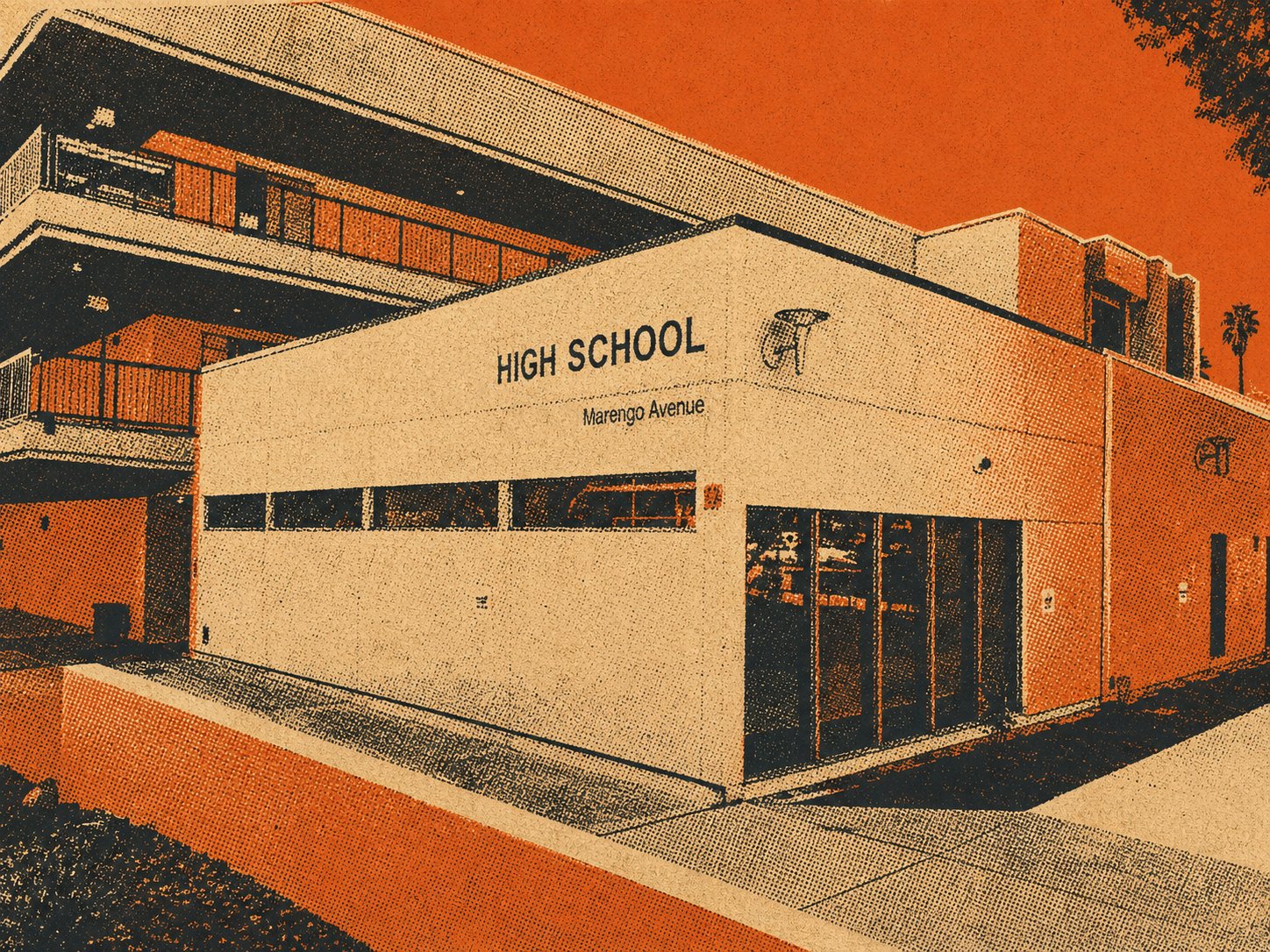
Walk onto almost any public schools in historically disinvested neighborhoods in Southern California and you’ll see the same thing, blacktop with a few painted circles, heat bouncing off every inch of it. No trees. No softness. Just the sound of kids playing on the pavement and the smell of tar in the hot sun.

This isn’t a coincidence. This has happened because that’s how schools for marginalized kids have been built, cheap, easy to maintain, and disconnected from nature.

Studies show that the pattern is national, not local. Across the United States, public schools in low-income Black and Latino neighborhoods are far more likely to have asphalt yards and little to no tree canopy. The Guardian reported that 36 percent of U.S. students attend school in urban heat islands, with the worst conditions concentrated in poorer districts.

Moving from the South Side of Chicago to Inglewood in 1980, we played “throw up tackle,” basically rugby we just didn’t know the formal name. Either way, it was on asphalt. When the school took the balls away, because of fear we would get hurt, we just saved the foil covering from our lunches and combined them large enough to make a ball. That was recess, heat, concrete, and a kind of creativity born out of neglect.

Forty years later, the paint is brighter, new murals appear on school walls calling it progress, but the ground never changed.

Heat that Literally Burns

The UCLA Luskin Center conducted a study showing how hot playground surface can get. School playgrounds could reach up to 160 °F, hot enough to burn skin in seconds. On a 90 degree day, grass stays around 95 °F, asphalt hits 150, and rubber turf can climb to 165. The EPA has also recorded conventional asphalt at 152 °F by midday.

That’s the reality for thousands of students in public schools in working class districts, mostly Black and Latino, whose schools double as heat islands. The same schools that can’t afford air conditioning are hard boiling kids from the ground.


What Greening Really Means

People talk about “greening” schoolyards like it’s a beautification project. It’s not. It’s called infrastructure, and it’s long overdue.

Sharon Gamson Danks of Green Schoolyards America says it plainly, “This is a long term infrastructure problem. It’s actual infrastructure, on par with highway building.”

Green Schoolyards America explains why this work matters:

“Living school grounds are richly layered outdoor environments that strengthen local ecological systems while providing place based, hands-on learning resources for children and youth of all ages.” Read More

Their mission is simple, but radical in its implications:

“All children have daily access to nature on their school grounds, supporting dynamic hands-on learning across the curriculum and grade levels, child directed play, student health and well being, and a positive social environment.” Read More

And she’s right. We have built highways through Black neighborhoods but never bothered to plant shade trees where their children learn. Read More

Now, a few places are trying to fix that.

Buchanan Elementary in Highland Park: North East Trees tore out 400 tons of asphalt and planted 150 trees, fruit bearing, shade casting, humanizing.

Washington STEM Magnet in Pasadena: Amigos de los Ríos turned a bare yard into an outdoor classroom with pollinator gardens and bioswales. “Green space doesn’t just support childhood development, it supercharges it,” said Arbor Day Foundation CEO Dan Lambe.

Even Pasadena school board member Tina Fredericks once made the point clear with a thermometer, asphalt at 157 °F, grass under an oak at 82. California has finally put money on the table, $150 million for “schoolyard forests.” LAUSD has a goal of 30 percent tree canopy by 2035. It’s late, but it’s something.

Cities like Pomona, where Measure Y now sets aside funds for youth programs, could follow suit. Greening a campus isn’t about landscaping, it’s about equity, safety, and pride of place.

Because what these spaces reveal isn’t just bad design, it’s a hierarchy of who gets nature and who doesn’t.

The concrete classroom was built to last

And it did, too well. It taught generations of kids to adapt to heat, to fall on pavement, to accept that the world around them would always be hard.

Every patch of asphalt replaced with soil is a small act of correction. Every tree planted is proof that children deserve more than durability, they deserve beauty, shade, and care.

We’ve paved enough. The next generation should learn on ground that breathes back.


Sources

Tina Fredericks, Pasadena Unified School Board
Guest Opinion: Yes on Measure R + Measure EE; Yes to Greener, Cooler, Safe Schools and Competitive Salaries.” Pasadena Now, 2024.

Segregation By Design
Los Angeles: Sugar Hill

Green Schoolyards America
Living School Grounds.”

Our Mission.”
https://www.greenschoolyards.org/mission

UCLA Luskin Center for Innovation
Action Area 3: Protecting Students from Heat Outdoors.” 2023.

CalMatters
Outdoor Shade: California Schools Face Heat Risks.” 2024.

U.S. Environmental Protection Agency (EPA)
Using Cool Pavements to Reduce Heat Islands.” 2024.

The Guardian
Asphalt Schoolyards Remade into Green Oases — in Pictures.” 2022.

Governing Magazine
Reimagining Schoolyards to Improve Health and Learning.” 2024.

Environmental Health News
Schools Across the U.S. Are Removing Asphalt to Reduce Heat Risks.” 2023.

Planetizen
Green Schoolyards Gain Momentum Across Southern California.” 2025.

Arbor Day Foundation / The Guardian
LA Schools Are Turning Blacktop into Green Spaces.” 2025.

Julian Lucas is a photographer, writer and provocateur committed to documenting what power tries to hide. Julian is the founder of The Pomonan and founder and owner of Mirrored Society, a bookshop dedicated to fine art books. His work, on the page, in the darkroom, and in the streets, documents what institutions try to forget. He publishes what others try to bury.

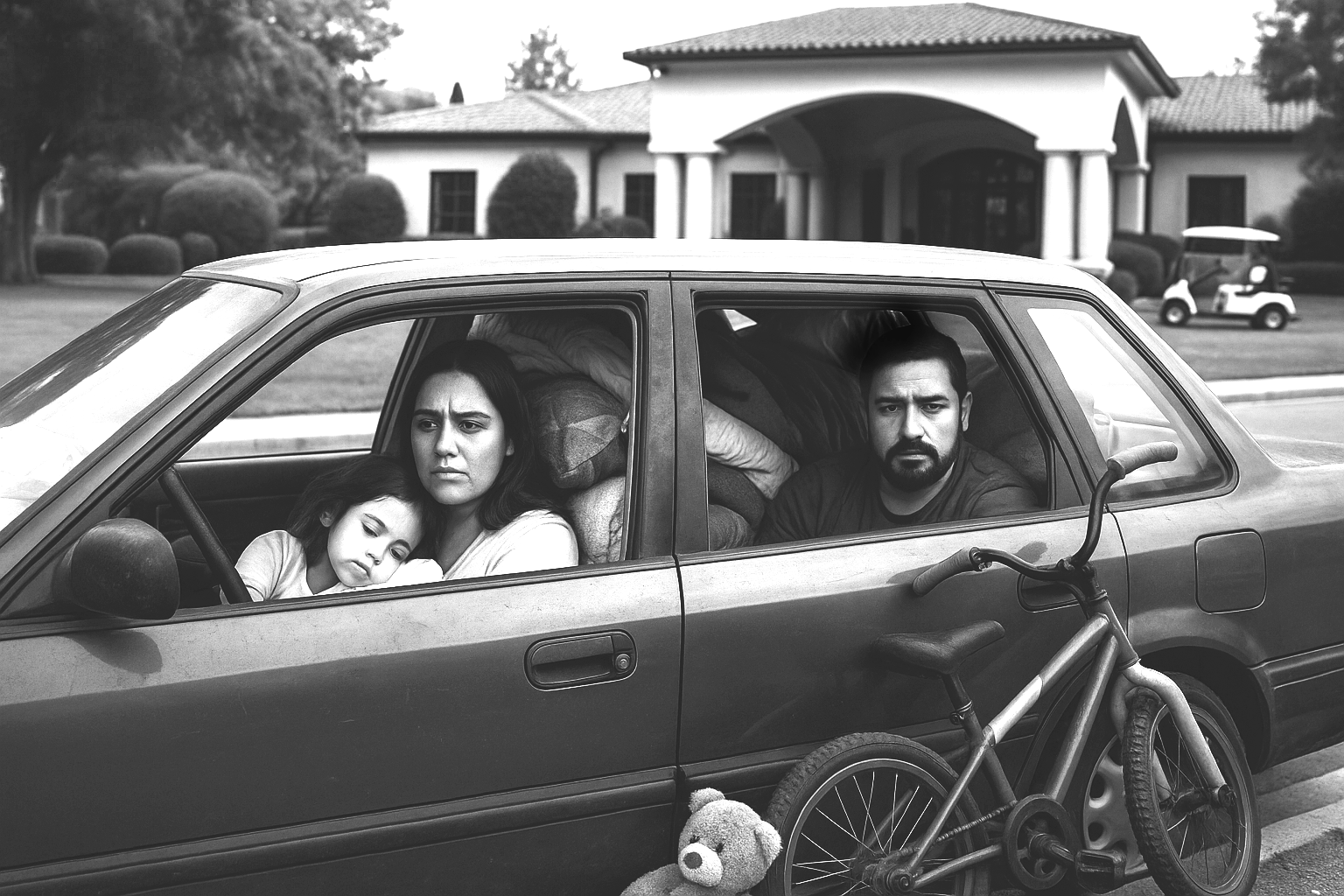
Country Clubs Get Breaks, Families Sleep in Cars

In my last article, California’s Housing Crisis Isn’t Just Scarcity, I argued that California’s housing crisis is not simply about scarcity, and that scarcity did not appear by accident but was manufactured through decades of policy choices like Proposition 13, privatization, and racial exclusion. If we want to understand why housing is unaffordable today, we need to look closely at who those policies have advantaged.

Proposition 13, passed in 1978, was sold as a way to shield homeowners from rising property taxes. But more than four decades later, the biggest winners are not retirees like my mom trying to hold onto their homes. They are elite institutions like country clubs. The Los Angeles Country Club, sitting on land valued at more than $8 billion, continues to pay property taxes based on 1970s assessments (Los Angeles Times). While affordable housing funds dry up, California still subsidizes golf courses for the wealthy.

When Prop 13 passed, the city of Pomona had its own fire department, so fire costs remained the city’s responsibility through its general fund. Later, when Pomona contracted with LA County Fire, the bill still had to be paid directly from that general fund, the same budget that also covers parks, libraries, and housing. Wealthier cities that had county fire service before Prop 13 saw those costs absorbed into property tax revenues, while cities like Pomona, Commerce, and San Fernando were left paying out of already stretched city budgets. That’s how arbitrary the winners and losers of Prop 13 have always been (Los Angeles County Fire Department, Los Angeles Times, 1986).

Whenever inequities are raised, some people are immediately turned off. Others will say, “But Prop 13 helped me,” as if that ends the conversation. I get it, my mom benefited, and as a retiree with a fixed income she’s able to hold onto her home. But personal benefit doesn’t erase the bigger picture. The same protections that gave her stability also gave billion-dollar country clubs and corporations a windfall, while younger families and renters were left to pay the real costs. We can hold both truths at once: Prop 13 helped some, but it hardened the divide for everyone else.

It doesn’t end there. In 2020, voters passed Proposition 19, pitched as a fix to Prop 13. It closed one loophole on inherited vacation homes but left others wide open. Proposition 19 does allow a primary residence to be transferred from parent to child without reassessment, but only if the child makes it their primary residence and the market value stays under an assessed-base-plus-$1 million cap (adjusted for inflation). Transfers exceeding that cap, or where the child doesn’t move in, face reassessment.

Trusts shelter properties, freezing tax bills while Californians face rising costs that widen the wealth gap.

This is neoliberalism at its finest, a model embraced by both parties since the late 1970s, where public resources are drained to protect private wealth and market solutions are treated as the only answers. Prop 13 was never neutral; it redistributed wealth upward and starved local governments. Prop 19 did not change that dynamic.

The same logic extends to corporate ownership of housing. Since 2018, corporations and investors have been buying up a growing share of homes. By early 2022, investors accounted for 28% of all single-family home purchases nationwide (Washington University Law Review). In the first quarter of 2025, investors were behind nearly 27% of all home purchases, a five-year high (Associated Press).

California’s overall numbers are smaller — large institutional investors own less than 2% of the state’s single-family housing stock (CalMatters). But a small share doesn’t mean small impact. When investors control the margins of the market, outbidding families with cash offers and locking in Prop 13 protections, they tilt the system in their favor.

Conventional buyers have also been sidelined. With mortgage rates high and home prices out of reach, many families are forced to wait, reducing competition. That opened the door for smaller investors with cash on hand to move quickly, outbidding households and gaining the same advantage.

For decades, California has chosen privatization over public responsibility. We abandoned public housing, slashed affordable housing budgets, and outsourced solutions to private developers and politically connected nonprofits. Prop 13 locked in low taxes for those who already had property. Prop 19 tinkered at the edges while protecting inheritance loopholes. And now corporate landlords are consolidating ownership and squeezing families.

Some argue the solution is deregulation. But California proves otherwise. Deregulation without deeper reform only benefits those already in power: developers, country clubs, and corporations. It does not address who reaps the rewards and who is locked out.

If California is serious about equity, the next chapter must look different. That means reassessing Prop 13’s protections for country clubs. It means closing inheritance and trust loopholes left intact by Prop 19. It means limiting corporate ownership of single-family housing and bulk purchases that push families aside. And it means reinvesting revenue into public and social housing, so homes are treated as places to live, not commodities to flip.

We are becoming a sharecropper nation, families paying more each year just to stay housed, while ownership and wealth are locked away by outdated tax protections and corporate landlords.

California has land and wealth. What it lacks is the will to stop protecting country clubs and corporations at the expense of families. Until we confront that reality, scarcity will remain less a fact than a choice. The real choice is whether we finally invest in public and social housing, or continue to protect country clubs while families sleep in cars.


Julian Lucas is a photographer, writer and provocateur committed to documenting what power tries to hide. Julian is the founder of The Pomonan and founder and owner of Mirrored Society, a bookshop dedicated to fine art books. His work, on the page, in the darkroom, and in the streets, documents what institutions try to forget. He publishes what others try to bury.

A Conversation Between “What is the Role of the Academic During Genocide?” and “On the Need to Organize Against Professionalization and Co-Optation in the Academy"

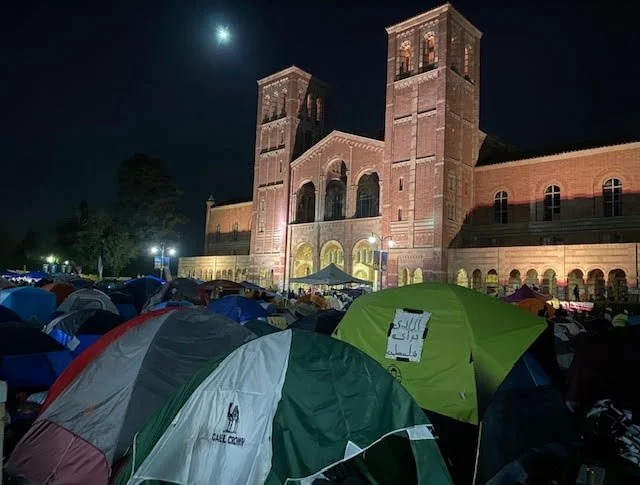
UCLA pro-Palestinian Protest May 1, 2024
Photography ©Julian Lucas

Noor Harmoush

Since Israel escalated its military offensive against Gaza in October 2023, university students across the United States have grappled with their role amid this harrowing moment of genocide. The veil has been lifted, and we are painfully aware of the contradiction in our own position as university students. We pay to attend institutions that use our money to financially support the very systems of violence and oppression that we are fighting against. We devote hours to reading and writing about postcolonial theory and critical discourse, while our universities are materially invested in colonial projects and racist endorsements. And when we speak out about the moral and material inconsistencies we see in our faculty and administration, we are met with apathy–or worse, we are punished. 

Historically, university campuses have served as sites of resistance, embodying both material and ideological forms of protest. Practices such as encampments, boycotts, and hunger strikes are part of a long-standing tradition of academic insurgency, situated within a legacy of reclaiming institutional space to demand social and political accountability. Scholars like Frantz Fanon, Edward Said, and Noam Chomsky played pivotal roles in the intellectual resistance against hegemonic narratives. Their work challenged colonial epistemologies, interrogated the ways in which institutional powers dominate our cultural and political spheres, and deconstructed the media’s role in manufacturing public consent. It is through their radical scholarship that the Humanities evolved not as a neutral field, but as a site of contestation–a space where we rigorously question and reclaim. It is in this historic spirit of radical resistance that I anchor myself as an “academic” during this time of genocide. 

Yet, we are living in a moment of the devolution of the academic. 

While academics of the past reimagined the world order and fueled political movements through their scholarship, today, academics have become ambivalent, or even disconnected from their radical origins. Today, academics make vague statements of solidarity with justice and freedom, but these statements rarely come with any real sacrifice. Quite the contrary–the academic remains comfortably embedded in institutional systems that perpetuate cycles of violence and oppression. The academic may engage in “dialogue” about said system, but will lean into “nuance” and “complexity” to appear more palatable or intellectually rigorous. The academic sidesteps accountability for their harmful role within these systems. In fact, the academic often benefits from upholding the status quo of these systems–say, by a very coveted bullet point on their CV. 

What is the role of the academic during genocide if not to accurately identify it as such? What is the role of the academic during genocide if not to critique the distractions that obfuscate the reality of genocide? What is the purpose of research, publications, and conferences if we are merely regurgitating discourse, lacking any synthesis of our reality? 

Conferences like the Pacific Ancient and Modern Language Association (PAMLA) are a perfect example of the tragedy of the pontificating academic. A proposed “special panel” for the 2025 conference, titled “A Duel Between Memories: Israel and Palestine,” highlights this problem. 

I wrote a letter to the panel’s presiding officers and the Executive Director of PAMLA (linked here) outlining my concerns about this panel. My main argument is that the panel’s description diverts attention from the genocide in Gaza, misconstrues the aggressive nature of the Israeli colonial project, and ultimately causes more harm to the Palestinian plight for liberation. At the time that I wrote the letter, Israel’s starvation campaign against Palestinians living in the Gaza Strip was well underway. Since then, the situation has become even more inhumane and dystopian. I argue that the panel is not only ideologically dishonest but also incredibly inappropriate, insensitive, and irresponsible–that is, to encourage a sort of “dialogue” about “opposing memories” while Gaza’s extermination is being captured live, through videos, photographs, and testimonials. 

One must ask: What academic merit, or moral value, is there in discussing “opposing memories” or “both sides” when hundreds of Palestinians are being murdered by Israeli forces each day? As Mohammed El-Kurd puts it, how can there be room for debate in the presence of burning flesh?

Moreover, how can an organization like PAMLA, whose statement on Diversity, Inclusion, and Equity outlines their commitment to “anti-racist and anti-prejudicial” scholarship, host a panel that normalizes Zionism through an exploration of “Israeli memory” in juxtaposition to “Palestinian memory”? It is absolutely absurd to champion a “postcolonial” slogan and its associated buzzwords while also platforming discourse that obstructs the reality of modern-day colonialism. Israel is a settler-colonial regime that is built on an ethno-national ideology of extermination and land theft, which, by any contemporary standards, is very racist and very prejudiced. 

How are we, academics, missing the mark this badly? The ideological framework of the Humanities has been corrupted, be it by neo-liberal agendas, a whitewashing of anticolonial theory, or covert (sometimes overt?) complicity in systems of racism and imperialism. PAMLA, like many other academic organizations across the country, is an example of how liberatory theory is strategically co-opted to advance the rhetoric–and often the agenda–of dominant and oppressive power structures. Academics have devolved into agents of the academic machine and its institutional powers. We’ve not only lost our moral compass, but we clearly lack an understanding of ideology and its connection to the material world. 

I requested that the panel be removed from the 2025 conference, or at the very least, be reframed to critique Zionist media and narratives from the perspectives of Israelis and Palestinians. 

After sending the letter and a petition with signatures of support from colleagues in the academic community, I received a response from the Executive Director, nearly three weeks after I had sent my initial letter:

“The Pacific Ancient and Modern Language Association (PAMLA) has received your request to remove a panel from our PAMLA 2025 Conference schedule.

We have carefully reviewed your request and determined that, in consonance with our Code of Conduct, we will continue to host the panel at PAMLA 2025.” 

This lack of thoughtful engagement from PAMLA’s leadership and the panel officers reflects a bad-faith approach to academic integrity. I did not merely request the removal of the panel; my letter sought to highlight a serious mistake we are making as academics–using our positions and resources to promote “both sides” rhetoric at a time of historic and monumental failure to distinguish right from wrong and humanity from insanity. PAMLA arrogantly missed an opportunity to foster “ongoing introspection and continual striving” that they proudly spout in their Diversity, Inclusion, and Equity statement, illustrating, yet again, the ways in which social justice jargon is thrown around for the sake of theatre. 

Is this really all we can expect from the academic? A mere puppet, spouting empty rhetoric? The failure is a collective one. We’ve forfeited our credibility in the fight for liberation, made a mockery of our discipline and its predecessors, and, most importantly, we’ve let down those who are the most vulnerable among us.


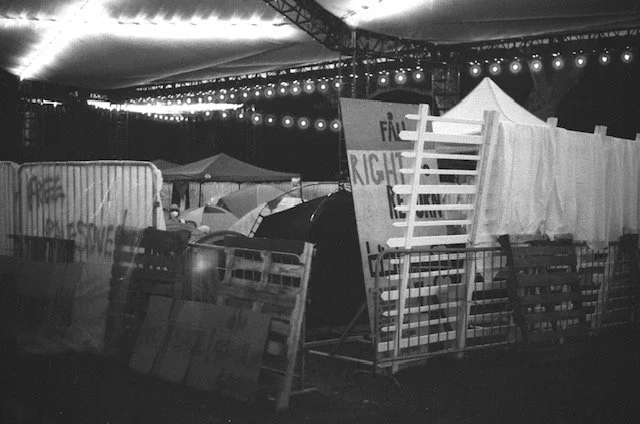
Pomona College pro-Palestinian Protest May 24, 2024
Photography ©Julian Lucas

Gilbert Aguirre

This PAMLA boycott is a model for other academics attempting to navigate institutions with the kind of false liberal morality that permits a panel titled “A Duel Between Memories: Israel and Palestine” during an ongoing genocide, alongside panels supporting Palestinian liberation, or in a more abstract vein, “post-colonial studies” generally. We can’t let academia start and stop at rhetoric, to be, in the words of Gayatri Spivak, just “willy-nilly an idea producing machine.” It is our responsibility as academics to course correct. This means uniting the moral and political intentions of our scholarship with the political work we do in the real world. Thus, from the institutions and organizations that platform our work as scholars, we must be uncompromising and demand that their ethos stay true to our own. If we were to present papers against normalization at the same conference actively normalizing genocidal rhetoric, we would have no legitimacy– there is no abstracting this fact, and we can not fall victim to trying to find excuses under another word: nuance.

The ability of academic institutions to co-opt movements and theories rooted in liberatory struggles can not be overlooked. If the question is, how do we combat the ability of academia to co-opt our work, the answer from us willing to resist co-optation becomes; we need to demand ideological consistency and material transparency from the organizations we use to advance our careers. 

We were proven wrong to assume that an organization tied closely to the liberal politics of the Humanities would stand against genocide. We found an inconsistency, pointed it out, and the façade unraveled. In response to thoughtful emails from members of the CSUSB cohort withdrawing their academic work from the conference, PAMLA’s director Craig Svonkin callously responded with some variation of “I’ve removed you from the program per your request” to us all. This response is qualified as callous because its bare reaction to our articulated disappointment with the PAMLA organization reveals little reflection or understanding of the collective effort and the weight of the decision we made to withdraw our work from the conference. Up to the writing of this document, PAMLA’s lead organizers have not met our good-faith critiques with any substantive response. Instead, we have received sanitized, PR speak emails that skirt around any stated position, other than continuing to stand by their Zionist panel. By skirting around a direct stance, their amoral stance was revealed. PAMLA is another toothless, ‘apolitical’ organization, whose lack of stance is a vehicle for co-optation and normalization.

We have heard that PAMLA, internally, gave greater consideration to our complaints than their emails let on– the rumor is that they will be raising the bar for entry on who is able to propose panels, because the student who proposed the panel is getting their undergraduate degree in philosophy– not a Master's student. If the rumor about raising the qualifications for panel proposals is true, we again see the academic machine finding their own rationale for deniability; The student proposing the panel is the problem, an MA student would moreso understand the audience and political context than an undergraduate. That, however, is bullshit. The student who proposed the panel, our pontificating academic Sebastian Prieto-Keith, is a symptom of the academy operating in a purely ideological world, where genocide is reduced to narrative, and liberatory theory is reduced to a lens of analysis. Raising the bar for submission in the future does not guarantee more academically rigorous panels, or even reduce the likelihood of pro- genocide discourse at PAMLA. Instead, it obfuscates PAMLA’s responsibility, making the Zionist panel the responsibility of the person who proposed it. This does not mean that the mass of pontificating academics who are comfortable arguing about the merits of genocide on stage are not worthy of shame and ridicule. Rather, our frustration cannot stop at these CV-hungry careerists; we must also address the institutions that create and reward these amoral opportunists by giving them panels and calling them scholars–a diluting move which, in turn, delegitimizes those of us who are doing political work in and outside of the academy. The reality is, PAMLA’s organizers accepted this panel, and are standing by its academic merit, on the basis of nuance, which we have discussed is how the pontificating academic can consider the representation of Israelis in Palestinian textbooks in the same room where bodies are being burned. 

PAMLA’s response to our good-faith concerns about their Zionist panel has taught us a lesson; from these organizations we depend on for aspects of our own professionalization, we must demand ideological consistency and accountability. To keep this statement from being empty, liberal sloganeering, we need to emphasize that from our class position–the mass of academics whose donations, participation, and scholarship these organizations completely depend on– if we boycott these organizations whose actions do not align with our values, we can make them fail. Instead of allowing their ideological inconsistencies to delegitimize our scholarship, we can use our scholarship to delegitimize the organizations that feign solidarity but ultimately stand for nothing.

We must fight against academia’s power to co-opt our political work and place it in a field so abstract it becomes toothless– a place so safe from action that work against genocide is placed beside excuses for genocide– a place for pontification; a conference hall. The canonized scholars who have been mentioned, Fanon, Said, Chomsky, Freire, Rodney (the list goes on) stood firmly against academic minutia– if we want to stand against the institutional machine, we must do the same. This means uniting as scholars against the institutions that depend on our labor, loyalty, and funding while speaking from both sides of their mouths. This is the legacy of academic boycotts: a refusal to legitimize institutions complicit in racist, genocidal, and nationalistic violence. Unfortunately, PAMLA is now on our list of unreputable organizations. We are sounding the alarm to dissuade other academics from legitimizing an organization that has revealed itself to be part of academia’s co-opting machine; a machine intent on delegitimizing the work of principled scholars, because the academy has material interests of its own–material interests that are kept safe when our work remains entirely ideological.

We are of the opinion that raising awareness about Israel’s genocide in Gaza has not been enough. As academics, we must bring action back into our field & stand against inaction and normalization. This is a call to all other academics unwilling to gain a CV bump from the institutions that perform solidarity while platforming genocidal rhetoric. All members of the CSUSB English cohort have withdrawn our accepted papers, and we urge other graduate students to stand with us in creating a united front as academics, conscious of our role during genocide, in pushing the institutions around us away from theatre and into action; instead of letting them push us from action into theatre.


Noor Harmoush and Gilbert Aguirre are graduate students in the English Department at California State University, San Bernardino. Harmoush focuses on Composition and Rhetoric, while Aguirre specializes in Literary Studies. Both ground their academic work in anti-colonial epistemologies, challenging dominant narratives and exploring knowledge systems shaped by resistance and liberation.

Pomona Considers Flipping the Script on Fire Protection — But At What Cost?

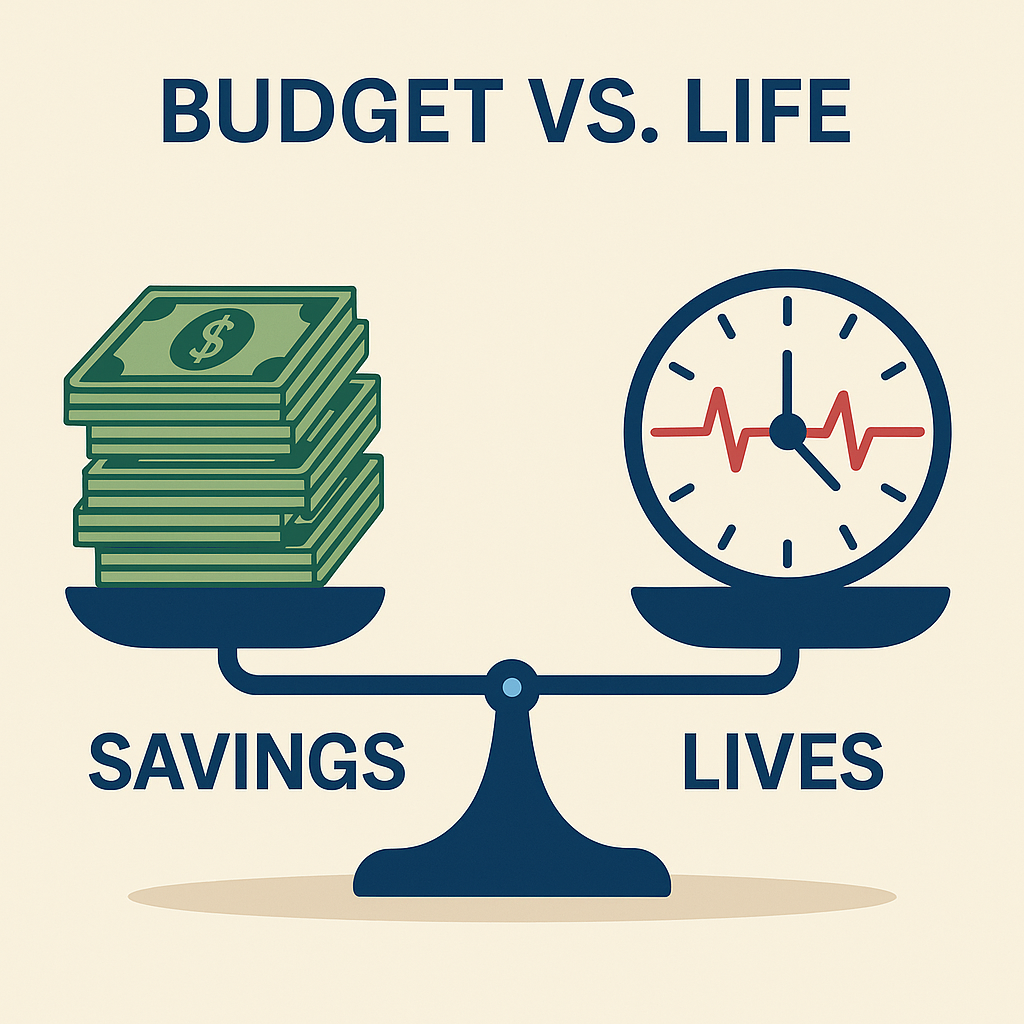
Pomona’s leaders are in talks to do something almost unheard of. They’re discussing handing the city’s fire and emergency services to a smaller suburb. The council calls this a financial decision. For residents, it isn’t abstract. It’s about whether shaving costs matters more than saving lives.

City leaders are now brainstorming either outsourcing services or creating a new joint fire district with La Verne, a smaller suburb one-fifth Pomona’s size, but either path raises the same concerns about costs, accountability, and capacity.

Across the country, the pattern is clear. Large departments absorb smaller ones, or cities pool resources through county fire authorities. Boise covers Garden City. Kansas City covers nearby villages. Bellevue covers Clyde Hill. The current runs one way. Rarely does a city of nearly 150,000 people outsource its most critical service to a neighbor of 30,000. That mismatch alone should give Pomona pause.

Pomona is a working class city. Here, fire and EMS calls aren’t just about putting out fire — though Pomona has a track record of unwanted buildings being burned down. They’re also about chest pains, overdoses, unhoused encampments catching fire, car crashes on Towne and Holt, and the everyday emergencies of families priced out of healthcare. For many residents, firefighters and paramedics are the first responders in every sense of the word.

La Verne doesn’t live that reality. Its fire department has never been responsible for a city Pomona’s size or scale. To imagine it suddenly covering Pomona is to flip the natural order of public safety upside down. It isn’t about whether La Verne has good firefighters, it’s about whether the entire system was ever built for the demands Pomona puts on its first responders every day.

This debate doesn’t exist in isolation. Just two years ago, Pomona’s City Council pushed Measure PG, a tax increase sold as the way to protect essential services. Yard signs sprouted across the city, some with councilmembers’ names. The pitch was clear enough: pay a little more in sales tax and your police and fire services would stay strong.

Councilmember Debra Martin even called Measure Y the “elephant in the room.” It’s a familiar move, most of the council opposed it when voters approved it, and now they’re looking for ways to scapegoat youth funding for the city’s financial troubles. But Measure Y didn’t create this crisis. Decades of quick fixes and mismanagement did.

Voters did their part. They trusted those promises. Now, some of the same leaders are contemplating outsourcing fire protection to a smaller, wealthier suburb which is simply unheard of. It’s understandable Los Angeles County Fire has increased their services, due to inflation, but this would mean the leaders and staff have to be creative in how to continue services with LA County Fire. Isn’t lives more important than money?

Council members talk about savings, but the numbers don’t add up. Here are the unanswered questions Pomona residents deserve clear answers to:

  • Will La Verne use the existing Fire Departments in the city?

  • Will La Verne need to hire? Pomona generates far more calls. La Verne will need to expand its workforce, buy new trucks, and grow its command staff. Will Pomona have to bankroll this contract and expansion?

  • What about equipment? Fire engines cost about $150,000. Over 1 million for ladder trucks etc. Ambulances, radios, protective gear, medical kits, all of it adds up. Will Pomona inherit some county gear, replacement costs will fall on Pomona’s side of the ledger?

  • What about pensions? This is the hidden bill. Will Pomona still owe its share of LA County Fire’s unfunded pension liabilities, even while paying into La Verne’s pension system? Does that mean double obligations: paying for the old system while building the new one.

And now residents are being told the joint Pomona and La Verne plan could require a parcel tax, an added property tax on top of everything else. That flips the story completely. Instead of saving money, Pomona homeowners may be asked to pay more to bankroll a smaller suburb’s fire expansion. A tax increase wasn’t part of the sales pitch, but it’s quickly becoming the fine print.

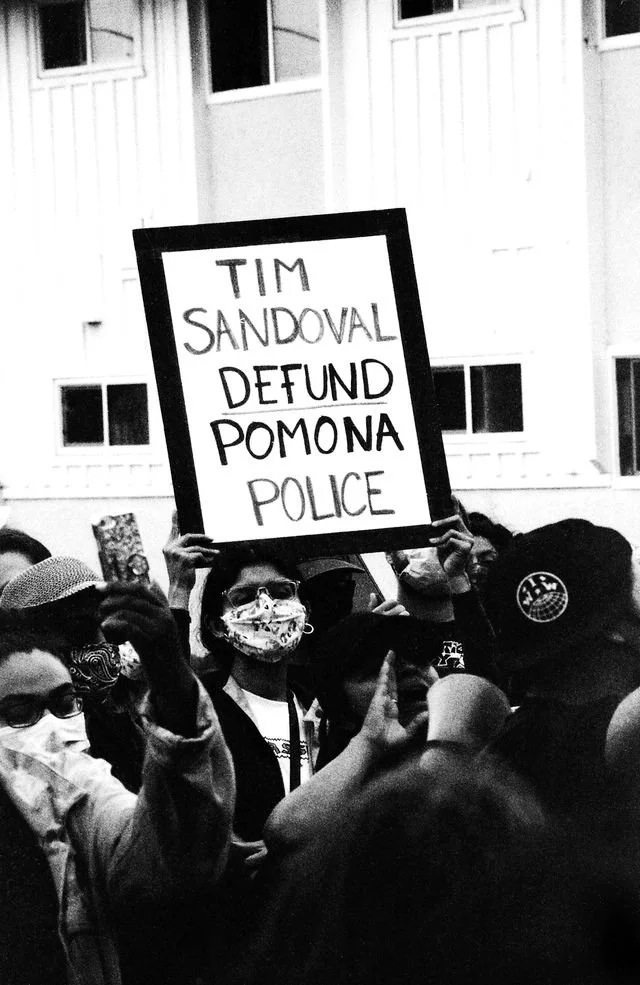
Then there was Mr. Sandoval. Once again, he used his seat on the dais to rebut residents during public comment. When one speaker suggested the proposal was political, he dismissed it as “nonsense.” He went further, telling another speaker they were “out of line.

Would this be considered a Brown Act violation? Under California’s Brown Act, officials may thank speakers, make brief professional clarification, or ask staff to follow up. City leaders are not supposed to single anyone out or scold residents from the dais. Public comment exists so people can address their leaders without being shut down in real time. Using the microphone to correct or chastise speakers may not only cross a legal line, it undermines the spirit of open government.

Pomona has driven down this road before. It appears that Pomona has always chased the quick fixes, patching holes, and kicking costs into the future, and the result has always been the same, long term debt and broken promises.

The choice before the city isn’t just about contracts, pensions, or budgets. It’s about whose lives are worth protecting, and whose voices count when decisions are made. Working-class families, renters, immigrant, the people who dial 911 most often are the ones who stand to lose the most if this gamble goes wrong.6

Fire protection isn’t just a line item on an agenda. Fire protection is a covenant between a city and the people who live in it. And no city should ever force its residents to choose between saving money and saving lives.


Julian Lucas is a photographer, writer and provocateur committed to documenting what power tries to hide. Julian is the founder of The Pomonan and founder and owner of Mirrored Society, a bookshop dedicated to fine art books. His work, on the page, in the darkroom, and in the streets, documents what institutions try to forget. He publishes what others try to bury.

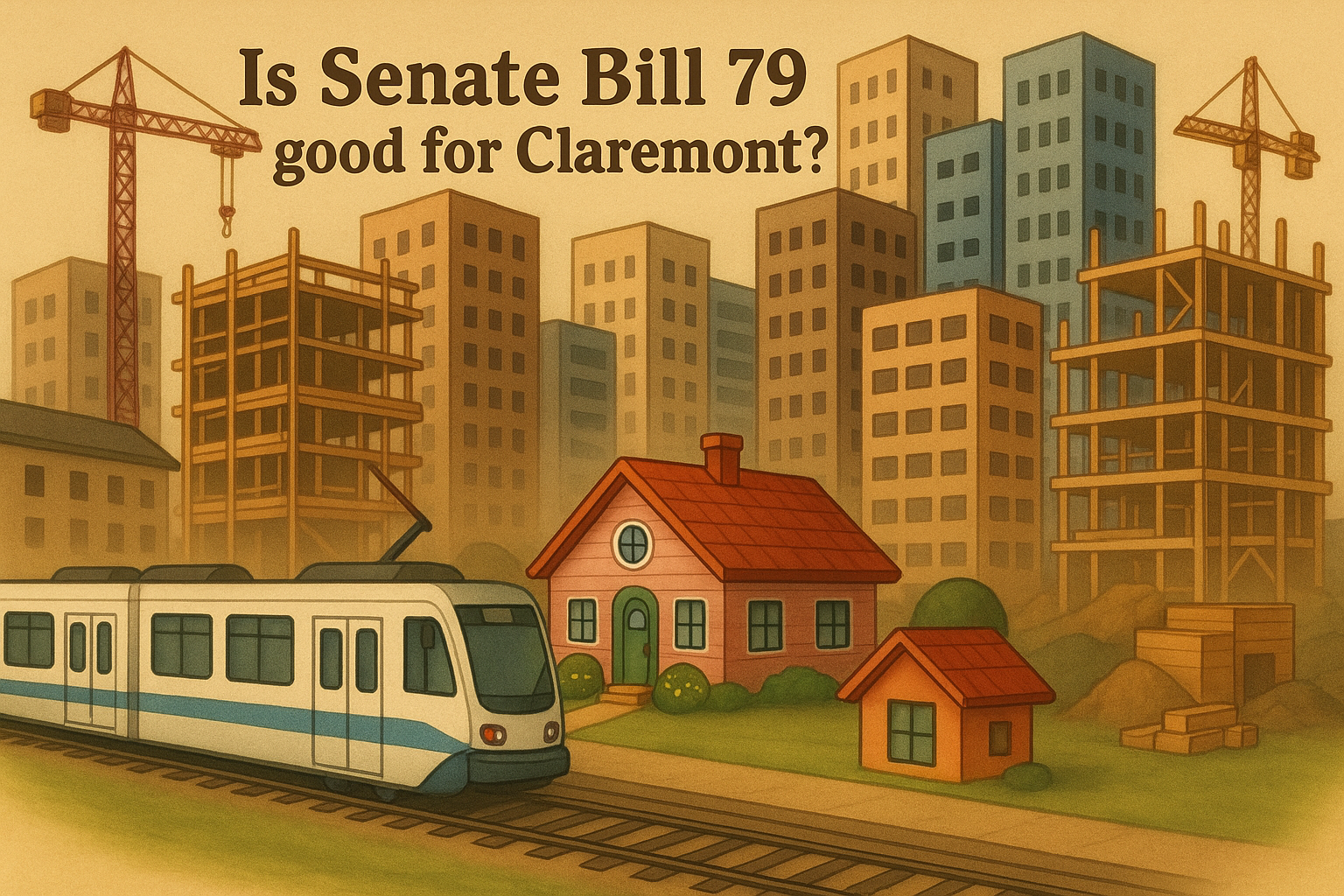
UPDATE: Is Senate Bill 79 good for Claremont?

In the next three days our State Assembly and State Senate will vote on SB 79, a Housing development bill.

SB 79 was recently amended, and what this now means for Claremont is that if SB 79 passes, the bill would upzone these areas from our train station in downtown Claremont to the following heights and densities:

• Within 1/4 mile – 65 feet (6 stories), 100 units per acre, Floor Area Ratio of 3.0 which means the total built-up area of the building can be up to 3 times the size of the land plot.

• Within 1/2 mile – 55 feet, (5 stories), 80 units per acre, Floor Area Ratio of 2.5 which means the total built-up area of the building can be up to 2.5 times the size of the land plot.

In addition, SB 79 allows for buildings immediately adjacent to our train station to be 8 stories high, with commensurate increase in density.

The proposed Village South development, just south of the train tracks on the west side of Indian Hill to Arrow Highway is 24 acres. Excluding streets, this could mean that the state would allow something like 1500 to 2,000 units at Village South. SB 79 disallows the City of Claremont from modifying that amount of units, providing green space or anything else. The density will be determined by the state, with no local input.

Under SB 79, only 10% of our historic buildings and neighborhoods with that half mile radius can be protected - the rest can be sacrificed.

Yes! to height and density by our train stations. But tell your state senator and assembly member we want to build a better bill.

We can build housing AND preserve historic communities, too.

Senator Sasha Renée Pérez Phone: (916) 651-4025

Assembly member John Harabedian Phone: (626) 351-1917


Pamela Casey Nagler is currently finishing her book, A Century of Disgrace: The Removal, Enslavement, and Massacre of California’s Indigenous People 1769 - 1869.

California’s State Bill 79 and What it Means for Claremont 

The Bill That Wants to Turn Claremont Into Anywhere, USA

Illustration Julian Lucas ©2025

Powering through our State Legislatures is a big, highly-contentious housing bill, authored by San Francisco’s Senator Scott Wiener. If passed, it could have big ramifications for Claremont.

What is California State Bill 79?
SB 79: Housing Development: Transit-oriented Development is a bill that would “up zone” or override our cities’ local ordinances in order to fast-track development one-half mile from our transit center(s). If passed, it would bring more height and density to our cities accompanied by less control over design standards like setbacks, facades, landscaping, trees, roads, parking and open space. Read full bill text here

The bill has not yet been signed into law, but it has already crossed over from our State Senate to our State Assembly, and will be subjected to a floor vote sometime before September 12th. If passed in both the Senate and Assembly, the Governor will either sign it into law or veto it.

SB 79 is being amended as we speak, so there is still time to voice concerns - but the clock is ticking. Assembly Committee meetings are being conducted throughout August.


What would SB 79 mean for Claremont?
This bill could make quite an impact on Claremont’s downtown. If passed, it dictates that within a quarter mile of our train or metro station, a developer could build 5-story buildings, and within a half-mile, 4-story buildings. In addition, Claremont could be subjected to an “adjacency intensifier” which would mean that developments directly adjacent to the transit stop could be 7-stories. SB79 also allows Transit agencies to develop their own properties. In Claremont, that would mean that Metrolink could develop its parking lot on First Street.

This is an approximation of the area in Claremont that would be affected by the passage of SB 79. Within this half-mile radius, the state would allow a developer to put up 4, 5, 7 story buildings with no public input. 

Arguments in favor of SB 79:

California needs more housing and more affordable housing. And it is good for the environment to locate this housing by our transit centers where people have access to public transportation.

Arguments against SB 79:

1. SB79 does not provide preservation for historic buildings which is part of downtown Claremont’s economic model.

SB 79 does not protect historic buildings and neighborhoods from the bulldozer. In Claremont - north to Eighth Street; west to the Claremont Colleges’ wash; south to below Peppertree Square; and east to Rosa Torrez Park - a developer could raze any single-family or multi-family dwelling within a half-mile radius from the transit stop to put up 4 or 5 story buildings. Though Senator Wiener recently amended SB 79 to provide protections for multi-family dwellings, this amendment only applies to cities with rental stabilization laws - and Claremont has none.

Claremont’s downtown economy was built on more than a century’s worth of town-and-gown planning. Historically, Claremont has sustained itself by attracting students to its colleges from all over the world - and by attracting day-tourists who come for our Farmer’s Market, restaurants, shops, art museums, movie theater, college events.

Claremont’s historical society, Claremont Heritage, states that 75% of the people who come to downtown Claremont on the weekend come from someplace else. If we do not continue to develop our downtown with some kind of historical preservation in mind, then we are likely to mess with the formulas that have made Claremont’s downtown successful and sustainable. Losing local control means losing control over our economic model.

Many neighborhoods who oppose SB 79 are neighborhoods of the historically-disenfranchised - like Leimert Park, South Central, Larchmont and Boyle Heights. Los Angeles City Council member Ysabel Jurado, who represents Boyle Heights, where almost the entirety of the neighborhood would be subject to ‘upzoning,’ stated her opposition to SB 79, by saying, “I'm not willing to gamble losing Boyle Heights.” The state legislator who represents South Central maintains that SB 79 would result in gentrification. She says that it would price longtime residents out, forcing them to relocate in more affordable regions inland. Read LAist coverage here | More from CalMatters

2. SB 79 does not have enough environmental protections for developing on land that was previously designated for light industry.

SB 79 poses big environmental concerns. This bill comes right on the heels of recent state decisions to weaken environmental standards for new development. In June of this year, Governor Newsom signed two bills that weaken environmental review standards in order to speed up the construction of housing in California. As a result, urban ‘infill” housing developments — housing built in and around existing development — are no longer subject to the California Environmental Quality Act (CEQA).
Read LA Times coverage | CalMatters analysis


When Newsom signed the two anti-environmental law bills into law, he called it the “most consequential housing reform that we’ve seen in modern history in the state of California.” And SB79’s author, San Francisco’s Senator Scott Wiener lauded the action saying that passing these bills was “the most consequential housing reform we’ve seen in modern history”
Read here

As a result of relaxing environmental standards, there is legitimate concern that there will not be adequate environmental review for soil and water chemical contamination. Historically, the areas near railways have been the location for machine and used car shops, body repair shops, light and heavy industry - and ‘back in the day,’ it was not uncommon for businesses to dump toxic chemicals directly into the soil. In some cases, these contaminants have leached into our water systems. With weakened environmental standards, many fear that SB79 will allow developers to bypass toxic clean-up, putting public health at risk - not just for ourselves, but for our children and our children’s children.

3. SB 79 shuts down the public process in favor of developers’ interests.

SB 79 is undemocratic. If passed, the community will lose their ability to voice their concerns on traffic and safety issues, parking issues, ingress and egress for evacuation purposes, environmental impacts, the effect on existing infrastructure - or anything else. All of the power goes to the developer in their pursuit of a profit margin. With SB 79, community needs are sacrificed to developers’ interests.

The League of California Cities has reiterated a common refrain among the more-than-150 cities that oppose the Bill, and that refrain is that the state is mandating development without regard to the community’s needs, environmental review, or public input. On Tuesday, August 19, the City of Los Angeles voted to oppose SB 79. On August 20, Los Angeles Mayor Karen Bass signed on saying she also opposed SB 79 “unless it is amended to exempt cities with a state-approved and compliant Housing Element.”

Understanding the full scope of SB 79 is difficult because there have been countless rewrites and multiple amendments. The League of California Cities recently published a breakdown, warning that the bill is rapidly changing and challenging for cities to keep up with.

One big problem with the bill is that, seemingly, the state legislators are for it, while the cities are largely against it. Los Angeles’ City Attorney Hydee Feldstein Soto, in her letter opposing SB 79, states that “the bill’s provisions impermissibly impose billions of dollars of costs on Los Angeles and other local jurisdictions, undermine local governance, circumvent local decision-making processes, and impose unintended burdens on communities.” She argues that it would cost the city billions to upgrade infrastructure such as sewage and electrical systems to handle an influx of residents. Mayor Karen Bass has also gone on record with concerns, noting in a recent statement that she opposes SB 79 unless amended.

Alhambra’s Mayor, Katherine Lee, in her letter opposing SB 79, adds that even if a city qualifies for one of the bill’s so-called exceptions, it is still required to meet the same requirements for density, whether or not these “make sense for the community.” She questions whether California will ever be able to meet its housing needs through SB 79’s state-driven, top-down, one-size-fits-all approval process, and suggests that what is needed instead is “a sustainable state investment that matches the scale of this decades-in-the-making process.”

Though Claremont City Council member and Senior Policy Advisor of Inner City Law Center, Jed Leano, has spoken twice at Assembly Council meetings in support of SB 79 — as one of only two speakers backing up the bill’s author — the City of Claremont itself has yet to weigh in officially.

Senator Wiener’s team has gone so far as to promise “Paris-style density” for California by eliminating local ordinances — a deeply ironic framing, since Paris is one of the most heavily planned cities in the world. More likely, the Senator is evoking the postcard-friendly tourist districts rather than the congested suburbs struggling with many of the same challenges Southern California faces. LAist recently explored this framing.

If you have your own concerns about SB 79, you can call or write Assemblymember John Harabedian at (626) 351-1917. or a41.asmdc.org/contact


Pamela Casey Nagler is currently finishing her book, A Century of Disgrace: The Removal, Enslavement, and Massacre of California’s Indigenous People 1769 - 1869.


Pomona Lost. Free Speech Won. And I Took the Pictures

Photography Julian Lucas
©Pomona, 2020

Updated July 15, 2025 8:50pm PST

When the City of Pomona cited Gente Organizada for the artwork on their own building, they weren’t just enforcing code. They were enforcing silence. 

The mural, born from the George Floyd protest Gente led through the streets of Pomona, wasn’t illegal. It was inconvenient. It didn’t flatter city hall or traffic in vague unity slogans. It remembered names. It is named systems. It refused to let grief be buried under press releases.

So the city cited them, censorship disguised as code.

The photo that ended up in the ACLU lawsuit? That was mine. I took it at that protest, camera raised as hundreds marched through a city still pretending nothing was wrong.  The ACLU described the mural as “imitating a roll of film.”  It didn’t imitate film, because it was shot on film. Shot on 35mm. Developed by me, by hand, and printed in the darkroom. Because even protest deserves process.

The city called it a signage issue. A permitting violation. A matter of process. But the real violation was against the truth.

Let’s not pretend this was neutral. If the mural had featured oranges, the Pomona goddess, or a heartwarming quote about God and community, it would’ve been up on the city’s Instagram. But because it showed resistance, because it echoed the chants from the street, it got cited.

This is the same city that has no issue with neon signs yelling “CASH” or hideous ‘Gucci’ purses painted across pawn shop windows, or liquor stores advertising booze, but exhibiting something historical, political, and Brown and or Black led? Suddenly it’s a code violation.

The photo was taken during the George Floyd protest in Pomona. Black Lives Matter signs, held up by youth, shouted through masks, all captured on film. Two years later it was installed as public art on the wall of Gente Organizada’s building.

Then cited by the City of Pomona, after a year of being displayed.

The mural was central to a 2023 lawsuit filed by the ACLU Foundation of Southern California, after the city issued citations and attempted to enforce sign code regulations to suppress Gente’s political speech.

“Pomona attempted to block our right to free speech and weaponized city code so that we could not exercise our right to artistic expression.” Ivan Hernandez, Gente Organizada

“The city’s actions violated the First Amendment” Jonathan Markovitz, ACLU SoCal


Gente took them to court, and won. That win forced real change.

The City of Pomona was forced to revise its sign code, waive all citations, and grant Gente five years of protection for future public art without permit. A legal victory. A First Amendment victory.

But that didn’t stop the erasure.

It was stolen. Taken in silence. No answers. No outrage. Just gone. But Pomona’s leaders, and those that stand abreast to their favor, will still try to sell you a story, that this city champions art, celebrates culture, uplifts youth voices.

Only if it’s quiet.
Only if it flatters them.
Only if it forgets.

You don’t need to burn anything even though that’s Pomona’s MO. Just take it down, late at night, and act like it never existed. But here’s the thing about truth, once it’s photographed, it lives.

Additionally not a single city official spoke up. Pomona’s Mayor Sandoval is silent. Nora Garcia, Victor Preciado, Steve Lustro, nothing. Every self declared “progressive” on council who loves to retweet youth-led organizing when it’s created by them, filtered, friendly, or ran by cops, vanished when those same youth were fined for speaking.

Pomona talks a lot about equity. But equity doesn’t look like citations. Equity doesn’t look like using city code to control narrative. Equity doesn’t look like silence.

So Gente sued. And they won.

The city waived the fines. Revised the code. Granted a five year window for new artwork without permit. But don’t confuse compliance with conscience. They only backed off when forced. They didn’t protect free speech. They got caught violating it.

The mural remains. The lawsuit is now public record. And the photo, my photo, stands as a witness.

Pomona didn’t just try to censor a wall. They tried to punish memory. But some things can’t be erased. They can only be exposed.

The mural remains in the public memory, but not on the wall.

They cited it. They stalled it. And when that didn’t work, someone took it. What Pomona couldn’t erase through fines, someone erased through theft.

So let’s stop pretending this was ever about signage. It was always about control. About power. About keeping the city’s story curated and quiet. But they lost. And even though the mural’s gone, the image remains. The lawsuit remains.  And we remain, watching, documenting, remembering. You can steal a painting.

Photo by Julian Lucas ©2022
Printed in the darkroom at the University of La Verne
Artists-in-Residence Program

You can issue citations, you can even steal the art off the wall, but you can’t erase what people saw and will continue to see.


Julian Lucas is a photographer, writer and provocateur committed to documenting what power tries to hide. Julian is the founder of The Pomonan and founder and owner of Mirrored Society, a bookshop and gallery dedicated to photography, artists’ books, and cultural critique. His work, on the page, in the darkroom, and in the streets, documents what institutions try to forget. He publishes what others try to bury.

Centennial of a Prophet: Malcolm X and America’s Enduring Denial

Malcolm X turns 100 today. That sentence alone should crack the sky. Not because we’ve come so far, but because we haven’t, at all.

A century later, the very system he warned us about still thrives. The police still kill with impunity. The media still gaslights. Our cities and schools still dilute. Gaza bleeds in real time. Prisons burst with the impoverished. And Malcolm? He’s still considered too much. Too Muslim. Too radical. Too honest. Too Black.

Meanwhile, America keeps stroking its chin and quoting Martin Luther King Jr. as if that’s the cure for everything, although America assassinated King too. But only certain parts of King make the cut, such as the dreamy lines about the content of our character, but never the hard hitting sermons condemning capitalism, militarism, and white moderation. King gets murals and recognizes in school curriculum. Malcolm doesn’t make the murals, or the curriculum.

So let’s celebrate Malcolm X’s centennial by saying the things that still scare people.

Let’s celebrate him by telling the truth. Malcolm X didn’t die because he was wrong. He died because he was dangerous to the structure of lies. He didn’t believe in asking the system to love us. He believed in power rooted in unity, not permission. So when white America defaults to Dr. King, it’s not about reverence, it’s about control. King is safer. He fits into a narrative of redemption. Malcolm forces confrontation. He didn’t beg for inclusion. He demanded power. And conservative Black communities, especially those clinging to respectability, too often go along with this, embracing King as the “correct” way to protest: quiet, suited, and church-approved.

But seriously, if Malcolm X makes you uncomfortable, it’s not because of his methods. It’s because he names the game.

And the game hasn’t changed.

Since the post Reconstruction era, Black Americans have owned roughly 1% to 3% of the nation’s wealth, despite over a century of so called progress. Meanwhile, white Americans consistently hold over 85% to 90% of the country’s total wealth. The gap isn’t closing. It’s calcified. This isn’t a flaw in the system, it is the system. One that was never designed for equity, only maintenance of dominance.

On a local level for example, if we take a walk through Martin Luther King Jr. Park in the city of Pomona. There’s a mural, bright, sprawling, reverent. It features Dr. King, Rosa Parks, John Lewis… and even Gandhi, who once referred to Africans as “savages.” But Malcolm? Not a glimpse. Not a shadow.

This isn’t just an oversight. It’s a curriculum. But it doesn’t have to stay that way. Curriculums can be rewritten. Walls can be repainted. And public memory, when reclaimed, becomes public power.

And where are some of the many Black organizations? The ones with grant money, or participate in gala dinners, and have “equity” in their mission statements? Why aren’t they celebrating Malcolm? Why isn’t there a single event, vigil, panel, or youth program in his name this week? The same groups that show up for MLK breakfasts and Juneteenth gatherings for photo ops go suspiciously quiet when it comes to Brother Malcolm. Maybe it’s because he didn’t smile for the donors. He didn’t dance around discomfort. He didn’t preach patience. And for many Black institutions desperate to seem “neutral” to gatekeepers, that makes him a liability, not a legacy.

But the truth is, Malcolm doesn’t need to be feared. He needs to be understood. He spoke out of love, tough love, yes, but love all the same. A love that demanded more for us than survival. A love that still waits for us to catch up. And maybe that’s the opportunity, not to shame those who’ve stayed silent, but to invite them to speak louder. To remember more fully. To honor him not just in words, but in action. There’s still time.

On a local level, Pomona suffers from selective remembrance. Mention Malcolm’s absence and you’ll be met with deflections. It’s easy to imagine city officials raising eyebrows, hesitating to greenlight a figure who still makes America uncomfortable.

That’s how erasure happens, not through censorship, but through cautious approvals, quiet committees, and unwritten rules about who’s “appropriate” for public celebration. But rules can be broken. Stories can be restored. And the absence of Malcolm today can become a presence tomorrow, if we’re bold enough to name what was left out.

The absence isn’t accidental. It’s strategic. And it says more about the institutions than it ever could about the artists.

But this isn’t about paint. It’s about principle.

Malcolm X challenged power. He called out liberal complicity. He said things that made white allies uncomfortable. And Pomona, like the rest of America, edits that kind of truth out of murals—and textbooks.

This mural isn’t neutral. It’s curated. But curation is a choice. And the next generation doesn’t have to inherit a version of history stripped of its sharpest truths. We can still choose to honor the full legacy, not the comfortable one, but the courageous one.

And when Malcolm X is left off the wall, we’re telling an entire generation:

Be grateful. Be quiet. Be like him, not him.

We’re living in an era of mass forgetting. The kind that turns revolutionaries into mascots and protests into brunch talking points.

Malcolm X, if he’s remembered at all, is reduced to a quote without context. A fire without heat.

But he saw it all coming:

The co-opted movements.

The liberal betrayal.

The Black faces in high places selling out the very people they claimed to uplift.

And he said so loudly.

Malcolm X turns 100 this year.

He’s not just a relic.

He’s a mirror.

And it’s long past time we stopped looking away.

And yet, there’s still time to get it right.

History isn’t fixed, it’s something we revise, remember, and rebuild. We can still teach our children the full truth, honor the voices that challenged us, and create public spaces where Malcolm’s name isn’t feared, but welcomed.

Because if we want justice, we can’t keep choosing comfort over clarity.

And if we want change, we’ll have to follow those who dared to say:

We didn’t come here to be liked. We came here to be free.

Happy 100th, Malcolm. We’re still listening.

And this time, we won’t forget.


Julian Lucas, is a photographer, a purveyor of books, and writer, but mostly a photographer. Don’t ever ask him to take photos of weddings or quinceaneras, or any other events because he will charge you a ton of money you couldn’t even make payments on.

Stop Blaming Leftists for Liberal Bullshit

How Neoliberalism Masquerades as Pragmatism, and Why It’s Failing Everyone Except the Donors

If you want to see neoliberalism in action, look no further than Pomona. From homelessness to land use to public-private partnerships, the city’s policies are a case study in how neoliberalism masquerades as pragmatic governance. As Part 1 explained, the real snake isn’t liberalism but neoliberalism, a corporate-friendly ideology embraced by both Democrats and Republicans for decades. But thanks to slick political branding, liberals are taking the heat for policies that were never meant to help regular people in the first place.

Homelessness isn’t a failure of the system. It’s a feature. Pomona’s entire governance model is a masterclass in shifting responsibility away from the state and onto nonprofits, private contractors, and ultimately, the residents themselves. And just a few blocks north, Claremont offers a quieter version of the same playbook—one that hides its exclusions behind college-town charm and progressive aesthetics.

The Neoliberal Blueprint: From Homelessness to Land Use

Homelessness: Managing Symptoms, Not Causes

Pomona’s approach to homelessness mirrors neoliberal strategies at the national level: decentralize responsibility, privatize services, and make sure the state doesn’t have to foot the bill. The city leans heavily on regional partnerships, outsourcing key services to nonprofits and faith-based organizations like the Tri City Mental Health Center and the Pomona Continuum of Care Coalition.

These partnerships might make services look efficient, but they’re really just a way to manage homelessness without addressing its root causes. In 2023, Pomona’s Point-in-Time Homeless Count showed a 14 percent increase in unsheltered individuals, exposing the limits of these stopgap solutions. Meanwhile, affordable housing construction continues to lag, with the city falling short of its Regional Housing Needs Assessment targets for very low-income units.

It’s a familiar move: rebrand cuts and outsourcing as innovation while ignoring the structural causes like rent hikes, wage stagnation, and the commodification of housing. And it’s not just Pomona. Claremont has consistently failed to meet its affordable housing goals as well, despite having more money, more land per resident, and far fewer excuses. Where Pomona outsources services to underfunded nonprofits, Claremont keeps poverty out of sight altogether through restrictive zoning, token planning efforts, and the quiet preservation of exclusivity.

Land Use: Privatization and Profit Over People

Neoliberalism isn’t just about outsourcing services. It’s about reshaping cities to serve private interests. Pomona’s land use policies are a textbook example. The city has prioritized commercial developments—parking lots, strip malls, and luxury housing—over public spaces or affordable housing. Community spaces that could serve the public good are instead converted into profit-driven developments, fueling gentrification and displacement.

This isn’t just bad planning. It’s a deliberate strategy to maximize profits for developers and private interests, often at the expense of the very residents who need housing the most. By treating land as a commodity rather than a shared resource, Pomona’s policies reflect the logic of deregulation and speculation.

Claremont’s version is subtler but just as damaging. Its charm is built on decades of exclusionary zoning and aesthetic preservation that keeps dense or affordable housing from entering the market. That’s not an accident—it’s policy. While Pomona gets blamed for visible poverty, Claremont’s affluence depends on limiting who gets to live there in the first place.

Public-Private Partnerships: Outsourcing Accountability

Pomona’s reliance on public-private partnerships extends beyond homelessness services. Essential public functions like fire protection and animal control are increasingly managed through private contracts rather than directly by the city. While this might look like efficiency on paper, it’s really about offloading responsibility and reducing public accountability.

The City Manager’s role now centers on contract oversight rather than public service. It’s a management style that treats residents as customers and government as a business. The result is a patchwork of services, each with different standards, limited oversight, and no one to blame when things go wrong.

And again, Claremont is not exempt. It outsources sanitation, contracts out landscaping, and delegates housing policy through technical consultants and planning workshops designed more to check boxes than build equity. Even when it has the power to lead, it prefers to manage from a distance. Both cities rely on the same operating system. They just wear different skins.

The Influence of Private Interests in Local Politics

If you want to know who really runs Pomona, follow the money. Campaign contributions from developers, contractors, and business associations shape local elections and drive the city’s priorities. Time and again, decisions favor commercial projects and privatized services over public goods.

This isn’t just a local trend. It reflects the national pattern of corporate influence in politics, where elected officials are forced to choose between their constituents and their donors, and the donors usually win. These policies are then rebranded as centrist compromises, when in reality, they are market-driven decisions that offload risk onto the public.

In Claremont, campaign donations are less obvious but just as decisive. Political caution, donor class preferences, and homeowner associations act as quiet enforcers of the same agenda. Protect property values. Avoid controversy. Keep things the way they are. Even progressive candidates learn quickly which fights they’re allowed to pick.

The Consequences: Fighting the Wrong Battles

Blaming leftists—or liberals—for Pomona’s policy failures is exactly what the real culprits want. It keeps the conversation focused on tone, rhetoric, and personalities while the underlying system continues to funnel resources upward. The same people who rail against government waste are often the first to privatize public services into oblivion. And the same voices who mock social programs are perfectly fine with taxpayers funding bloated contracts for private firms.

Meanwhile, the people advocating for real solutions—affordable housing, living wages, and public services that aren’t siphoned off by middlemen—are dismissed as naive or unrealistic. That’s the hustle. Any demand for systemic change is labeled radical, while business as usual gets to parade around as common sense.

Name the Real Enemy

Pomona’s policies are not mistakes. They are predictable outcomes of a political system designed to offload risk, shrink public responsibility, and transfer wealth into private hands. Claremont plays the same game with different aesthetics. Both cities are symptoms of a broader crisis.

The first step to fixing it is naming it. This is neoliberal governance, not liberal failure. And until we call it what it is, the same cycle will repeat: nonprofits stretched thin, contractors cashing in, and cities treating their residents like liabilities instead of people.

But it doesn’t have to stay this way. We already know what works. Cities that invest directly in housing, pay people living wages, and provide services without middlemen are not utopias—they’re just places where policy follows need instead of donors. It takes will. It takes organizing. And yes, it takes the guts to stop pretending that tinkering around the edges will fix what’s broken at the core.

Real solutions exist. We don’t need more blueprints. We need the courage to build.

Because if we don’t, the billionaires won’t just keep laughing. They’ll keep winning.


REFERENCES

Foundational Texts on Neoliberalism
Wendy Brown — Undoing the Demos: Neoliberalism’s Stealth Revolution
David Harvey — A Brief History of Neoliberalism
Thomas Frank — Listen, Liberal: Or, What Ever Happened to the Party of the People?

A scathing look at how Democrats embraced meritocracy and markets while abandoning working-class politics.

Adolph Reed Jr. — “The Limits of Anti-Racism” (essay)

Argues that elite liberalism uses symbolic politics to dodge material redistribution.

Lester Spence — Knocking the Hustle: Against the Neoliberal Turn in Black Politics

Julian Lucas, is a photographer, a purveyor of books, and writer, but mostly a photographer. Don’t ever ask him to take photos of weddings or quinceaneras, or any other events because he will charge you a ton of money you couldn’t even make payments on.

Claremont Might Legalize Airbnb Rentals. Lets be Honest, the Ban Never Really Existed Anyway.

The Claremont City Council is set to vote tomorrow, Tuesday, April 22, on whether to lift the city’s so-called ban on short-term rentals.

If Claremont’s leadership was actually honest, we would understand the ban was never real.

According to the city’s own 2024 staff report, there are currently 81 short-term rentals operating in Claremont, despite the official ban prohibiting rentals under 30 days. Nearly 80 percent are entire homes, and 88 percent are single-family properties—meaning they’re not just spare bedrooms, they’re full residences pulled off the long-term market. All are operating illegally, and the city knows it.

Enforcement has been nearly nonexistent.Since 2020, only 23 properties have received citations, and just 38 code violation cases have been opened in total. That’s not meaningful enforcement, that’s a quiet shrug from a city unwilling to confront a problem it’s already surrendered to.

The city relies on complaints, not active monitoring. There is no dedicated enforcement division, and platforms like Airbnb don’t check legality before publishing a listing. If a host gets caught, the fine is just $100 to $500. That’s just slap on the wrist - it’s less than they make in a weekend.

So now, instead of cracking down, the city is preparing to legalize what has quietly become the norm.

The proposed ordinance would create a permitting process, require proof of primary residence, ban commercial events like weddings, and limit where short-term rentals can operate. It’s being sold as regulation but let’s be clear, it is a retroactive permission slip for people who broke the rules and got away with it.

And the cost? Housing.

Short-term rentals take away homes out of the long-term rental pool. They reduce available housing, inflate rents, and create a fake “market rate” shaped by tourism demand instead of local need. STRs turn stable neighborhoods into rotating hotels. They profit the few while displacing the many.

This vote isn’t just about zoning. It’s about whether Claremont continues to chip away at its livability, one Airbnb at a time.

IS ANYONE ON THE DAIS WILLING TO SAY THIS OUT LOUD?

Legalizing STRs is just another case of the city privatizing public interest under the banner of “efficiency.” It is housing policy through a utilitarian lens, which is typical for politicians. Instead of looking through the lens of morality, this particular housing policy prioritizes whoever can extract the most profit, not who needs a place to live. This is the same logic that gutted public transit, hollowed out social housing, and turned basic needs into speculative assets. Airbnb is just the latest mask on an old face: commodification in the guise of choice.

If we keep designing cities for tourists instead of residents, we’re not just getting priced out, we’re watching it happen in real time.

The meeting is tomorrow at 6:30 PM at 225 W. Second Street. Public comments are due by 3 PM at CityClerk@claremontca.gov.


Julian Lucas, is a photographer, a purveyor of books, and writer, but mostly a photographer. Don’t ever ask him to take photos of weddings or quinceaneras, or any other events because he will charge you a ton of money you couldn’t even make payments on.

Prop 13 Is Killing California, But We’re Too Nostalgic to Admit It

There’s no polite way to say it, but proposition 13 has slowly killed California, gutted our schools, choked out our housing market, and shielded corporations from paying their fair share. But try bringing that up in a room full of California homeowners and you’ll be met with something between a hiss and a heart attack, especially from those in burbs.

Prop 13 has become a sacred cow, sold to us as the measure that saved homeowners from being taxed out of their properties. And while it may have once served a purpose, today it’s a policy zombie, dead logic still roaming the halls of Sacramento, kept alive by nostalgia, fear, and misinformation.

Let’s break the myth: Prop 13 doesn’t protect the working class, it protects those who bought early and big. The system punishes new homeowners and renters, locks in generational inequality, and grants absurd tax breaks to corporations that haven’t had their properties reassessed since the late 1970s [1].

While you’re paying market rate for a one-bedroom in Pomona, Chevron is sitting on commercial land taxed like it’s 1982. Is that fairness? Is that equity? No, it’s a long con dressed up as property rights.

And let’s not forget how Prop 13 gutted funding for public schools and local services. Before 1978, California ranked among the top states for education funding. Now? We’re lucky if schools have working HVAC systems. That isn’t accidental. That’s what happens when you starve local governments for decades and expect them to run on fumes and bake sales [2].

Prop 13 was a political coup wrapped in populist language. It passed with bipartisan support, but its legacy is bipartisan failure. Even Jerry Brown, who was governor when it passed, embraced it after the fact. No one wanted to touch the “third rail” of California politics, even as the damage became obvious.

SO WHAT DO WE DO ABOUT IT?

We stop pretending this policy is sacred. We start telling the truth about who it protects and who it punishes. That means having the courage to:

Close the commercial loopholes. It’s obscene that Disneyland and Chevron are taxed like it’s still 1978 while working families pay full freight. The 2020 attempt (Prop 15) to fix this nearly passed. With better organizing and clearer messaging, it could pass next time [3].

Introduce a progressive reassessment structure. We can protect elderly and low-income homeowners while still updating the assessed value of properties, especially investment homes and land banking schemes that drive up rent and displacement.

Use the additional revenue to reinvest locally. Public schools, housing, transit, and healthcare have all been starved for decades under Prop 13. Restoring local funding would actually make California livable again—not just for the wealthy, but for working people who built this state.

This isn’t about punishing success, it’s about undoing structural protections for inherited wealth and corporate hoarding that are actively destroying access to opportunity for everyone else.

And yes, the governor matters. And yes, so do state policies. But let’s stop blaming every problem in California on whoever’s in office and start calling out the policies that have quietly driven this crisis for decades.

Because while we’re yelling at governors, blaming immigrants, and pointing fingers at social programs, the real culprit has been quietly sitting there for decades, untouched and untouchable.

But maybe it’s not untouchable anymore.

Maybe The Pomonan just touched it.

This is your sacred cow. Consider it tipped.


Julian Lucas, is a photographer, a purveyor of books, and writer, but mostly a photographer. Don’t ever ask him to take photos of weddings or quinceaneras, because he will charge you a ton of money.

Stop Blaming Liberals for Neoliberalism Bullshit

How the Two-Party System Protects the Rich and Leaves You Behind

Let’s cut the crap, if you think “liberals” are to blame for the economic hellscape we’re living in, you’ve been conned. The real snake is neoliberalism, a corporate friendly ideology that both Democrats and Republicans have been shoving down our throats for decades. But thanks to some corny slick ass political branding and media twist, liberals are the ones being blamed while the actual offenders walk right past you.

Conservatives love to blame liberals for everything, (especially suburbia) from skyrocketing rents to wage stagnation, but here’s the kicker: those are the direct results of free market policies championed by the right and center left Democrats. Meanwhile, disillusioned Democrats are all pissy, fighting amongst their own party members for selling out to Wall Street and calling it “progress.”

So let’s sort through the shit and figure out why liberals are getting blamed for neoliberalism’s mess, and why that’s exactly what the real culprits want.

The Bait-and-Switch: Liberalism vs. Neoliberalism

First, a little context. When we talk about “liberals” in America, we’re usually talking about people who want a stronger social safety net, higher taxes on the rich, and regulations to keep corporate assholes in check. Think FDR’s New Deal or LBJ’s Great Society.

Neoliberalism, on the other hand, is the polar opposite. It’s about slashing regulations, cutting taxes for corporations, and letting the free market solve everything, even when it screws over working  people. This isn’t some fringe theory; it’s been mainstream U.S. policy since at least the 1980s.

The problem is, the line between these two ideologies has been intentionally blurred. Neoliberalism got branded as “centrist” or even “progressive,” which is like putting lipstick on a pig and calling it a prom queen. Both parties ran with it, but liberals, especially the ones who still believe in social safety nets and fair wages, got stuck with the blame.

How Both Parties Sold Us Out

The love affair with neoliberalism started with Ronald Reagan, who cut taxes for the rich, gutted regulations, and kicked unions in the teeth. But it didn’t stop there. The real betrayal came in the 1990s when Bill Clinton and the Democratic Party hopped on the neoliberal bandwagon. Here’s what that looked like:

  • NAFTA: Clinton’s free trade deal was sold as a win for American workers. In reality, it was a gift-wrapped handout to corporations that offshored jobs faster than you can say “outsourcing.” Manufacturing towns across the U.S. are still paying the price.

  • Welfare Reform: The 1996 welfare reform law gutted federal aid programs and left millions of low-income Americans screwed. Clinton called it “ending welfare as we know it,” but what he really did was kick people while they were down.

  • Financial Deregulation: Repealing the Glass-Steagall Act in 1999 gave Wall Street the green light to gamble with the entire economy. Less than a decade later, the 2008 financial crisis proved just how much of a disaster that was.

Obama didn’t help much, either. Sure, he passed the Affordable Care Act, but he also cozied up to Wall Street, bailed out the banks, and pushed the Trans-Pacific Partnership, another neoliberal trade deal that would’ve screwed American workers even more if it hadn’t died in Congress.

So Why Do Liberals Get the Blame?

If both parties embraced neoliberalism, why do liberals get most of the heat? Here’s the brutal truth: it’s part political strategy, part betrayal, and part sheer stupidity.

1. Betrayal of Expectations

• People expect Republicans to carry water for corporations, that’s not news. But liberals are supposed to stand up for the working class, regulate Wall Street, and actually care about inequality. When Democratic leaders started pushing neoliberal policies, it felt like a knife in the back.

2. Conservative Bullshit Tactics

• Conservatives have spent decades turning “liberal” into a catch-all insult for anything they don’t like. By branding neoliberal policies like deregulation and welfare cuts as “liberal failures,” they managed to deflect blame from their own free-market fanaticism. It’s a slick con, and it worked.

3. The Leftist Roast Session

• The loudest critics of neoliberalism aren’t conservatives, they’re people on the left. When Bernie Sanders and groups like Occupy Wall Street called out the Democratic Party for selling out, they ended up reinforcing the idea that “liberals” were to blame for everything. That’s not what they meant, but that’s how it landed.

4. Media Brainwashing

• The mainstream media loves to blur the lines between liberalism and neoliberalism, mostly because they’re owned by the same corporate interests that profit from keeping us confused. By presenting neoliberal policies as “centrist” or even “progressive,” they’ve made it damn near impossible for most people to tell the difference.

The Consequences: Fighting the Wrong Battles

Blaming liberals for neoliberalism is a waste of time, and it’s exactly what the real culprits want. While we’re busy throwing punches at each other, corporate power is getting stronger, inequality is getting worse, and the same policies that got us into this mess are still running the show.

If you’re a conservative who actually gives a damn about economic fairness, you should be just as pissed at corporate power as any leftist. And if you’re a Democrat who’s sick of getting screwed by your own party, it’s time to stop settling for candidates who just slap a rainbow sticker on neoliberal policies and call it a day.

What Needs to Happen Now

Step one is getting our definitions straight. If you think “liberal” means deregulation and free-market worship, congratulations, you’ve been played. Neoliberalism is the real enemy, and both parties are guilty.

Step two is demanding more from our so-called leaders. For Republicans, that means actually standing up to corporate power instead of just whining about “woke” culture. For Democrats, it means ditching the Wall Street cash and going back to actual liberal values, like protecting workers, regulating corporations, and making sure regular people can afford to live.

If we can’t do that, we might as well just roll out the red carpet for the billionaires and get used to living in a corporate-owned dystopia.

The bottom line is this: blaming liberals for neoliberalism’s failures is not just wrong, it’s exactly what the people in power want. By keeping us confused and divided, they get to keep raking in profits while we fight each other over scraps.

So let’s call out the real villains: the politicians in both parties who sold us out for campaign donations and boardroom gigs. Let’s stop pretending that liberals and neoliberals are the same thing, and start holding the real culprits accountable, for once.

Because if we don’t figure this out soon, we’re going to keep blaming the wrong people while the billionaires laugh all the way to the bank.


Julian Lucas, is a photographer, a purveyor of books, and writer, but mostly a photographer. Don’t ever ask him to take photos of weddings or quinceaneras, because he will charge you a ton of money.

Protecting Immigrants

Photography Courtesy of Julian Lucas
Originally Published for Vice Media ©2014

There are some very good bills just introduced in the California Assembly and Senate seeking to provide some protection for immigrants. California’s AB 49 and SB 48 aim to keep federal agents from detaining undocumented students or their families on or near school property without a warrant. While these bills, if passed, would not override federal law, they would work to make it safer for children of immigrants to attend school by making it harder and more time-consuming for agents to enter schools or daycare centers. It is limited—it would delay arrests, though it would not stop them.

In 2014, Murrieta, California, became the site of intense protests as demonstrators clashed over the arrival of buses carrying immigrant families. Protesters held signs with messages like “Save our children from diseases” and “U.S. citizens don’t get a free pass—why should illegals?” These slogans reflected the fear and resistance some Americans feel toward undocumented immigration, even as immigrant families seek safety and stability. That divide remains stark today.

It is important to keep students in school learning, documented or undocumented—not only for their future but for ours as well. Education is one of the most effective tools to create opportunity and stability, both for individuals and for communities as a whole.

There is also the fiscal side of things to consider. Right now (this changes in 2026), the money our schools receive is tied to attendance. Fear of detention or deportation discourages parents from sending their children to school, which not only disrupts their education but also puts school funding at risk.

Currently, 12% of California students have at least one undocumented parent. These children are part of our community and deserve access to a safe and stable education.

Contact your California Senator or Assembly member and ask for their support for AB 49 and SB 48. President Trump intends to “make good” on his campaign promises. Californians need to step up and do what we can.

Update: On April 7, Immigration enforcement officers from the U.S. Department of Homeland Security attempted to enter two Los Angeles Unified School District elementary schools, but were denied entry by school administrators.

This appears to be one of the first confirmed attempts of immigration enforcement seeking to enter schools since a change in federal policy allowing it.

School leaders at LAUSD’s Russell Elementary School and Lillian Street Elementary School checked with their district leadership and legal counsel before turning away the agents.

DHS later said the officers left “without incident” after school leaders refused to share information on the children without a court order or warrant. At the time, the Department of Homeland Security (DHS) maintained that the incidents were “wellness checks on children who arrived unaccompanied at the border.” They also stated that they had received permission from the students' guardians.

However, later when school officials contacted the students' guardians, the guardians said that they had not been contacted by the DHS.

According to California's two U.S. senators, Adam Schiff and Alex Padilla, who spoke directly with Immigration and Customs Enforcement officials, the agents falsely told school staff they had permission from the students' families to speak with them,

Later, on April 11, Tricia McLaughlin, DHS assistant secretary for public affairs said that, “This had nothing to do with immigration enforcement,” in a statement to K-12 Dive. McLaughlin said the check was to ensure the children “are safe and not being exploited, abused, and sex trafficked.”

Update: as of late Tuesday, January 21, 2015, the Trump administration has, according to Newsweek, " reversed longstanding policies that restricted immigration enforcement at sensitive locations such as schools, churches, and hospitals."


Find Your California Representatives
California Legislative Information


Pamela Casey Nagler is currently finishing her book, A Century of Disgrace: The Removal, Enslavement, and Massacre of California’s Indigenous People 1769 - 1869.

Victory Gardens: Where Did They Go? Has Patriotism Traded Roots for Asphalt and Symbols?

Illustration by Julian Lucas ©2024

In the 1940s, American patriotism got their hands dirty. During World War II, “Victory Gardens” sprouted in backyards, empty lots, schoolyards, and public spaces. Although originally called war gardens during World War I beginning in 1917. At their peak, nearly 20 million gardens produced an estimated 40% of the fresh vegetables consumed in the United States. The phrase "victory garden" was first used by the head of the National War Garden Commission, Charles Lathrop Pack during the end of World War I. The word was so popular that it was used again during World War II, when victory gardeners returned to duty. It was more optimistic than "war garden. "These gardens were a response to wartime rationing and strained supply chains, but the gardens were also a powerful symbol of solidarity and resilience. Families, schools, and entire neighborhoods participated, showing that patriotism was a communal effort rooted in a palpable action. 

Victory Gardens were a source of food, but more over they were a cultural movement. Public campaigns encouraged Americans to see gardening as a civic duty, with posters urging citizens to Dig for Victory. Magazines published gardening tips, and communities came together to share seeds and tools. These efforts embodied elements of socialism prioritizing the collective good over individual profit. This means, the Silent Generation, parents of the Baby Boomers, was focused on mutual aid and ensuring that everyone had access to the resources and knowledge they needed to contribute. This sense of shared purpose was a stark contrast to the hyper individualism that dominates present American culture.

WWII Victory Garden Campaign 1942

A Resident of Southwest Washington, DC and her Victory Garden.” Note the service flag in her window. Two stars means two family members serving in the war. Photo by Joseph A. Horne, Office of War Information, June 1943.

Furthermore, the Black community also participated by growing food in their backyards as they were accustomed to gardening. Their resilience persevered during during the time of Victory Gardens because Jim Crow Laws, segregation, and lynching’s were still common. Segregation made it more difficult for Blacks because of the limited access to high quality seeds.

Additionally, Japanese Americans were also encouraged to grow gardens on camp property during the war, despite being forced to relocate to internment camps because of discrimination as well.

In the modern day, collaborative attitudes have diminished. Instead of repurposing public and private land for food production, modern America has embraced privatization and industrialization, additionally consumerism and performative patriotism. Big trucks with American flags as large as king-size bed sheets flapping in the wind, along with social media posts proclaiming allegiance to the nation. The symbols of patriotism are everywhere, flags hanging from houses or planted in green suburban lawns, campaign signs with slogans draped over freeways, and president-branded t-shirts and caps becoming a fashionable trend. However, the substance, acts of service, community building, and self reliance, is increasingly absent. Meanwhile, growing your own food, once seen as a patriotic duty and some has also associated to poverty as it was a necessity for people who couldn’t afford to purchase food from the grocery stores on a regular basis, more so in rural areas. Today, the concepts of growing your own food and farm-to-table dining are often viewed by some as leftist, socialist, or liberal niche interests and are not always taken seriously. However, those who truly understand the value of these practices, particularly people from densely populated and diverse cities, view them as a more health conscious and environmentally responsible alternative to industrialized food, which is commonly served at chain restaurants. Many local restaurants have embraced the farm to table concept. At such places, the commitment to sourcing fresh, local ingredients is evident from the moment you sit down, with servers often highlighting that their food comes directly from local farms.

"Sow the Seeds of Victory!" poster by James Montgomery Flagg, c. 1917. Library of Congress.

The rise of neoliberal policies, championed by politicians on both sides of the aisle, has prioritized privatization over public welfare. Food production has been monopolized by massive corporations focused on profits. Urban food deserts have been flooded with unhealthy processed options, while fresh, affordable produce remains scarce. Land once accessible for community or agricultural use has been parceled out for private development, turning potential gardens into parking lots, strip malls, and luxury housing, all done in the name of the almighty dollar.

Public spaces like parks and sidewalks, which were integral to the Victory Garden movement, are now largely overlooked as resources for combating food insecurity. During World War II, parks and other communal spaces were repurposed for food production, serving as hubs for community gardening. Today, these same spaces are either privatized, with the use of a BID (Business Improvement District) heavily policed by the BID with the use of private security, or restricted in ways that make them inaccessible for urban agriculture. For example, beautification ordinances or privatization deals often prioritize aesthetics and corporate interests over utility and community needs. Sidewalks, which could host planter boxes or small-scale gardens in dense urban areas, are treated as commercial spaces or are heavily regulated to limit community use.

'Dig for Victory' campaign was set up during WWII by the British Ministry of Agriculture. Published 1939

The Victory Garden movement wasn’t just about food, it was about empowerment and resilience. It showed that, in times of crisis, communities could take action to address their own needs. It provided a sense of control and pride at a time when global events felt overwhelming. Imagine how this ethos could transform neighborhoods in food deserts today, where access to healthy food is limited by systemic neglect and corporate-driven policies.

In neighborhoods like Pomona and Claremont, and other surrounding cities vacant lots and neglected public spaces could be transformed into thriving urban farms, although it is understandable the empty lots are privately owned. Instead of being seen as an eyesore or impractical, these spaces could become the heart of a modern “Victory Garden” movement, one that combats food deserts, fosters community, and challenges the dominance of profit-driven food systems.Additionally, Victory Gardens can go as far as to broaden its reach by collaborating with restaurants, bringing the farm to table culinary experience to life. This would mean instead of your salad coming from bagged treated lettuce, it would come directly down the street from the Victory Garden. 

Published 1917 Courtesy of Library of Congress

If patriotism is about having pride and loving your country, it must also mean caring for all its people, not just protecting corporate profits or only a certain group of people. A modern “patriotic gardening” movement could reclaim urban spaces, empowering all disinvested communities throughout America to combat food insecurity. By reinvesting in public spaces and rejecting neoliberal policies that prioritize profit over people, we could bring the spirit of Victory Gardens back to life.

Real patriotism isn’t performative. It’s all about action, getting your hands dirty to build something sustainable. Today, planting a garden could be one of the most radical acts of modern patriotism, opposing privatization and empowering communities. The seeds of a more equitable America are waiting to be sown, it’s time we planted them.


Julian Lucas, is a photographer, a purveyor of books, and writer, but mostly a photographer. Don’t ever ask him to take photos of weddings or quinceaneras, because he will charge you a ton of money.

Rest in Power: Former President Jimmy Carter on Israel/Palestine

President Carter was a supporter of Israel - and Palestine. In March 1977, at the beginning of his presidency, he announced, “The first prerequisite of a lasting peace is the recognition of Israel by her neighbors, Israel’s right to exist, Israel’s right to exist permanently.” 

Carter never wavered from that position, despite condemnations hurled at him by Israelis and Israel’s
American boosters for the rest of his life because Carter also supported Palestinian rights.

Later, in his book published in 2006, Palestine: Peace not Apartheid, the former President advocated for the Palestinians:

“Peace will come to Israel and the Middle East only when the Israeli government is willing to comply with international law…It will be a tragedy – for the Israelis, the Palestinians, and the world—if peace is rejected and a system of oppression, apartheid, and sustained violence is permitted to prevail.”

And he told journalist Amy Goodman in 2007:

“And the word “apartheid” is exactly accurate. Within Palestinian territory, they are absolutely and totally separated, much worse than they were in South Africa, by the way. And the other thing is, the other definition of “apartheid” is, one side dominates the other. And the Israelis completely dominate the life of the Palestinian people.”

RIP, President Jimmy Carter. We are grateful for your service.


Pamela Casey Nagler, Pomona-born, is an independent scholar, currently conducting research on California’s indigenous people, focusing on the Spanish, Russian, Mexican and US invasions between 1769 and the 1860s. The point of studying this history is to tell us how we got here from there. 

Turning Back the Pages: 15 (or so) Takeaways from Jimmy Carter's 1976 Playboy Interview

Playboy Magazine, founded by Hugh Hefner on April 9, 1926, became an iconic publication celebrated not only for glamor nude photography, but also for its exceptional journalism. On March 18, 2020, just days after the world shut down due to the pandemic, CEO Ben Kohn announced that the Spring issue would be the last to be printed, marking the publication’s transition to an online-only format. However, the magazine will return to print in February 2025 with an issue featuring entrepreneur and model Lori Harvey, with another issue scheduled for November 2025 and quarterly issues planned for 2026.

Hugh Hefner, a Chicago-born publisher and editor, created more than just a magazine he built one of the most recognizable global platforms of its kind, offering content that appealed to diverse audiences. Hefner once explained his view of obscenity as “racism, war, and bigotry,” rejecting the notion that sex was taboo. He famously stated, “What a cold world this would be if we weren’t sexual beings. That’s the heart of who we are.”

Hefner was also a passionate supporter of civil rights, though that deserves a deeper exploration in another article.

In 1976, Jimmy Carter made an unexpected and bold move during his presidential campaign, by giving an interview to Playboy magazine. It was a surprising choice, given the magazine’s provocative reputation, but Carter wasn’t one to shy away from connecting with people, even through unconventional means. At a time when trust in government was at an all-time low, Carter saw this as an opportunity to speak directly to Americans about who he was, his values, struggles, and hopes for the country.

One of the most talked about moments from the interview was Carter’s admission of having “lust in his heart.” It was a raw and deeply personal statement, rooted in his Christian faith, where he confessed that, like everyone else, he wasn’t perfect. He struggled with temptations, just as we all do. By sharing this, Carter wasn’t just baring his soul he was reaching out to voters in a deeply human way, showing that even a man running for president had flaws and wrestled with moral challenges.

Carter also wanted to make one thing clear, his faith shaped his values, but it wouldn’t dictate how he governed. He strongly believed in the separation of church and state. To him, America was a place for everyone, no matter what they believed. His faith gave him the foundation to serve others, but he wasn’t about to impose those beliefs on anyone else. It was a balancing act, but one he thought was essential for fairness and unity.

At the center of Carter’s campaign was a promise of honesty and transparency. He had seen how scandals like Watergate and the Vietnam War had shattered the public’s trust in government. Carter wanted to change by turning the page on that chapter of American politics. He spoke openly about his frustration with the lies and secrecy that had become so common, and he promised to lead with integrity. For Carter, leadership wasn’t about power it was about trust and service. Wished more presidents were like this, including state and city politicians.

Though many people would think the goal of a president is to be a fixer of politics, however, Carter’s vision wasn’t just about fixing Washington, it was about people. He cared deeply about human rights, both in other parts of the world and at home. On the global stage, he promised to stand up for freedom and justice. At home, he was committed to civil rights, a passion that came from growing up in the segregated South. Carter had witnessed racism up close and knew it wasn’t just a Southern problem it was a moral failing that the entire nation needed to address.

Furthermore, humility was another cornerstone of Carter’s beliefs. He didn’t see leadership as a stage for self-promotion but as a duty to serve others. He talked about the dangers of pride in politics, warning that arrogance and self righteousness could lead to destructive choices. Instead, he championed humility and forgiveness, believing that progress came from understanding, not division.

Being raised in rural Georgia, was a big part in shaping who he was. He often credited his early years with teaching him the values of hard work, honesty, and empathy. Those lessons stayed with him, guiding his vision for America, a country where people worked together, treated each other with kindness, and overcame challenges as one.

Additionally, Carter wasn’t afraid to push back against the superficiality of politics. Carter believed voters deserved sincerity, not empty promises or the usual cony political commentary. He wanted people to see him as he was flawed, honest, and genuinely trying to do the right thing.

Even his decision to give the Playboy interview reflected his approach. Carter knew the magazine had a controversial reputation, but he also recognized its broad reach. He didn’t shy away from the opportunity to engage with people where they were, even if it meant raising a few eyebrows. To him, it was worth it if it allowed him to connect authentically with a wider audience.

Ultimately, Carter’s Playboy interview was more than just a campaign moment, it was a reflection of who he was as a human. It showed his willingness to be vulnerable, his commitment to integrity, and his belief in leading with humility. At its core, it captured the tension between a nation that publicly clings to puritanical values but often struggles with contradictions behind closed doors, which is more prevalent in the political landscape today. Carter wasn’t afraid to confront those complexities, offering a vision of leadership that was as real and human as he was.


Julian Lucas, is a darkroom photographer, a purveyor of books, and writer, but mostly a photographer. Don’t ever ask him to take photos of weddings or quinceaneras, because he will charge you a ton of money.

Claremont: Your Theater is Circling the Drain – Rediscover the Magic Before It’s Gone

Run Lola Run
Laemmle Claremont 5
Photography Julian Lucas ©2024

Claremont, California, has long prided itself on being a hub of intellectual vibrancy. Surrounded by a cluster of colleges with a three billion dollar endowment, and a rich history of creativity. Claremont used to be an artistic exploration that thrived. The emphasis here is on "used to be." These days, it feels like everything dope (cool) has been plundered. Those who were lucky enough to experience Claremont’s once bustling art scene probably yearn for the good ol' days when it was more avant-garde and less chain consumerism focused entities. Ironically, Claremont is often called the "City of Trees and PhDs." You’d think a city that bills itself this way would have at least one bookstore, right? But Claremont did have bookstores! In fact, it used to have several. Like anything else good, those have whistled away with the wind.

But this article isn’t really about bookstores, although I have to say, Mirrored Society Bookstore was something else. It was a fine art bookstore that specialized in limited edition photobooks, and let's just say it was probably the most artistically innovative, avant-garde, and dare I say controversial bookstore in all of suburbia. I mean, where else could you walk in and buy a signed book by Nobuyoshi Araki, imported straight from Japan, or pick up a title like Street Walker by Scot Sothern. Yeah, that last one definitely earned us many side eyes and warnings from the suburban crowd. But hey, we were pushing the envelope right off the table and into uncharted territory. Although we thought we'd be embraced given Claremont’s cultural history, we weren't. It was quite the opposite.

Today, Claremont has transformed, and in the process, it has lost its creatives. What was once a thriving hub for artistic expression has begun to change in ways that risk stifling that very spirit. The arrival of more corporate chains and the growing trend toward mainstream establishments are slowly reshaping Claremont’s unique cultural landscape. The 1990s era of the dimly lit coffee shops has vanished and for those who remember, the bohemian, feminist, and "hippie art” paintings of trees or abstract self nudes adorning the off white walls, mismatched chairs surrounding coffee stained tables, and teas from around the world lining the entire counter. Additionally, these spaces were home to uncensored conversations about anything and everything, free from someone becoming triggered, offended, or distractedly reaching for their phone to scroll due to a dwindling attention span.

Now coffee shops have the aesthetics of a dentist office with lifeless blank white walls. iPads are used for cash registers, matching furniture, youngsters trying to live a hippie life, however are more sensitive to conversations, everyone gets triggered, and now more than ever humans have lost conversation to scrolling or constantly checking their phones.

But let's get into it. Now is a crucial time for the community to recognize what it stands to lose especially when it comes to independence.

Laemmle Theatre, a haven known for its independent, international, and art house cinema serves as a sharp reminder that Claremont’s film scene is at a crossroads. Laemmle is more than just a movie theater; it's a cultural hub, offering an array of films, but it's time for Laemmle to start pushing the boundaries a bit and offer more films that represent the LGBTQ+ community and more indie and foreign films. How about showcasing films shot on 35mm? Why not take it back to the old school with screenings of films like Y Tu Mamá También? It might piss a few people off, but who cares, it would undoubtedly attract and broaden the range of audiences who can love and appreciate those kinds of films. And yes we understand old films can be streamed. But you can also pop popcorn at home. That has never stopped anyone from buying theater pop corn.

Anyway, Claremont continues to face a void that needs to be filled. Maybe more screenings of independent films out here in the 909? Make those cool actors drive 30 miles east to do talks out this way, because doesn’t suburbia matter? 

The shift towards conformity has threatened and has drowned the free-spirited essence that has defined the city’s charm. The soul of Claremont has slowly been redefined by chain driven consumerism, and the cultural vibrancy that once drew artists, thinkers, and nonconformists to the area is in danger of becoming a mere shadow of its former self.

This cultural shift highlights the significance of the arts, including galleries, museums, indie films, and the cultivation of an environment where alternative voices can thrive. This is not just about cinema; it's about preserving Claremont’s identity as a place where creativity is celebrated, controversy is embraced, and nonconformity isn’t just tolerated, but actively encouraged. In a world where mainstream entertainment often leans toward homogenized, feel-good content, Claremont’s film scene needs to be a place that challenges its audience, that sparks discussion, and yes—sometimes creates controversy.

The recent events of Laemmle Theatre announcing its closure and most recently being added to an auction which failed, doesn’t have to signal the end of independent films in Claremont. Rather, it should be a catalyst for reinvention. However, with reinvention comes creativity, yes money as well, it's understandable. 

But the question remains, is there still a driving culture of creativity within a city that prides itself as “the city of trees and PhDs? Is there enough interest that would spark more interest for indie films to thrive? 

What about such initiatives as a film festival? It would not only fill the cultural void but also attract diverse audiences from around the world to celebrate creativity, and put Claremont on the map as a hub for independent and artistic cinema. With its intellectual resources and diverse population, Claremont is uniquely positioned to host a festival that celebrates films which push boundaries, provoke thought, and explore new ways of storytelling. By focusing on the kind of films that are often sidelined by major studios, Claremont could carve out a niche for itself as a cultural hotspot for filmmakers and film lovers alike.Claremont is a college town, how about partnering with the colleges, maybe Pitzer College? This is a potential rallying point for Claremont’s creative community, providing a platform for local filmmakers and drawing audiences who crave more than just commercial blockbusters.

But to make this a reality, the community must step up. It’s not enough to hope for change from the top down; residents, students, and local leaders need to show active support for indie cinema by attending screenings, encouraging local theaters to take risks, and advocating for more diverse programming. Claremont must recognize that this city isn’t just a place where people go to eat burgers, drink beer and ladies go to get their hair done, it’s a space where art should challenge, inspire, and at times, provoke.

Moreover, Claremont must remember that part of what makes it special is its willingness to embrace controversy and nonconformity. It’s time for Claremont to make a stand. The city should become a place where unconventional stories can be told and where the celebration of art doesn't have to come with a safe, mass-market appeal. We need more films that question the status quo, more films that engage with pressing social issues, and more films that stir the pot.

In short, Claremont’s film scene needs to evolve to match the intellectual and fill the void of the artistic energy in the city. By embracing indie films, hosting a film festival, and supporting unconventional storytelling, Claremont can assert itself as a city that values culture over convenience and creativity over conformity. It’s time to push back against the growing tide of uniformity and reclaim Claremont's place as a haven for free thinkers, artists, and filmmakers.

Claremont can’t stand to lose Laemmle Theatre. This is an opportunity, It’s a call to take action, a chance for the Claremonters to step up and ensure that the city remains a place where independent cinema can thrive. But to do so, residents and leaders must recognize what they stand to lose, and take deliberate steps to ensure that Claremont continues to be a space where controversy is welcomed, and creativity is celebrated. If the city wants to preserve its unique identity, it must embrace the films that reflect the diverse, intellectual, and nonconformist spirit that made Claremont great in the first place.


Julian Lucas, is a photographer, a purveyor of books, and writer, but mostly a photographer. Don’t ever ask him to take photos of weddings or quinceaneras, because he will charge you a ton of money.

In the Face of Rising Heat, OSHA’s New Rule is an Indispensable Protection for Workers 

Photography courtesy of Julian Lucas

So far, 2023 has been the hottest year on record. With wet-bulb temperature heatwaves and heat-related ailments on the rise, it becomes ever more obvious that capitalist-caused climate change is an existential threat to the human race, and to the majority of life on Earth. Immediately - indeed, in the past - it has already been an existential threat for those most vulnerable to extreme weather conditions, and most especially the global working class. Day laborers, construction workers, farmworkers, warehouse workers, just to name a few, all face the dangers of extreme heat at the workplace every single day. It is for this reason that the Pomona Economic Opportunity Center has devoted such time and effort to outreach to its members and community about newly proposed heat-related OSHA regulations

“The Biden-Harris administration has unveiled a proposed OSHA rule aimed at protecting roughly 36 million workers from health risks posed by extreme heat,” the Occupational Health and Safety Magazine (OHS) reported on July 9th, 2024. “If finalized, this would cover indoor and outdoor work settings, aiming to reduce heat-related injuries, illnesses and fatalities.” 

According to the OHS, the new OSHA regulations include more thorough evaluations of heat risks in the workplace, as well as the wider application of measures to improve workplace conditions, such as mandatory provision of free drinking water on-site, enforced rest breaks and controls on indoor temperature. New and returning employees not yet acclimated to extreme heat would receive extra attention. 

In a recent statement in regards to these new nationwide regulations, Assistant Secretary for Occupational Safety and Health Doug Parker said “Workers all over the country are passing out, suffering heat stroke and dying from heat exposure from just doing their jobs, and something must be done to protect them.” 

The new rules were proposed on July 2nd, 2024, under the name “Heat Injury and Illness Prevention in Outdoor and Indoor Work Settings.” Along with the regulations discussed above, the new rules would mandate that workplaces “implement control

measures at two distinct heat exposure thresholds.” Morgan Lewis reports that the two heat exposure thresholds are the following: 

“An ‘initial heat trigger’ equal to a heat index of 80 degrees Fahrenheit or a ‘wet bulb globe temperature’ equal to the National Institute for Occupational Safety and Health (NIOSH) Recommended Alert Limit 

A ‘higher heat trigger’ equal to a heat index of 90 degrees Fahrenheit or a ‘wet bulb globe temperature’ equal to the NIOSH Recommended Exposure Limit” 

When these thresholds are reached, Morgan Lewis goes on to provide the full list of control measures discussed briefly above. In addition to the threshold-control measures, employers are required to draft and present a plan for their workplace, “referred to as the Heat Injury and Illness Prevention Plan (HIIPP), containing worksite-specific information developed with the input of ‘non-managerial employees and their representatives.” That workers themselves would be consulted in the drafting of these on-site plans, should this new rule be implemented, would be a significant victory for the working class, a testament to our capacity to fight for our demands and make our voices understood by employers and the state. 

Among other things, HIIPPs must include: (a) A comprehensive list of all work activities covered; (b) All policies and procedures necessary to comply with the standard; and (c) A heat illness and emergency response plan.

However, this new set of rules, despite the glaring and obvious need of them in the face of the growing ecological crisis, will likely meet with opposition in the Supreme Court. In a recent court-ruling, Republican-led states and anti-regulatory interests have contended that Congress unconstitutionally delegated its powers to the executive branch by giving “such broad authority to the agency [OSHA],” the agency responsible for setting and enforcing all workplace standards. In other words, while this charge was dismissed by the court, two dissenting justices - Clarence Thomas and Neil Gorsuch - are questioning OSHA’s right to exist, let alone expand upon already insufficient controls.

Taking the long view, it is no exaggeration to say the most basic and essential right of working people - the right to life and safety - is in jeopardy. Not only is it a question if these vital regulations will be implemented in the near future, but OSHA’s capacity to function in any capacity may be undermined, if the two dissenting Justices - and the rapacious business interests they represent - have their way in a future court ruling. As always, it is class struggle, the willingness of working people everywhere to organize, fight and take command, that will decide these vital questions. The clock is ticking.


SPANISH TRANSLATION 

Ante el Aumento del calor, la Nueva Regla de OSHA es una Protección Indispensable para los Trabajadores

Hasta ahora, el 2023 ha sido el año mas caluroso en registrado. Con el aumento ahumento  de las olas de calor de bulbo húmedo y las dolencias relacionadas con el calor, se vuelve cada vez más obvio que el cambio climático causado por el capitalismo es una amenaza existencial para la raza humana y para la mayoría de la vida en la Tierra. Inmediatamente -de hecho, en el pasado- ya ha sido una amenaza existencial para los más vulnerables a las condiciones climáticas extremas, y muy especialmente para la clase trabajadora mundial. Los jornaleros, trabajadores de la construcción, trabajadores agrícolas, trabajadores de almacenes, solo por nombrar algunos, enfrentan los peligros del calor extremo en el lugar de trabajo todos los días. Es por esta razón que el Centro de Oportunidad Económica de Pomona ha dedicado tanto tiempo y esfuerzo a comunicar a sus miembros y a la comunidad sobre nuevas propuestas sobre medidas relacionadas con la calor por Cal OSHA 

“La administración Biden-Harris ha presentado una regla propuesta de OSHA destinada a proteger a aproximadamente 36 millones de trabajadores de los riesgos para la salud que plantea el calor extremo”, informó la Revista de Seguridad y Salud Ocupacional (OHS) el 9 de julio de 2024. “Si se finaliza, esto cubrirá entornos de trabajo interiores y exteriores, con el objetivo de reducir las lesiones, enfermedades y muertes relacionadas con el calor”.

Según la OHS, las nuevas regulaciones de OSHA incluyen evaluaciones más exhaustivas de los riesgos de calor en el lugar de trabajo, así como la aplicación más amplia de medidas para mejorar las condiciones del lugar de trabajo, como el suministro obligatorio de agua potable gratuita en el lugar, descansos obligatorios y controles. sobre la temperatura interior. Los empleados nuevos y recurrentes que aún no se hayan aclimatado al calor extremo recibirán atención adicional.

En una reciente declaración  con respecto a estas nuevas regulaciones a nivel nacional, el Subsecretario de Seguridad y Salud Ocupacional, Doug Parker, dijo: "Los trabajadores de todo el país se están desmayando, sufriendo insolación y muriendo por exposición al calor simplemente por hacer su trabajo, y se debe hacer algo". hecho para protegerlos”.

Las nuevas reglas se propusieron el 2 de Julio de 2024  , bajo el nombre "Prevención de enfernedades y lesiones por calor en trabajos interiores o exteriores."  Junto con las regulaciones discutidas anteriormente, las nuevas reglas exigirán que los lugares de trabajo “implementen controles medidas en dos umbrales distintos de exposición al calor”. Morgan Lewis informa que los dos umbrales de exposición al calor son los siguientes:

“Un ‘desencadenante de calor inicial’ igual a un índice de calor de 80 grados Fahrenheit o una ‘temperatura global de bulbo húmedo’ igual al límite de alerta recomendado por el Instituto Nacional de Seguridad y Salud Ocupacional (NIOSH) 

Un 'desencadenante de calor más alto' igual a un índice de calor de 90 grados Fahrenheit o una 'temperatura global de bulbo húmedo' igual al límite de exposición recomendado por NIOSH”.

Cuando se alcanzan estos umbrales, Morgan Lewis proporciona la lista completa de medidas de control analizadas brevemente anteriormente. Además de las medidas de control de umbrales, los empleadores deben redactar y presentar un plan para su lugar de trabajo, “denominado Plan de Prevención de Enfermedades y Lesiones por Calor (HIIPP), que contiene información específica del lugar de trabajo desarrollada con el aporte de 'no profesionales'. empleados directivos y sus representantes”. Que los propios trabajadores sean consultados en la redacción de estos planes in situ, en caso de que se implemente esta nueva regla, sería una victoria significativa para la clase trabajadora, un testimonio de nuestra capacidad para luchar por nuestras demandas y hacer que los empleadores entiendan nuestras voces. y el estado.

Entre otras cosas, los HIIPP deben incluir : (a) Una lista completa de todas las actividades laborales cubiertas; (b) Todas las políticas y procedimientos necesarios para cumplir con la norma; y (c) Un plan de respuesta a emergencias y enfermedades causadas por el calor.

Sin embargo, este nuevo conjunto de reglas, a pesar de su evidente y evidente necesidad ante la creciente crisis ecológica, probablemente encontrará oposición en la Corte Suprema. En un fallo judicial reciente, los estados liderados por los republicanos y los intereses anti-regulatorios han sostenido que el Congreso delegó inconstitucionalmente sus poderes al poder ejecutivo al otorgar "una autoridad tan amplia a la agencia [OSHA]", la agencia responsable de establecer y hacer cumplir todas las leyes. estándares laborales. En otras palabras, si bien el tribunal desestimó este cargo, dos jueces disidentes, Clarence Thomas y Neil Gorsuch, están cuestionando el derecho de OSHA a existir, y mucho menos a ampliar controles ya insuficientes.

A largo plazo, no es exagerado decir que el derecho más básico y esencial de los trabajadores -el derecho a la vida y a la seguridad- está en peligro. No sólo es una cuestión si estas regulaciones vitales se implementarán en el futuro cercano, sino que la capacidad de OSHA para funcionar en cualquier capacidad puede verse socavada, si los dos jueces disidentes - y los intereses comerciales rapaces que representan - se salen con la suya en el futuro. fallo de la Corte. Como siempre, es la lucha de clases, la voluntad de los trabajadores de todas partes para organizarse, luchar y tomar el mando, lo que decidirá estas cuestiones vitales. El reloj está corriendo.


Beau Zinman is a Pitzer Graduate of Philosophy and a Volunteer at Pomona Economic Opportunity Center.

Government Funds Mismanagement

Photo Courtesy of Veronica Cabrera

Published February 6, 2024 | 11:48am PST

No money will ever be enough when there is mismanagement of city funds. It’s not that different from one’s personal finances.

Governments often outsource public services. Sometimes they privatize public property with the fallacy that it will save costs, but the reality is that with these economic practices, the private sector is the sector that benefits the most. Privatization opens doors to potential corruption, monopolies, loss of citizens' autonomy, and citizens' financial distress.

Cambridge Dictionary defines outsourcing as paying privately-owned companies to get some work or services done for the public. Privatization is selling a service provided by the government to the private sector for their control and management.

Here in Pomona, we can talk about one recent example, the privatization of the city-owned trash company to Athens Co.

Pomona has had its own city trash company since the city was founded, but In 2022, the current Mayor and five city council members decided to transfer the trash service to Athens, a privately-owned trash company. By speaking with hundreds of small business owners, commercial property owners, and residents, I learned that their trash company bills went up from 200% to 400%. In this instance, evidently, Athens Co. charged the citizens more than enough to provide service, they charged them to make a profit, and, in this case, also cover the city’s franchise fees. Athens received an exclusive contract with the City of Pomona. The citizens of Pomona are stuck. Nobody can  hire any other trash company apart from Athens, and since the company is not accountable to the citizens, the risk of corruption runs high. 

The City of Pomona has not provided a decent explanation to the citizens about how they have created a monopoly, an aberrant practice that violates the antitrust laws. To learn about antitrust laws, click here. The citizens, businesses, and property owners in this transaction have lost the right to have direct contract with those who are providing their service.


The Pomonan sent an open invitation to all candidates to submit substantive op-eds stating their position on an issue (or issues) that they consider critical to our community.

Veronica Cabrera is a resident of Pomona. She is also running for the mayoral seat for the city of Pomona.