
The Bill That Wants to Turn Claremont Into Anywhere, USA

Illustration Julian Lucas ©2025
Powering through our State Legislatures is a big, highly-contentious housing bill, authored by San Francisco’s Senator Scott Wiener. If passed, it could have big ramifications for Claremont.
What is California State Bill 79?
SB 79: Housing Development: Transit-oriented Development is a bill that would “up zone” or override our cities’ local ordinances in order to fast-track development one-half mile from our transit center(s). If passed, it would bring more height and density to our cities accompanied by less control over design standards like setbacks, facades, landscaping, trees, roads, parking and open space. Read full bill text here
The bill has not yet been signed into law, but it has already crossed over from our State Senate to our State Assembly, and will be subjected to a floor vote sometime before September 12th. If passed in both the Senate and Assembly, the Governor will either sign it into law or veto it.
SB 79 is being amended as we speak, so there is still time to voice concerns - but the clock is ticking. Assembly Committee meetings are being conducted throughout August.
What would SB 79 mean for Claremont?
This bill could make quite an impact on Claremont’s downtown. If passed, it dictates that within a quarter mile of our train or metro station, a developer could build 5-story buildings, and within a half-mile, 4-story buildings. In addition, Claremont could be subjected to an “adjacency intensifier” which would mean that developments directly adjacent to the transit stop could be 7-stories. SB79 also allows Transit agencies to develop their own properties. In Claremont, that would mean that Metrolink could develop its parking lot on First Street.
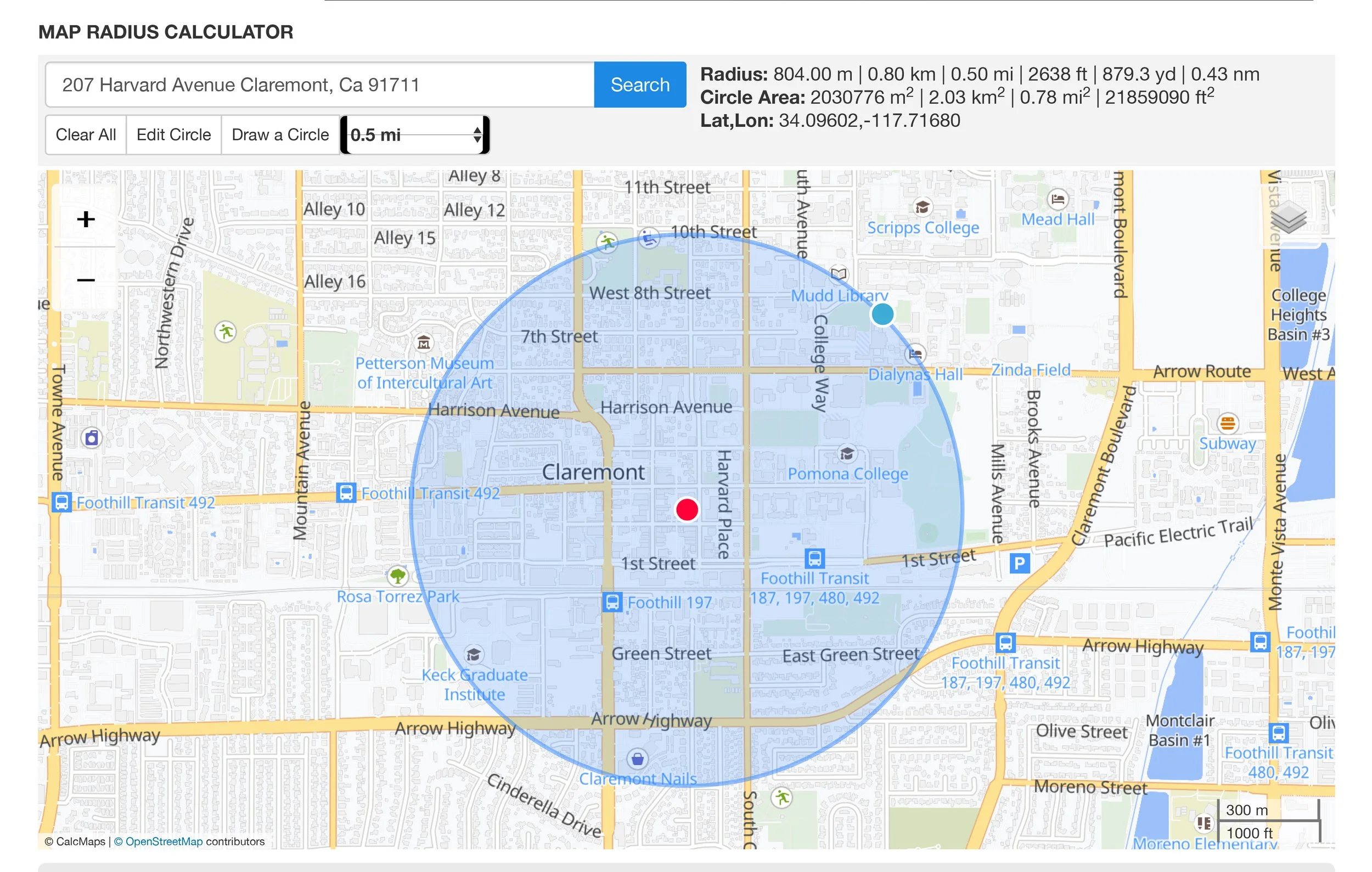
This is an approximation of the area in Claremont that would be affected by the passage of SB 79. Within this half-mile radius, the state would allow a developer to put up 4, 5, 7 story buildings with no public input.
Arguments in favor of SB 79:
California needs more housing and more affordable housing. And it is good for the environment to locate this housing by our transit centers where people have access to public transportation.
Arguments against SB 79:
1. SB79 does not provide preservation for historic buildings which is part of downtown Claremont’s economic model.
SB 79 does not protect historic buildings and neighborhoods from the bulldozer. In Claremont - north to Eighth Street; west to the Claremont Colleges’ wash; south to below Peppertree Square; and east to Rosa Torrez Park - a developer could raze any single-family or multi-family dwelling within a half-mile radius from the transit stop to put up 4 or 5 story buildings. Though Senator Wiener recently amended SB 79 to provide protections for multi-family dwellings, this amendment only applies to cities with rental stabilization laws - and Claremont has none.
Claremont’s downtown economy was built on more than a century’s worth of town-and-gown planning. Historically, Claremont has sustained itself by attracting students to its colleges from all over the world - and by attracting day-tourists who come for our Farmer’s Market, restaurants, shops, art museums, movie theater, college events.
Claremont’s historical society, Claremont Heritage, states that 75% of the people who come to downtown Claremont on the weekend come from someplace else. If we do not continue to develop our downtown with some kind of historical preservation in mind, then we are likely to mess with the formulas that have made Claremont’s downtown successful and sustainable. Losing local control means losing control over our economic model.
Many neighborhoods who oppose SB 79 are neighborhoods of the historically-disenfranchised - like Leimert Park, South Central, Larchmont and Boyle Heights. Los Angeles City Council member Ysabel Jurado, who represents Boyle Heights, where almost the entirety of the neighborhood would be subject to ‘upzoning,’ stated her opposition to SB 79, by saying, “I'm not willing to gamble losing Boyle Heights.” The state legislator who represents South Central maintains that SB 79 would result in gentrification. She says that it would price longtime residents out, forcing them to relocate in more affordable regions inland. Read LAist coverage here | More from CalMatters
2. SB 79 does not have enough environmental protections for developing on land that was previously designated for light industry.
SB 79 poses big environmental concerns. This bill comes right on the heels of recent state decisions to weaken environmental standards for new development. In June of this year, Governor Newsom signed two bills that weaken environmental review standards in order to speed up the construction of housing in California. As a result, urban ‘infill” housing developments — housing built in and around existing development — are no longer subject to the California Environmental Quality Act (CEQA).
Read LA Times coverage | CalMatters analysis
When Newsom signed the two anti-environmental law bills into law, he called it the “most consequential housing reform that we’ve seen in modern history in the state of California.” And SB79’s author, San Francisco’s Senator Scott Wiener lauded the action saying that passing these bills was “the most consequential housing reform we’ve seen in modern history”
Read here
As a result of relaxing environmental standards, there is legitimate concern that there will not be adequate environmental review for soil and water chemical contamination. Historically, the areas near railways have been the location for machine and used car shops, body repair shops, light and heavy industry - and ‘back in the day,’ it was not uncommon for businesses to dump toxic chemicals directly into the soil. In some cases, these contaminants have leached into our water systems. With weakened environmental standards, many fear that SB79 will allow developers to bypass toxic clean-up, putting public health at risk - not just for ourselves, but for our children and our children’s children.
3. SB 79 shuts down the public process in favor of developers’ interests.
SB 79 is undemocratic. If passed, the community will lose their ability to voice their concerns on traffic and safety issues, parking issues, ingress and egress for evacuation purposes, environmental impacts, the effect on existing infrastructure - or anything else. All of the power goes to the developer in their pursuit of a profit margin. With SB 79, community needs are sacrificed to developers’ interests.
The League of California Cities has reiterated a common refrain among the more-than-150 cities that oppose the Bill, and that refrain is that the state is mandating development without regard to the community’s needs, environmental review, or public input. On Tuesday, August 19, the City of Los Angeles voted to oppose SB 79. On August 20, Los Angeles Mayor Karen Bass signed on saying she also opposed SB 79 “unless it is amended to exempt cities with a state-approved and compliant Housing Element.”
Understanding the full scope of SB 79 is difficult because there have been countless rewrites and multiple amendments. The League of California Cities recently published a breakdown, warning that the bill is rapidly changing and challenging for cities to keep up with.
One big problem with the bill is that, seemingly, the state legislators are for it, while the cities are largely against it. Los Angeles’ City Attorney Hydee Feldstein Soto, in her letter opposing SB 79, states that “the bill’s provisions impermissibly impose billions of dollars of costs on Los Angeles and other local jurisdictions, undermine local governance, circumvent local decision-making processes, and impose unintended burdens on communities.” She argues that it would cost the city billions to upgrade infrastructure such as sewage and electrical systems to handle an influx of residents. Mayor Karen Bass has also gone on record with concerns, noting in a recent statement that she opposes SB 79 unless amended.
Alhambra’s Mayor, Katherine Lee, in her letter opposing SB 79, adds that even if a city qualifies for one of the bill’s so-called exceptions, it is still required to meet the same requirements for density, whether or not these “make sense for the community.” She questions whether California will ever be able to meet its housing needs through SB 79’s state-driven, top-down, one-size-fits-all approval process, and suggests that what is needed instead is “a sustainable state investment that matches the scale of this decades-in-the-making process.”
Though Claremont City Council member and Senior Policy Advisor of Inner City Law Center, Jed Leano, has spoken twice at Assembly Council meetings in support of SB 79 — as one of only two speakers backing up the bill’s author — the City of Claremont itself has yet to weigh in officially.
Senator Wiener’s team has gone so far as to promise “Paris-style density” for California by eliminating local ordinances — a deeply ironic framing, since Paris is one of the most heavily planned cities in the world. More likely, the Senator is evoking the postcard-friendly tourist districts rather than the congested suburbs struggling with many of the same challenges Southern California faces. LAist recently explored this framing.
If you have your own concerns about SB 79, you can call or write Assemblymember John Harabedian at (626) 351-1917. or a41.asmdc.org/contact.
Pamela Casey Nagler is currently finishing her book, A Century of Disgrace: The Removal, Enslavement, and Massacre of California’s Indigenous People 1769 - 1869.
SOURCES
• LegiScan: Full bill text of SB 79
• LAist: Los Angeles City Council votes to oppose SB 79
• CalMatters Digital Democracy: Bill tracker: SB 79
• Los Angeles Times: Newsom pushes major housing reform through Legislature (June 30, 2025)
• CalMatters: Analysis: CEQA changes and urban infill housing (June 2025)
• Los Angeles Times: Scott Wiener on 'the most consequential housing reform' (July 2, 2025)


