

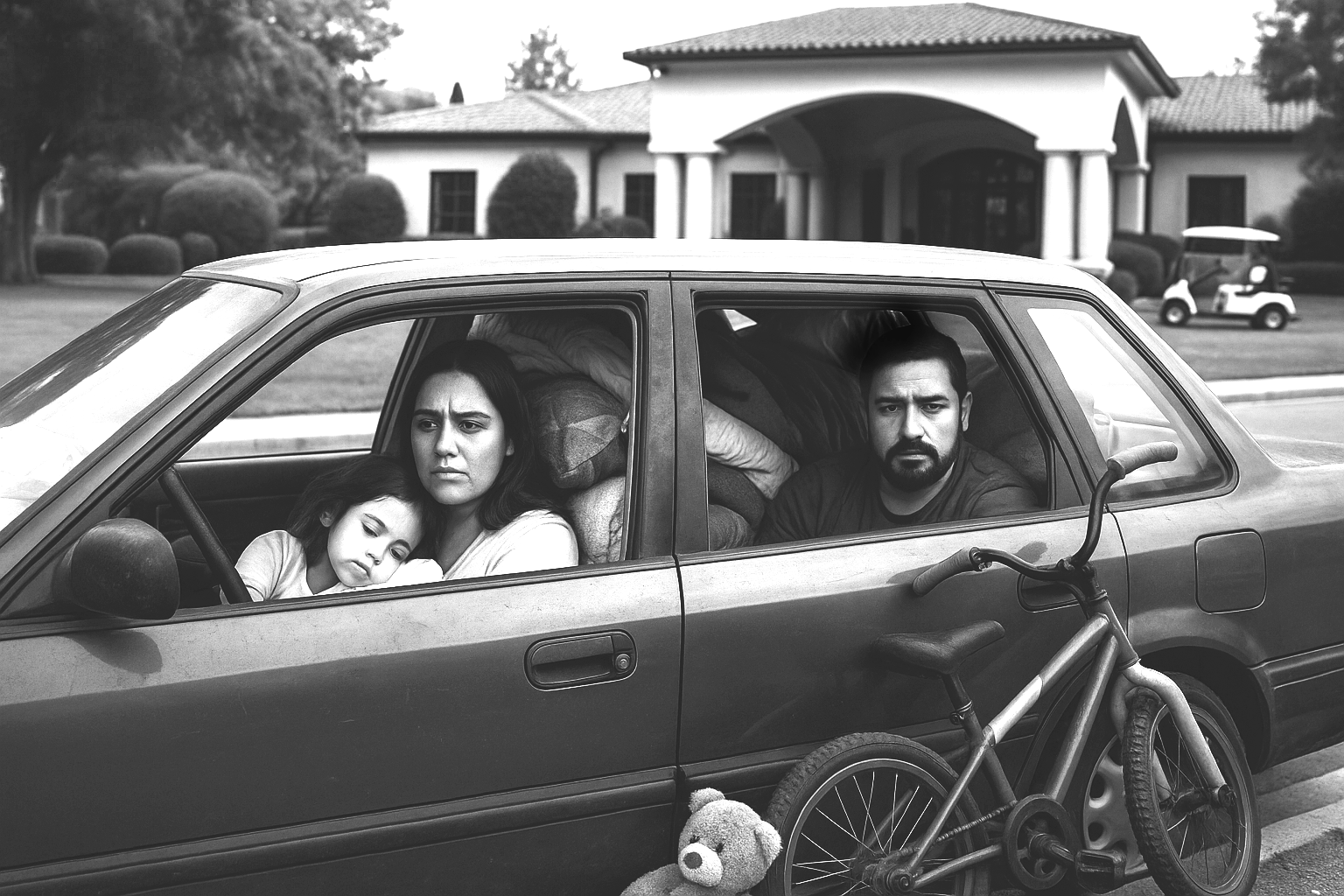
In my last article, California’s Housing Crisis Isn’t Just Scarcity, I argued that California’s housing crisis is not simply about scarcity, and that scarcity did not appear by accident but was manufactured through decades of policy choices like Proposition 13, privatization, and racial exclusion. If we want to understand why housing is unaffordable today, we need to look closely at who those policies have advantaged.
Proposition 13, passed in 1978, was sold as a way to shield homeowners from rising property taxes. But more than four decades later, the biggest winners are not retirees like my mom trying to hold onto their homes. They are elite institutions like country clubs. The Los Angeles Country Club, sitting on land valued at more than $8 billion, continues to pay property taxes based on 1970s assessments (Los Angeles Times). While affordable housing funds dry up, California still subsidizes golf courses for the wealthy.
When Prop 13 passed, the city of Pomona had its own fire department, so fire costs remained the city’s responsibility through its general fund. Later, when Pomona contracted with LA County Fire, the bill still had to be paid directly from that general fund, the same budget that also covers parks, libraries, and housing. Wealthier cities that had county fire service before Prop 13 saw those costs absorbed into property tax revenues, while cities like Pomona, Commerce, and San Fernando were left paying out of already stretched city budgets. That’s how arbitrary the winners and losers of Prop 13 have always been (Los Angeles County Fire Department, Los Angeles Times, 1986).
Whenever inequities are raised, some people are immediately turned off. Others will say, “But Prop 13 helped me,” as if that ends the conversation. I get it, my mom benefited, and as a retiree with a fixed income she’s able to hold onto her home. But personal benefit doesn’t erase the bigger picture. The same protections that gave her stability also gave billion-dollar country clubs and corporations a windfall, while younger families and renters were left to pay the real costs. We can hold both truths at once: Prop 13 helped some, but it hardened the divide for everyone else.
It doesn’t end there. In 2020, voters passed Proposition 19, pitched as a fix to Prop 13. It closed one loophole on inherited vacation homes but left others wide open. Proposition 19 does allow a primary residence to be transferred from parent to child without reassessment, but only if the child makes it their primary residence and the market value stays under an assessed-base-plus-$1 million cap (adjusted for inflation). Transfers exceeding that cap, or where the child doesn’t move in, face reassessment.
Trusts shelter properties, freezing tax bills while Californians face rising costs that widen the wealth gap.
This is neoliberalism at its finest, a model embraced by both parties since the late 1970s, where public resources are drained to protect private wealth and market solutions are treated as the only answers. Prop 13 was never neutral; it redistributed wealth upward and starved local governments. Prop 19 did not change that dynamic.
The same logic extends to corporate ownership of housing. Since 2018, corporations and investors have been buying up a growing share of homes. By early 2022, investors accounted for 28% of all single-family home purchases nationwide (Washington University Law Review). In the first quarter of 2025, investors were behind nearly 27% of all home purchases, a five-year high (Associated Press).
California’s overall numbers are smaller — large institutional investors own less than 2% of the state’s single-family housing stock (CalMatters). But a small share doesn’t mean small impact. When investors control the margins of the market, outbidding families with cash offers and locking in Prop 13 protections, they tilt the system in their favor.
Conventional buyers have also been sidelined. With mortgage rates high and home prices out of reach, many families are forced to wait, reducing competition. That opened the door for smaller investors with cash on hand to move quickly, outbidding households and gaining the same advantage.
For decades, California has chosen privatization over public responsibility. We abandoned public housing, slashed affordable housing budgets, and outsourced solutions to private developers and politically connected nonprofits. Prop 13 locked in low taxes for those who already had property. Prop 19 tinkered at the edges while protecting inheritance loopholes. And now corporate landlords are consolidating ownership and squeezing families.
Some argue the solution is deregulation. But California proves otherwise. Deregulation without deeper reform only benefits those already in power: developers, country clubs, and corporations. It does not address who reaps the rewards and who is locked out.
If California is serious about equity, the next chapter must look different. That means reassessing Prop 13’s protections for country clubs. It means closing inheritance and trust loopholes left intact by Prop 19. It means limiting corporate ownership of single-family housing and bulk purchases that push families aside. And it means reinvesting revenue into public and social housing, so homes are treated as places to live, not commodities to flip.
We are becoming a sharecropper nation, families paying more each year just to stay housed, while ownership and wealth are locked away by outdated tax protections and corporate landlords.
California has land and wealth. What it lacks is the will to stop protecting country clubs and corporations at the expense of families. Until we confront that reality, scarcity will remain less a fact than a choice. The real choice is whether we finally invest in public and social housing, or continue to protect country clubs while families sleep in cars.
Julian Lucas is a photographer, writer and provocateur committed to documenting what power tries to hide. Julian is the founder of The Pomonan and founder and owner of Mirrored Society, a bookshop dedicated to fine art books. His work, on the page, in the darkroom, and in the streets, documents what institutions try to forget. He publishes what others try to bury.


