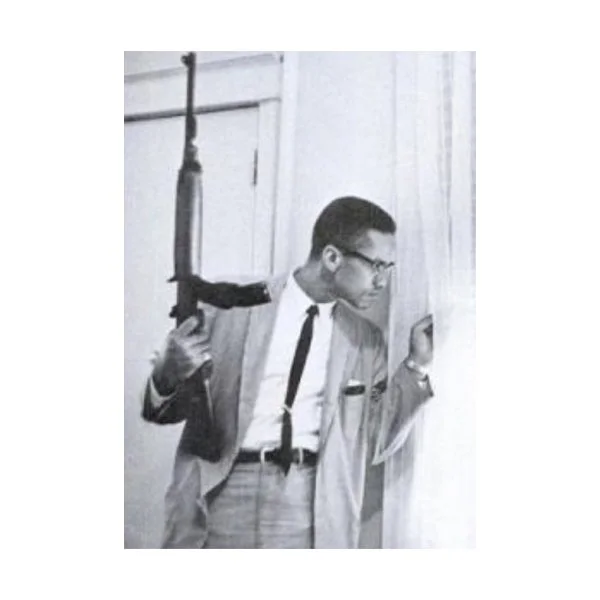
A century later, the very system he warned us about still thrives. The police still kill with impunity. The media still gaslights. Our cities and schools still dilute. Gaza bleeds in real time. Prisons burst with the impoverished. And Malcolm? He’s still considered too much. Too Muslim. Too radical. Too honest. Too Black.
Meanwhile, America keeps stroking its chin and quoting Martin Luther King Jr. as if that’s the cure for everything, although America assassinated King too. But only certain parts of King make the cut, such as the dreamy lines about the content of our character, but never the hard hitting sermons condemning capitalism, militarism, and white moderation. King gets murals and recognizes in school curriculum. Malcolm doesn’t make the murals, or the curriculum.
So let’s celebrate Malcolm X’s centennial by saying the things that still scare people.
Let’s celebrate him by telling the truth. Malcolm X didn’t die because he was wrong. He died because he was dangerous to the structure of lies. He didn’t believe in asking the system to love us. He believed in power rooted in unity, not permission. So when white America defaults to Dr. King, it’s not about reverence, it’s about control. King is safer. He fits into a narrative of redemption. Malcolm forces confrontation. He didn’t beg for inclusion. He demanded power. And conservative Black communities, especially those clinging to respectability, too often go along with this, embracing King as the “correct” way to protest: quiet, suited, and church-approved.
But seriously, if Malcolm X makes you uncomfortable, it’s not because of his methods. It’s because he names the game.
And the game hasn’t changed.
Since the post Reconstruction era, Black Americans have owned roughly 1% to 3% of the nation’s wealth, despite over a century of so called progress. Meanwhile, white Americans consistently hold over 85% to 90% of the country’s total wealth. The gap isn’t closing. It’s calcified. This isn’t a flaw in the system, it is the system. One that was never designed for equity, only maintenance of dominance.
On a local level for example, if we take a walk through Martin Luther King Jr. Park in the city of Pomona. There’s a mural, bright, sprawling, reverent. It features Dr. King, Rosa Parks, John Lewis… and even Gandhi, who once referred to Africans as “savages.” But Malcolm? Not a glimpse. Not a shadow.
This isn’t just an oversight. It’s a curriculum. But it doesn’t have to stay that way. Curriculums can be rewritten. Walls can be repainted. And public memory, when reclaimed, becomes public power.
And where are some of the many Black organizations? The ones with grant money, or participate in gala dinners, and have “equity” in their mission statements? Why aren’t they celebrating Malcolm? Why isn’t there a single event, vigil, panel, or youth program in his name this week? The same groups that show up for MLK breakfasts and Juneteenth gatherings for photo ops go suspiciously quiet when it comes to Brother Malcolm. Maybe it’s because he didn’t smile for the donors. He didn’t dance around discomfort. He didn’t preach patience. And for many Black institutions desperate to seem “neutral” to gatekeepers, that makes him a liability, not a legacy.
But the truth is, Malcolm doesn’t need to be feared. He needs to be understood. He spoke out of love, tough love, yes, but love all the same. A love that demanded more for us than survival. A love that still waits for us to catch up. And maybe that’s the opportunity, not to shame those who’ve stayed silent, but to invite them to speak louder. To remember more fully. To honor him not just in words, but in action. There’s still time.
On a local level, Pomona suffers from selective remembrance. Mention Malcolm’s absence and you’ll be met with deflections. It’s easy to imagine city officials raising eyebrows, hesitating to greenlight a figure who still makes America uncomfortable.
That’s how erasure happens, not through censorship, but through cautious approvals, quiet committees, and unwritten rules about who’s “appropriate” for public celebration. But rules can be broken. Stories can be restored. And the absence of Malcolm today can become a presence tomorrow, if we’re bold enough to name what was left out.
The absence isn’t accidental. It’s strategic. And it says more about the institutions than it ever could about the artists.
But this isn’t about paint. It’s about principle.
Malcolm X challenged power. He called out liberal complicity. He said things that made white allies uncomfortable. And Pomona, like the rest of America, edits that kind of truth out of murals—and textbooks.
This mural isn’t neutral. It’s curated. But curation is a choice. And the next generation doesn’t have to inherit a version of history stripped of its sharpest truths. We can still choose to honor the full legacy, not the comfortable one, but the courageous one.
And when Malcolm X is left off the wall, we’re telling an entire generation:
Be grateful. Be quiet. Be like him, not him.
We’re living in an era of mass forgetting. The kind that turns revolutionaries into mascots and protests into brunch talking points.
Malcolm X, if he’s remembered at all, is reduced to a quote without context. A fire without heat.
But he saw it all coming:
The co-opted movements.
The liberal betrayal.
The Black faces in high places selling out the very people they claimed to uplift.
And he said so loudly.
Malcolm X turns 100 this year.
He’s not just a relic.
He’s a mirror.
And it’s long past time we stopped looking away.
And yet, there’s still time to get it right.
History isn’t fixed, it’s something we revise, remember, and rebuild. We can still teach our children the full truth, honor the voices that challenged us, and create public spaces where Malcolm’s name isn’t feared, but welcomed.
Because if we want justice, we can’t keep choosing comfort over clarity.
And if we want change, we’ll have to follow those who dared to say:
We didn’t come here to be liked. We came here to be free.
Happy 100th, Malcolm. We’re still listening.
And this time, we won’t forget.