

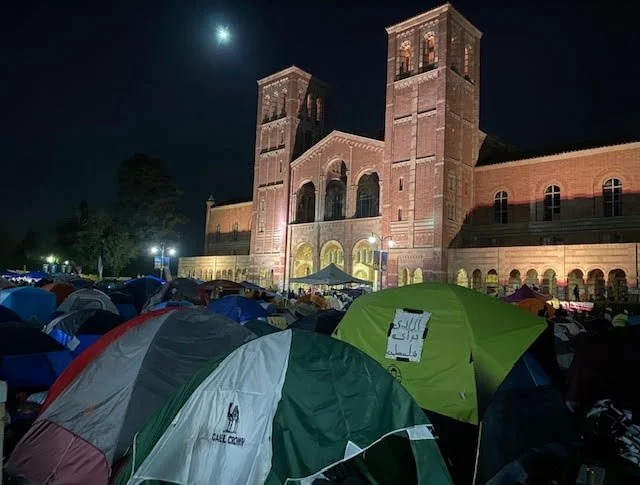
UCLA pro-Palestinian Protest May 1, 2024
Photography ©Julian Lucas
Noor Harmoush
Since Israel escalated its military offensive against Gaza in October 2023, university students across the United States have grappled with their role amid this harrowing moment of genocide. The veil has been lifted, and we are painfully aware of the contradiction in our own position as university students. We pay to attend institutions that use our money to financially support the very systems of violence and oppression that we are fighting against. We devote hours to reading and writing about postcolonial theory and critical discourse, while our universities are materially invested in colonial projects and racist endorsements. And when we speak out about the moral and material inconsistencies we see in our faculty and administration, we are met with apathy–or worse, we are punished.
Historically, university campuses have served as sites of resistance, embodying both material and ideological forms of protest. Practices such as encampments, boycotts, and hunger strikes are part of a long-standing tradition of academic insurgency, situated within a legacy of reclaiming institutional space to demand social and political accountability. Scholars like Frantz Fanon, Edward Said, and Noam Chomsky played pivotal roles in the intellectual resistance against hegemonic narratives. Their work challenged colonial epistemologies, interrogated the ways in which institutional powers dominate our cultural and political spheres, and deconstructed the media’s role in manufacturing public consent. It is through their radical scholarship that the Humanities evolved not as a neutral field, but as a site of contestation–a space where we rigorously question and reclaim. It is in this historic spirit of radical resistance that I anchor myself as an “academic” during this time of genocide.
Yet, we are living in a moment of the devolution of the academic.
While academics of the past reimagined the world order and fueled political movements through their scholarship, today, academics have become ambivalent, or even disconnected from their radical origins. Today, academics make vague statements of solidarity with justice and freedom, but these statements rarely come with any real sacrifice. Quite the contrary–the academic remains comfortably embedded in institutional systems that perpetuate cycles of violence and oppression. The academic may engage in “dialogue” about said system, but will lean into “nuance” and “complexity” to appear more palatable or intellectually rigorous. The academic sidesteps accountability for their harmful role within these systems. In fact, the academic often benefits from upholding the status quo of these systems–say, by a very coveted bullet point on their CV.
What is the role of the academic during genocide if not to accurately identify it as such? What is the role of the academic during genocide if not to critique the distractions that obfuscate the reality of genocide? What is the purpose of research, publications, and conferences if we are merely regurgitating discourse, lacking any synthesis of our reality?
Conferences like the Pacific Ancient and Modern Language Association (PAMLA) are a perfect example of the tragedy of the pontificating academic. A proposed “special panel” for the 2025 conference, titled “A Duel Between Memories: Israel and Palestine,” highlights this problem.
I wrote a letter to the panel’s presiding officers and the Executive Director of PAMLA (linked here) outlining my concerns about this panel. My main argument is that the panel’s description diverts attention from the genocide in Gaza, misconstrues the aggressive nature of the Israeli colonial project, and ultimately causes more harm to the Palestinian plight for liberation. At the time that I wrote the letter, Israel’s starvation campaign against Palestinians living in the Gaza Strip was well underway. Since then, the situation has become even more inhumane and dystopian. I argue that the panel is not only ideologically dishonest but also incredibly inappropriate, insensitive, and irresponsible–that is, to encourage a sort of “dialogue” about “opposing memories” while Gaza’s extermination is being captured live, through videos, photographs, and testimonials.
One must ask: What academic merit, or moral value, is there in discussing “opposing memories” or “both sides” when hundreds of Palestinians are being murdered by Israeli forces each day? As Mohammed El-Kurd puts it, how can there be room for debate in the presence of burning flesh?
Moreover, how can an organization like PAMLA, whose statement on Diversity, Inclusion, and Equity outlines their commitment to “anti-racist and anti-prejudicial” scholarship, host a panel that normalizes Zionism through an exploration of “Israeli memory” in juxtaposition to “Palestinian memory”? It is absolutely absurd to champion a “postcolonial” slogan and its associated buzzwords while also platforming discourse that obstructs the reality of modern-day colonialism. Israel is a settler-colonial regime that is built on an ethno-national ideology of extermination and land theft, which, by any contemporary standards, is very racist and very prejudiced.
How are we, academics, missing the mark this badly? The ideological framework of the Humanities has been corrupted, be it by neo-liberal agendas, a whitewashing of anticolonial theory, or covert (sometimes overt?) complicity in systems of racism and imperialism. PAMLA, like many other academic organizations across the country, is an example of how liberatory theory is strategically co-opted to advance the rhetoric–and often the agenda–of dominant and oppressive power structures. Academics have devolved into agents of the academic machine and its institutional powers. We’ve not only lost our moral compass, but we clearly lack an understanding of ideology and its connection to the material world.
I requested that the panel be removed from the 2025 conference, or at the very least, be reframed to critique Zionist media and narratives from the perspectives of Israelis and Palestinians.
After sending the letter and a petition with signatures of support from colleagues in the academic community, I received a response from the Executive Director, nearly three weeks after I had sent my initial letter:
“The Pacific Ancient and Modern Language Association (PAMLA) has received your request to remove a panel from our PAMLA 2025 Conference schedule.
We have carefully reviewed your request and determined that, in consonance with our Code of Conduct, we will continue to host the panel at PAMLA 2025.”
This lack of thoughtful engagement from PAMLA’s leadership and the panel officers reflects a bad-faith approach to academic integrity. I did not merely request the removal of the panel; my letter sought to highlight a serious mistake we are making as academics–using our positions and resources to promote “both sides” rhetoric at a time of historic and monumental failure to distinguish right from wrong and humanity from insanity. PAMLA arrogantly missed an opportunity to foster “ongoing introspection and continual striving” that they proudly spout in their Diversity, Inclusion, and Equity statement, illustrating, yet again, the ways in which social justice jargon is thrown around for the sake of theatre.
Is this really all we can expect from the academic? A mere puppet, spouting empty rhetoric? The failure is a collective one. We’ve forfeited our credibility in the fight for liberation, made a mockery of our discipline and its predecessors, and, most importantly, we’ve let down those who are the most vulnerable among us.
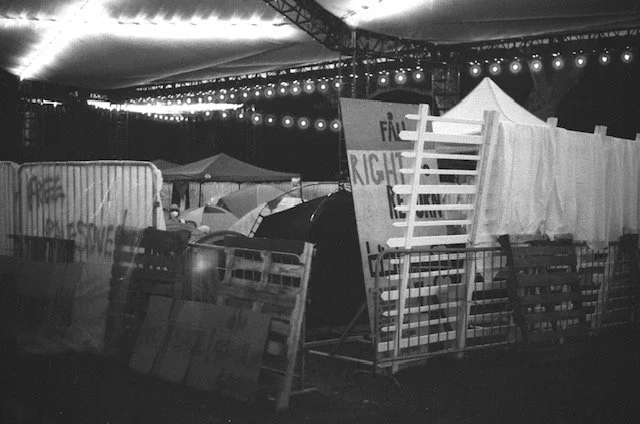
Pomona College pro-Palestinian Protest May 24, 2024
Photography ©Julian Lucas
Gilbert Aguirre
This PAMLA boycott is a model for other academics attempting to navigate institutions with the kind of false liberal morality that permits a panel titled “A Duel Between Memories: Israel and Palestine” during an ongoing genocide, alongside panels supporting Palestinian liberation, or in a more abstract vein, “post-colonial studies” generally. We can’t let academia start and stop at rhetoric, to be, in the words of Gayatri Spivak, just “willy-nilly an idea producing machine.” It is our responsibility as academics to course correct. This means uniting the moral and political intentions of our scholarship with the political work we do in the real world. Thus, from the institutions and organizations that platform our work as scholars, we must be uncompromising and demand that their ethos stay true to our own. If we were to present papers against normalization at the same conference actively normalizing genocidal rhetoric, we would have no legitimacy– there is no abstracting this fact, and we can not fall victim to trying to find excuses under another word: nuance.
The ability of academic institutions to co-opt movements and theories rooted in liberatory struggles can not be overlooked. If the question is, how do we combat the ability of academia to co-opt our work, the answer from us willing to resist co-optation becomes; we need to demand ideological consistency and material transparency from the organizations we use to advance our careers.
We were proven wrong to assume that an organization tied closely to the liberal politics of the Humanities would stand against genocide. We found an inconsistency, pointed it out, and the façade unraveled. In response to thoughtful emails from members of the CSUSB cohort withdrawing their academic work from the conference, PAMLA’s director Craig Svonkin callously responded with some variation of “I’ve removed you from the program per your request” to us all. This response is qualified as callous because its bare reaction to our articulated disappointment with the PAMLA organization reveals little reflection or understanding of the collective effort and the weight of the decision we made to withdraw our work from the conference. Up to the writing of this document, PAMLA’s lead organizers have not met our good-faith critiques with any substantive response. Instead, we have received sanitized, PR speak emails that skirt around any stated position, other than continuing to stand by their Zionist panel. By skirting around a direct stance, their amoral stance was revealed. PAMLA is another toothless, ‘apolitical’ organization, whose lack of stance is a vehicle for co-optation and normalization.
We have heard that PAMLA, internally, gave greater consideration to our complaints than their emails let on– the rumor is that they will be raising the bar for entry on who is able to propose panels, because the student who proposed the panel is getting their undergraduate degree in philosophy– not a Master's student. If the rumor about raising the qualifications for panel proposals is true, we again see the academic machine finding their own rationale for deniability; The student proposing the panel is the problem, an MA student would moreso understand the audience and political context than an undergraduate. That, however, is bullshit. The student who proposed the panel, our pontificating academic Sebastian Prieto-Keith, is a symptom of the academy operating in a purely ideological world, where genocide is reduced to narrative, and liberatory theory is reduced to a lens of analysis. Raising the bar for submission in the future does not guarantee more academically rigorous panels, or even reduce the likelihood of pro- genocide discourse at PAMLA. Instead, it obfuscates PAMLA’s responsibility, making the Zionist panel the responsibility of the person who proposed it. This does not mean that the mass of pontificating academics who are comfortable arguing about the merits of genocide on stage are not worthy of shame and ridicule. Rather, our frustration cannot stop at these CV-hungry careerists; we must also address the institutions that create and reward these amoral opportunists by giving them panels and calling them scholars–a diluting move which, in turn, delegitimizes those of us who are doing political work in and outside of the academy. The reality is, PAMLA’s organizers accepted this panel, and are standing by its academic merit, on the basis of nuance, which we have discussed is how the pontificating academic can consider the representation of Israelis in Palestinian textbooks in the same room where bodies are being burned.
PAMLA’s response to our good-faith concerns about their Zionist panel has taught us a lesson; from these organizations we depend on for aspects of our own professionalization, we must demand ideological consistency and accountability. To keep this statement from being empty, liberal sloganeering, we need to emphasize that from our class position–the mass of academics whose donations, participation, and scholarship these organizations completely depend on– if we boycott these organizations whose actions do not align with our values, we can make them fail. Instead of allowing their ideological inconsistencies to delegitimize our scholarship, we can use our scholarship to delegitimize the organizations that feign solidarity but ultimately stand for nothing.
We must fight against academia’s power to co-opt our political work and place it in a field so abstract it becomes toothless– a place so safe from action that work against genocide is placed beside excuses for genocide– a place for pontification; a conference hall. The canonized scholars who have been mentioned, Fanon, Said, Chomsky, Freire, Rodney (the list goes on) stood firmly against academic minutia– if we want to stand against the institutional machine, we must do the same. This means uniting as scholars against the institutions that depend on our labor, loyalty, and funding while speaking from both sides of their mouths. This is the legacy of academic boycotts: a refusal to legitimize institutions complicit in racist, genocidal, and nationalistic violence. Unfortunately, PAMLA is now on our list of unreputable organizations. We are sounding the alarm to dissuade other academics from legitimizing an organization that has revealed itself to be part of academia’s co-opting machine; a machine intent on delegitimizing the work of principled scholars, because the academy has material interests of its own–material interests that are kept safe when our work remains entirely ideological.
We are of the opinion that raising awareness about Israel’s genocide in Gaza has not been enough. As academics, we must bring action back into our field & stand against inaction and normalization. This is a call to all other academics unwilling to gain a CV bump from the institutions that perform solidarity while platforming genocidal rhetoric. All members of the CSUSB English cohort have withdrawn our accepted papers, and we urge other graduate students to stand with us in creating a united front as academics, conscious of our role during genocide, in pushing the institutions around us away from theatre and into action; instead of letting them push us from action into theatre.
Noor Harmoush and Gilbert Aguirre are graduate students in the English Department at California State University, San Bernardino. Harmoush focuses on Composition and Rhetoric, while Aguirre specializes in Literary Studies. Both ground their academic work in anti-colonial epistemologies, challenging dominant narratives and exploring knowledge systems shaped by resistance and liberation.


