
Los Angeles

The Concrete Classroom: Why Marginalized Public School Kids Got Asphalt Instead of Grass

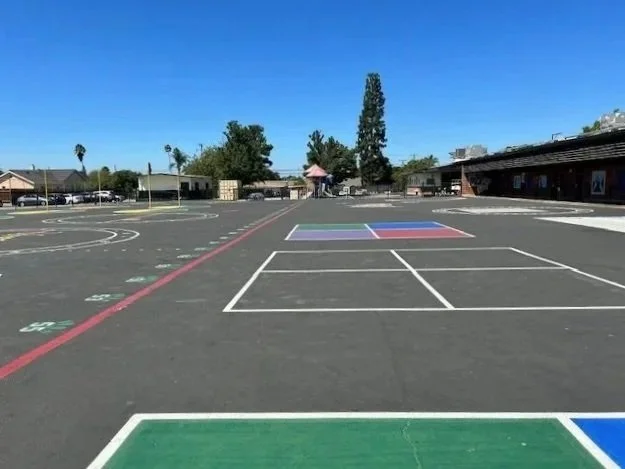
Walk onto almost any public schools in historically disinvested neighborhoods in Southern California and you’ll see the same thing, blacktop with a few painted circles, heat bouncing off every inch of it. No trees. No softness. Just the sound of kids playing on the pavement and the smell of tar in the hot sun.

This isn’t a coincidence. This has happened because that’s how schools for marginalized kids have been built, cheap, easy to maintain, and disconnected from nature.

Studies show that the pattern is national, not local. Across the United States, public schools in low-income Black and Latino neighborhoods are far more likely to have asphalt yards and little to no tree canopy. The Guardian reported that 36 percent of U.S. students attend school in urban heat islands, with the worst conditions concentrated in poorer districts.

Moving from the South Side of Chicago to Inglewood in 1980, we played “throw up tackle,” basically rugby we just didn’t know the formal name. Either way, it was on asphalt. When the school took the balls away, because of fear we would get hurt, we just saved the foil covering from our lunches and combined them large enough to make a ball. That was recess, heat, concrete, and a kind of creativity born out of neglect.

Forty years later, the paint is brighter, new murals appear on school walls calling it progress, but the ground never changed.

Heat that Literally Burns

The UCLA Luskin Center conducted a study showing how hot playground surface can get. School playgrounds could reach up to 160 °F, hot enough to burn skin in seconds. On a 90 degree day, grass stays around 95 °F, asphalt hits 150, and rubber turf can climb to 165. The EPA has also recorded conventional asphalt at 152 °F by midday.

That’s the reality for thousands of students in public schools in working class districts, mostly Black and Latino, whose schools double as heat islands. The same schools that can’t afford air conditioning are hard boiling kids from the ground.

What Greening Really Means

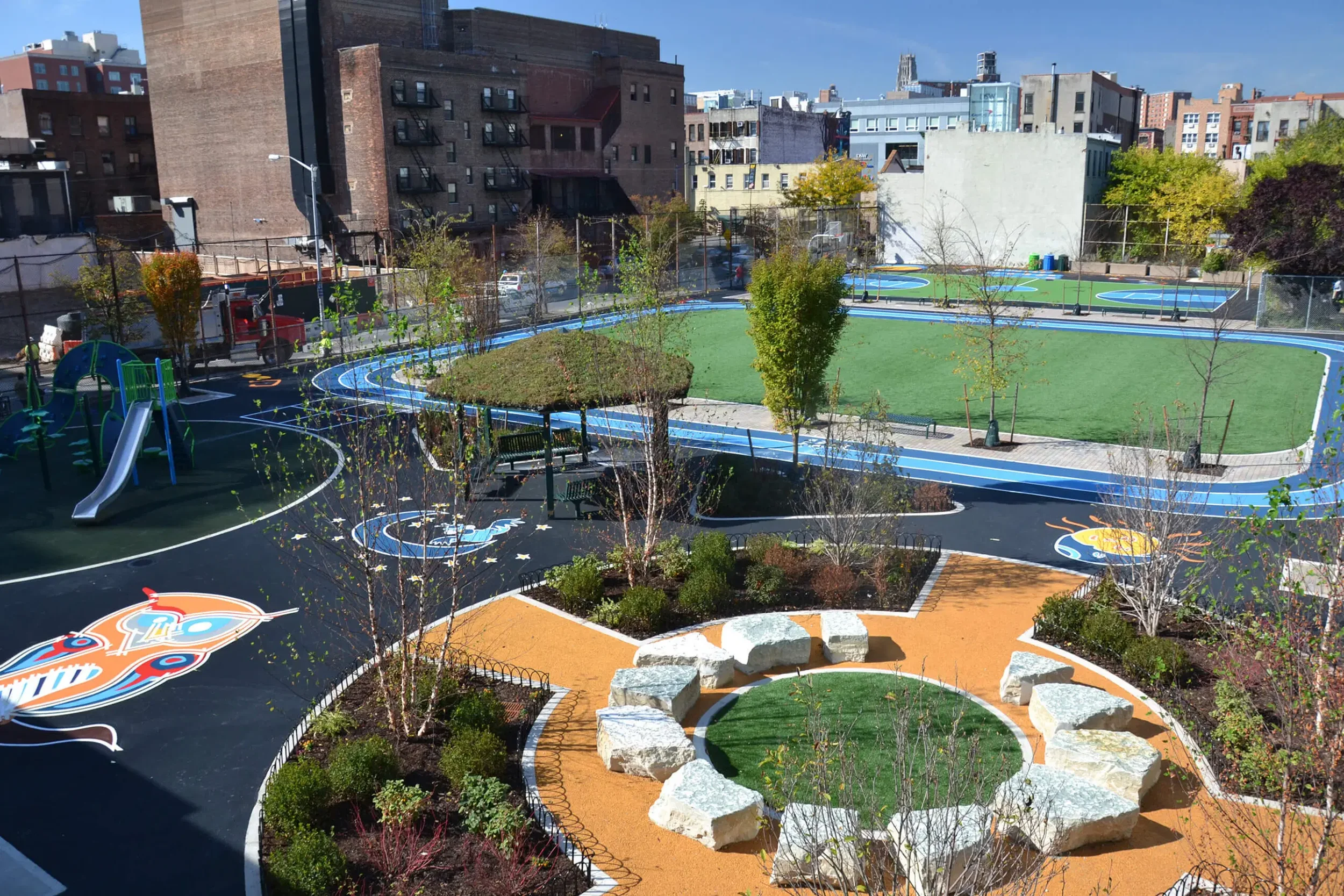
People talk about “greening” schoolyards like it’s a beautification project. It’s not. It’s called infrastructure, and it’s long overdue.

Sharon Gamson Danks of Green Schoolyards America says it plainly, “This is a long term infrastructure problem. It’s actual infrastructure, on par with highway building.”

Green Schoolyards America explains why this work matters:

“Living school grounds are richly layered outdoor environments that strengthen local ecological systems while providing place based, hands-on learning resources for children and youth of all ages.” Read More

Their mission is simple, but radical in its implications:

“All children have daily access to nature on their school grounds, supporting dynamic hands-on learning across the curriculum and grade levels, child directed play, student health and well being, and a positive social environment.” Read More

And she’s right. We have built highways through Black neighborhoods but never bothered to plant shade trees where their children learn. Read More

Now, a few places are trying to fix that.

Buchanan Elementary in Highland Park: North East Trees tore out 400 tons of asphalt and planted 150 trees, fruit bearing, shade casting, humanizing.

Washington STEM Magnet in Pasadena: Amigos de los Ríos turned a bare yard into an outdoor classroom with pollinator gardens and bioswales. “Green space doesn’t just support childhood development, it supercharges it,” said Arbor Day Foundation CEO Dan Lambe.

Even Pasadena school board member Tina Fredericks once made the point clear with a thermometer, asphalt at 157 °F, grass under an oak at 82. California has finally put money on the table, $150 million for “schoolyard forests.” LAUSD has a goal of 30 percent tree canopy by 2035. It’s late, but it’s something.

Cities like Pomona, where Measure Y now sets aside funds for youth programs, could follow suit. Greening a campus isn’t about landscaping, it’s about equity, safety, and pride of place.

Because what these spaces reveal isn’t just bad design, it’s a hierarchy of who gets nature and who doesn’t.

The concrete classroom was built to last

And it did, too well. It taught generations of kids to adapt to heat, to fall on pavement, to accept that the world around them would always be hard.

Every patch of asphalt replaced with soil is a small act of correction. Every tree planted is proof that children deserve more than durability, they deserve beauty, shade, and care.

We’ve paved enough. The next generation should learn on ground that breathes back.


Sources

Tina Fredericks, Pasadena Unified School Board
Guest Opinion: Yes on Measure R + Measure EE; Yes to Greener, Cooler, Safe Schools and Competitive Salaries.” Pasadena Now, 2024.

Segregation By Design
Los Angeles: Sugar Hill

Green Schoolyards America
Living School Grounds.”

Our Mission.”
https://www.greenschoolyards.org/mission

UCLA Luskin Center for Innovation
Action Area 3: Protecting Students from Heat Outdoors.” 2023.

CalMatters
Outdoor Shade: California Schools Face Heat Risks.” 2024.

U.S. Environmental Protection Agency (EPA)
Using Cool Pavements to Reduce Heat Islands.” 2024.

The Guardian
Asphalt Schoolyards Remade into Green Oases — in Pictures.” 2022.

Governing Magazine
Reimagining Schoolyards to Improve Health and Learning.” 2024.

Environmental Health News
Schools Across the U.S. Are Removing Asphalt to Reduce Heat Risks.” 2023.

Planetizen
Green Schoolyards Gain Momentum Across Southern California.” 2025.

Arbor Day Foundation / The Guardian
LA Schools Are Turning Blacktop into Green Spaces.” 2025.

Julian Lucas is a photographer, writer and provocateur committed to documenting what power tries to hide. Julian is the founder of The Pomonan and founder and owner of Mirrored Society, a bookshop dedicated to fine art books. His work, on the page, in the darkroom, and in the streets, documents what institutions try to forget. He publishes what others try to bury.

Centennial of a Prophet: Malcolm X and America’s Enduring Denial

Malcolm X turns 100 today. That sentence alone should crack the sky. Not because we’ve come so far, but because we haven’t, at all.

A century later, the very system he warned us about still thrives. The police still kill with impunity. The media still gaslights. Our cities and schools still dilute. Gaza bleeds in real time. Prisons burst with the impoverished. And Malcolm? He’s still considered too much. Too Muslim. Too radical. Too honest. Too Black.

Meanwhile, America keeps stroking its chin and quoting Martin Luther King Jr. as if that’s the cure for everything, although America assassinated King too. But only certain parts of King make the cut, such as the dreamy lines about the content of our character, but never the hard hitting sermons condemning capitalism, militarism, and white moderation. King gets murals and recognizes in school curriculum. Malcolm doesn’t make the murals, or the curriculum.

So let’s celebrate Malcolm X’s centennial by saying the things that still scare people.

Let’s celebrate him by telling the truth. Malcolm X didn’t die because he was wrong. He died because he was dangerous to the structure of lies. He didn’t believe in asking the system to love us. He believed in power rooted in unity, not permission. So when white America defaults to Dr. King, it’s not about reverence, it’s about control. King is safer. He fits into a narrative of redemption. Malcolm forces confrontation. He didn’t beg for inclusion. He demanded power. And conservative Black communities, especially those clinging to respectability, too often go along with this, embracing King as the “correct” way to protest: quiet, suited, and church-approved.

But seriously, if Malcolm X makes you uncomfortable, it’s not because of his methods. It’s because he names the game.

And the game hasn’t changed.

Since the post Reconstruction era, Black Americans have owned roughly 1% to 3% of the nation’s wealth, despite over a century of so called progress. Meanwhile, white Americans consistently hold over 85% to 90% of the country’s total wealth. The gap isn’t closing. It’s calcified. This isn’t a flaw in the system, it is the system. One that was never designed for equity, only maintenance of dominance.

On a local level for example, if we take a walk through Martin Luther King Jr. Park in the city of Pomona. There’s a mural, bright, sprawling, reverent. It features Dr. King, Rosa Parks, John Lewis… and even Gandhi, who once referred to Africans as “savages.” But Malcolm? Not a glimpse. Not a shadow.

This isn’t just an oversight. It’s a curriculum. But it doesn’t have to stay that way. Curriculums can be rewritten. Walls can be repainted. And public memory, when reclaimed, becomes public power.

And where are some of the many Black organizations? The ones with grant money, or participate in gala dinners, and have “equity” in their mission statements? Why aren’t they celebrating Malcolm? Why isn’t there a single event, vigil, panel, or youth program in his name this week? The same groups that show up for MLK breakfasts and Juneteenth gatherings for photo ops go suspiciously quiet when it comes to Brother Malcolm. Maybe it’s because he didn’t smile for the donors. He didn’t dance around discomfort. He didn’t preach patience. And for many Black institutions desperate to seem “neutral” to gatekeepers, that makes him a liability, not a legacy.

But the truth is, Malcolm doesn’t need to be feared. He needs to be understood. He spoke out of love, tough love, yes, but love all the same. A love that demanded more for us than survival. A love that still waits for us to catch up. And maybe that’s the opportunity, not to shame those who’ve stayed silent, but to invite them to speak louder. To remember more fully. To honor him not just in words, but in action. There’s still time.

On a local level, Pomona suffers from selective remembrance. Mention Malcolm’s absence and you’ll be met with deflections. It’s easy to imagine city officials raising eyebrows, hesitating to greenlight a figure who still makes America uncomfortable.

That’s how erasure happens, not through censorship, but through cautious approvals, quiet committees, and unwritten rules about who’s “appropriate” for public celebration. But rules can be broken. Stories can be restored. And the absence of Malcolm today can become a presence tomorrow, if we’re bold enough to name what was left out.

The absence isn’t accidental. It’s strategic. And it says more about the institutions than it ever could about the artists.

But this isn’t about paint. It’s about principle.

Malcolm X challenged power. He called out liberal complicity. He said things that made white allies uncomfortable. And Pomona, like the rest of America, edits that kind of truth out of murals—and textbooks.

This mural isn’t neutral. It’s curated. But curation is a choice. And the next generation doesn’t have to inherit a version of history stripped of its sharpest truths. We can still choose to honor the full legacy, not the comfortable one, but the courageous one.

And when Malcolm X is left off the wall, we’re telling an entire generation:

Be grateful. Be quiet. Be like him, not him.

We’re living in an era of mass forgetting. The kind that turns revolutionaries into mascots and protests into brunch talking points.

Malcolm X, if he’s remembered at all, is reduced to a quote without context. A fire without heat.

But he saw it all coming:

The co-opted movements.

The liberal betrayal.

The Black faces in high places selling out the very people they claimed to uplift.

And he said so loudly.

Malcolm X turns 100 this year.

He’s not just a relic.

He’s a mirror.

And it’s long past time we stopped looking away.

And yet, there’s still time to get it right.

History isn’t fixed, it’s something we revise, remember, and rebuild. We can still teach our children the full truth, honor the voices that challenged us, and create public spaces where Malcolm’s name isn’t feared, but welcomed.

Because if we want justice, we can’t keep choosing comfort over clarity.

And if we want change, we’ll have to follow those who dared to say:

We didn’t come here to be liked. We came here to be free.

Happy 100th, Malcolm. We’re still listening.

And this time, we won’t forget.


Julian Lucas, is a photographer, a purveyor of books, and writer, but mostly a photographer. Don’t ever ask him to take photos of weddings or quinceaneras, or any other events because he will charge you a ton of money you couldn’t even make payments on.