
Pomona

The Concrete Classroom: Why Marginalized Public School Kids Got Asphalt Instead of Grass

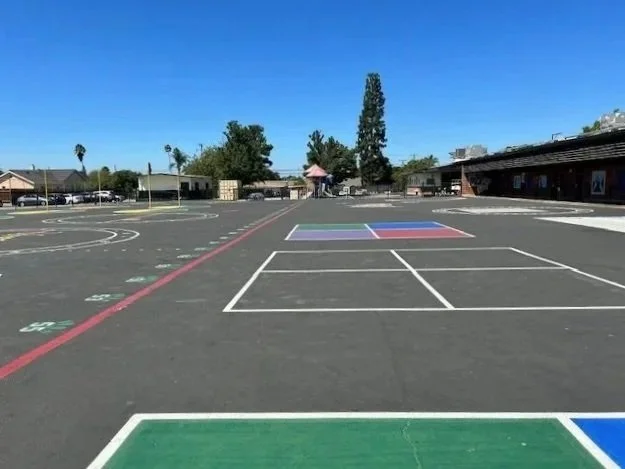
Walk onto almost any public schools in historically disinvested neighborhoods in Southern California and you’ll see the same thing, blacktop with a few painted circles, heat bouncing off every inch of it. No trees. No softness. Just the sound of kids playing on the pavement and the smell of tar in the hot sun.

This isn’t a coincidence. This has happened because that’s how schools for marginalized kids have been built, cheap, easy to maintain, and disconnected from nature.

Studies show that the pattern is national, not local. Across the United States, public schools in low-income Black and Latino neighborhoods are far more likely to have asphalt yards and little to no tree canopy. The Guardian reported that 36 percent of U.S. students attend school in urban heat islands, with the worst conditions concentrated in poorer districts.

Moving from the South Side of Chicago to Inglewood in 1980, we played “throw up tackle,” basically rugby we just didn’t know the formal name. Either way, it was on asphalt. When the school took the balls away, because of fear we would get hurt, we just saved the foil covering from our lunches and combined them large enough to make a ball. That was recess, heat, concrete, and a kind of creativity born out of neglect.

Forty years later, the paint is brighter, new murals appear on school walls calling it progress, but the ground never changed.

Heat that Literally Burns

The UCLA Luskin Center conducted a study showing how hot playground surface can get. School playgrounds could reach up to 160 °F, hot enough to burn skin in seconds. On a 90 degree day, grass stays around 95 °F, asphalt hits 150, and rubber turf can climb to 165. The EPA has also recorded conventional asphalt at 152 °F by midday.

That’s the reality for thousands of students in public schools in working class districts, mostly Black and Latino, whose schools double as heat islands. The same schools that can’t afford air conditioning are hard boiling kids from the ground.


What Greening Really Means

People talk about “greening” schoolyards like it’s a beautification project. It’s not. It’s called infrastructure, and it’s long overdue.

Sharon Gamson Danks of Green Schoolyards America says it plainly, “This is a long term infrastructure problem. It’s actual infrastructure, on par with highway building.”

Green Schoolyards America explains why this work matters:

“Living school grounds are richly layered outdoor environments that strengthen local ecological systems while providing place based, hands-on learning resources for children and youth of all ages.” Read More

Their mission is simple, but radical in its implications:

“All children have daily access to nature on their school grounds, supporting dynamic hands-on learning across the curriculum and grade levels, child directed play, student health and well being, and a positive social environment.” Read More

And she’s right. We have built highways through Black neighborhoods but never bothered to plant shade trees where their children learn. Read More

Now, a few places are trying to fix that.

Buchanan Elementary in Highland Park: North East Trees tore out 400 tons of asphalt and planted 150 trees, fruit bearing, shade casting, humanizing.

Washington STEM Magnet in Pasadena: Amigos de los Ríos turned a bare yard into an outdoor classroom with pollinator gardens and bioswales. “Green space doesn’t just support childhood development, it supercharges it,” said Arbor Day Foundation CEO Dan Lambe.

Even Pasadena school board member Tina Fredericks once made the point clear with a thermometer, asphalt at 157 °F, grass under an oak at 82. California has finally put money on the table, $150 million for “schoolyard forests.” LAUSD has a goal of 30 percent tree canopy by 2035. It’s late, but it’s something.

Cities like Pomona, where Measure Y now sets aside funds for youth programs, could follow suit. Greening a campus isn’t about landscaping, it’s about equity, safety, and pride of place.

Because what these spaces reveal isn’t just bad design, it’s a hierarchy of who gets nature and who doesn’t.

The concrete classroom was built to last

And it did, too well. It taught generations of kids to adapt to heat, to fall on pavement, to accept that the world around them would always be hard.

Every patch of asphalt replaced with soil is a small act of correction. Every tree planted is proof that children deserve more than durability, they deserve beauty, shade, and care.

We’ve paved enough. The next generation should learn on ground that breathes back.


Sources

Tina Fredericks, Pasadena Unified School Board
Guest Opinion: Yes on Measure R + Measure EE; Yes to Greener, Cooler, Safe Schools and Competitive Salaries.” Pasadena Now, 2024.

Segregation By Design
Los Angeles: Sugar Hill

Green Schoolyards America
Living School Grounds.”

Our Mission.”
https://www.greenschoolyards.org/mission

UCLA Luskin Center for Innovation
Action Area 3: Protecting Students from Heat Outdoors.” 2023.

CalMatters
Outdoor Shade: California Schools Face Heat Risks.” 2024.

U.S. Environmental Protection Agency (EPA)
Using Cool Pavements to Reduce Heat Islands.” 2024.

The Guardian
Asphalt Schoolyards Remade into Green Oases — in Pictures.” 2022.

Governing Magazine
Reimagining Schoolyards to Improve Health and Learning.” 2024.

Environmental Health News
Schools Across the U.S. Are Removing Asphalt to Reduce Heat Risks.” 2023.

Planetizen
Green Schoolyards Gain Momentum Across Southern California.” 2025.

Arbor Day Foundation / The Guardian
LA Schools Are Turning Blacktop into Green Spaces.” 2025.

Julian Lucas is a photographer, writer and provocateur committed to documenting what power tries to hide. Julian is the founder of The Pomonan and founder and owner of Mirrored Society, a bookshop dedicated to fine art books. His work, on the page, in the darkroom, and in the streets, documents what institutions try to forget. He publishes what others try to bury.

YIMBY Grassroots or Astroturf?

Who are the YIMBYs? How did they come to amass so much power? And do they have the right ‘fix’ for our enormous affordability housing problem?

Illustration Julian Lucas

Updated 10/02/25 2:06 pm PST

YIMBY *grassroots or astro-turf . . . or both ?

[*astro-turf - an organization that appears to be grassroots, but is in fact funded by multi-millionaires]

This past California legislative season California YIMBY had an inordinate influence on housing legislation. This is not just my opinion, but an opinion shared by major media outlets and YIMBYs themselves who are planning a big victory party at the end of October to celebrate their legislative wins. (Tickets start at $100, going up to $10,000 for sponsors.)

So . . . who or what are YIMBYs?  

YIMBY, the catchy acronym for “Yes, in my backyard!”, has recently notched some big legislative wins. Major outlets like Yahoo News, LAist, and the Los Angeles Times have all reported on the passage of SB 79, a bill that overrides local zoning to promote dense housing near transit hubs. CalMatters called it a landmark shift, while Yahoo framed it as YIMBYs achieving their “holy grail.” The movement itself even celebrated with a victory party.

And so, YIMBYs have self-defined as the ‘good guys’ in a binary fight between good v. evil. The fight is much more nuanced than that, but YIMBYs have gained traction by keeping the conversation about housing simple. Their solution is simply to build more - market rate or affordable housing - it doesn’t really matter.  They figure that if we simply build more, housing will eventually ‘trickle down’ to become more affordable for more people. And the secret to building more? Upzone, that is, override local zoning ordinances. Eliminate local processes at the city level. Bypass community involvement in favor of state-run bureaucracy. Remove environmental review. 

Early on, YIMBYs gained traction with high tech executives and the real estate developers who donated large amounts of money to get the YIMBY movement up and running. According to a 2018 article in Dollars and Sense, “California YIMBY, the first political YIMBY group, was founded with the funding of Bay Area tech executives and companies. Dustin Moskovitz (Facebook, Asana) and his wife Cari Tuna donated $500,000 via their Open Philanthropy foundation; Nat Friedman (Xamarin, GitHub) and Zack Rosen (Pantheon Systems) donated another $500,000. Another $1 million donation came from the online payments company Stripe.” See More

Early on, high tech executives recognized that lack of housing was preventing them from recruiting and retaining the labor force they needed. They also recognized that jumping on board demanding housing deflected attention from their complicity in the housing crisis in the first place. Their high tech workers were rapidly displacing longtime residents, lower income residents and people of color, and the optics were not good. High tech could have invested in workforce housing, but it was cheaper to donate to activist groups like YIMBY. 

And it is not hard to imagine why real estate developers have also donated large sums of money. Deregulation smooths the way for them to build more and grow their profits. 

Deregulation used to be the purview of the conservative right, but the neo-liberals and the libertarians have come to embrace the ideology. They call themselves supply-side progressives - and believe that simply by increasing the amount of essential goods and services - in this case, housing - will automatically achieve progressive outcomes. 

The YIMBYs recently received a big, national boost for their philosophy when New York Times podcaster Ezra Klein and Altantic writer Derek Thompson just released their book this spring, titled, Abundance. The abundance ideology is based upon the precepts of ‘build, baby, build,’ and deregulate, deregulate, deregulate, and that with abundance, affordability will follow. 

The logic of both the Abundance movement and the YIMBYs goes something like this: what’s great for landlords, developers, and the financial institutions has to be great for the rest of us too — at least, that is the YIMBYs’ story, and they are sticking to it.

The beauty (and terror) of supply side progressivism is that it poses a solution to a big complex and difficult problem without disrupting capitalism - in fact, it advantages the venture capitalist who operates in high tech and real estate. And this is exactly how the YIMBYs have managed to amass so much power. They have secured large amounts of money (and organization skills) from their wealthy benefactors.. A simple google search of YIMBY donors yields a plethora of names of CEOs and other high-ranking executives. 

Many - myself included - have been inclined, to think of YIMBY as a grassroots movement, but in fact, YIMBY is actually a shell-game of many richly endowed nonprofit organizations, a syndicate as it were, who lobbies - and lobbies hard - on housing laws aimed at streamlining the development process.

For a start, in California,  the YIMBYs are Yes in My Backyard, California YIMBY, California YIMBY Action, California YIMBY Victory Fund, YIMBY Law, YIMBY Education Fund.

Yes in My Backyard trains people to advocate for more housing in their neighborhoods. Tax-exempt revenue reported for Yes In My Back Yard for 2023, was $2.14M.

Yes In My Backyard is linked to YIMBY Law which reviews public records to identify cities that may be violating housing laws. They inform cities of possible violations and file litigation to ensure cities follow the law and housing is built.

In 2021, YIMBY Law filed its first lawsuit against Simi Valley. Since then, they have filed additional lawsuits in places like Cupertino, Los Angeles, San Francisco, Sausalito, Redondo Beach, Burbank, Burlingame, Culver City, Fairfax, Lafayette, Millbrae, Newport Beach, Santa Monica. YIMBY detractors and supporters alike have called their strategy “sue the suburbs.” YIMBYs have even filed a lawsuit against California’s Department of Housing and Community Development (HCD). Launching lawsuits costs money. 

Yes In My Back Yard also partners with YIMBY Action to create and disseminate resources. YIMBY Action reported revenue for 2023 of $1,592,988 with assets of $1,022,696.

ProPublica: YIMBY Action financials

Then there’s California YIMBY which works with housing policy experts, elected officials, and grassroots organizations across California to craft and pass legislation at the state and local level that will accelerate home building and upzoning.

California YIMBY, tax-exempt, reported $4.49 million in revenue for 2023. Its total assets for that year were $6.89 million.

California YIMBY’s top people make a very good salary. In 2023, President and CEO Brian Hanlon made $335,815; Senior VP Melissa Breach, $224,939; Directors Matthew M. Lewis, $152,330; Robyn Leslie, $138,762; Konstantin A. Hatcher, $137,190; and Edward S. Resnikoff, Robert Cruickshank, Matthew N. Gray, made between $123,091 and $109,973. All actually earned additional income from the nonprofit, amounting to between $17,667 and $6,803 in 2023.

California Yimby is linked to the California YIMBY Victory Fund, a state Political Action Committee (PAC) that supports candidates for elected offices in California. The California YIMBY Victory Fund spends a great deal of money contributing to candidate campaigns - a strategy that appears to be working for them.

California YIMBY Education Fund features reports, maps, ongoing projects, and an extensive research catalog. In 2023, the California YIMBY Education Fund reported over $8 million worth of assets.

There are also any number of local splinter groups. The YIMBY Action website lists 19 in California and many, many more across the US. See here

Not all of the YIMBY organizations have YIMBY in their name. For instance, Streets For All is a fiscally-sponsored project of the California YIMBY Education Fund. And California YIMBY’s President and CEO Brian Hanlon co-founded the California Renters Legal Advocacy and Education Fund (CaRLA) in 2015. Abundant Housing LA works in conjunction with the Abundant Housing LA Education Fund to represent the YIMBY movement in Los Angeles.

Taken together, YIMBY nonprofit lobbying organizations in California post assets of likely more than 20 million dollars.

There can be no better indication that YIMBY’s sphere of influence is rising than the fact that a Congressional Yes In My Back Yard (YIMBY) Caucus, a bipartisan US congressional caucus, was founded in November 2024.

Currently, State Senator Scott Wiener (SF), YIMBY’s champion in the state senate, is making his own bid to move up to the national level. He recently opened a campaign committee to run for San Francisco’s congressional seat currently held by former Speaker Nancy Pelosi. Wiener is perhaps the singular California elected official who is most closely aligned with the YIMBY effort to build more housing and upzone through deregulation, streamlining, and loss of local control.

YIMBYs and this California legislative season
This year and in the last few years, the YIMBYs have lobbied for a large number of bills in California, and this year, their crowning achievement, among other achievements, was the passage of two anti-environmental bills (AB 130 and SB 131) in June, and the probable passage of a Transit-Oriented Development bill (SB 79) that is sitting on Governor Newsom’s desk, right now, awaiting his signing by October 12. All three bills were authored and sponsored by YIMBY-endorsed State Senator Scott Wiener (SF).

The Transit-Oriented Development bill (SB 79) comes as the third part of a one-two-three punch. Governor Newsom essentially paved the way for the passage of SB 79 when he strong-armed our state legislators in June of this bill to pass two anti-CEQA (California Environmental Quality Act) bills by tying them to the approval of our state budget. These bills waived the need for environmental reviews on infill housing projects in our cities. Governor Newsom lauded the passage of these anti-environmental bills, saying it "the most consequential housing reform that we’ve seen in modern history in the state of California.”Scott Wiener on “the most consequential housing reform” – LA Times
Environmental groups outraged by Newsom CEQA overhaul – LA Times

Which brings us to California Senate Bill 79: Housing development: transit-oriented development also known as the Abundant & Affordable Homes Near Transit Act.

SB79 will upzone and override local zoning to allow for the construction of greater height (5, 6, 7, 8, 9-stories) and density (up to 38,000 units in a 1/2 mile radius) near train stops and Metro light rail stations in 8 out of 58 of California’s counties - including Los Angeles.

Mapping the potential impact of SB79

The Potential (Negative) Impacts of SB 79: Transit Oriented Development
While locating housing developments near transit stops encourages people to get out of their cars and encouraging development away from our fire hazard severity zones is necessary, SB 79 brings with it plenty of negatives. 

Primarily, there is the issue of affordability. Basically, only about 10% of the transit-oriented housing will be affordable, the remainder will be offered at market rate.

In addition, if Governor Newsom signs this bill in the next couple of weeks, local residents will no longer have the ability to weigh-in on such matters as setbacks and parking, open space, trees and environmental review, facades, architectural design, traffic and safety for new development for these new developments within a half mile of a train stop. The approvals for development will now come from a centralized intelligence - our state’s Department of Housing and Community Development (HCD). SB79 is basically undemocratic. With SB79, local communities lose their ability to make their city anything but cookie-cutter. As it turns out there is a whole lot more to planning and re-planning a neighborhood than simply drawing a circle on a map.

In a quarter to a half mile radius from a city’s train stop, apartment houses and multi-family housing will receive some protection from demolition - at least until 2030, when the state’s rental stabilization law sunsets - but there will be no protections for single family housing, housing with an ADU, two-on-a-lot, or duplexes.

Historical buildings and neighborhoods will not be adequately protected from demolition. Only 10% of historical buildings on the local registry will be protected. And protecting one building while surrounding it by 5, 6, 7, 8, 9-story buildings is really no protection at all. Housing advocates, including YIMBYs, are often dismissive of the need to preserve historic districts. “Our cities are not museums,” one State Senator said. But the truth is that conserving our historic districts is neither ineffective or irrelevant. As it turns out, our historic districts are not the enemies of diversity, density and affordability, rather, they are often the places that are already meeting these important and legitimate public goals.

 In addition, the waiving of environmental reviews should be deeply concerning to all of us. In the so-called olden days, railway stops were the places for light and heavy industry where workers poured contaminants in the soil, and in some places, these have leached into our water systems. It’s hard to believe that our state government feels that the imperative to build outweighs our need for basic testing and clean-up.

My story, my hometown, my legislators
I only found out about SB 79 and the many ways it could negatively impact my hometown of Claremont, some 35 miles away from Los Angeles in early July - and I definitely came late to the ‘party.’

Unbeknownst to me, all four of the regional elected officials (two of them recently elected) that I spoke with before the vote in early September, had accepted campaign finance money from the California YIMBY Victory Fund.

Claremont City Councilman, Jed Leano received $5,500 for his unsuccessful bid for the Assembly, and Assemblymembers John Harabedian (Altadena to Pasadena to Upland) and Mike Fong (Alhambra to Temple City to Monterey Park) accepted $1,500 and $1,000 respectively. Newly-elected Senator Sasha Renée Pérez (Alhambra to Rancho Cucamonga) accepted $2,500.

Before the California Democratic Club’s Executive Board endorsed SB 79 in mid-August, they accepted $3,500 from the California YIMBY Victory Fund.

California campaign contributions – 2023
California campaign contributions – 2025

Two of my elected representatives, Councilman Leano and State Senator Pérez, endorsed SB 79 on the floor of the state legislatures. Council member Leano spoke before two Assembly Committees in July as Senator Scott Wiener’s ‘right hand’ man; and Senator Pérez endorsed SB 79 on the Senate floor in September right before the State Senate voted in support.

There is an old joke that our elected officials, like Nascar racers, should wear the patches of their sponsors on their coats. If only my representatives had been wearing their YIMBY patches when I met with them, our conversations would have been so much clearer.

On the local scene, on August 18, 2025, Claremont City Councilman Leano wrote an opinion piece for Pasadena Now, promoting SB 79, titled “The Real Reason California Housing Costs Are Outrageous: A Claremont city councilman explains how wealthy residents control housing decisions.” His talking points are basically YIMBY talking points - California YIMBY posted his op-ed on their website and circulated it on their Instagram account.

In it, he blamed the housing shortage on “older, male, longtime-resident homeowners” who he said “dominate” the town meetings in places like Claremont. Interestingly enough, Leano chose not to post his op-ed in his own local newspaper, but in Pasadena, some thirty miles away.

Undeniably, Councilman Leano is right. Whites, historically, are the reason for our segregated California neighborhoods. It happened over the centuries that red-lining, real estate covenants, sundowner towns, the California Native American genocide, Mexican repatriation of 1929 -39, and Japanese Internment of WWII, among other actions, effectively carved out ‘white’ neighborhoods in California.

However, there are definite questions about what is the correct ‘fix’ to systematic injustice. Here, Councilman Leano, by vilifying the very people who participate in his town’s government, is dismissive of the efforts of legions of people who have worked very hard serving on local commissions and committees, building local businesses, maintaining non-profits, in order to create a highly livable, walkable city with trees and parks where people want to live.

Claremont is not really the best example of NIMBYism - though, of course, it certainly exists.. In 2021, Claremont approved its own 25 acre transit-oriented development project (with height, density, historical preservation and open space) after an intense public process. Unfortunately, it has stalled out -for now - not due to local resistance or regulations, but due to problems with property owners and financing. 

While Leano leans heavily on the stereotype of the white boomer NIMBY as the villain of the housing affordability crisis, in truth, there are many factors that interfere with housing construction, including rising material and construction costs, financing problems, private ownership, labor shortages, high interest rates, insufficient public funding for affordable housing, institutional investors buying up large amounts of housing, the failure to develop state-sanctioned development plans with nearby existing airports, along with all the infrastructure, planning, and costs that accompany rapid growth. In the meantime, Claremont is not quite the all-white city that Leano describes. According to the 2020 census, Claremont is now a minority-majority city, with less than half - 47% - self-describing as white.

Claremont, California – Wikipedia
Map of Los Angeles Metro Area (Claremont marked)

Elsewhere, in Councilman Leano’s op-ed, he declares that, “new homes are nearly impossible to build” - a statement that is both hyperbolic and inaccurate. Claremont sits on the edge of the Inland Empire that is experiencing a building boom - with 4-story or higher apartment houses going up all over the region.

According to the Inland Empire Multi-family Market Report, August 2025:

“Supply growth was on track to reach a new peak, with 2,864 units delivered during the first half of the year, while the pipeline remained robust with 9,549 units underway.”

And Cal State San Bernardino’s Housing & Transportation Report – CSUSB:

“Over the past 30 years, Southern California’s Inland Empire (IE), encompassing Riverside and San Bernardino Counties, has experienced rapid growth and economic change. As of December 2023, the region’s population reached approximately 4.7 million residents, making it the thirteenth most populous metropolitan area in the United States and the third largest in California (U.S. Census Bureau, 2024). The region has tripled in population and positioned itself as one of the nation’s fastest-growing areas . . . In 2022, the Inland Empire was identified as the fifth fastest-growing region in Southern California.”

Even in Councilman Leano’s own jurisdiction of Claremont, there are a multitude of development projects underway. Listed on the Claremont City website are: Old School House Development (OSH); La Puerta Development; Clara Oaks Development; Village South Specific Plan (VSSP); Residence Inn by Marriott (formerly Knights Inn); City Ventures Indian Hill Project; TCCS Student Services Building; Olson Housing Project - Descanso Walk; 365 West San Jose Condominium Project; and Larkin Place Permanent Supportive Housing Project.

Just on the other side of the Councilman Leano’s city borders - in Upland, Montclair, Pomona, LaVerne - multi-family apartment housing projects are springing up with astonishing speed. Driving on the 210 from Claremont to Fontana, there are giant swaths of new homes, roof to roof.

So . . . maybe the conversations that we need to have is what California could do to create the housing that people can actually afford. 


Pamela Nagler Pamela Nagler is finishing her book, Unceded Land, Indigenous California and the Foreign Invasions: Spanish, Mexican, Russian, US  1769-1869.

Centennial of a Prophet: Malcolm X and America’s Enduring Denial

Malcolm X turns 100 today. That sentence alone should crack the sky. Not because we’ve come so far, but because we haven’t, at all.

A century later, the very system he warned us about still thrives. The police still kill with impunity. The media still gaslights. Our cities and schools still dilute. Gaza bleeds in real time. Prisons burst with the impoverished. And Malcolm? He’s still considered too much. Too Muslim. Too radical. Too honest. Too Black.

Meanwhile, America keeps stroking its chin and quoting Martin Luther King Jr. as if that’s the cure for everything, although America assassinated King too. But only certain parts of King make the cut, such as the dreamy lines about the content of our character, but never the hard hitting sermons condemning capitalism, militarism, and white moderation. King gets murals and recognizes in school curriculum. Malcolm doesn’t make the murals, or the curriculum.

So let’s celebrate Malcolm X’s centennial by saying the things that still scare people.

Let’s celebrate him by telling the truth. Malcolm X didn’t die because he was wrong. He died because he was dangerous to the structure of lies. He didn’t believe in asking the system to love us. He believed in power rooted in unity, not permission. So when white America defaults to Dr. King, it’s not about reverence, it’s about control. King is safer. He fits into a narrative of redemption. Malcolm forces confrontation. He didn’t beg for inclusion. He demanded power. And conservative Black communities, especially those clinging to respectability, too often go along with this, embracing King as the “correct” way to protest: quiet, suited, and church-approved.

But seriously, if Malcolm X makes you uncomfortable, it’s not because of his methods. It’s because he names the game.

And the game hasn’t changed.

Since the post Reconstruction era, Black Americans have owned roughly 1% to 3% of the nation’s wealth, despite over a century of so called progress. Meanwhile, white Americans consistently hold over 85% to 90% of the country’s total wealth. The gap isn’t closing. It’s calcified. This isn’t a flaw in the system, it is the system. One that was never designed for equity, only maintenance of dominance.

On a local level for example, if we take a walk through Martin Luther King Jr. Park in the city of Pomona. There’s a mural, bright, sprawling, reverent. It features Dr. King, Rosa Parks, John Lewis… and even Gandhi, who once referred to Africans as “savages.” But Malcolm? Not a glimpse. Not a shadow.

This isn’t just an oversight. It’s a curriculum. But it doesn’t have to stay that way. Curriculums can be rewritten. Walls can be repainted. And public memory, when reclaimed, becomes public power.

And where are some of the many Black organizations? The ones with grant money, or participate in gala dinners, and have “equity” in their mission statements? Why aren’t they celebrating Malcolm? Why isn’t there a single event, vigil, panel, or youth program in his name this week? The same groups that show up for MLK breakfasts and Juneteenth gatherings for photo ops go suspiciously quiet when it comes to Brother Malcolm. Maybe it’s because he didn’t smile for the donors. He didn’t dance around discomfort. He didn’t preach patience. And for many Black institutions desperate to seem “neutral” to gatekeepers, that makes him a liability, not a legacy.

But the truth is, Malcolm doesn’t need to be feared. He needs to be understood. He spoke out of love, tough love, yes, but love all the same. A love that demanded more for us than survival. A love that still waits for us to catch up. And maybe that’s the opportunity, not to shame those who’ve stayed silent, but to invite them to speak louder. To remember more fully. To honor him not just in words, but in action. There’s still time.

On a local level, Pomona suffers from selective remembrance. Mention Malcolm’s absence and you’ll be met with deflections. It’s easy to imagine city officials raising eyebrows, hesitating to greenlight a figure who still makes America uncomfortable.

That’s how erasure happens, not through censorship, but through cautious approvals, quiet committees, and unwritten rules about who’s “appropriate” for public celebration. But rules can be broken. Stories can be restored. And the absence of Malcolm today can become a presence tomorrow, if we’re bold enough to name what was left out.

The absence isn’t accidental. It’s strategic. And it says more about the institutions than it ever could about the artists.

But this isn’t about paint. It’s about principle.

Malcolm X challenged power. He called out liberal complicity. He said things that made white allies uncomfortable. And Pomona, like the rest of America, edits that kind of truth out of murals—and textbooks.

This mural isn’t neutral. It’s curated. But curation is a choice. And the next generation doesn’t have to inherit a version of history stripped of its sharpest truths. We can still choose to honor the full legacy, not the comfortable one, but the courageous one.

And when Malcolm X is left off the wall, we’re telling an entire generation:

Be grateful. Be quiet. Be like him, not him.

We’re living in an era of mass forgetting. The kind that turns revolutionaries into mascots and protests into brunch talking points.

Malcolm X, if he’s remembered at all, is reduced to a quote without context. A fire without heat.

But he saw it all coming:

The co-opted movements.

The liberal betrayal.

The Black faces in high places selling out the very people they claimed to uplift.

And he said so loudly.

Malcolm X turns 100 this year.

He’s not just a relic.

He’s a mirror.

And it’s long past time we stopped looking away.

And yet, there’s still time to get it right.

History isn’t fixed, it’s something we revise, remember, and rebuild. We can still teach our children the full truth, honor the voices that challenged us, and create public spaces where Malcolm’s name isn’t feared, but welcomed.

Because if we want justice, we can’t keep choosing comfort over clarity.

And if we want change, we’ll have to follow those who dared to say:

We didn’t come here to be liked. We came here to be free.

Happy 100th, Malcolm. We’re still listening.

And this time, we won’t forget.


Julian Lucas, is a photographer, a purveyor of books, and writer, but mostly a photographer. Don’t ever ask him to take photos of weddings or quinceaneras, or any other events because he will charge you a ton of money you couldn’t even make payments on.

Victory Gardens: Where Did They Go? Has Patriotism Traded Roots for Asphalt and Symbols?

Illustration by Julian Lucas ©2024

In the 1940s, American patriotism got their hands dirty. During World War II, “Victory Gardens” sprouted in backyards, empty lots, schoolyards, and public spaces. Although originally called war gardens during World War I beginning in 1917. At their peak, nearly 20 million gardens produced an estimated 40% of the fresh vegetables consumed in the United States. The phrase "victory garden" was first used by the head of the National War Garden Commission, Charles Lathrop Pack during the end of World War I. The word was so popular that it was used again during World War II, when victory gardeners returned to duty. It was more optimistic than "war garden. "These gardens were a response to wartime rationing and strained supply chains, but the gardens were also a powerful symbol of solidarity and resilience. Families, schools, and entire neighborhoods participated, showing that patriotism was a communal effort rooted in a palpable action. 

Victory Gardens were a source of food, but more over they were a cultural movement. Public campaigns encouraged Americans to see gardening as a civic duty, with posters urging citizens to Dig for Victory. Magazines published gardening tips, and communities came together to share seeds and tools. These efforts embodied elements of socialism prioritizing the collective good over individual profit. This means, the Silent Generation, parents of the Baby Boomers, was focused on mutual aid and ensuring that everyone had access to the resources and knowledge they needed to contribute. This sense of shared purpose was a stark contrast to the hyper individualism that dominates present American culture.

WWII Victory Garden Campaign 1942

A Resident of Southwest Washington, DC and her Victory Garden.” Note the service flag in her window. Two stars means two family members serving in the war. Photo by Joseph A. Horne, Office of War Information, June 1943.

Furthermore, the Black community also participated by growing food in their backyards as they were accustomed to gardening. Their resilience persevered during during the time of Victory Gardens because Jim Crow Laws, segregation, and lynching’s were still common. Segregation made it more difficult for Blacks because of the limited access to high quality seeds.

Additionally, Japanese Americans were also encouraged to grow gardens on camp property during the war, despite being forced to relocate to internment camps because of discrimination as well.

In the modern day, collaborative attitudes have diminished. Instead of repurposing public and private land for food production, modern America has embraced privatization and industrialization, additionally consumerism and performative patriotism. Big trucks with American flags as large as king-size bed sheets flapping in the wind, along with social media posts proclaiming allegiance to the nation. The symbols of patriotism are everywhere, flags hanging from houses or planted in green suburban lawns, campaign signs with slogans draped over freeways, and president-branded t-shirts and caps becoming a fashionable trend. However, the substance, acts of service, community building, and self reliance, is increasingly absent. Meanwhile, growing your own food, once seen as a patriotic duty and some has also associated to poverty as it was a necessity for people who couldn’t afford to purchase food from the grocery stores on a regular basis, more so in rural areas. Today, the concepts of growing your own food and farm-to-table dining are often viewed by some as leftist, socialist, or liberal niche interests and are not always taken seriously. However, those who truly understand the value of these practices, particularly people from densely populated and diverse cities, view them as a more health conscious and environmentally responsible alternative to industrialized food, which is commonly served at chain restaurants. Many local restaurants have embraced the farm to table concept. At such places, the commitment to sourcing fresh, local ingredients is evident from the moment you sit down, with servers often highlighting that their food comes directly from local farms.

"Sow the Seeds of Victory!" poster by James Montgomery Flagg, c. 1917. Library of Congress.

The rise of neoliberal policies, championed by politicians on both sides of the aisle, has prioritized privatization over public welfare. Food production has been monopolized by massive corporations focused on profits. Urban food deserts have been flooded with unhealthy processed options, while fresh, affordable produce remains scarce. Land once accessible for community or agricultural use has been parceled out for private development, turning potential gardens into parking lots, strip malls, and luxury housing, all done in the name of the almighty dollar.

Public spaces like parks and sidewalks, which were integral to the Victory Garden movement, are now largely overlooked as resources for combating food insecurity. During World War II, parks and other communal spaces were repurposed for food production, serving as hubs for community gardening. Today, these same spaces are either privatized, with the use of a BID (Business Improvement District) heavily policed by the BID with the use of private security, or restricted in ways that make them inaccessible for urban agriculture. For example, beautification ordinances or privatization deals often prioritize aesthetics and corporate interests over utility and community needs. Sidewalks, which could host planter boxes or small-scale gardens in dense urban areas, are treated as commercial spaces or are heavily regulated to limit community use.

'Dig for Victory' campaign was set up during WWII by the British Ministry of Agriculture. Published 1939

The Victory Garden movement wasn’t just about food, it was about empowerment and resilience. It showed that, in times of crisis, communities could take action to address their own needs. It provided a sense of control and pride at a time when global events felt overwhelming. Imagine how this ethos could transform neighborhoods in food deserts today, where access to healthy food is limited by systemic neglect and corporate-driven policies.

In neighborhoods like Pomona and Claremont, and other surrounding cities vacant lots and neglected public spaces could be transformed into thriving urban farms, although it is understandable the empty lots are privately owned. Instead of being seen as an eyesore or impractical, these spaces could become the heart of a modern “Victory Garden” movement, one that combats food deserts, fosters community, and challenges the dominance of profit-driven food systems.Additionally, Victory Gardens can go as far as to broaden its reach by collaborating with restaurants, bringing the farm to table culinary experience to life. This would mean instead of your salad coming from bagged treated lettuce, it would come directly down the street from the Victory Garden. 

Published 1917 Courtesy of Library of Congress

If patriotism is about having pride and loving your country, it must also mean caring for all its people, not just protecting corporate profits or only a certain group of people. A modern “patriotic gardening” movement could reclaim urban spaces, empowering all disinvested communities throughout America to combat food insecurity. By reinvesting in public spaces and rejecting neoliberal policies that prioritize profit over people, we could bring the spirit of Victory Gardens back to life.

Real patriotism isn’t performative. It’s all about action, getting your hands dirty to build something sustainable. Today, planting a garden could be one of the most radical acts of modern patriotism, opposing privatization and empowering communities. The seeds of a more equitable America are waiting to be sown, it’s time we planted them.


Julian Lucas, is a photographer, a purveyor of books, and writer, but mostly a photographer. Don’t ever ask him to take photos of weddings or quinceaneras, because he will charge you a ton of money.

Life in Pomona 20 Something Years ago: In Pictures

Published 2/21/2024 | 9:04am PST

Twenty-something years ago, Pomonans embraced the underground and packed art exhibitions. Families and artists found affordable rent, sort of. Families and artists were able to pay affordable rent, kind of. Of course, those were different times, but not in a way that made them unrecognizable.

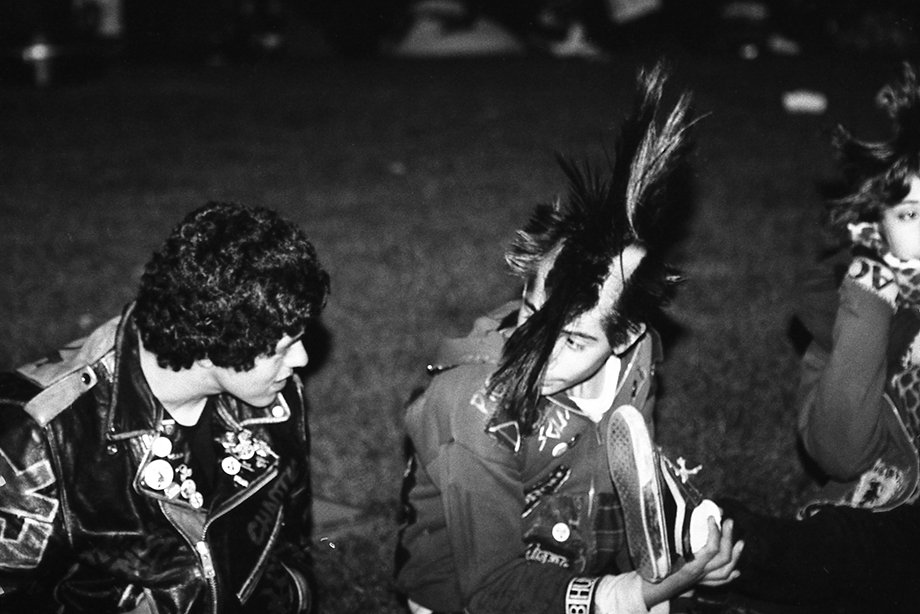
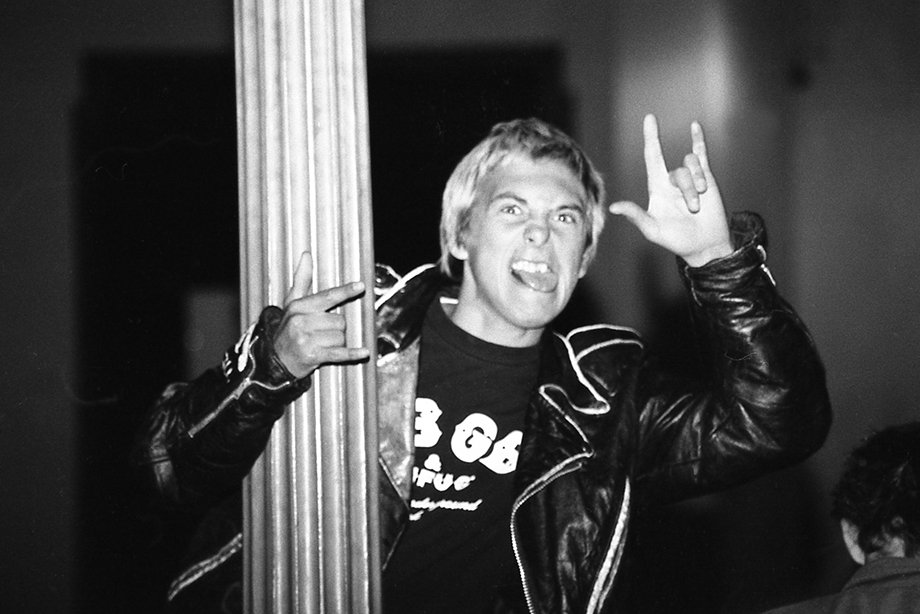
Rockers hanging out at Thomas Square
Julian Lucas ©2000

Published 02/20/204 12:00 am | PST

Did you know that the attack on the Twin Towers occurred 23 years ago, in 2001? That same year introduced us to some of our favorite independent films, such as Amélie, Requiem for a Dream, and Y Tu Mamá También.

Y Tu Mamá También taught us that both self-pleasure and sex with others are acceptable, while also exploring themes of self-discovery and loss. Requiem for a Dream taught us about mental illness wasn’t talked about, including drug addiction as a disease. It also taught us about belonging, wealth, family and the past. And we learned to enjoy life’s simple pleasures in Amelie.

LIFE IN POMONA
Pomona has never fully transformed from its gritty, 1980s South Central ambience into the haven many hoped it would become—and still hope it will one day. Although if we go back to the earlier years it was once a booming city. The city of 155k people even received some publicity being named in multiple films, including films such as the 1967 “Look Whose Coming to Dinner, staring Sidney Portier.

However, the early 2000s were also a boom period—not so much in films, but in hip hop songs that glamorized pimping, "the hoe stroll," and the selling of sex, as popularized by artists like Sugafree.

New York-style lofts in downtown Pomona served as backdrops for porn movies, while strip clubs and “massage parlors”—which were really fronts for rub-and-tug services—occupied storefronts along the corridors.

Although police brutality existed, there weren’t any activists staging rallies or protests on city council nights. The only activism was activism through art. 

Pomona PD frisking an unhoused individual at Veterans Park.
©2001 Julian Lucas

Pomona PD Patrols Second Street on Bike
Julian Lucas ©2001

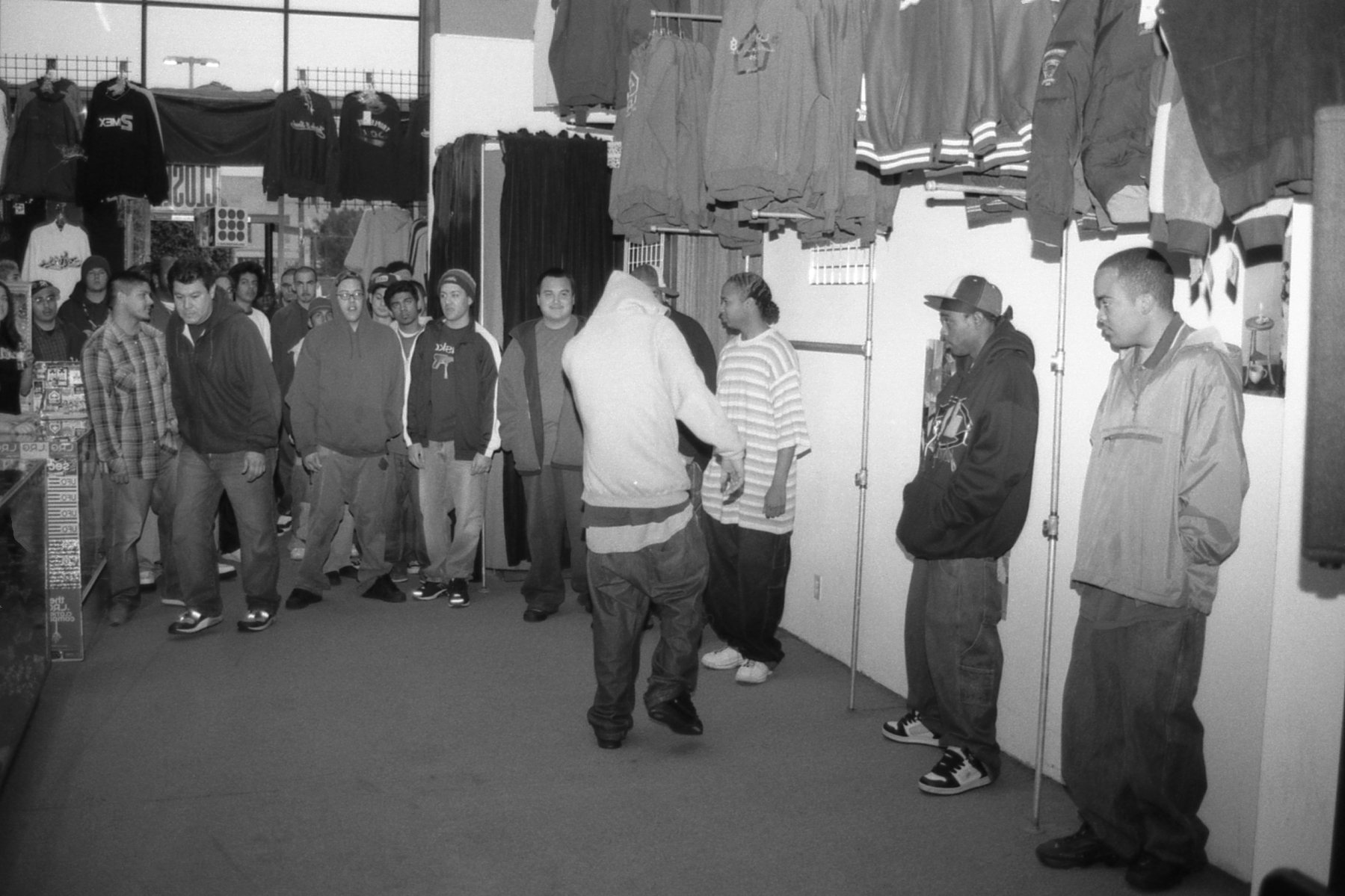
Backpack Hip Hop heads hit Pomona like a domino affect in the early 2000s, but people still wanted to dance, although there weren’t any dance clubs in Pomona, you could still crash someones quinceañera or wedding reception. 

Urban Ecclectic
Julian Lucas ©2002

Globe Clothing Store (in store)
Julian Lucas ©2001

Globe Clothing Store (in store)
Julian Lucas ©2001

Globe Clothing Store (in store)
Julian Lucas ©2001

People Dancing at a Quinceañera
Julian Lucas ©2001

People Dancing at Quinceañera
Julian Lucas ©2001

Quinceañera
Julian Lucas ©2001

Young lady at her quinceañera
Julian Lucas ©2001

Accompanying underground Hip Hop was Rock en Espanol. Tower Records was a haven for CDs and magazines from all over the world and unfortunately closed in 2006. But we could also purchase our music and our studded belts, buttons of our favorite punk band, and band shirts from the Rio Rancho swap meet attached to Cardenas. Tijuana No! and Mana were of my favorites.

Raquel (Rachel) Rio Rancho Mall
Julian Lucas ©2002

El Taco Nazo, El Merendero, and Juan Pollo were the only restaurants in the downtown area. Taco Nazo was special. It was the hangout during the day and at night the restaurant featured poetry night on Thursdays, called A Mic and Dim Lights, hosted by educator Cory ‘Besskep’ Coffer, who is the original poet who brought poetry to Pomona.

Reyna in the kitchen of Taco Nazo 2001

Kayla Owner of Funky Thangz sitting at Taco Nazo 2002

Mike and girlfriend owner of Futures Collide 2001

Rockers hanging out at Thomas Square during Glass House Concert
Julan Lucas ©2001

Rockers hanging out at Thomas Square during a Glass House Concert
Julan Lucas ©2001

Rockers hanging out at Thomas Square during a Glass House Concert
Julan Lucas ©2001

Rockers hanging out at the Glass House
Julan Lucas ©2001

OG Homies
Julian Lucas ©2001

Homies in front of the Armory Building
Julian Lucas ©2001

Today there are rules and rules for artists, there is privatization of public streets and sidewalks, there is conformity, and there is censorship, Pomona’s politicians use art walk nights as their platform, and thats unfortunate. 


Julian Lucas, is a photographer, a purveyor of books, and writer, but mostly a photographer. Don’t ever ask him to take photos of events. Julian is also the owner and founder of Mirrored Society Book Shop, publisher of The Pomonan, founder of Book-Store, and founder of PPABF.

Always Keep Your Back to the Wall: A 1988 Interview Conducted in Two Parts with Former Pomona City Council Member, State Assembly Member and State Senator Nell Soto

Part I:

The Early Years: Growing Up With Segregation in Pomona in the 1920s, 30s & 40s - Neighborhoods, Swimming Pools, Movie Theaters, Public Schools & Jobs.

By Julian Lucas
Edited by Pamela Casey Nagler

Published 8:30 Am PST

Nell Soto

In this interview, conducted by Carlos Vasquez of the UCLA and State Government Oral History Program, Former Pomona City Council Member Nell Soto (1926-2009) talks about  her early days growing up as a Spanish/Mexican girl and young adult,  and, later, describes her days helping her politician husband, Assemblyman Phil Soto in the 1960s. 

Soto was proud that her husband broke race barriers in California politics:

“I think the most significant thing to me was that Phil [Soto’s husband] was one of the first Hispanic legislators. To me, that was very significant. Although he never ran on that banner, as the standard-bearer of anything, it was very coolly and calmly accepted. But we knew that we had broken a barrier— the two of us knew it— that had been there for years;- - I mean, in the whole century of this State, a state that had been founded by and been [part of] Mexico, they had never had a Mexican in the legislature. I think that is still significant, and I would hope that somebody would put that in the history. To me, it’s really very important that people know that.”  (pages 55-6)

She also acknowledged that she would have liked to have run for office herself in the 60s, 70s, 80s, but the time was not right for a woman: “My mother used to say, ‘Why don't you run? Why don't you? That poor guy [Soto’s husband]! You're just making him run! You're always campaigning. Why don't you run it? You're the one that should run.’ I'd say, ‘Ma, people are never going to elect me. This is not the time for women. Women are not going to be elected.’ I would have loved to have run then. I would still love it, to be an assemblyperson, but I'm too old now. That'll never happen.” (47)


However, history proved Soto wrong on this one. She served as an Assembly member between 1998 and 2000, and again in 2006 and 2008. In the interim, she served as a member of the California State Senate. In 2006, she authored legislation that included expansion of the Nell Soto Teacher Involvement program, improving foster care licensing, and improving welfare to work programs.


During Soto’s life, she attended many colleges and loved to study, but poverty, jobs, marriage, babies and politics interfered. She took many business courses because that was expected, but she loved history and English - and loved to write. She talks about attending Mt. Sac in Pomona in the early days:

“A lot of the G.I.'s who came back from the war just went back and enrolled at Mount San Antonio [College]. A lot of us had never gone on to higher education, so we went to school there. That was quite an experience because Mount San Antonio, if you see it now, is a beautiful college campus. In those days it was in army barracks on dirt hills. We had to climb through mud and rain to get to the barracks to our classes, but it was fun.” (3)


Throughout the interview, Soto’s vibrant personality and optimism shines through. Even though she grew up in poverty with the attendant problems of segregation and discrimination, she says,  “It was a fun life because we used to laugh at everything. No matter what happened, we would make fun of things that happened to us. Being so poor, it didn't really matter.” (15-6)

At the end of the interview, she sums up her life in politics when the interviewer asks her, “Of all the lessons that you learned in your political experiences to date, which stands out most in your mind?” She answers, “About politics, either as a woman, as a wife of a politician, or as a principal player?  Always keep your back to the wall.” (107)


Nell Soto Part I: The Early Years: Growing Up in Segregated Pomona in the 20s, 30s & 40s - Neighborhoods, Swimming Pools, Movie Theaters, Public Schools & Jobs

NELL SOTO:  I’m a sixth or seventh-generation Pomonan. I don't know which, but my dad always said we were seventh generation. I've gone back and counted, but he must have known . . . My grandfather [Antonio Marta Garcia] was from the Palomares and Yorba and Veja people who got the land grants here in Pomona. My great-great-great-grandmother [Nelli Garcia] was a Garcia who married into the Palomareses and Vejars. Some of them are buried here in the historical cemetery [Palomares Cemetery]. My great-grandfather [Forestino Garcia] was born here, and so on, all the way back . . . 


The poor people lived on the south side of the tracks . . . The haves lived on the northside of Holt[Avenue] and the have-nots lived on the south side of Holt. Holt is one of the main streets and runs east and west. What always stands out in my mind is that my dad, being a descendant of one of the founding families, should have been treated with a little more dignity. But there was so much prejudice that if you had brown skin or a Spanish surname, there was a lot of prejudice. At the time it wasn't noticed that there was prejudice. It was just understood that the [Mexican] people here became sort of like the servants, the peons. They picked the oranges and the lemons. The "settlers," as they called them, were the Anglos who bought the land, cultivated it, planted oranges, and became very successful citrus growers. The people who lived in Pomona who were Hispanic and had come here in the late 1700s and early 1800s became the labor force. They're the ones who harvested the oranges and lemons. On the outskirts of Pomona and in Chino there was a great agricultural industry. A lot of people from Pomona worked in the fields in Chino . . .” (4-6)


CARLOS VASQUEZ:  When you say discrimination wasn't noticed, by whom was it not noticed? 

Soto: The Anglos.
Vasquez: 
Did you notice it?

Soto:
Oh, yes. (6-7)

Soto: Some people don't like to admit to this—that is, people who are old-timers in Pomona--but Mexicans were not allowed to live on the north side of town.


Vasquez: 
There were restrictive covenants in the selling of homes?

Soto:
There wasn't any [legal] segregation, it was sort of de facto segregation. It wasn't anything that was written. It was just understood that you lived in a certain part of town if you were Mexican. They didn't recognize that you were Spanish, like my dad was. His great-grandmother was from Spain. They didn't recognize it. They didn't really care, and I don't think the dignity that was owed him was given. But he didn't seem to mind. He just went on his way and didn't need them for anything. He just didn't get in their way. My mother never allowed us to be humiliated in that manner. She would say, "No, you don't go there, because you're not wanted. You're not going to go there.”

Vasquez: 
Why were you not wanted at the swimming pool? 

Soto: 
Because we were "Mexicans" even though we were considered Spanish by my parents. They had only one day in which Mexicans could swim.

Vasquez: 
What day was that?

Soto:
I don't remember if it was Monday or Friday, but on that day the pool would be cleaned out at night. Then the Anglo kids would swim. If there was a Mexican child who didn't know the rules and went there, they would just chase him away, ‘No, Mexicans aren't allowed in here.’ The same way in the theaters. There were a lot of places where they wouldn't allow Mexicans. They didn't hire any Hispanics on Second Street until the end of the war.

Vasquez:  What is Second Street?

Soto:
Second Street was where the main shopping [district] used to be. I was one of the first  Hispanlcs to go to work on Second Street. I worked as a salesgirl [at the] National Dollar Store. I'll never forget it, because the man had the courage to give me a job. It must have been 1943 or '44, towards the end of the war. There were only maybe two of us Mexican/ Hispanic girls working on Second Street- At the time my mother used to tell us, “Don't let anybody tell you that you're not as good as anybody else. You go out there and you look for a job. You make them see that you're smart and you can do the job.”  She never really let us believe that we were less than anybody else because we were Hispanic/Mexicans And she used to say, “You're not Mexicans. You just have to remember that. You're not Mexicans as in 'came from Mexico.' You're Spaniards like your father is. You have to remember that.”  My dad was very proud of the fact that he was a Spaniard, a pioneer-native rather than a Mexican. Because he was a Spaniard. But my mother came from Tecate, Baja California. She was very proud of the fact. I could never see myself saying, "I'm Spanish." I always said, "I'm a Mexican."

I didn't see the difference.

Vasquez: 
Now, when the war came along and you went to work in the defense industries, was the composition there pretty reflective of the society? That is to say, was there discrimination there too?

Soto:
In the factory that I worked in in Pomona, there were a lot of Mexican girls from school who went to work there. And there were some Anglos.

Vasquez: 
Was there any pay differential?

Soto: 
No. Not that I knew of. Even my mother worked there, because they needed it. One thing happened which I think is very significant. It's not written in history books, but I think it should be. We moved to the outskirts of Pomona one day, because in those old days, when you were poor, you just kept moving. You moved around a lot.

Vasquez: 
Why was that?

Soto:
Because you just sometimes couldn't afford to pay the rent. You would go two or three months without paying your rent and get evicted-. You’d go find another house for rent. You didn't need a first or last month's rent. You would just need a few dollars and you could move in. We moved to the outskirts of Pomona towards Chino. The Chino school was closer than the Pomona school, so my mother took my little brother and sister there. I didn't want to go there because I was already in high school and wanted to go to Pomona. My mother took the kids to Chino. The schools were segregated. There wasn't any covenant, as you call it, or de facto [segregation]. It was blatant. She took them to the Anglo school [Chino High School]. The principal told my mother that her children couldn't go there because they were Mexicans. 

She asked, “Why? My children are Americans.”

He said, "No. No, they're Mexicans and they can't go here."

She said, ‘Okay, will a bullet go around my son should he go into the service? Since he's a Mexican, is the bullet going to go around him? . . . I want you to answer that. He's an American. He's going to be fighting for his country. Is a bullet going to go around him? Or is it going to stop with him just like it does with the other kids?’

Vasquez: 
What answer did she get?

Soto:
Nothing. He let the kids in . . .

So I used to tell my mother afterwards, during the days of the civil rights movement and everything that was going on, I'd say, ‘Mom, you don't even realize that you were a pioneer in integration, because of what happened in Little Rock [Arkansas] and so forth.’ . . . I said, ‘You know, you were probably one of the first people that had the nerve to stand up to people who were segregating children.’ 

I wish that somebody would have been there to record that, because it was very significant around here. Nobody had the nerve to stand up to those people. And she did. She called him a dirty name.

She said [whispers], ‘You sonuvabitch, is a bullet going to go around my son?’ (7-11)


Julian Lucas, is a photographer, a purveyor of books and writer in training, but mostly a photographer. Julian is the founder of Mirrored Society Books. Julian was once called a “bitter artist” on the Nextdoor app. Julian embraces name calling, because he believes when people express themselves uncensored, they are their most creative self.

Pamela Casey Nagler, Pomona-born, is an independent scholar, currently conducting research on California’s indigenous people, focusing on the Spanish, Russian, Mexican and US invasions between 1769 and the 1860s. The point of studying this history is to tell us how we got here from there.