Victor Preciado

Who Is Funding Pomona’s District 2 Council Race?

Pomona District 2 campaign funding

Reported itemized monetary and nonmonetary contributions through June 30, plus late-contribution reports through August 28, 2026.

The candidates, Jacky Elizalde and the incumbent Victor Preciado campaign filings reveal two very different fundraising operations, and one contribution that is deserving of a disclosure.

We understand that money does not cast a ballot, but its always been the storyteller within politics. In Pomona’s District 2 City Council race, incumbent Victor Preciado and challenger Jacky Elizalde are financing their campaigns through noticeably different networks of supporters.

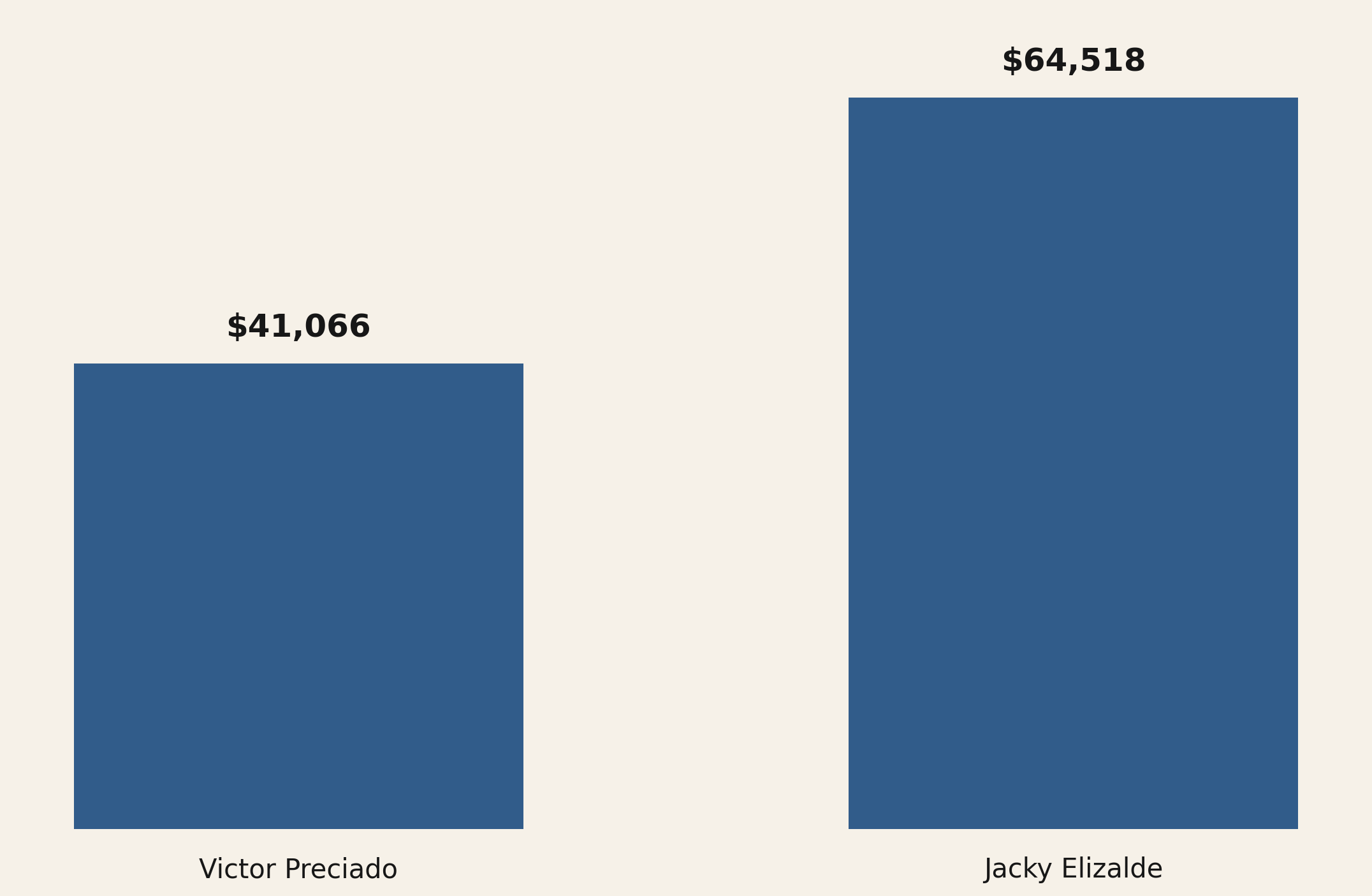
After a review of itemized contributions reported through June 30, along with late-contribution reports filed through August 28, shows approximately $41,066 in monetary and nonmonetary contributions reported by Preciado’s committee and approximately $64,518 reported by Elizalde’s committee.

While these figures do not necessarily represent each campaign’s complete fundraising total, they provide us with a story of who is investing in each candidate. Also understand they are calculated from itemized transactions in Pomona’s campaign finance database and do not include every small, unitemized contribution, loan or independent expenditure.

Victor Preciado, Incumbent

The incumbent, Preciado, has a contributor list that is a mixture of Pomona residents, local business interests, organized labor, political and figures.

Preciado’s filings also include individuals connected to local nonprofits. Emily Dolce is the executive director of The Common Good LA. Christian Verdugo is president of the 909 Market Foundation and Holly Reynolds is an educator at Bright Prospect. Bright Prospects was founded by Mayor Tim Sandoval.

The contributions came from the individuals, not their organizations. That distinction matters because a 501(c)(3) cannot legally contribute to a political candidate, but the people operating the non-profit can. 

Several of Preciado’s individual contributors are connected to nonprofits that have received public funds through the city of Pomona. The filings show who contributed money. So what does this connection mean? 

His largest reported contributor is the Laborers Local 300 Small Contributor Committee, which gave $2,750. United Food and Commercial Workers Union Local 1428 contributed $2,000.

Other substantial contributors include Metro Event Center at $1,800, All Sports Hospitality LLC at $1,500, Ana Preciado at $1,500, Marisol Ramirez at $1,250 and 24 Hour Laundry Inc. at $1,250.

Several contributors gave approximately $1,000, including Miguel Sanchez, Sergio Gomez, Laura Mundy, Rick Albertini, Michael Preciado, Stein Team Realty and Thomas “Tom” Hsieh.

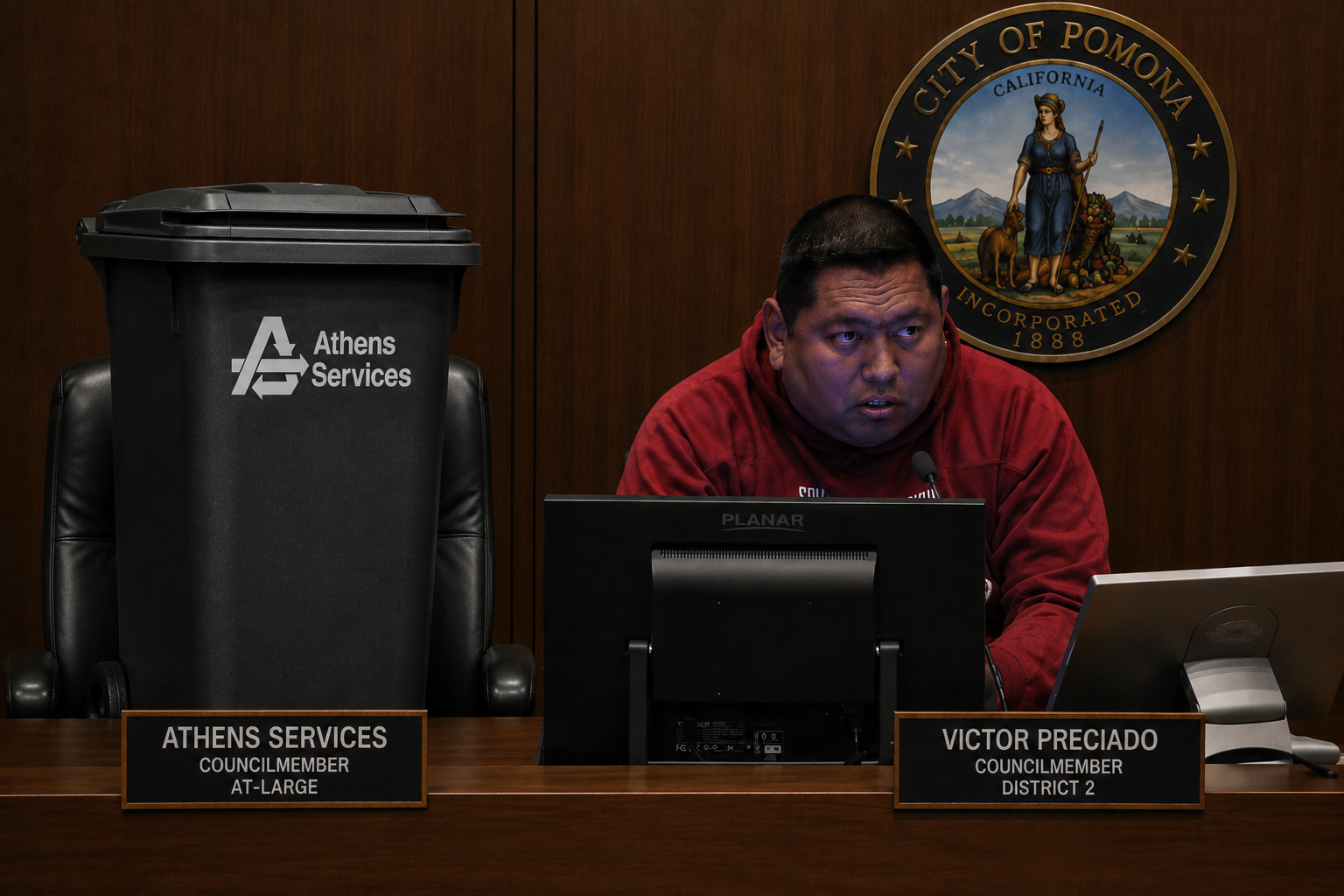
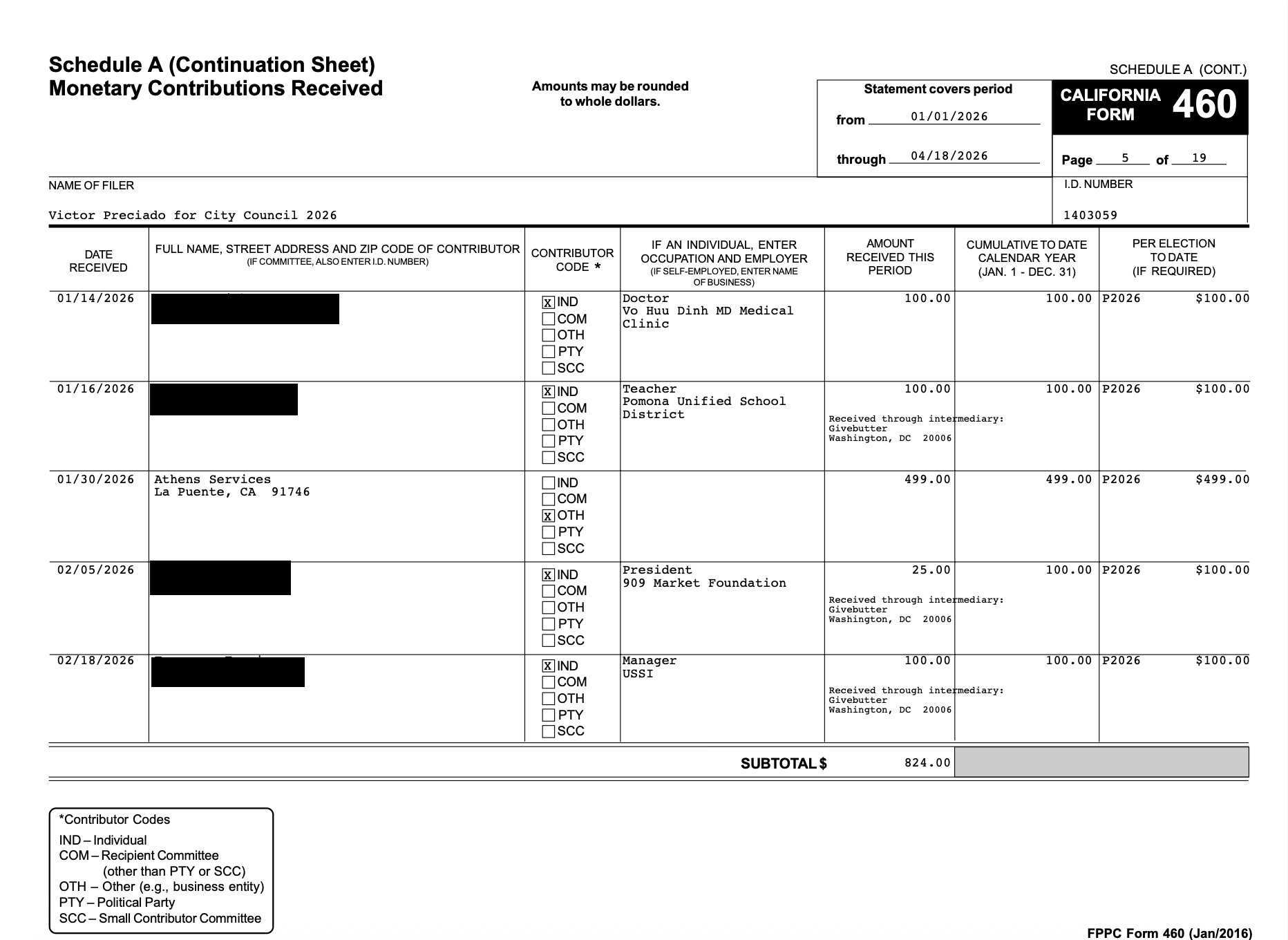
Another contributor we all are aware of from our previous reporting was Athens Services, which gave Preciado’s campaign $499 on January 30, 2026. Athens holds Pomona’s exclusive franchise for residential and commercial trash collection under an agreement awarded by the City Council. Of course the contribution does not establish that Preciado gave Athens favorable treatment. But when a company doing business with the City contributes to a sitting councilmember, that relationship belongs in front of voters, not hiding behind the garbage can with its wheels and ass sticking out.

Athens is not the only corporate private business appearing in Preciado’s filings. Additionally, Preciado’s cute collection of contributors include businesses and people connected to real estate, hospitality, development and other commercial interests, although much of his money also comes from individual donors and organized labor. But these contributions do not tell or prove that anyone purchased influence. But corporations do not need Pomona City Hall to rewrite the federal tax code. But what they do need is the approvals of contracts, developments, franchises, fees and policies that can affect their bottom lines.

Approximately $24,134 of Preciado’s reported itemized contributions came from contributors with Pomona addresses. Roughly $16,932 came from “out-of-town”. And to think Measure Y was given such a hard time for receiving “out-of-town” money. Hypocritical? However, that does not make every local contribution more virtuous. It is just the insular suburban mindset. “Out-of-town” money is suspicious when it fits the narrative and perfectly acceptable when it does not. Preciado’s financial base is mostly local, but it is hardly confined to Pomona.

Preciado also benefited from a whopping $2,250 independent expenditure reported by none other than the “po-po”—or “One-Time”—or “5-0”—or “the fuzz,” depending on which generation you belong to, but also known as the Pomona Police Officers Association Political Action Committee. Independent expenditures are not contributions to a candidate’s committee and are legally supposed to be made without coordinating with the campaign, but voters should still know when an outside organization spends money supporting a candidate.

Jacky Elizalde, Challenger

Elizalde has reported more itemized contribution money, but her fundraising base is much more heavily concentrated among labor organizations and contributors outside Pomona.

The largest amounts reported under her committee include $7,000 from Plumbers and Steamfitters U.A. Local Union 398, $5,900 from the Los Angeles County Firefighters Local 1014 Legislative Fund Committee and $5,900 from the UA Journeymen and Apprentices Local 250 PAC.

The IBEW PAC Educational Fund contributed a reported $4,000. Western States PAC contributed $3,000. Other substantial contributors include the Service Employees International Union Local 121RN Health Care Fund at $2,950, Superior Duct Fabrication at $2,950 and the United Firefighters of Los Angeles City Local 112 PAC at $2,500.

After June 30, Elizalde reported another $2,950 from the Apartment Association of Greater Los Angeles PAC, $1,000 from the International Brotherhood of Electrical Workers Local Union 40 PAC and $1,000 from the Sheet Metal, Air, Rail and Transportation Workers Local Union 105 Political Education Fund.


Approximately $9,021 of Elizalde’s itemized contributions reported through June 30 came from contributors with Pomona addresses. Approximately $50,547 came from outside Pomona. Her three late contributions reported in August, totaling $4,950, also came from organizations based outside the city.

Again, geography does not settle whether a contribution is good, bad or delivered by a hood pigeon. Labor organizations routinely support candidates in local elections because city governments make decisions affecting public works, development, employment and contracting. But the concentration is still relevant. Elizalde’s campaign is receiving significant financial support from organized labor beyond Pomona’s borders.

However, to be clear, union support is not something dirty. Unions are supposed to fight for workers, including at the ballot box. The point is not that Elizalde accepted union money. The point is that voters should know who is funding her campaign.

Her filings also complicate any attempt to place the candidates into tidy political boxes. Alongside union support, Elizalde received money connected to real estate and apartment interests, including Mark Warren Realty and Investments, Indian Hills Ltd., doing business as Villa Del Sol, and the Apartment Association of Greater Los Angeles PAC. Pomona politics, as usual, declines to organize itself into a convenient screenplay.

Among Preciado’s contributors is Stein Team Realty, which gave his campaign $500 on November 14, 2025, and another $500 on April 8, 2026, for a total of $1,000.

The company is associated with Mitchell Stein, creator of The Pomona Bulletin, a shiny, ambitious real estate pamphlet with an accompanying Facebook group created in 2023. Somewhere along the journey, that Facebook group also became an editorial board. Interestingly enough, another Facebook group called Pomona Bulletin had already existed. It was created by challenger Jacky Elizalde in 2019. In the Hip Hop world, creating a new Facebook group with the same name in 2023 is called biting, or being a biter. Translation: copycat. 

Additionally, Stein’s relationship with Preciado goes beyond the $1,000 campaign contribution. Stein publicly identifies himself as a co-founder of Collective Acción, a Pomona-based 501(c)(3). A post in Stein’s Pomona Bulletin group also credited Preciado’s “shared effort to create” the nonprofit. So the person calling on Elizalde to withdraw was not simply commenting from outside the friend group. He was Preciado’s donor and had publicly credited Preciado with helping create the same nonprofit.

Anyway, the group later published an editorial calling on Elizalde to withdraw from the District 2 race because of her attendance record on the Parks and Recreation Commission. The editorial did not disclose Stein Team Realty’s $1,000 contribution to Preciado, the candidate who would benefit from Elizalde’s withdrawal.

That contribution does not automatically invalidate the attendance criticism. Elizalde’s missed meetings remain fair grounds for scrutiny, and she owes voters a clear explanation of her record.

But the financial connection should have been disclosed. Readers deserved to know that a business associated with the person making the argument had contributed to the opposing candidate.

Apparently, the attendance record deserved a full editorial. The campaign contribution could not find its way into a footnote.

The filings do not prove that contributors control either candidate. A campaign donation is evidence of financial support, not evidence of a secret agreement, promised vote or political conspiracy.  

What the records show is not a tidy contest between corporations and working people. Preciado’s financial consortium combines local residents, private businesses, property interests and organized labor. Elizalde’s campaign relies much more heavily on unions and other organizations outside Pomona, although apartment and real estate interests appear in her filings as well. One campaign is more locally dispersed. The other is more institutionally concentrated.

District 2 voters can decide which fundraising model concerns them more, or whether either one concerns them at all. They can ask Preciado what his contributors expect from his continued service. They can ask Elizalde how she will remain independent of the organizations investing heavily in her campaign.

They can also expect political commentators to disclose their own financial relationships before ordering a candidate to leave the race.

Campaign-finance filings rarely deliver a dramatic confession. Mostly, they deliver names, dates and dollar amounts. The interesting part begins when those details are placed beside what Pomona’s political voices choose to say—and what they quietly leave out.


Julian Lucas is a darkroom photographer, writer, and bookseller, though photography remains his primary language. He is the founder of Mirrored Society Book Shop, publisher of The Pomonan, and creator of Book-Store and Print Pomona Art Book Fair. And he will charge you $ 2.5 million for event photography.

Who Speaks for District 2?

Victor Preciado and Jacky Elizalde are campaigning to represent Pomona City Council District 2. Here is what they are emphasizing, and how residents can participate in The Pomonan’s reader poll.

Pomona voters will return to the polls on November 3 to decide who represents District 2 on the City Council.

Incumbent Victor Preciado and challenger Jacky Elizalde advanced from the June primary. Preciado received 1,154 votes, or 45.38 percent. Elizalde received 840 votes, or 33.03 percent. Samantha Zavala-Angulo finished third with 549 votes, or 21.59 percent.

Neither remaining candidate is presenting the race as a dramatic ideological break. Both are campaigning on familiar municipal concerns: public safety, housing, infrastructure, city services and opportunities for young people. The differences may be found less in the subjects they discuss than in their experience, priorities and proposed approach to governing.

Preciado is the incumbent and has served on the Pomona City Council since 2018.

His campaign points to work involving parks, neighborhood infrastructure, food distribution, small-business assistance and youth mentorship. For another term, Preciado says he wants to continue focusing on transportation and infrastructure, expand housing opportunities—including affordable and inclusionary housing—and support programs for young people.

Elizalde is challenging Preciado with a campaign centered on public safety, reliable city services and greater fiscal accountability.

Her stated priorities include addressing homelessness and human trafficking, improving housing affordability, supporting seniors and young people, encouraging economic development and expanding after-school programs. Elizalde has also emphasized transparent, measurable city spending and identifying additional revenue before considering higher taxes. Which candidate currently has the support of The Pomonan’s readers?

This is an informal, voluntary reader poll. It is not a scientific survey or an election forecast. Respondents are not independently verified as registered voters or District 2 residents, and the results should not be interpreted as representative of the District 2 electorate.


The Pomonan will continue following the candidates and the issues shaping the race before Election Day.

Vote here


The Pomonan editorial board consists of opinion journalists whose perspectives are shaped by their expertise, research, discussions, and established principles. This board operates independently from the newsroom.

The Municipal Romance of Trash, Trucks, and Campaign Cash

A campaign contribution from Athens Services is reopening old questions about privatization, infrastructure, political alliances, and who Pomona believes City Hall ultimately serves.

Editorial illustration by The Pomonan

There are only a few things less glamorous than garbage. It sits outside quietly in black and blue containers, rolled toward the curb once a week with the expectation that it disappears before the next morning. Most residents do not think about sanitation contracts, transfer stations, hauling agreements, or municipal privatization until something changes. But when the bill jumps. A service changes. A truck appears more often than it used to. Then suddenly, garbage becomes political.

And of course, in Pomona, where politics increasingly feels trendier than the restaurants, galleries, and art itself, trash had already become a political issue long before campaign season arrived. 

For years, residents, business owners, and city observers have argued over the city’s relationship with Athens Services, the private company tied to Pomona’s controversial waste collection transition. Some defended the move as modernization. Others viewed it as another example of a city steadily outsourcing pieces of itself while residents were left absorbing the consequences in real time.

Now there's an issue that has entered the campaign season directly. Public campaign finance filings for Victor Preciado’s 2026 reelection campaign show a $499 contribution from Athens Services dated January 30, 2026. Preciado is not a neutral observer in Pomona’s trash debate. As an incumbent councilmember, he sits inside the same governing structure that defended and normalized the city’s relationship with Athens while residents and businesses continued raising concerns about cost, accountability, and transparency. 

The amount itself is not a 5 million dollar lottery ticket. In California politics, $499 barely qualifies as eyebrow raising. But local politics operates differently than Sacramento or Washington. In municipal elections, symbolism often matters more than scale. Residents do not experience city government through million dollar lobbying campaigns. They experience it through potholes, homicides (unless the cops are not reporting) warehouse fires, zoning decisions, abandoned buildings, police response times, parks, and trash bills. That is why the contribution matters.

Not because it proves corruption. It doesn’t. Campaign donations are legal and happen all the time. But when a company tied to one of the city’s most controversial contracts starts donating to elected officials during election season, people are naturally going to question how close City Hall has become with the same companies doing business with the city. 

The Athens debate never really ended in Pomona because it was never just about trash pickup. It has always been about control.

Residents watched the city transition away from a municipal service structure toward privatization while being told efficiency and improvement would follow. Instead, many businesses complained about increased costs. Residents questioned accountability. Illegal dumping remained visible in  parts of the city. And politically, the issue lingered in the background like the smell residents insist they notice even when officials pretend not to.

Meanwhile, parts of Pomona continue carrying the physical burden of the region’s infrastructure economy. District 3 remains surrounded by warehouses, truck routes, industrial land use, and the waste transfer station itself, where the movement of garbage becomes part of the neighborhood landscape rather than an invisible municipal function hidden safely elsewhere.

This is where Pomona’s politics become revealing. 

The city often speaks about growth abstractly, but growth always lands somewhere physically. Warehouses land somewhere. Heavy truck traffic lands somewhere. Waste infrastructure lands somewhere. Rarely are those burdens distributed evenly across the map. Some neighborhoods become corridors. Others become destinations.

And once residents begin seeing those patterns, every campaign contribution starts carrying a little more meaning than it otherwise might.

The current election cycle is already exposing tensions inside Pomona’s political culture. Challengers are openly discussing council voting blocs, predictable alliances, and decisions that residents increasingly believe are settled before meetings even begin. Questions about transparency, consent agendas, and political alignment are surfacing more publicly than they have in years.

The Athens contribution enters that atmosphere at precisely the wrong time for incumbents hoping the trash debate had faded quietly into administrative history. Because residents remember.

They remember the transition. They remember the arguments. They remember who defended the contract and who questioned it. More importantly, they remember that one of the most basic services in city life became a symbol for something larger. The feeling that decisions affecting everyday people are often negotiated far above them, then delivered back down as inevitabilities.

The problem for incumbents like Victor Preciado is not simply that residents noticed the contribution. It is that many residents already believe City Hall has grown too comfortable operating within a small political orbit where contractors, council alliances, and major city decisions increasingly overlap.

And that is the danger for Pomona’s political establishment heading into 2026. Not the contribution itself. The timing.

Because once infrastructure, campaign finance, district frustration, and public distrust begin entering the same conversation, local politics stops feeling procedural. It starts feeling personal.

Garbage has a way of doing that.

Investigative Report: Did Current City Council Members Victor Preciado and Steve Lustro Properly Disclose the Campaign Contributions they received from Pomona Police Officers' Association in 2018?

During the 2018 election cycle, the Pomona Police Officers Association PAC (PPOA) made campaign contributions to three Pomona City Council candidates for around $9,000 each - Victor Preciado, Steve Lustro, Christina Carrizosa. Preciado and Lustro won their election that year and are currently sitting members of Pomona’s City Council today.

In recent days, it has come to the attention of the Pomonan editorial Board that these campaign contributions were not properly reported.

In the fall of 2018, the PPOA paid more than $41 thousand to the Freedman Public Affairs for mailers to support the campaign of Victor Preciado, Steve Lustro, who won their election, and Christina Carrizosa, who lost hers.

According to CalAccess, District 2 council member Victor Preciado received a total of $9,689.12, and District 5 council member Steve Lustro received $9.396.56 from the PPOA through contributions and late independent expenditures.

Before assuming office on Dec. 3, 2018, both officials filed a California Form 700, also known as Statement of Economic Interests form, but neither reported the amount received from the PPOA. The form is meant to prevent decisions made by public officials from being influenced by their personal financial interests.

Pomona Ordinance No. 4298 states any person holding a position in Government Code Section 87200 needs to file any required Statement of Economic Interests report online or electronically with the City Clerk.

The PPOA made 83 donations to Preciado’s campaign and 72 donations to Lustro’s campaign of different totals ranging from $72.54, $27.67, $26.86, $1,436.07 and $678.59 from Sept. 2018 through Nov. 2018.

On his 700 form, Preciado reported his salary working with the Kellogg Company and from the San Gabriel Valley Conservation Corps as in the range from $1,001 to $10,000, but did not report the amount donated to his campaign by the PPOA.

Lustro did not report any of the donations from the PPOA or any other salary that might influence his decision making. See both Form-700

Under the Pomona City Code, Article II, Sec. 10-34, it stated that a candidate shall not solicit or accept any contribution which will cause the total amount contributed by such person with respect to a single election in support of or opposition to a candidate that exceeds $500.00.

However, Section 10-36 of the same code states that all contributions, including campaign contributions, exceeding $25 needs to be reported.

During the same election, the PPOA also made 72 donations that equated to $9,449.49 to the campaign of Council member Christina Carrizosa of District. Carrizosa was currently on the Council at the time, but lost her position to current Pomona City Council member, Nora Garcia.

The Police Oversight Starts Today (POST), a coalition of Pomona and area residents, filed a complaint with the Fair Political Practices Commission in Aug. 2021 claiming the PPOA caused a conflict of interest when it donated sums of money to certain council members and not equally to every potential candidate.

Council member Preciado, recently contacted, said he wasn’t aware of the money. He also stated that, the form does not need to have that kind of payment on it: 

“While [the PPOA] have to state who they are using it for, they actually can’t legally coordinate or talk to the candidate about it. In this example I wasn’t aware of this expenditure or what they used it for.”

To date, Pomona city council member Lustro has not responded to this reporter’s request for comment.