Measure Z

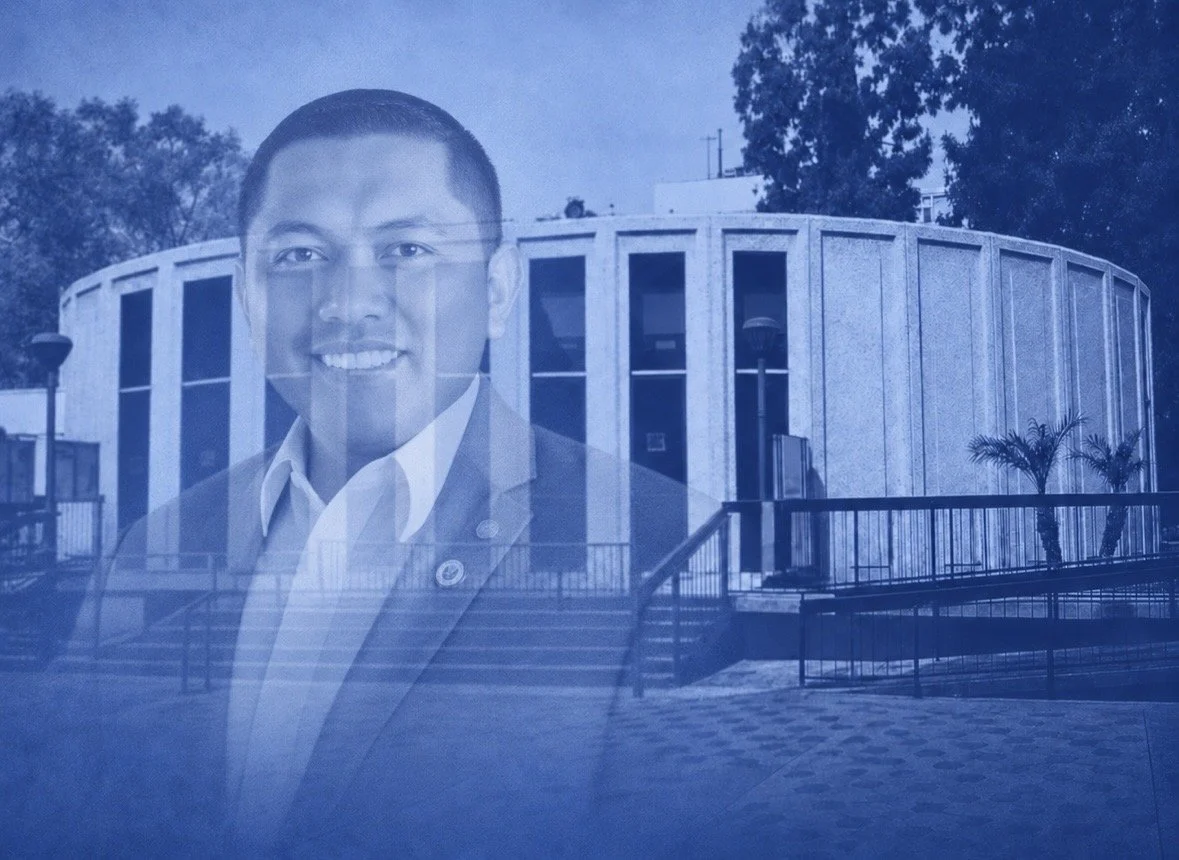
Victor Preciado Wants Four More Years. District 2 Has a Record to Judge

The incumbent, Victor Preciado is campaigning on neighborhood improvements and community work. The question is what another term would deliver.

Victor Preciado’s campaign website calls its accomplishments section “The Receipts.” After nearly eight years on the Pomona City Council, that is a reasonable place to start.

First elected in 2018, Preciado is asking District 2 to keep him in office against a familiar opponent: Jacqueline “Jacky” Elizalde. Their November 2022 race ended with 1,216 votes for Preciado and 1,109 for Elizalde. He won by 107 votes. District 2 has already demonstrated that keeping him is an argument, not a formality. [1][2]

Preciado’s political identity rests heavily on neighborhood work. ActiveSGV, which honored him in 2022, described his involvement in pandemic grocery deliveries and the monthly CommUnity Pull Up resource fairs. Its account credited volunteers and community organizations alongside the councilmember. The work extended beyond an election-season appearance. [2]

That record gives voters something concrete to assess: whether those services reached them, whether they continued and whether City Hall became easier to deal with.

His reelection campaign highlights park improvements and street repairs. Its next-term priorities include affordable housing, transportation and youth mentorship. These are familiar municipal promises. An incumbent has to explain what remains unfinished and why another four years would change it. [3]

In an Inland Valley Daily Bulletin candidate questionnaire, Preciado called affordability the top issue facing District 2. He supported increasing housing supply for renters and prospective homeowners, backed modern logistics projects that meet higher environmental standards while opposing unchecked warehouse expansion, and said City resources should not be used to assist federal immigration enforcement. The positions are clearer than the broad themes on his campaign site, although they still leave questions about the ordinances, funding and votes he would pursue. [10]

Preciado also represents Pomona on Foothill Transit’s governing board. That gives him a regional role in a service residents depend on to reach work, school and appointments. Voters can reasonably ask which service improvements he intends to pursue and how he would measure success. [4]

His campaign’s language sometimes gives him personal credit for public work. The park claim is especially broad: the site says he revitalized every park in District 2. Voters should be able to match that claim to individual parks, completed work and funding sources. A councilmember can help advance a project; staff, taxpayers, outside agencies and the rest of the council also have roles. [3]

The next term needs an explanation of its own: which repairs remain, which housing proposals he would bring forward and what residents would receive that they are not receiving now.

Community events can be useful public service. Residents also need a government that answers between events, explains its decisions and makes its spending understandable. An incumbent asking for another term should be prepared to discuss both.

His campaign donors include a company that does business with the City. As The Pomonan previously reported, Athens Services contributed $499 to Preciado’s campaign on January 30, 2026. Athens holds Pomona’s exclusive franchise for residential and commercial trash collection. The company residents pay to haul their trash also helped finance the incumbent’s reelection campaign. [5]

His record also includes votes for Flock cameras. On December 18, 2023, Preciado joined a 7–0 vote accepting an $860,000 state grant and authorizing a sole-source lease of Flock cameras and related services. On September 16, 2024, he joined a 6–0 vote authorizing another Flock camera purchase of up to $500,000; Councilmember Robert Torres was absent. Both actions were approved through the consent calendar. [6][7]

On February 23, 2026, Preciado also joined the 7–0 vote adopting Resolution No. 2026-22, placing a proposal to amend Measure Y before voters in June. That proposal became Measure Z. It sought to repeal the youth funding measure’s Charter provisions and replace them with Municipal Code provisions. His campaign emphasizes youth mentorship; his record also includes voting to put that rewrite on the ballot. [8][9]

Preciado’s case for reelection rests on work he can point to and relationships he has built. District 2’s decision is whether that record adds up to enough—and whether his next-term plans are specific enough to warrant four more years.


REFERENCES

1. Los Angeles County, November 2022 final official election results, page 85.

2. ActiveSGV, August 31, 2022 award profile. This is an award citation from an organization recognizing him, rather than an independent audit of his record.

3. Victor Preciado campaign website. Accomplishments and future priorities attributed to the campaign are campaign claims.

4. Foothill Transit governing boards.

5. The Pomonan, Who Is Funding Pomona’s District 2 Council Race?. Previously published reporting identifying the Athens contribution and franchise relationship.

6. December 18, 2023 final City Council minutes, pages 2–3 and 5–6: attendance, consent-calendar vote and Item 7, Resolution No. 2023-239.

7. September 16, 2024 final City Council minutes, pages 2 and 8: attendance and Item 5, Flock purchase authorization.

8. February 23, 2026 final City Council minutes, pages 2 and 9–10: attendance and Item 13, Resolution No. 2026-22.

9. City of Pomona, Measure Z, identifying Resolution No. 2026-22 as the measure text.

10. Inland Valley Daily Bulletin, May 5, 2026, Preciado primary-election candidate questionnaire.


Editor’s note: The Pomonan invited both District 2 candidates to submit an op ed or participate in a written interview. Neither responded by the stated deadline. Their positions are drawn from public records, campaign materials and published questionnaires.


The Pomonan is an independent publication of essays, criticism, photography, and cultural commentary.
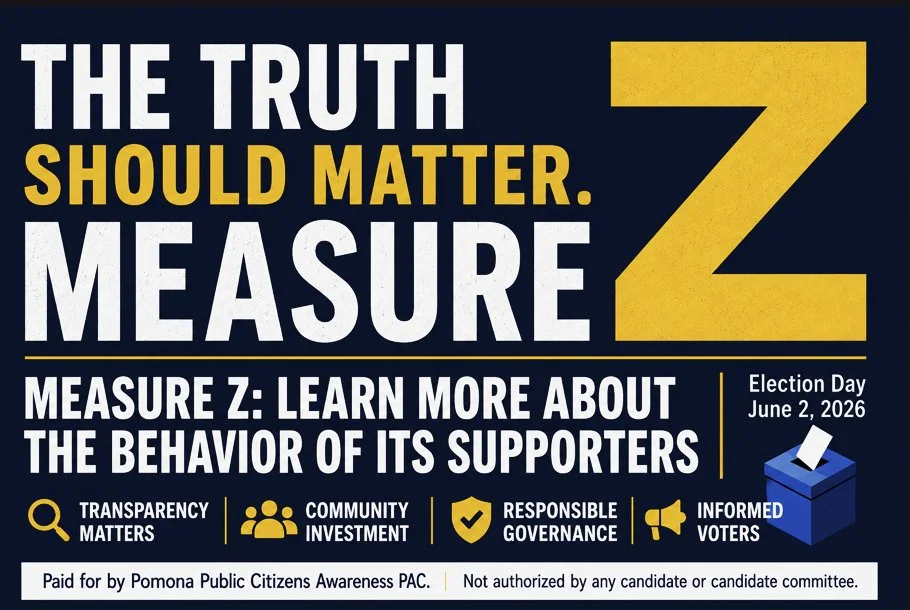
Measure Z: Learn More About the Behavior of its Supporters

Pomona politics has always had an oddly territorial quality to it. After a while, you begin noticing a kind of hyper-local identity bubble surrounding parts of Pomona’s culture, where social belonging, familiarity, and longtime relationships often matter as much as the actual issues being debated.

The public reaction surrounding Measure Z has exposed that dynamic in ways that go far beyond budgeting or youth funding.

At first glance the debate appears to be about budgeting. Youth funding versus city services. Fiscal responsibility versus protected investment. But spend enough time watching the social media conversations unfold and another pattern starts emerging underneath the numbers. The debate quickly stops being about policy and starts becoming about legitimacy. Suddenly the real question becomes, who is actually allowed to speak for Pomona? 

Support Measure Y publicly and watch what happens. Where do you live? How long have you lived here? Are you a home owner, or just a renter? Who do you work for? Are you connected to outside organizations? Do you actually understand the city? Did you even read the measure correctly? Are you really a concerned resident or just somebody pushing another agenda? Residents defending youth investment increasingly find themselves having to explain their community ties, backgrounds, volunteer history, employment, and even family roots simply to participate in the conversation without suspicion.

That reaction is revealing. Because healthy civic disagreement usually focuses on the policy itself. The insular community prioritizes social belonging over outside connection.

And once a city begins treating political disagreement like possible infiltration, the conversation shifts into something much deeper than budgeting.

And the language surrounding Measure Y has repeatedly drifted into exactly that territory. Opponents regularly describe supporters as influenced by “coastal elites,” outside organizations, Northern California money, or people who supposedly do not understand the consequences of what they voted for. One of the more revealing arguments circulating publicly is the claim that the only reason Measure Y passed was because average voters “didn’t understand” the impact it would have on the city.

That is an extraordinary thing to say about your own electorate.

Because once you frame voters as uninformed, manipulated, or emotionally misled, every supporter of the measure becomes politically suspect by default. Support for youth investment no longer appears as a legitimate civic position. It becomes evidence of confusion, outside influence, or ideological capture.

At times the reaction begins resembling the same insulated political behavior visible throughout national politics, where disagreement itself becomes treated as evidence of infiltration rather than a normal part of democracy.

And that is where the conversation starts revealing deeper anxieties inside Pomona’s political ecosystem.

For decades the city has comfortably operated through overlapping relationships between nonprofits, political figures, consultants, developers, commissions, unions, business interests, and civic organizations. None of that was ever treated like some dangerous outside invasion threatening the soul of Pomona. The city absorbed years of redevelopment promises, consultant culture, politically connected projects, and uneven reinvestment without this level of existential panic.

In cities this insular, even the self-proclaimed “only” local media (LOL) eventually stop functioning like independent observers and start sounding like extensions of the same political social circles protecting each other from criticism. 

There is also something almost performative in the way fiscal responsibility suddenly enters the conversation once youth funding becomes structurally protected. Pomona residents spent years watching warehouses spread across the city, expensive revitalization promises come and go, consultant studies pile up, executive compensation rise well into the hundreds of thousands, and politically connected development culture operate with relatively little public hysteria about bankruptcy. Public salary databases already show multiple city positions with total compensation reaching deep into six figures. Yet once the discussion shifts toward guaranteed investment in young people, the language immediately becomes apocalyptic. Suddenly the city is supposedly standing at the edge of collapse. That contrast is difficult to ignore.  

But Measure Y triggered something different.

Another revealing argument repeated throughout the debate is the insistence that Pomona already has youth programs. But that response unintentionally exposes another layer of the conflict. The issue was never whether young people receive absolutely nothing. The issue was who controls the investment, how protected it remains over time, and whether funding stays dependent on the same familiar institutional networks already embedded within the city’s political culture. Symbolic support feels comfortable when it moves through existing relationships. Structural obligation feels different.

Because unlike symbolic campaign promises about helping youth “someday,” Measure Y attempted to structurally protect funding outside the normal rhythm of political discretion. And once public money becomes structurally protected, the old political comfort zone starts changing. Future councils lose flexibility. Institutional networks lose leverage. The familiar relationship between speeches, priorities, and spending begins shifting away from personality-driven politics and toward obligation.

That is why the reaction feels so emotionally charged.

The fear is not simply about numbers on a spreadsheet. The fear is about losing control over the narrative of who gets to define Pomona’s priorities moving forward.

And honestly, that is why so much of the debate has started sounding strangely territorial. The rhetoric repeatedly circles back toward authenticity, belonging, and ownership over the city itself. Who is a “real” Pomonan? Who understands the city properly? Who gets trusted automatically? Who has to prove themselves first?

What makes the reaction especially revealing is how tightly parts of Pomona’s political culture now operate through identity, loyalty, and social belonging. “One Pomona,” a phrase heavily promoted over the years as a vision of unity, increasingly begins functioning less like a civic ideal and more like a political social circle with a strangely cult-like relationship to disagreement. Once that happens, disagreement itself becomes treated as betrayal.

Once that happens, criticism no longer feels like ordinary democratic conflict. It feels personal. Outsiders become suspicious. Dissent becomes disloyalty, and the name calling begins among grown-adults. And support for structurally protected youth funding suddenly gets interpreted as an attack on the city itself rather than a policy disagreement between residents.

Those questions now appear almost as often as discussions about the actual measures.

The irony is that cities do not survive by becoming socially sealed ecosystems suspicious of every unfamiliar voice or political coalition. Cities evolve through participation, disagreement, demographic change, migration, organizing, experimentation, and new generations demanding different priorities than the ones before them. Pomona itself has always been shaped by outside forces, regional economics, state policies, transportation systems, labor migration, development interests, and cultural change. The idea that the city exists as some isolated political island untouched by outside influence has never really been true.

But insular political cultures often respond to change by tightening social boundaries instead of widening civic conversation.

And that is exactly what parts of Pomona have revealed. 


Julian Lucas is a darkroom photographer, writer, and a bookseller, though photography remains his primary language. He is the founder of Mirrored Society Book Shop, publisher of The Pomonan, and creator of Book-Store and Print Pomona Art Book Fair. And yes he will charge you 2.5 Million dollars for event photography.

The Establishment Learns to Speak Activist

Pomona survived warehouses, consultant culture, infrastructure upgrades, privatization deals, and endless promises of revitalization. But somehow protected youth funding is where the city suddenly discovered fiscal panic.

Photography Julian Lucas ©2021

For years, Pomona’s political establishment treated young people the way cities often do, as symbolism. Scholarship photos. Ribbon cuttings. Nonprofit brochures. Election season speeches about “the future.” Everyone loves talking about youth investment as long as the investment remained flexible, manageable, and safely dependent on whichever city council happened to be in power at the time. Then Measure Y passed, and suddenly the same institutional culture that comfortably survived warehouses, mis-match hodgepodge development, privatization deals, consultant culture, and selective reinvestment discovered a deep existential fear about fiscal responsibility. And all of a sudden everyone in the establishment has become an activist.

The city has begun to speak the language of “community.” The Pomona Police Association is now speaking the language of “protecting youth.” The same political culture that spent years approving truck corridors, privatization agreements, endless consultant studies, and development patterns that somehow always seemed to benefit everybody except the people already living here now appears deeply worried that Pomona may financially collapse if young people receive protected investment. Apparently the city survived everything else just fine. Warehouses, giveaways, politically connected nonprofit ecosystems, selective reinvestment, and a municipal addiction to “revitalization” projects that rarely seem to revitalize the same neighborhoods twice, all manageable. But youth funding? That is where the adults draw the line.The performance would almost be impressive if it were not so transparent.

Because Measure Z is not being sold honestly as an attempt to weaken Measure Y. Nobody is standing at the podium saying, “Actually we preferred the old arrangement where youth investment depended entirely on whichever council happened to be in office that year.” Instead residents receive the modern municipal remix. Accountability, sustainability, flexibility, protecting services, responsible implementation. The establishment did not reject the language of reform after Measure Y passed. It learned it like a Hip Hop song, repeating the words confidently long before understanding where they came from. Now everyone suddenly cares deeply about transparency.

It’s rather comical Pomona’s leadership has discovered grassroots vocabulary the same way corporations discover social justice during Pride Month. Overnight. Professionally designed. Of course condescending and full of concern.

And yes, Pomona Police Officers Association is going hard for Measure Z. Which is almost beautiful in its irony. Pomona spent years hearing that grassroots organizers were too emotional, too disruptive, too unrealistic about the city’s finances. Now suddenly the establishment is out here running full campaign mode. Signs, videos, coordinated messaging, carefully rehearsed concern about the future of the city. At this point you half expect to see PPOA members and city council allies sweating on corners waving Measure Z signs like they just discovered activism three weeks ago, buying bacon wrapped hot dogs con todo and Funions con chile from somebody’s abuelita selling on the sidewalk.

Meanwhile, the actual structural changes buried underneath the language of “responsibility” tell a much more interesting story. Public analyses comparing Measure Y and Measure Z argue that the newer measure would dramatically reduce the scale of the original Children and Youth Fund while weakening parts of the accountability framework voters originally approved. According to those analyses, Measure Z changes the funding source entirely, significantly reduces projected revenue, weakens the authority of the Accountability Board, softens participatory budgeting language, removes timelines, and shifts more control back toward traditional city administration.  

That is not a technical adjustment. That is the establishment trying to pull the steering wheel back after briefly losing control of the car.

And the funniest part is how carefully the entire thing is packaged. Nobody sounds angry. Nobody sounds defensive. Everything is delivered in the soothing language of adults trying to save the city from reckless idealism. The message is not “we oppose youth investment.” The message is “trust us to manage it properly.” Which in Pomona is particularly rich considering many of the people now warning residents about instability belong to the exact political ecosystem that helped produce the instability residents were organizing against in the first place.

That is what makes the geography of the campaign so revealing. Measure Z signs bloom comfortably through Lincoln Park Historic District, parts of Ganesha Hills, and likely sections of Phillips Ranch. Stable homeowner zones. Established civic territory. The old guard neighborhoods where “community concern” often arrives fastest once funding structures stop revolving around City Hall discretion. Political lawn signs rarely appear randomly. They map anxiety geographically.

And the anxiety here is not really about children. It is about power. Measure Y mattered because it attempted to create protected youth investment outside the city’s normal rhythm of speeches, nonprofit galas, ribbon cuttings, and selective urgency. Young people in Pomona have always photographed beautifully for campaigns. Scholarship students. Honor roll kids. Carefully curated success stories standing beside elected officials holding oversized checks. But Measure Y threatened to move youth investment from symbolic performance into structural obligation. Suddenly future councils could not simply praise young people publicly while redirecting priorities elsewhere privately. That changes relationships inside a city.

Especially a city like Pomona where institutional networks, nonprofits, political figures, commissions, consultants, and civic influence circles often overlap so tightly they begin to resemble one long continuous luncheon.

And so the response arrives wrapped in the language of moderation. Calm voices warning about fiscal collapse. Police associations presenting themselves as guardians of youth investment. Old political structures suddenly play activist grassroots organizing because the actual grassroots organizing worked once and scared the fuck out of them.

Pomona residents should pay attention to that panic.

Because institutions rarely reveal themselves more honestly than when they begin losing control of the narrative.


Julian Lucas is a darkroom photographer, writer, and a bookseller, though photography remains his primary language. He is the founder of Mirrored Society Book Shop, publisher of The Pomonan, and creator of Book-Store and Print Pomona Art Book Fair. And yes he will charge you 2.5 Million dollars for event photography.