Pomona City Council

District 2 Isn’t Just a Voting Bloc

Why Pomona’s political imagination may be smaller than the community it claims to represent.

Julian Lucas ©2021

District 2 is often talked about during election season as if the demographic is treated as a simple category: “the immigrant district” or “the working-class district.” Labels make politics easier. Pomona politicians flatten the people who live in this district into statistics.

But if you actually walk the streets of District 2, you quickly realize it’s something else entirely, a dense web of families, languages, small businesses, and households that hold stories stretching far wider than Pomona.

Pomona itself reflects this complexity. Roughly 72 percent of the city identifies as Hispanic or Latino (I’ve never been fond of the term Hispanic), and about one-third of residents were born outside the United States.

District 2 sits squarely inside that reality.

Many residents here are first-generation Americans. Many are immigrants. Some households include parents who have lived in the United States for decades and children who were born here. Others are newer arrivals still navigating paperwork, language barriers, and the daily uncertainties that come with starting over in a new country.

That makes District 2 different from the way it’s often portrayed in political conversations. It isn’t simply a “community of voters.” District 2 is a community of families who live with a particular kind of vulnerability.

And recently, that vulnerability became visible again.

District 2 is not unique in this regard, but in recent months residents reported ICE activity in the neighborhood, the kind of presence that sends a quiet ripple through a community. Doors close earlier. Comadres, compadres, primos, primas, tias, tios, and vecinos text each other warnings. Kids hear conversations they’re not supposed to hear yet and school absences increase.

Whether someone supports immigration enforcement or not, the emotional effect in immigrant neighborhoods is unmistakable. People feel monitored. People feel exposed.

Many people in District 2 know this feeling well.

It’s also a district where many people work jobs that rarely show up in political conversations: warehouse jobs, retail work, service work, construction, caregiving. The kinds of jobs that keep the region functioning but rarely translate into political influence.

Which raises a simple question during an election year. What does representation actually look like for a district like this?

Not representation as a campaign catchphrase, but representation as something lived day to day. Someone who understands why ICE enforcement agents are parked on a corner can change the mood of entire neighborhoods. Someone who understands that for many families here, politics isn’t an abstract debate. It’s something that touches housing, safety, schools, food insecurities, and the basic feeling of belonging.

But there’s another dynamic that often surfaces during election seasons in Pomona.

A familiar line appears in speeches at commission, committee, and council meetings, delivered with the seriousness of a credential.

“I’m from Pomona.”

The Chest-Thumping Politics of Being “From Pomona”

In Pomona politics there is a credential that gets repeated with the seriousness of a law degree.

Sometimes the curriculum vitaé gets expanded.

“I’m from Pomona.” Or “I’m a lifelong resident of Pomona.”

“I’m a homeowner.”

You’ll hear it at council meetings, campaign announcements, and the occasional moment when a politician decides to pound their chest like a hometown King Kong guarding the city limits while planting trees.

From Pomona. Not studied elsewhere. Not exposed to different ways cities function. Not particularly curious about how other communities solve problems.

Just… from Pomona.

Now don’t get me wrong. Loving the place you grew up is admirable. Loyalty to a city is a good thing. I can even say Pomona could be a gem. But it has been just that for the last couple of decades.

Being from Pomona is not the issue. Some of the most thoughtful, caring, and understanding people in this city grew up here. Others arrived later and built lives here just the same. Cities are shaped by both. The problem begins when birthplace itself becomes a substitute for ideas.

However, in Pomona politics the phrase sometimes works less like biography and more like gatekeeping.

Because once someone declares themselves the authentic voice of Pomona, something subtle happens next: everyone else starts getting sorted into categories.

You’re either a “real Pomonan” or you’re not. Then comes the classist logic: homeowner or tenant. In many political spaces, tenants are treated as if they couldn’t possibly have a voice.

Question something? You must not understand Pomona politics.

Offer a different idea?

That won’t work, you must not be from Pomona. The idea will quietly reappear later with someone else’s name on it. And whatever they produce will come with their own Pomona-ass spin on it. It’s as if the Pomonans who end up claiming the ideas live behind an imaginary wall, with little lived experience beyond the city limits. That kind of insularity is never sustainable.

Or those not from Pomona but have money to invest will build something that isn’t aligned with the present culture, opening businesses as if the city were still living in the 1990s. It doesn’t last. It closes, reopens under another name, and the cycle repeats.

Suggest the city could learn something from somewhere else?

Then you become suspicious and they’ll think you’re running for office.

It’s a clever rhetorical trick. Declare yourself the hometown authority and suddenly disagreement becomes disloyalty.

But here’s the irony.

Pomona itself is one of the most globally shaped cities in Southern California. Immigrant families, first generation Americans, people whose lives stretch across multiple cultures and countries.

Many residents here carry more international experience in their family histories than the politicians lecturing them about what “real Pomona” is supposed to look like.

So when leaders beat their chest about being “from Pomona,” the question worth asking isn’t where they were born.

The real question is how much of the world they’ve allowed into their thinking since then.

Because cities don’t grow through insularity.

They grow through exposure, curiosity, and the willingness to imagine something bigger than the street you grew up on. Key word curiosity.

Otherwise politics becomes strangely performative. Leaders loudly celebrate their hometown while quietly shrinking the possibilities of what that hometown could become.

And that’s really not civic pride. It’s just a very small box with Pomona written on the outside.

District 2 doesn’t live inside that small box. The district is shaped by families whose lives stretch across borders, languages, and cultures. In many ways, the people politicians claim to represent already understand the world in ways far larger than the narrow version of Pomona politics sometimes presented at City Hall.

Which makes the real question for voters this year a simple one. Who actually understands the district as it exists today, not as the city imagined it thirty years ago?

From what I see, the council is mostly Latino, including the mayor, and the commissions include a mix of Latinos and whites. Yet there seems to be an assumption that because many residents are working-class, they only want certain kinds of businesses. When Burlington arrives and it’s framed as a big win, it suggests leaders believe this is what the working class wants. That kind of thinking can slip into stereotyping the very community they claim to represent.

At some point the question becomes whether this is really what the working class wants, or simply the limit of what local leadership imagines the city can be.


Julian Lucas is a darkroom photographer, writer, and a bookseller, though photography remains his primary language. He is the founder of Mirrored Society Book Shop, publisher of The Pomonan, and creator of Book-Store and Print Pomona Art Book Fair. And yes he will charge you 2.5 Million for event photography.

Op-ed: Addressing Homelessness

Photo Courtesy Chara Swodeck

Published 02/13/2024 | 8:00am PST

Back in 2011, I attended a meeting at Club Nokia (LA Live) hosted by the new United Way and the Downtown LA Chamber Joint Task Force called Home For Good. Their objective was to focus on chronic homelessness and create Permanent Support Housing (PSH). 

These organizations spoke of ending chronic homelessness in Los Angeles in 5 years, and they stressed how much more affordable it was to actually house people in PSH, rather than to leave them living on the streets. At that time, they estimated the costs of housing the homeless to be about 42% less than leaving them on the streets.

Their challenge was getting cities to buy into the idea. It required each city in the County to have their share of PSH available (small housing facilities with 6-8 units) in order to house the unhoused in their community while providing supportive services.

These organizations aimed to address the fact that many well-meaning organizations only sought to house, feed and clothe the unhoused, but failed to deal with their mental health, physical health, or career development. Working with the unhoused community in the City of Hollywood, they were successful in bringing organizations together to create pathways not just to housing, food and clothing, but also to long-term mental, physical, and financial health.

These were brilliant ideas, but these were also ideas that relied on the support of communities - and that support was not always there. As time went on, the project had to adapt as city by city refused to allow Skid Row residents to be placed in their city.

Even so, today, this program has raised and aligned more than $62 million in private funding through the Funders Collaborative, leveraging more than $5 billion in public resources while setting new standards for helping people currently living in encampments to successfully transition into stable housing.

During all those discussions with these organizations, I learned that the term ‘homeless’ gets tossed around as a catch-all term for anyone on the streets and rarely refers to families. I also learned the difference between someone who recently lost housing and someone who is “chronically” homeless. In Pomona, we average just over 700 unhoused individuals during our annual counts, but the number neglects the 3,114 children classified as homeless according to the 2023 California Dashboard. When residents and business owners talk about the “homeless” problem, they often only refer to the ones who sleep in front of stores, build fires on street corners, leave trash in alleys and needles in playgrounds, but there are so many more who are dealing with homelessness.

Our local communities must come to understand that part of the challenge of housing the homeless is that we are facing an ever-increasing housing deficit. I personally have worked to help find housing for many families - particularly during the pandemic. I have built a tremendous relationship with Donyielle Holley, City of Pomona Homeless Services Supervisor, and know the very real challenges we face due to limited motel vouchers, long housing waiting lists, and delayed mental health intake. All these challenges are compounded by the fact that our local Hope for Home had to reduce the number of their shelter beds due to COVID protocols, and that there are those who simply refuse to live anywhere else but on the streets.

Everyone’s looking for a solution that is hopefully fast and inexpensive, however most are guilty of  throwing the entire homelessness conversation into ‘one large bucket’ - so to speak. In truth, there has to be as many solutions as there are unhoused people. We need to break it down to find sustainable solutions. We need to distinguish programs for recently unhoused families from programs for families who still have housing, but are in danger of being unhoused. We need to prioritize unhoused students and find safe quiet living spaces for them to succeed. We need to take into consideration unhoused Veterans, many with PTSD, severe health challenges, and lack of medicine. We need to realize how it feels for someone with extreme anxiety or paranoia to sleep in a bunk bed in the center of hundreds of other people under a large semi-permanent tent.

I am grateful for Donyielle (CIty of Pomona), Reggie (Volunteers of America), Patty (PUSD Family Services),who do so many others who do everything they possibly can every day to address this overwhelming challenge by seeing, listening, and caring. Mother Teresa once said, “We think sometimes that poverty is only being hungry, naked and homeless. The poverty of being unwanted, unloved and uncared for is the greatest poverty.”

There are so many programs. Some that seem to work, others that don’t. Programs like Pathway Home, which I saw work firsthand recently with 43 unhoused individuals from Holt and San Antonio who were given supportive housing. This program is part of the Los Angeles County’s Homeless Initiative and has funding from Measure H. Other programs like Community Assistance, Recovery, and Empowerment (CARE) Court, which seems like an effective idea, but has yet to prove effective. Jerel Ezell, in an article in Time magazine stated, “Going back to the early 18th Century, American prisons and mental health wards have used coercive or involuntary treatment on their populations, while so-called drug courts, invented in the 1970s, often make enrollment into substance use treatment programs, like methadone, a condition for favorable adjudication terms. CARE Courts are presented as a more compassionate and flexible iteration, yet can still involuntarily retain patients under a variety of open-ended scenarios, while their ultimate value in solving California’s problems is very much open to question.”

We cannot continue to utilize blanket solutions to highly specific challenges. We must address clear milestones and programs for each specific unhoused demographic; asking who are we helping and what are the steps needed to provide sustainable progress. We must implement various paths, whether through rapid re-housing, permanent supportive housing, voucher programs, or homeless prevention, coupled with jobs programs, substance abuse support, and basic needs relief. We cannot just keep trying to move people around from corner to corner without building trust and providing stronger mental health support on the streets, in the shelter, and in the motels, camps, and RV Parks. Lastly, but most importantly, we must do this together. This can’t be a problem that we drop on the City’s understaffed departments, or on underfunded nonprofits.


The Pomonan sent an open invitation to all candidates to submit substantive op-eds stating their position on an issue (or issues) that they consider critical to our community.

Chara Swodeck; is a community member of 20 years in the city of Pomona, a wife and mother, business owner, community collaborator, problem solver and dreamer. Chara brings ideas to life with goals, milestones, and conditions of satisfaction. Chara Swodeck is running for city council person District 4.

After collaborating with Mayor Tim Sandoval and 20 local black community leaders, the need for a space to build community came up. This led to a small group creating the African American Advisory Alliance (Pomona4As) and opened the Alliance Cultural Community Center in Downtown Pomona to provide a space for programs and collaborations from the Black community for the entire community.

Op-ed: Government Funds Mismanagement

Photo Courtesy of Veronica Cabrera

Published February 6, 2024 | 11:48am PST

No money will ever be enough when there is mismanagement of city funds. It’s not that different from one’s personal finances.

Governments often outsource public services. Sometimes they privatize public property with the fallacy that it will save costs, but the reality is that with these economic practices, the private sector is the sector that benefits the most. Privatization opens doors to potential corruption, monopolies, loss of citizens' autonomy, and citizens' financial distress.

Cambridge Dictionary defines outsourcing as paying privately-owned companies to get some work or services done for the public. Privatization is selling a service provided by the government to the private sector for their control and management.

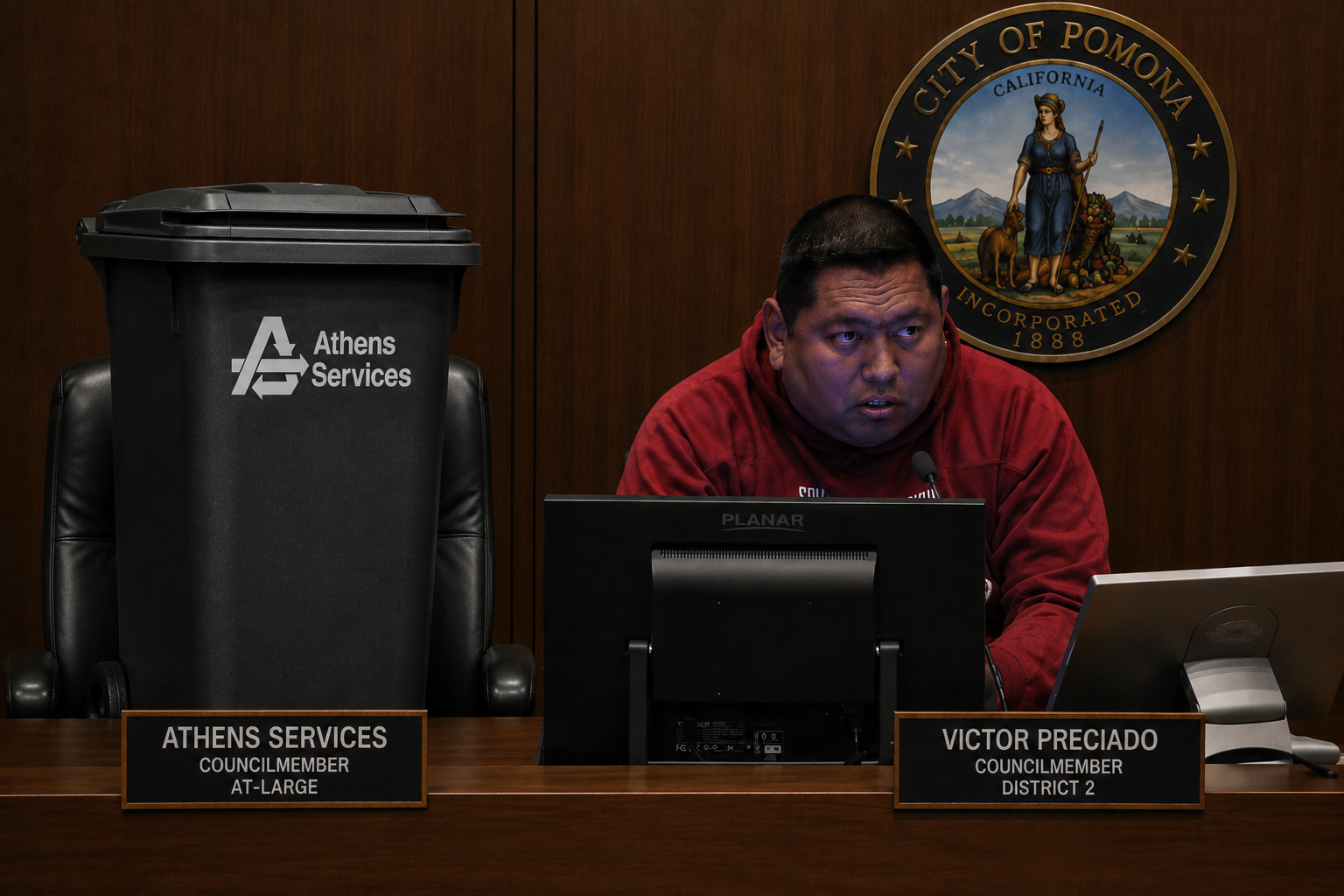
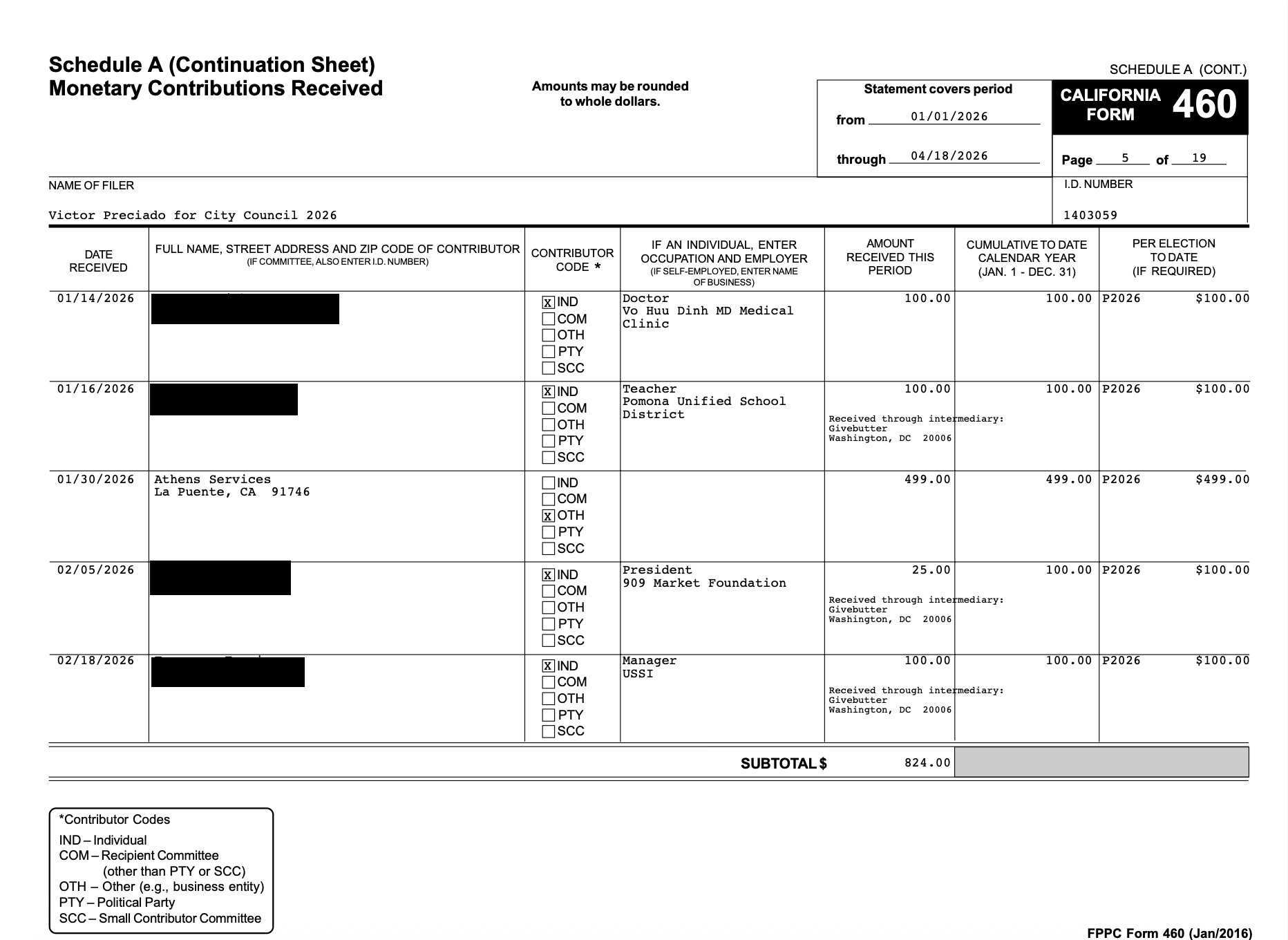
Here in Pomona, we can talk about one recent example, the privatization of the city-owned trash company to Athens Co.

Pomona has had its own city trash company since the city was founded, but In 2022, the current Mayor and five city council members decided to transfer the trash service to Athens, a privately-owned trash company. By speaking with hundreds of small business owners, commercial property owners, and residents, I learned that their trash company bills went up from 200% to 400%. In this instance, evidently, Athens Co. charged the citizens more than enough to provide service, they charged them to make a profit, and, in this case, also cover the city’s franchise fees. Athens received an exclusive contract with the City of Pomona. The citizens of Pomona are stuck. Nobody can  hire any other trash company apart from Athens, and since the company is not accountable to the citizens, the risk of corruption runs high. 

The City of Pomona has not provided a decent explanation to the citizens about how they have created a monopoly, an aberrant practice that violates the antitrust laws. To learn about antitrust laws, click here. The citizens, businesses, and property owners in this transaction have lost the right to have direct contract with those who are providing their service.


The Pomonan sent an open invitation to all candidates to submit substantive op-eds stating their position on an issue (or issues) that they consider critical to our community.

Veronica Cabrera is a resident of Pomona. She is also running for the mayoral seat for the city of Pomona.

Op-ed: Why Transparency is Important and how Pomona Can Achieve it

Transparency is the principle of allowing those affected by administrative decisions to know about the resulting facts and figures and about the process that resulted in those decisions. – ICMA

Published January 12, 2024 | 7:35 am PST

The principle of open government is not new. Throughout our nation’s history we have made progress on making government more accountable and accessible to voters. Yet, many people still feel that government is not responsive to their concerns. This cynicism about government leads to low public participation in elections. In California, 81 percent of eligible voters are registered to vote, and only 41 percent of eligible voters cast ballots. In Pomona, off cycle elections typically see a turnout of 25 percent of registered voters. The lack of voter participation is due to a lack of transparency in decision-making. The voters can change this by insisting Pomona adopt a transparent budget process that engages the community and values their participation.

If you ask any elected official in Pomona if they think government should be participatory, they will likely answer in the affirmative. If you ask these same officials what they are doing to make governing more participatory, you’ll probably get a blank stare. Pomona struggles with finding constructive ways to engage residents in the decision-making process because the city schedules meetings at times that are inconvenient for residents. In 2023 the city announced budget meetings for March 27 at 5:30 pm and another on April 5 at 3:00 pm. These meetings are not accessible to people who work, but then maybe that’s the point of scheduling meetings at times where public participation is not possible. Participatory government is one whose intent is to make itself accessible to residents where they reside and at times that are convenient to them. The metric for these meetings should be the number in attendance, not the number of meetings. Having meetings at times that people cannot attend demonstrates a desire to prevent citizen participation. We should not accept a situation where our elected officials refuse to create forums for meaningful citizen participation.

Government should be collaborative. A collaborative government seeks to find ways to obtain community and stakeholder input on policies and community priorities. It uses an iterative process to inform decision-making. By creating a feedback loop, an iterative process ensures that policies can be adapted to changing conditions or as new information exposes flaws in previous approaches. A collaborative process ensures a dialogue rather than a focus on point-in-time feedback. The City currently employs surveys to obtain resident feedback but does not engage in ongoing discussions about policy implementation, updates on approaches, or alternatives to current approaches. Quarterly and midyear updates and meetings on important city projects should be the norm to ensure that residents remain informed about the status of these projects. These meetings should be more informal than council meetings to ensure that residents have the opportunity to engage in a dialogue with staff and elected officials.

Government should be transparent. Transparency is more than informing the public what the decisions are, it is about informing residents how decisions are made and what factors were considered and rejected, and why. We know the city formulates priorities, but we do not have any understanding why or how these became priorities, or even what issues were rejected and why. Santa Monica employs a budget process where it holds year-round town halls to listen and document community priorities. Through these meetings the city formulates a budget, which is a political document that reflects the values and concerns of the residents. Without question, this is arduous work, but it is necessary towards ensuring a well-functioning and transparent budget process. More importantly, it allows residents to see their participation come to fruition as it becomes city policy.

These ideas are not new, they are part of the core values for Public Administrators and should act to guide elected officials. If Pomona made a sincere effort to adopt these values it would see greater resident participation, greater satisfaction with government, and a city whose policies are more closely aligned with resident values. We must not accept the status quo and must continue to insist that our elected officials agree to abide by these core values; and we must be willing to oust those who are reluctant or refuse to adhere to them.


Guillermo Gonzalez has a Master of Science in Public Administration from California State University – Los Angeles where he graduated with honors. He has been a resident of Pomona since 2011 and is currently a candidate for Pomona City Council.

Community Responses: 2024 Mayoral & City Council Poll

By Julian Lucas
Published 12/20/2023 | 11:15 Am PST


Earlier this month, the Pomonan published an election poll, which included the race for Mayor and City Council Districts 1, 4, and 6. Additionally, the Pomonan asked a series of three questions in regards to transparency, accountability & election promises, and what issues voters feel need to be addressed.

The mayoral poll took a shocking turn when candidate California Assembly Member, Freddie Rodriguez from Assembly District 52, announced his candidacy for Mayor. Mayor Tim Sandoval, the incumbent, leading poll popularity was humbled and Rodriguez took a slight lead at the time of the poll’s closing.

Initially, District 1 City Council incumbent, John Nolte, had an enormous lead, but this lead quickly shrunk when Pomona Library Board of Trustees Commissioner Debra Martin made it known she was also running.

District 4’s incumbent, Elizabeth Cole-Ontiveras continues to lose popularity as voters continue to choose between the two other contenders, Chara Swodeck and Guillermo Gonzalez. Gonzalez has a commanding lead over both candidates.

There is no incumbent for the 2024 City Council race for District 6. The three contenders, Lorraine Canales, Miranda Sheffield, and Glenda Barillas are almost level at this point.

When individuals run for office, they promise to perform certain tasks once elected. Since the poll became active on December 4th voters have voiced their concerns about the functionality of the city. 76.6% of voters feel the leadership has not fulfilled their tasks as promised.

Voters also voiced their concerns about the lack of transparency in government. 76.6% feel there isn’t transparency within the government..

57.8% of voters feel Mayor Sandoval has not addressed important issues such as economic development, city budget management, infrastructure improvements, along with social equity and inclusion. While 20.8% voiced their confidence in the Mayor, but 20.1% said they were unsure.

Furthermore, community members were able to voice important concerns regarding what they’d like to see addressed by city leaders. Many concerns were voiced and the majority of what was concerning was crime, prostitution, and the unhoused situation. We have provided a list of items that are important concerns for the people of Pomona. This list does not include all concerns and many of the responders’ concerns were the same.

The concerns they listed tallied in this order: Crime followed by Taxes, Homelessness, Economic Development and Youth Services. 

The poll will close in 5 days, but The Pomonan plans to repoll in the spring and fall. The poll represents 154 people so far. They are responding in a city within a county that are both notorious for low voter registration rates and low voter turnout rates. 

The Pomonan sends an open invitation to all candidates to submit substantive op-eds stating their position on an issue (or issues) that they consider critical to our community. No campaign propaganda, please. The Pomonan plans to publish articles where a candidate takes a stand, explains their position and explains how they plan to address the issue.


Julian Lucas, is a photographer, a purveyor of books, and writer, but mostly a photographer. Don’t ever ask him to take photos of events. Julian is also the owner and founder of Mirrored Society Book Shop, publisher of The Pomonan, founder of Book-Store, and founder of PPABF.