Pomona politics

Pomona Had Plenty of Absent Commissioners. City Hall Removed the One Running for Council

The 2026 candidate for Pomona’s District 2. Jacky Elizalde missed meetings. So did other Pomona commissioners. Their cases concluded with their commissions. Hers went upstairs,  and landed before the City Council and followed her onto the November ballot. 
Updated 10/14/2026 5:15 pm PST

Pomona has always had a way of conducting itself when times get hairy by “playing politics”. Nothing cryptic about that. In this particular case Pomona has gone full brow, full beard, or full bush whichever you prefer. The city has had commissioners who miss meetings,  it's not breaking news, because shit happens. People get sick. Their kids get sick. Work runs late. Family emergencies happen. Sometimes people simply do not show up because they’re tired of being tired. 

The City also has a process for when this happens. The rules are after three absences in a calendar year, excused or unexcused, the commission secretary puts a removal recommendation on the agenda. The commissioners hear the circumstances and decide whether to send the matter to the City Council. Three absences trigger a review. 

Ms. Elizalde missed three Parks and Recreation Commission meetings in 2025. Her commission reviewed the absences and voted 7–0 against recommending her removal.

In 2026 she missed three more: March 19, April 17 and June 17. The City classified all three as unexcused. On July 16, the commission tried again. The vote was 3–3. The motion to recommend her removal failed.

Pomona’s bylaws already said what came next. If a commission declines to recommend removal after the third absence, the matter returns after the commissioner misses another meeting. Ms. Elizalde did not miss another meeting first.

Councilmember Elizabeth Ontiveros-Cole stepped in four days later and asked staff to place Elizalde’s removal before the City Council. It is also imperative to understand Ms. Ontiveros-Cole had appointed Elizalde to the commission. 

The staff report acknowledged that the motion failed. Then it reached for Section 801(b) of the City Charter, which allows the Council to remove a commissioner by majority vote.
The report said the Council could remove Elizalde “outside of the process established by the standard by-laws.” The attendance process reached one result, so City Hall used another process to reach a different one.

Mayor Sandoval was absent. Councilmember Victor Preciado recused himself. The remaining five council members voted to remove Elizalde on  August 3. 

Pomona did not bring this kind of heat every time another commissioner hit the same or worse attendance threshold. 

Vehicle Parking District Commissioner Alejandra M. Tessier reached three absences in 2026. One involved illness. Another involved a family emergency. Her commission heard her explanation and voted 5–0 to retain her. Nobody escorted Ms Tessier before the full City Council for a second round. She remained on the commission and was still listed as a member in October.

Ethics Commissioner Bernice Stillions reached three excused and unexcused absences in 2025. The Ethics Commission voted 7–0 against recommending her removal. She was still serving in September 2026.

Planning Commissioners John Ontiveros and Edgar Rodriguez each had four absences in 2025. Not three, but four absences. 

The Planning Commission discussed their attendance and took no action. The chair said their absences had not delayed the commission’s work. Rodriguez said he had asked to attend one meeting remotely. Both men were still on the commission a year later.

According to Pomona’s Only Local Newspaper, La Nueva Voz their September 24 Issue reported Cultural Arts Commissioner Jovani Esparza was counted for having 15 documented absences since 2019, including four while he chaired the commission. It reported that the City Clerk confirmed Esparza had served as Preciado’s appointee since 2023. That total spans several years; the report did not give a year-by-year breakdown.

Their situations were not identical. Nothing in the bylaws required them to be. The commission review exists so actual human circumstances can be heard before City Hall starts canning people from an unpaid civic position.

Pomona has sent another attendance case toward removal. In February 2025, the City Council had an item recommending the removal of Parks and Recreation Commissioner Audrey Olmos-Govea after three or more absences. The item was pulled after she resigned that day.

Elizalde was not the first commissioner whose attendance became a serious issue. She was the commissioner whose removal motion failed, then got revived by the councilmember who had appointed her. She was also running for City Council against an incumbent.

Emails obtained show Ontiveros-Cole raising concerns with City staff before the commission reviewed Elizalde’s absences. On July 13, she asked Community Services Manager Mike Osoff for an update and wrote, “Where are we on this? I am very disappointed.” Two days later, she told Osoff and three other City employees that Elizalde had been “pardoned in 2025” and had failed to report later absences. She wrote that another commissioner was surprised by Elizalde’s “aloofness” and repeated his claim that Elizalde said she was “not getting paid.” The Pomonan could not independently verify that exchange. After the commission deadlocked 3–3, Ontiveros-Cole asked staff to place the matter before the City Council. The records reviewed by The Pomonan did not include the 2025 letter that Ontiveros-Cole said she had sent concerning Elizalde’s earlier absences. 

Ontiveros-Cole did not respond to our request for comments about why she revived the matter or whether Elizalde received the same treatment as other commissioners.

Councilmember Nora Garcia responded after the deadline. She said she supported “the decision and wishes of the appointing Councilmember” because commissioners serve at the Council’s discretion. She also said nothing in the bylaws prevents a councilmember from requesting an appointee’s removal at any time. That explains the power. It does not explain the double treatment.

Councilmember Lorraine Canales said she was not fully educated about what constituted removal and would investigate. No further explanation arrived before publication. The other council members contacted by The Pomonan did not respond.

The Council did not just take away the commissioner seat. On August 4, the City Clerk Karla Shipman told Elizalde she could no longer use “Parks Recreation Commissioner,” the ballot designation she had used during the primary. She no longer held the position. The City gave her until August 7 to choose another label.

Ms. Elizalde replied that City staff had not told her the removal would appear on the August 3 agenda. She said she believed the matter had ended at the commission level with the 3–3 vote.The records reviewed by The Pomonan do not establish whether the City had a separate legal duty to notify her personally beyond posting the public agenda.

The city clerk described the path City Hall used. The Parks and Recreation Commission did not recommend removal because its vote failed. Ontiveros-Cole made a separate request. The Council then used its Charter power to remove Elizalde outside the attendance procedure in the standard bylaws.

On August 7, Elizalde filed a replacement ballot designation: “Nonprofit Director/Mother.” Her alternate choices were “In-Home Caregiver/Mother” and “Oversight Member/Mother.”

A commission refused to recommend removal. A councilmember brought the same commissioner before the Council anyway. Five council members removed a candidate, and the City made her rewrite the words that would appear beside her name on the November ballot.

Missing three meetings did not automatically warrant a removal by a city council. Tessier, Stillions, Ontiveros, and Rodriguez were all able to stay. 

Maybe the officials had a cute collection of explanations for treating this case differently. However they did not provide one even when given the opportunity to. 

Ontiveros-Cole did not answer. Garcia said she followed the wishes of the appointing councilmember. Canales said she would look into it. The rest offered the familiar municipal sound of an empty room.

Pomona had its rules. The commission voted to not remove her. City Hall removed her anyway. Does Pomona follow its own rules out of conveniency to produce the results City Hall wants?


References

● Pomona City Charter, Article VIII, Section 801(b)

● Ordinance No. 4328

● Elizalde removal file 26-1585

● August 3 City Council meeting

● July 16 Parks and Recreation Commission meeting

● Tessier attendance file

● Planning Commission attendance file

● August 28, 2025 Ethics Commission minutes

● City email correspondence

● Elizalde ballot designation works
Victor Preciado Accepted Pomona’s Spending Ceiling 66 Days After the Primary. City Hall Has Not Explained What That Means

Victor Preciado Opted Into Pomona’s Spending Limit 66 Days After the Primary. City Hall Still Can’t Explain What Happened.

Updated 10/13/2026 5:17 am PST
Updated 10/08/2026 12:11 pm PST


The District 2 incumbent accepted Pomona’s $27,460 general election ceiling more than two months after the primary. City records show no tracking records, written guidance or legal analysis explaining what happened next.

October 8, 2026

Pomona’s campaign finance rules offer candidates a deal. Accept a voluntary spending ceiling and the candidate may place a statement in the voter information guide. Decline the ceiling and the statement is off the table.

District 2 Councilmember Victor Preciado first declined that deal. Then, more than two months after the June primary, he changed his mind and changed his answer.

On August 7, Preciado filed an amended Candidate Intention Statement saying he was “amending to accept the voluntary expenditure ceiling.” He checked the box stating that he accepted the ceiling for the 2026 primary and general election.

By then, the primary was over. His campaign reports showed total expenditures above the dollar amount of Pomona’s primary ceiling.

Pomona created a campaign spending rule tied to access to the voter guide. Preciado changed his filing 66 days after the primary, although the state law incorporated into Pomona’s City Charter contains a 14-day window. The City received and posted the amendment but has produced no records showing whether anyone reviewed it or determined that it was effective.

Pomona lists a voluntary expenditure ceiling of$15,680 for a City Council primary and $27,460 for a general election.

Preciado’s filing history shows two changes in position. On December 17, 2025, he filed an amendment stating that he would “no longer accept” the ceiling. Then, on August 7, 2026, he filed another amendment saying he would accept it.

The August filing came 66 days after the June 2 primary.

The amendment had a real consequence. Los Angeles County’s official candidate statement portal lists Preciado and provides access to his statement for the November 3 general election. The County describes its online candidate statement as an additional option to the printed statement in the Sample Ballot book.

Pomona’s City Charter says its voluntary expenditure ceiling is governed by California Government Code section 85400 and the sections that follow. One of those provisions, section 85401, says a candidate who declined the ceiling may accept it for a general election within 14 days after the primary, provided the candidate did not exceed the primary ceiling.

That state law is written for candidates for state office. Pomona chose to incorporate those provisions into its City Charter. How the City applies its timing and eligibility rules to City Council candidates is therefore not a minor technicality. It is the question.

Preciado’s May 21 campaign statement reported $22,918.69 in cumulative expenditures through May 16. That reported total was $7,238.69 higher than the $15,680 ceiling. Establishing whether he exceeded the ceiling requires identifying which expenses counted toward it. A later statement placed his cumulative expenditures through June 30 at $29,476.02.

Preciado was allowed to spend past the primary ceiling because he opted out. Then he opted back in. That is where things get a wee bit messy. The state rules Pomona adopted appear to allow that switch only if the candidate stayed below the primary limit.

His August form creates another question. It checked the general box accepting the ceiling, but it did not mark the separate amendment line declaring that the candidate had not exceeded the primary ceiling and was accepting the ceiling for the general election.

Maybe the City has an interpretation that makes the amendment proper. If so, it should be able to state it and identify the rule. So far, it has done neither.

What his latest filing shows

The numbers must be separated by election period. Preciado’s first general election preelection statement, filed September 24 and covering July 1 through September 19, reported:

$4,190 in monetary contributions received during the period;

$4,709.41 in payments made;

no accrued expenses or unpaid bills; and

an ending cash balance of $5,560.03.

Even if every dollar in payments reported for that period counted toward the general election ceiling, the total remained $22,750.59 below it.

The same filing lists $34,185.43 in total expenditures for the calendar year. That amount combines spending across reporting periods and cannot simply be compared with the general election ceiling. Calculating spending counted toward that ceiling requires reviewing the expenses and allocating them to the appropriate election.

The City says it keeps no tracking records

The Pomonan asked the City for the records that should settle the issue.

In response to a September 10 Public Records Act request, the City pointed to its public filing portal and municipal code. But when it came to the files that would actually blow this open, the official response was straight blunt: “No responsive documents.”

The City said it had no spreadsheet, worksheet, database entry, calculation, audit record or review notes tracking Preciado’s expenditures against the ceiling. It said it had no written policy or staff guidance explaining how compliance is monitored, which expenses count, what happens if a candidate reaches the ceiling or whether exceeding it affects a candidate statement. It also reported no internal communications, warning, determination, referral, complaint, enforcement record or legal analysis concerning whether Preciado reached or exceeded the limit. That response was marked complete on September 23.

What the response does show is that City Hall could not produce a paper trail explaining how it administers a rule that determines what voters see in their election guide.

A narrower follow up request was submitted on September 24 seeking records showing any City analysis of the August amendment, its timing and Preciado’s eligibility to accept the general election ceiling after the primary. Under the California Public Records Act, an agency generally must make a determination within 10 days or provide written notice of an extension based on unusual circumstances.

As of October 8, the City had provided no determination, no records and no extension notice in response to that request.

Preciado also did not respond to detailed questions sent by The Pomonan about the amendment, his campaign spending and the City’s administration of the ceiling.

A ceiling is not much use if nobody can explain it

The unresolved issue is whether the August amendment was timely and effective, and why City Hall has produced no records showing that anyone made that determination.

Pomona made the deal simple. Agree to the spending ceiling, get space in the voter guide. Preciado declined the ceiling for the primary, reported total expenditures above the primary ceiling’s dollar amount, then filed an amendment accepting the general election ceiling 66 days after the primary. His statement now appears on Los Angeles County’s official candidate statement portal. The City received and posted his amendment but has produced no record explaining whether the amendment was timely and effective or who reviewed it.

Pomona has no shortage of rules. Keeping track of whether City Hall actually follows them is another story. If Preciado’s amendment complied, the City should explain why. If the 14 day condition works differently for local candidates, the City should point to the rule that says so. And if nobody reviewed the amendment at all, voters deserve to know that too.

The ceiling may be voluntary. Explaining how City Hall administers it is not.


SOURCE DOCUMENTS


Julian Lucas is the founder and publisher of The Pomonan, as well as a photographer and writer. His work examines art, culture, local government, race, displacement and the social consequences of public policy. And don’t trip out and shit. He knows he needs to update his website.

The Establishment Learns to Speak Activist

Pomona survived warehouses, consultant culture, infrastructure upgrades, privatization deals, and endless promises of revitalization. But somehow protected youth funding is where the city suddenly discovered fiscal panic.

Photography Julian Lucas ©2021

For years, Pomona’s political establishment treated young people the way cities often do, as symbolism. Scholarship photos. Ribbon cuttings. Nonprofit brochures. Election season speeches about “the future.” Everyone loves talking about youth investment as long as the investment remained flexible, manageable, and safely dependent on whichever city council happened to be in power at the time. Then Measure Y passed, and suddenly the same institutional culture that comfortably survived warehouses, mis-match hodgepodge development, privatization deals, consultant culture, and selective reinvestment discovered a deep existential fear about fiscal responsibility. And all of a sudden everyone in the establishment has become an activist.

The city has begun to speak the language of “community.” The Pomona Police Association is now speaking the language of “protecting youth.” The same political culture that spent years approving truck corridors, privatization agreements, endless consultant studies, and development patterns that somehow always seemed to benefit everybody except the people already living here now appears deeply worried that Pomona may financially collapse if young people receive protected investment. Apparently the city survived everything else just fine. Warehouses, giveaways, politically connected nonprofit ecosystems, selective reinvestment, and a municipal addiction to “revitalization” projects that rarely seem to revitalize the same neighborhoods twice, all manageable. But youth funding? That is where the adults draw the line.The performance would almost be impressive if it were not so transparent.

Because Measure Z is not being sold honestly as an attempt to weaken Measure Y. Nobody is standing at the podium saying, “Actually we preferred the old arrangement where youth investment depended entirely on whichever council happened to be in office that year.” Instead residents receive the modern municipal remix. Accountability, sustainability, flexibility, protecting services, responsible implementation. The establishment did not reject the language of reform after Measure Y passed. It learned it like a Hip Hop song, repeating the words confidently long before understanding where they came from. Now everyone suddenly cares deeply about transparency.

It’s rather comical Pomona’s leadership has discovered grassroots vocabulary the same way corporations discover social justice during Pride Month. Overnight. Professionally designed. Of course condescending and full of concern.

And yes, Pomona Police Officers Association is going hard for Measure Z. Which is almost beautiful in its irony. Pomona spent years hearing that grassroots organizers were too emotional, too disruptive, too unrealistic about the city’s finances. Now suddenly the establishment is out here running full campaign mode. Signs, videos, coordinated messaging, carefully rehearsed concern about the future of the city. At this point you half expect to see PPOA members and city council allies sweating on corners waving Measure Z signs like they just discovered activism three weeks ago, buying bacon wrapped hot dogs con todo and Funions con chile from somebody’s abuelita selling on the sidewalk.

Meanwhile, the actual structural changes buried underneath the language of “responsibility” tell a much more interesting story. Public analyses comparing Measure Y and Measure Z argue that the newer measure would dramatically reduce the scale of the original Children and Youth Fund while weakening parts of the accountability framework voters originally approved. According to those analyses, Measure Z changes the funding source entirely, significantly reduces projected revenue, weakens the authority of the Accountability Board, softens participatory budgeting language, removes timelines, and shifts more control back toward traditional city administration.  

That is not a technical adjustment. That is the establishment trying to pull the steering wheel back after briefly losing control of the car.

And the funniest part is how carefully the entire thing is packaged. Nobody sounds angry. Nobody sounds defensive. Everything is delivered in the soothing language of adults trying to save the city from reckless idealism. The message is not “we oppose youth investment.” The message is “trust us to manage it properly.” Which in Pomona is particularly rich considering many of the people now warning residents about instability belong to the exact political ecosystem that helped produce the instability residents were organizing against in the first place.

That is what makes the geography of the campaign so revealing. Measure Z signs bloom comfortably through Lincoln Park Historic District, parts of Ganesha Hills, and likely sections of Phillips Ranch. Stable homeowner zones. Established civic territory. The old guard neighborhoods where “community concern” often arrives fastest once funding structures stop revolving around City Hall discretion. Political lawn signs rarely appear randomly. They map anxiety geographically.

And the anxiety here is not really about children. It is about power. Measure Y mattered because it attempted to create protected youth investment outside the city’s normal rhythm of speeches, nonprofit galas, ribbon cuttings, and selective urgency. Young people in Pomona have always photographed beautifully for campaigns. Scholarship students. Honor roll kids. Carefully curated success stories standing beside elected officials holding oversized checks. But Measure Y threatened to move youth investment from symbolic performance into structural obligation. Suddenly future councils could not simply praise young people publicly while redirecting priorities elsewhere privately. That changes relationships inside a city.

Especially a city like Pomona where institutional networks, nonprofits, political figures, commissions, consultants, and civic influence circles often overlap so tightly they begin to resemble one long continuous luncheon.

And so the response arrives wrapped in the language of moderation. Calm voices warning about fiscal collapse. Police associations presenting themselves as guardians of youth investment. Old political structures suddenly play activist grassroots organizing because the actual grassroots organizing worked once and scared the fuck out of them.

Pomona residents should pay attention to that panic.

Because institutions rarely reveal themselves more honestly than when they begin losing control of the narrative.


Julian Lucas is a darkroom photographer, writer, and a bookseller, though photography remains his primary language. He is the founder of Mirrored Society Book Shop, publisher of The Pomonan, and creator of Book-Store and Print Pomona Art Book Fair. And yes he will charge you 2.5 Million dollars for event photography.

The Municipal Romance of Trash, Trucks, and Campaign Cash

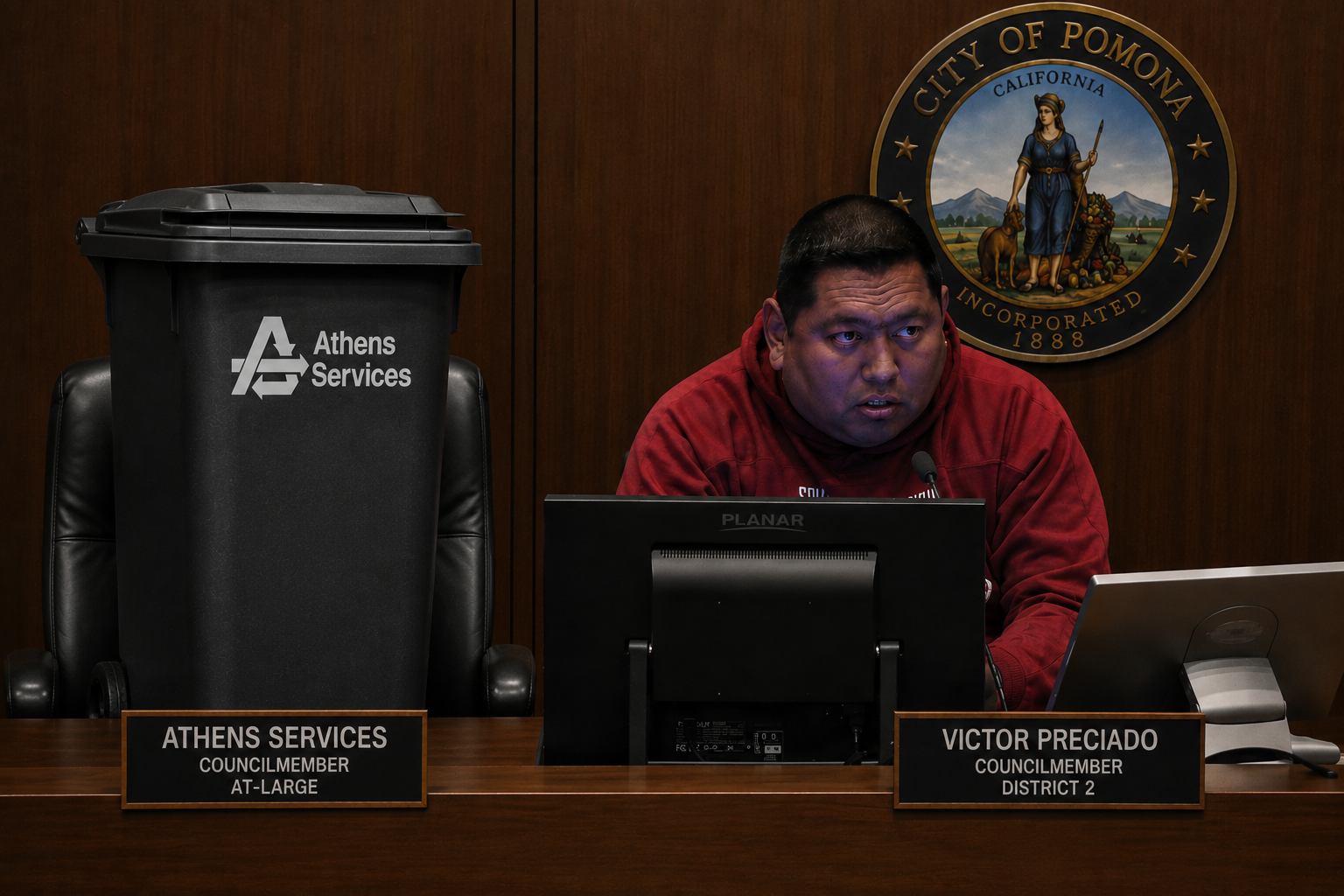
A campaign contribution from Athens Services is reopening old questions about privatization, infrastructure, political alliances, and who Pomona believes City Hall ultimately serves.

Editorial illustration by The Pomonan

There are only a few things less glamorous than garbage. It sits outside quietly in black and blue containers, rolled toward the curb once a week with the expectation that it disappears before the next morning. Most residents do not think about sanitation contracts, transfer stations, hauling agreements, or municipal privatization until something changes. But when the bill jumps. A service changes. A truck appears more often than it used to. Then suddenly, garbage becomes political.

And of course, in Pomona, where politics increasingly feels trendier than the restaurants, galleries, and art itself, trash had already become a political issue long before campaign season arrived. 

For years, residents, business owners, and city observers have argued over the city’s relationship with Athens Services, the private company tied to Pomona’s controversial waste collection transition. Some defended the move as modernization. Others viewed it as another example of a city steadily outsourcing pieces of itself while residents were left absorbing the consequences in real time.

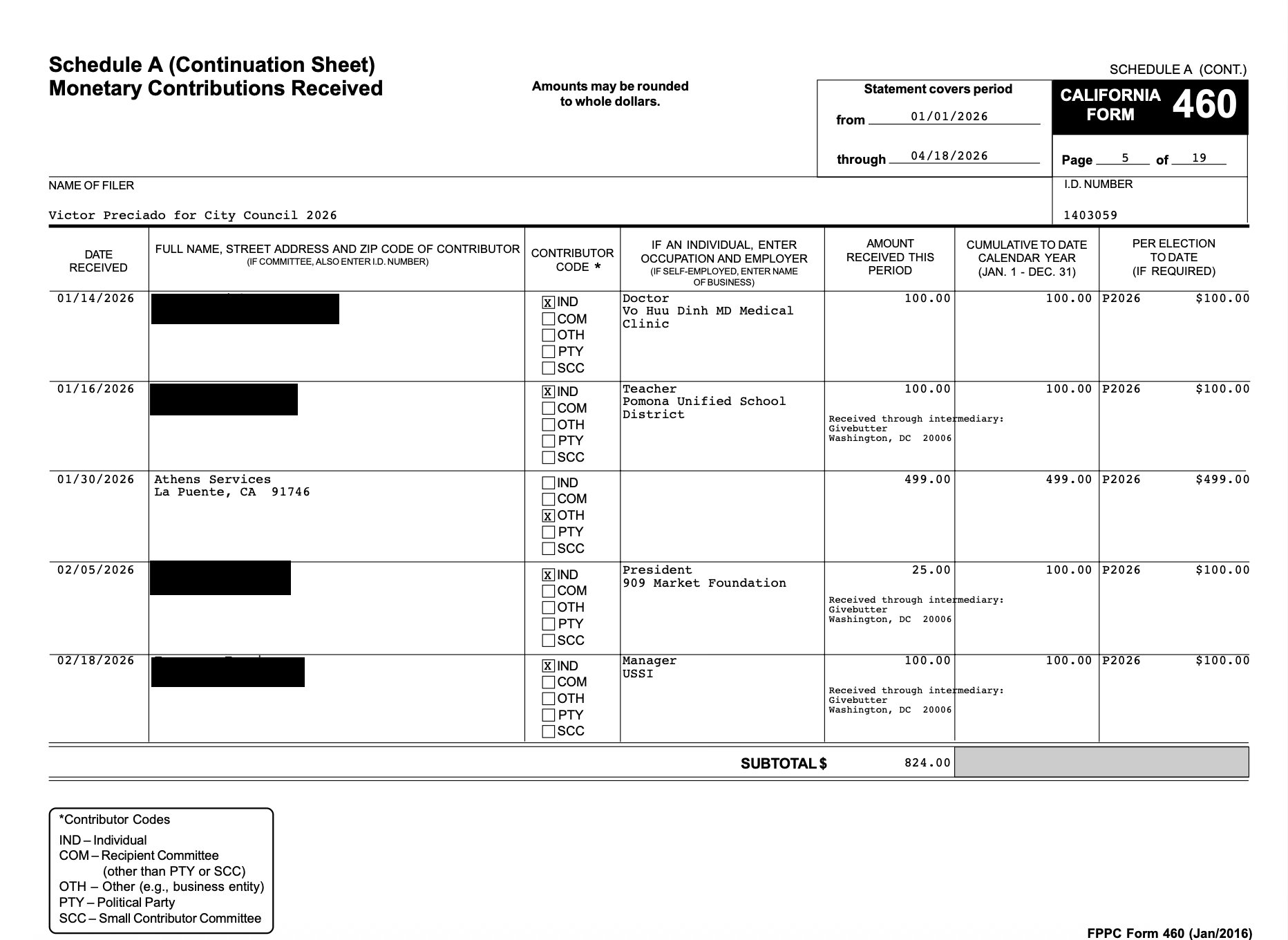
Now there's an issue that has entered the campaign season directly. Public campaign finance filings for Victor Preciado’s 2026 reelection campaign show a $499 contribution from Athens Services dated January 30, 2026. Preciado is not a neutral observer in Pomona’s trash debate. As an incumbent councilmember, he sits inside the same governing structure that defended and normalized the city’s relationship with Athens while residents and businesses continued raising concerns about cost, accountability, and transparency. 

The amount itself is not a 5 million dollar lottery ticket. In California politics, $499 barely qualifies as eyebrow raising. But local politics operates differently than Sacramento or Washington. In municipal elections, symbolism often matters more than scale. Residents do not experience city government through million dollar lobbying campaigns. They experience it through potholes, homicides (unless the cops are not reporting) warehouse fires, zoning decisions, abandoned buildings, police response times, parks, and trash bills. That is why the contribution matters.

Not because it proves corruption. It doesn’t. Campaign donations are legal and happen all the time. But when a company tied to one of the city’s most controversial contracts starts donating to elected officials during election season, people are naturally going to question how close City Hall has become with the same companies doing business with the city. 

The Athens debate never really ended in Pomona because it was never just about trash pickup. It has always been about control.

Residents watched the city transition away from a municipal service structure toward privatization while being told efficiency and improvement would follow. Instead, many businesses complained about increased costs. Residents questioned accountability. Illegal dumping remained visible in  parts of the city. And politically, the issue lingered in the background like the smell residents insist they notice even when officials pretend not to.

Meanwhile, parts of Pomona continue carrying the physical burden of the region’s infrastructure economy. District 3 remains surrounded by warehouses, truck routes, industrial land use, and the waste transfer station itself, where the movement of garbage becomes part of the neighborhood landscape rather than an invisible municipal function hidden safely elsewhere.

This is where Pomona’s politics become revealing. 

The city often speaks about growth abstractly, but growth always lands somewhere physically. Warehouses land somewhere. Heavy truck traffic lands somewhere. Waste infrastructure lands somewhere. Rarely are those burdens distributed evenly across the map. Some neighborhoods become corridors. Others become destinations.

And once residents begin seeing those patterns, every campaign contribution starts carrying a little more meaning than it otherwise might.

The current election cycle is already exposing tensions inside Pomona’s political culture. Challengers are openly discussing council voting blocs, predictable alliances, and decisions that residents increasingly believe are settled before meetings even begin. Questions about transparency, consent agendas, and political alignment are surfacing more publicly than they have in years.

The Athens contribution enters that atmosphere at precisely the wrong time for incumbents hoping the trash debate had faded quietly into administrative history. Because residents remember.

They remember the transition. They remember the arguments. They remember who defended the contract and who questioned it. More importantly, they remember that one of the most basic services in city life became a symbol for something larger. The feeling that decisions affecting everyday people are often negotiated far above them, then delivered back down as inevitabilities.

The problem for incumbents like Victor Preciado is not simply that residents noticed the contribution. It is that many residents already believe City Hall has grown too comfortable operating within a small political orbit where contractors, council alliances, and major city decisions increasingly overlap.

And that is the danger for Pomona’s political establishment heading into 2026. Not the contribution itself. The timing.

Because once infrastructure, campaign finance, district frustration, and public distrust begin entering the same conversation, local politics stops feeling procedural. It starts feeling personal.

Garbage has a way of doing that.

District 2 Isn’t Just a Voting Bloc

Why Pomona’s political imagination may be smaller than the community it claims to represent.

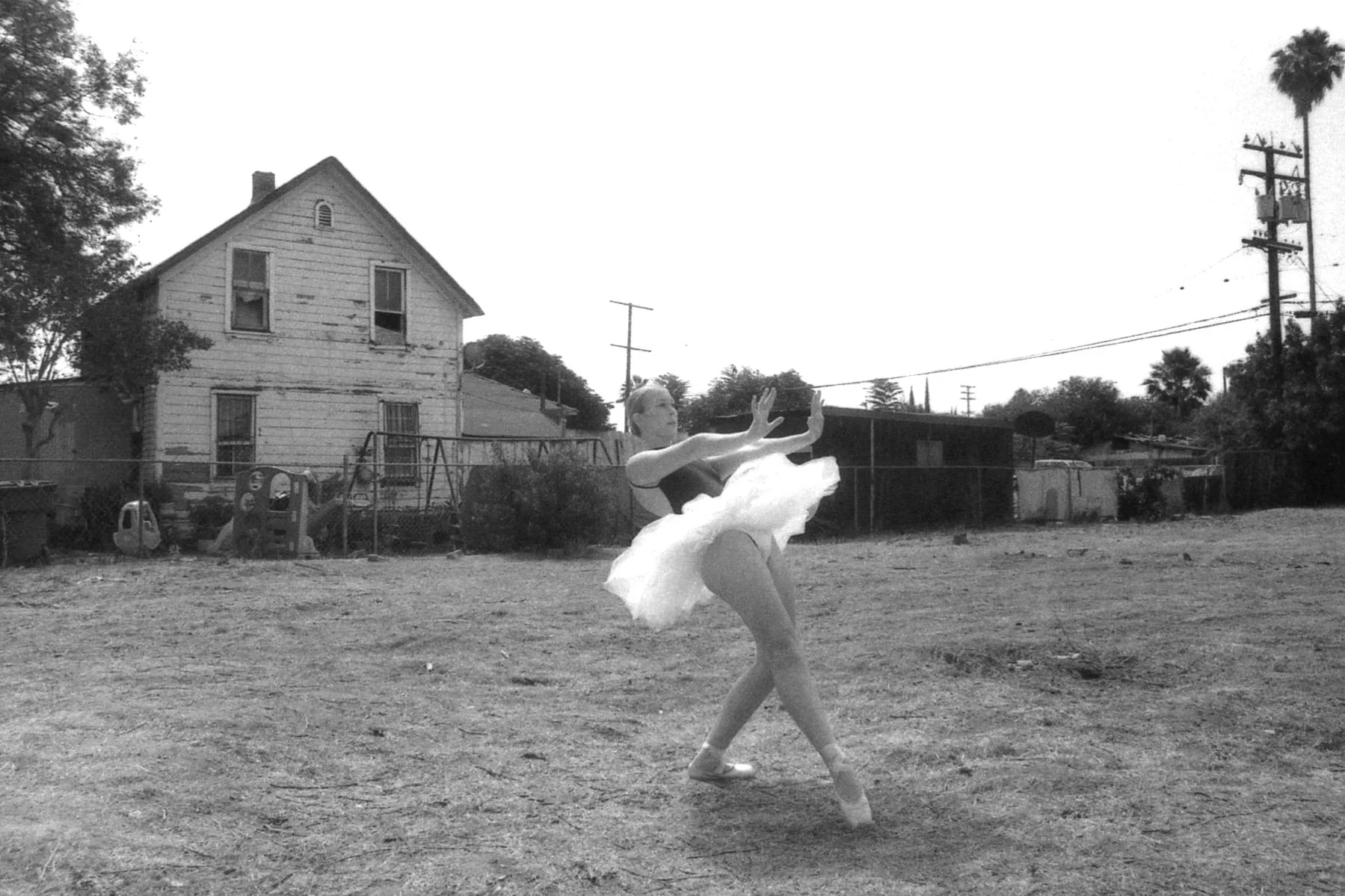
Julian Lucas ©2021

District 2 is often talked about during election season as if the demographic is treated as a simple category: “the immigrant district” or “the working-class district.” Labels make politics easier. Pomona politicians flatten the people who live in this district into statistics.

But if you actually walk the streets of District 2, you quickly realize it’s something else entirely, a dense web of families, languages, small businesses, and households that hold stories stretching far wider than Pomona.

Pomona itself reflects this complexity. Roughly 72 percent of the city identifies as Hispanic or Latino (I’ve never been fond of the term Hispanic), and about one-third of residents were born outside the United States.

District 2 sits squarely inside that reality.

Many residents here are first-generation Americans. Many are immigrants. Some households include parents who have lived in the United States for decades and children who were born here. Others are newer arrivals still navigating paperwork, language barriers, and the daily uncertainties that come with starting over in a new country.

That makes District 2 different from the way it’s often portrayed in political conversations. It isn’t simply a “community of voters.” District 2 is a community of families who live with a particular kind of vulnerability.

And recently, that vulnerability became visible again.

District 2 is not unique in this regard, but in recent months residents reported ICE activity in the neighborhood, the kind of presence that sends a quiet ripple through a community. Doors close earlier. Comadres, compadres, primos, primas, tias, tios, and vecinos text each other warnings. Kids hear conversations they’re not supposed to hear yet and school absences increase.

Whether someone supports immigration enforcement or not, the emotional effect in immigrant neighborhoods is unmistakable. People feel monitored. People feel exposed.

Many people in District 2 know this feeling well.

It’s also a district where many people work jobs that rarely show up in political conversations: warehouse jobs, retail work, service work, construction, caregiving. The kinds of jobs that keep the region functioning but rarely translate into political influence.

Which raises a simple question during an election year. What does representation actually look like for a district like this?

Not representation as a campaign catchphrase, but representation as something lived day to day. Someone who understands why ICE enforcement agents are parked on a corner can change the mood of entire neighborhoods. Someone who understands that for many families here, politics isn’t an abstract debate. It’s something that touches housing, safety, schools, food insecurities, and the basic feeling of belonging.

But there’s another dynamic that often surfaces during election seasons in Pomona.

A familiar line appears in speeches at commission, committee, and council meetings, delivered with the seriousness of a credential.

“I’m from Pomona.”

The Chest-Thumping Politics of Being “From Pomona”

In Pomona politics there is a credential that gets repeated with the seriousness of a law degree.

Sometimes the curriculum vitaé gets expanded.

“I’m from Pomona.” Or “I’m a lifelong resident of Pomona.”

“I’m a homeowner.”

You’ll hear it at council meetings, campaign announcements, and the occasional moment when a politician decides to pound their chest like a hometown King Kong guarding the city limits while planting trees.

From Pomona. Not studied elsewhere. Not exposed to different ways cities function. Not particularly curious about how other communities solve problems.

Just… from Pomona.

Now don’t get me wrong. Loving the place you grew up is admirable. Loyalty to a city is a good thing. I can even say Pomona could be a gem. But it has been just that for the last couple of decades.

Being from Pomona is not the issue. Some of the most thoughtful, caring, and understanding people in this city grew up here. Others arrived later and built lives here just the same. Cities are shaped by both. The problem begins when birthplace itself becomes a substitute for ideas.

However, in Pomona politics the phrase sometimes works less like biography and more like gatekeeping.

Because once someone declares themselves the authentic voice of Pomona, something subtle happens next: everyone else starts getting sorted into categories.

You’re either a “real Pomonan” or you’re not. Then comes the classist logic: homeowner or tenant. In many political spaces, tenants are treated as if they couldn’t possibly have a voice.

Question something? You must not understand Pomona politics.

Offer a different idea?

That won’t work, you must not be from Pomona. The idea will quietly reappear later with someone else’s name on it. And whatever they produce will come with their own Pomona-ass spin on it. It’s as if the Pomonans who end up claiming the ideas live behind an imaginary wall, with little lived experience beyond the city limits. That kind of insularity is never sustainable.

Or those not from Pomona but have money to invest will build something that isn’t aligned with the present culture, opening businesses as if the city were still living in the 1990s. It doesn’t last. It closes, reopens under another name, and the cycle repeats.

Suggest the city could learn something from somewhere else?

Then you become suspicious and they’ll think you’re running for office.

It’s a clever rhetorical trick. Declare yourself the hometown authority and suddenly disagreement becomes disloyalty.

But here’s the irony.

Pomona itself is one of the most globally shaped cities in Southern California. Immigrant families, first generation Americans, people whose lives stretch across multiple cultures and countries.

Many residents here carry more international experience in their family histories than the politicians lecturing them about what “real Pomona” is supposed to look like.

So when leaders beat their chest about being “from Pomona,” the question worth asking isn’t where they were born.

The real question is how much of the world they’ve allowed into their thinking since then.

Because cities don’t grow through insularity.

They grow through exposure, curiosity, and the willingness to imagine something bigger than the street you grew up on. Key word curiosity.

Otherwise politics becomes strangely performative. Leaders loudly celebrate their hometown while quietly shrinking the possibilities of what that hometown could become.

And that’s really not civic pride. It’s just a very small box with Pomona written on the outside.

District 2 doesn’t live inside that small box. The district is shaped by families whose lives stretch across borders, languages, and cultures. In many ways, the people politicians claim to represent already understand the world in ways far larger than the narrow version of Pomona politics sometimes presented at City Hall.

Which makes the real question for voters this year a simple one. Who actually understands the district as it exists today, not as the city imagined it thirty years ago?

From what I see, the council is mostly Latino, including the mayor, and the commissions include a mix of Latinos and whites. Yet there seems to be an assumption that because many residents are working-class, they only want certain kinds of businesses. When Burlington arrives and it’s framed as a big win, it suggests leaders believe this is what the working class wants. That kind of thinking can slip into stereotyping the very community they claim to represent.

At some point the question becomes whether this is really what the working class wants, or simply the limit of what local leadership imagines the city can be.


Julian Lucas is a darkroom photographer, writer, and a bookseller, though photography remains his primary language. He is the founder of Mirrored Society Book Shop, publisher of The Pomonan, and creator of Book-Store and Print Pomona Art Book Fair. And yes he will charge you 2.5 Million for event photography.