The Pomonan

Victor Preciado Accepted Pomona’s Spending Ceiling 66 Days After the Primary. City Hall Has Not Explained What That Means

Victor Preciado Opted Into Pomona’s Spending Limit 66 Days After the Primary. City Hall Still Can’t Explain What Happened.
Updated 10/08/2026 12:11 pm PST

The District 2 incumbent accepted Pomona’s $27,460 general election ceiling more than two months after the primary. City records show no tracking records, written guidance or legal analysis explaining what happened next.

October 8, 2026

Pomona’s campaign finance rules offer candidates a deal. Accept a voluntary spending ceiling and the candidate may place a statement in the voter information guide. Decline the ceiling and the statement is off the table.

District 2 Councilmember Victor Preciado first declined that deal. Then, more than two months after the June primary, he changed his mind and changed his answer.

On August 7, Preciado filed an amended Candidate Intention Statement saying he was “amending to accept the voluntary expenditure ceiling.” He checked the box stating that he accepted the ceiling for the 2026 primary and general election.

By then, the primary was over. His own campaign reports showed that he had already spent more than Pomona’s primary ceiling.

Pomona created a campaign spending rule tied to access to the voter guide. Preciado changed his filing 66 days after the primary, although the state law incorporated into Pomona’s City Charter contains a 14-day window. The City received and posted the amendment but has produced no records showing whether anyone reviewed it or determined that it was effective.

Pomona lists a voluntary expenditure ceiling of$15,680 for a City Council primary and $27,460 for a general election.

Preciado’s filing history shows two changes in position. On December 17, 2025, he filed an amendment stating that he would “no longer accept” the ceiling. Then, on August 7, 2026, hefiled another amendment saying he would accept it.

The August filing came 66 days after the June 2 primary.

The amendment had a real consequence. Los Angeles County’s official candidate statement portal lists Preciado and provides access to his statement for the November 3 general election. The County describes its online candidate statement as an additional option to the printed statement in the Sample Ballot book.

Pomona’s City Charter says its voluntary expenditure ceiling is governed by California Government Code section 85400 and the sections that follow.One of those provisions, section 85401, says a candidate who declined the ceiling may accept it for a general election within 14 days after the primary, provided the candidate did not exceed the primary ceiling.

That state law is written for candidates for state office. Pomona chose to incorporate those provisions into its City Charter. How the City applies its timing and eligibility rules to City Council candidates is therefore not a minor technicality. It is the question.

Preciado’sMay 21 campaign statement reported $22,918.69 in cumulative expenditures through May 16. That was already $7,238.69 above Pomona’s $15,680 primary ceiling, more than two weeks before election day. A later statement placed his cumulative expenditures through June 30 at $29,476.02.

Preciado was allowed to spend past the primary ceiling because he opted out. Then he opted back in. That is where things get a wee bit messy. The state rules Pomona adopted appear to allow that switch only if the candidate stayed below the primary limit. Preciado had already spent $7,238.69 more.

His August form creates another question. It checked the general box accepting the ceiling, but it did not mark the separate amendment line declaring that the candidate had not exceeded the primary ceiling and was accepting the ceiling for the general election.

Maybe the City has an interpretation that makes the amendment proper. If so, it should be able to state it and identify the rule. So far, it has done neither.

What his latest filing shows

The numbers must be separated by election period. Preciado’sfirst general election preelection statement, filed September 24 and covering July 1 through September 19, reported:

$4,190 in monetary contributions received during the period;

$4,709.41 in payments made;

no accrued expenses or unpaid bills; and

an ending cash balance of $5,560.03.

Even if every dollar in payments reported for that period counted toward the general election ceiling, the total remained $22,750.59 below it.

The same filing lists $34,185.43 in total expenditures for the calendar year. That figure includes spending reported before July 1, including the primary campaign, so comparing the entire amount with the general election ceiling would be misleading.

The City says it keeps no tracking records

The Pomonan asked the City for the records that should settle the issue.

In response to a September 10 Public Records Act request, the City pointed to its public filing portal and municipal code. But when it came to the files that would actually blow this open, the official response was straight blunt: “No responsive documents.”

The City said it had no spreadsheet, worksheet, database entry, calculation, audit record or review notes tracking Preciado’s expenditures against the ceiling. It said it had no written policy or staff guidance explaining how compliance is monitored, which expenses count, what happens if a candidate reaches the ceiling or whether exceeding it affects a candidate statement. It also reported no internal communications, warning, determination, referral, complaint, enforcement record or legal analysis concerning whether Preciado reached or exceeded the limit. That response was marked complete on September 23.

What the response does show is that City Hall could not produce a paper trail explaining how it administers a rule that determines what voters see in their election guide.

A narrower follow up request was submitted on September 24 seeking records showing any City analysis of the August amendment, its timing and Preciado’s eligibility to accept the general election ceiling after the primary. Under the California Public Records Act, an agency generally must make a determination within 10 days or provide written notice of an extension based on unusual circumstances.

As of October 8, the City had provided no determination, no records and no extension notice in response to that request.

Preciado also did not respond to detailed questions sent by The Pomonan about the amendment, his campaign spending and the City’s administration of the ceiling.

A ceiling is not much use if nobody can explain it

The unresolved issue is whether the August amendment was timely and effective, and why City Hall has produced no records showing that anyone made that determination.

Pomona made the deal simple. Agree to the spending ceiling, get space in the voter guide. Preciado declined the ceiling for the primary, spent above the primary limit, then opted into the general election ceiling 66 days later. His statement now appears on Los Angeles County’s official candidate statement portal. The City received and posted his amendment but has produced no record explaining why he was allowed to opt into the ceiling 66 days after the primary or who reviewed that decision.

Pomona has no shortage of rules. Keeping track of whether City Hall actually follows them is another story. If Preciado’s amendment complied, the City should explain why. If the 14 day condition works differently for local candidates, the City should point to the rule that says so. And if nobody reviewed the amendment at all, voters deserve to know that too.

The ceiling may be voluntary. Explaining how City Hall administers it is not.


SOURCE DOCUMENTS


Julian Lucas is the founder and publisher of The Pomonan, as well as a photographer and writer. His work examines art, culture, local government, race, displacement and the social consequences of public policy. And don’t trip out and shit. He knows he needs to update his website.

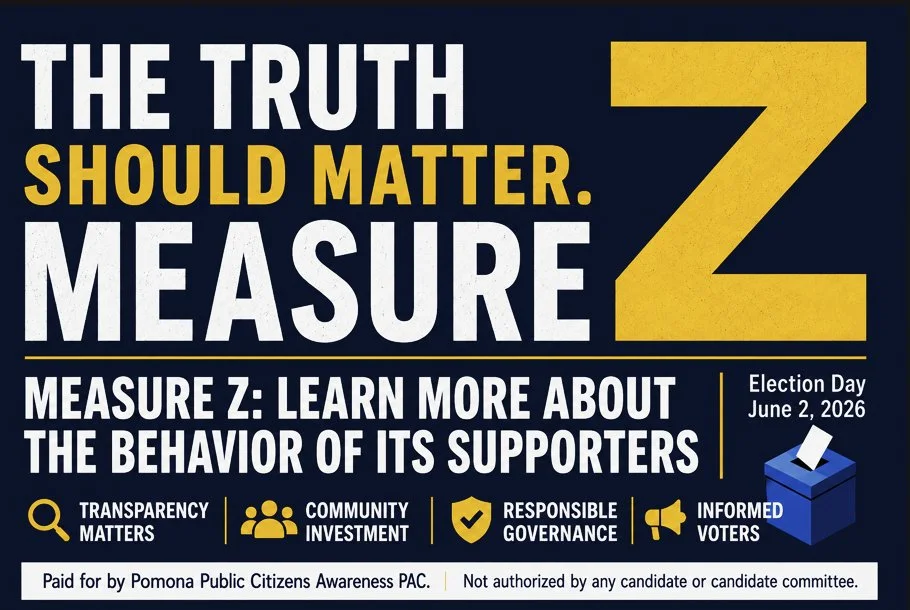
Measure Z: Learn More About the Behavior of its Supporters

Pomona politics has always had an oddly territorial quality to it. After a while, you begin noticing a kind of hyper-local identity bubble surrounding parts of Pomona’s culture, where social belonging, familiarity, and longtime relationships often matter as much as the actual issues being debated.

The public reaction surrounding Measure Z has exposed that dynamic in ways that go far beyond budgeting or youth funding.

At first glance the debate appears to be about budgeting. Youth funding versus city services. Fiscal responsibility versus protected investment. But spend enough time watching the social media conversations unfold and another pattern starts emerging underneath the numbers. The debate quickly stops being about policy and starts becoming about legitimacy. Suddenly the real question becomes, who is actually allowed to speak for Pomona? 

Support Measure Y publicly and watch what happens. Where do you live? How long have you lived here? Are you a home owner, or just a renter? Who do you work for? Are you connected to outside organizations? Do you actually understand the city? Did you even read the measure correctly? Are you really a concerned resident or just somebody pushing another agenda? Residents defending youth investment increasingly find themselves having to explain their community ties, backgrounds, volunteer history, employment, and even family roots simply to participate in the conversation without suspicion.

That reaction is revealing. Because healthy civic disagreement usually focuses on the policy itself. The insular community prioritizes social belonging over outside connection.

And once a city begins treating political disagreement like possible infiltration, the conversation shifts into something much deeper than budgeting.

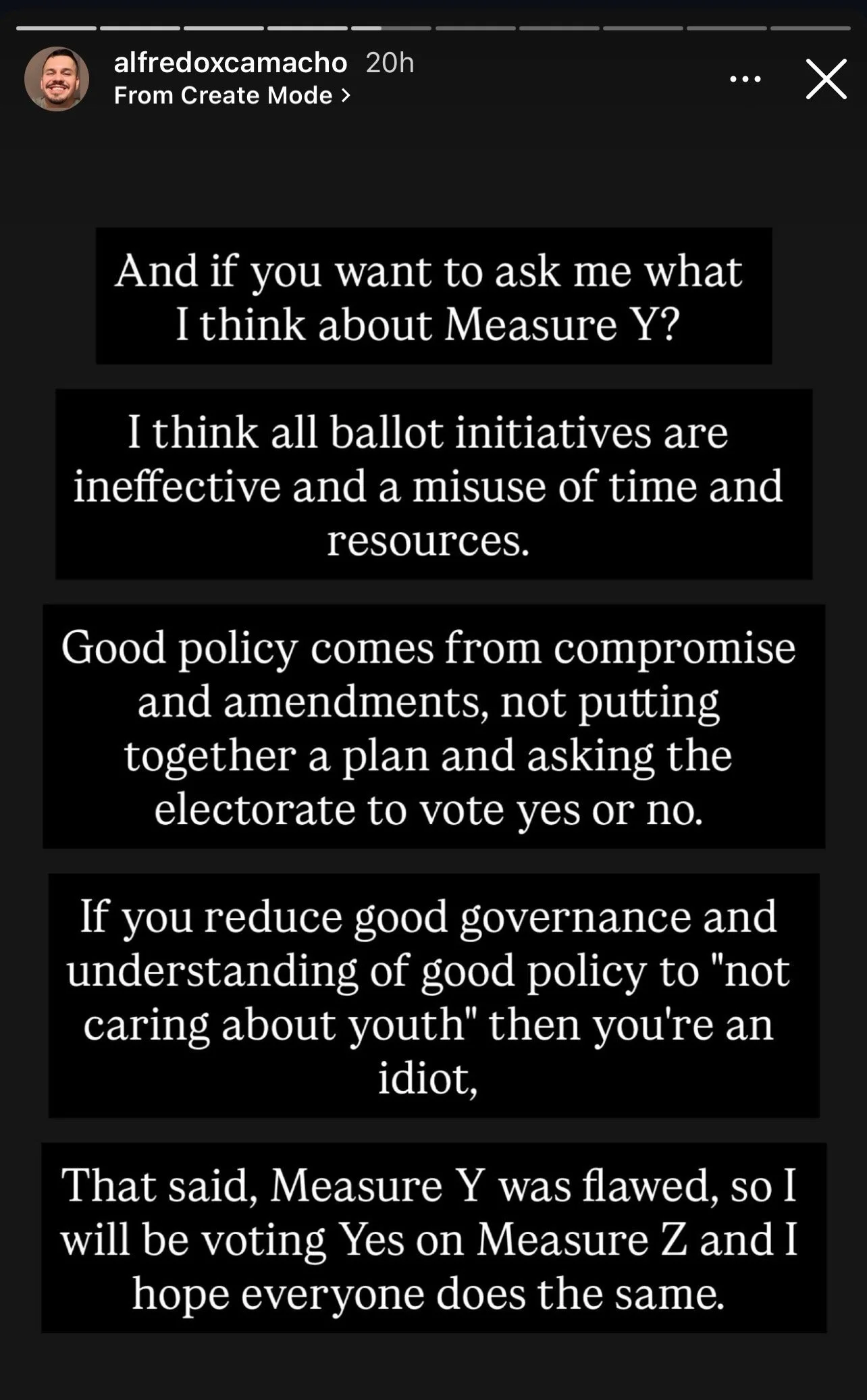
And the language surrounding Measure Y has repeatedly drifted into exactly that territory. Opponents regularly describe supporters as influenced by “coastal elites,” outside organizations, Northern California money, or people who supposedly do not understand the consequences of what they voted for. One of the more revealing arguments circulating publicly is the claim that the only reason Measure Y passed was because average voters “didn’t understand” the impact it would have on the city.

That is an extraordinary thing to say about your own electorate.

Because once you frame voters as uninformed, manipulated, or emotionally misled, every supporter of the measure becomes politically suspect by default. Support for youth investment no longer appears as a legitimate civic position. It becomes evidence of confusion, outside influence, or ideological capture.

At times the reaction begins resembling the same insulated political behavior visible throughout national politics, where disagreement itself becomes treated as evidence of infiltration rather than a normal part of democracy.

And that is where the conversation starts revealing deeper anxieties inside Pomona’s political ecosystem.

For decades the city has comfortably operated through overlapping relationships between nonprofits, political figures, consultants, developers, commissions, unions, business interests, and civic organizations. None of that was ever treated like some dangerous outside invasion threatening the soul of Pomona. The city absorbed years of redevelopment promises, consultant culture, politically connected projects, and uneven reinvestment without this level of existential panic.

In cities this insular, even the self-proclaimed “only” local media (LOL) eventually stop functioning like independent observers and start sounding like extensions of the same political social circles protecting each other from criticism. 

There is also something almost performative in the way fiscal responsibility suddenly enters the conversation once youth funding becomes structurally protected. Pomona residents spent years watching warehouses spread across the city, expensive revitalization promises come and go, consultant studies pile up, executive compensation rise well into the hundreds of thousands, and politically connected development culture operate with relatively little public hysteria about bankruptcy. Public salary databases already show multiple city positions with total compensation reaching deep into six figures. Yet once the discussion shifts toward guaranteed investment in young people, the language immediately becomes apocalyptic. Suddenly the city is supposedly standing at the edge of collapse. That contrast is difficult to ignore.  

But Measure Y triggered something different.

Another revealing argument repeated throughout the debate is the insistence that Pomona already has youth programs. But that response unintentionally exposes another layer of the conflict. The issue was never whether young people receive absolutely nothing. The issue was who controls the investment, how protected it remains over time, and whether funding stays dependent on the same familiar institutional networks already embedded within the city’s political culture. Symbolic support feels comfortable when it moves through existing relationships. Structural obligation feels different.

Because unlike symbolic campaign promises about helping youth “someday,” Measure Y attempted to structurally protect funding outside the normal rhythm of political discretion. And once public money becomes structurally protected, the old political comfort zone starts changing. Future councils lose flexibility. Institutional networks lose leverage. The familiar relationship between speeches, priorities, and spending begins shifting away from personality-driven politics and toward obligation.

That is why the reaction feels so emotionally charged.

The fear is not simply about numbers on a spreadsheet. The fear is about losing control over the narrative of who gets to define Pomona’s priorities moving forward.

And honestly, that is why so much of the debate has started sounding strangely territorial. The rhetoric repeatedly circles back toward authenticity, belonging, and ownership over the city itself. Who is a “real” Pomonan? Who understands the city properly? Who gets trusted automatically? Who has to prove themselves first?

What makes the reaction especially revealing is how tightly parts of Pomona’s political culture now operate through identity, loyalty, and social belonging. “One Pomona,” a phrase heavily promoted over the years as a vision of unity, increasingly begins functioning less like a civic ideal and more like a political social circle with a strangely cult-like relationship to disagreement. Once that happens, disagreement itself becomes treated as betrayal.

Once that happens, criticism no longer feels like ordinary democratic conflict. It feels personal. Outsiders become suspicious. Dissent becomes disloyalty, and the name calling begins among grown-adults. And support for structurally protected youth funding suddenly gets interpreted as an attack on the city itself rather than a policy disagreement between residents.

Those questions now appear almost as often as discussions about the actual measures.

The irony is that cities do not survive by becoming socially sealed ecosystems suspicious of every unfamiliar voice or political coalition. Cities evolve through participation, disagreement, demographic change, migration, organizing, experimentation, and new generations demanding different priorities than the ones before them. Pomona itself has always been shaped by outside forces, regional economics, state policies, transportation systems, labor migration, development interests, and cultural change. The idea that the city exists as some isolated political island untouched by outside influence has never really been true.

But insular political cultures often respond to change by tightening social boundaries instead of widening civic conversation.

And that is exactly what parts of Pomona have revealed. 


Julian Lucas is a darkroom photographer, writer, and a bookseller, though photography remains his primary language. He is the founder of Mirrored Society Book Shop, publisher of The Pomonan, and creator of Book-Store and Print Pomona Art Book Fair. And yes he will charge you 2.5 Million dollars for event photography.