
Pomona

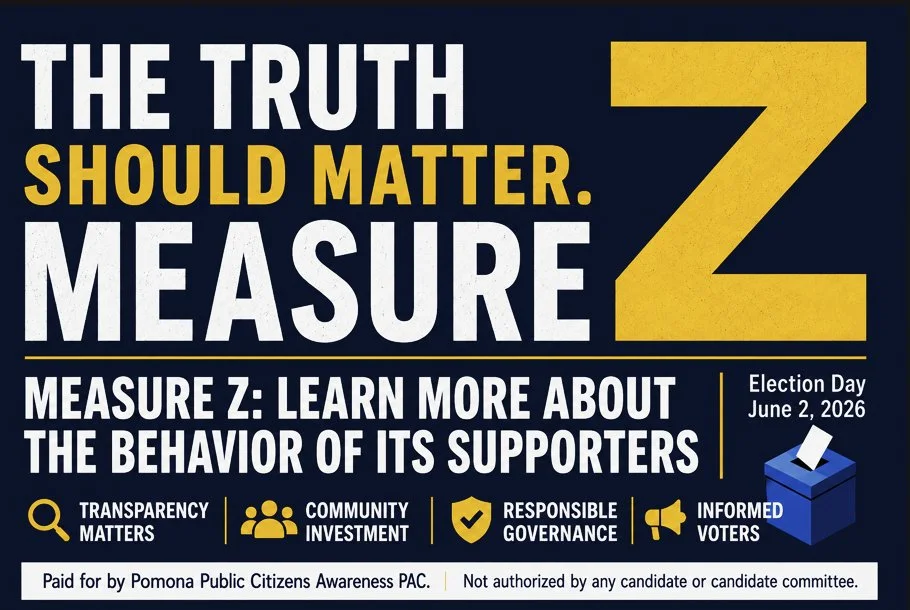
Measure Z: Learn More About the Behavior of its Supporters

Pomona politics has always had an oddly territorial quality to it. After a while, you begin noticing a kind of hyper-local identity bubble surrounding parts of Pomona’s culture, where social belonging, familiarity, and longtime relationships often matter as much as the actual issues being debated.

The public reaction surrounding Measure Z has exposed that dynamic in ways that go far beyond budgeting or youth funding.

At first glance the debate appears to be about budgeting. Youth funding versus city services. Fiscal responsibility versus protected investment. But spend enough time watching the social media conversations unfold and another pattern starts emerging underneath the numbers. The debate quickly stops being about policy and starts becoming about legitimacy. Suddenly the real question becomes, who is actually allowed to speak for Pomona? 

Support Measure Y publicly and watch what happens. Where do you live? How long have you lived here? Are you a home owner, or just a renter? Who do you work for? Are you connected to outside organizations? Do you actually understand the city? Did you even read the measure correctly? Are you really a concerned resident or just somebody pushing another agenda? Residents defending youth investment increasingly find themselves having to explain their community ties, backgrounds, volunteer history, employment, and even family roots simply to participate in the conversation without suspicion.

That reaction is revealing. Because healthy civic disagreement usually focuses on the policy itself. The insular community prioritizes social belonging over outside connection.

And once a city begins treating political disagreement like possible infiltration, the conversation shifts into something much deeper than budgeting.

And the language surrounding Measure Y has repeatedly drifted into exactly that territory. Opponents regularly describe supporters as influenced by “coastal elites,” outside organizations, Northern California money, or people who supposedly do not understand the consequences of what they voted for. One of the more revealing arguments circulating publicly is the claim that the only reason Measure Y passed was because average voters “didn’t understand” the impact it would have on the city.

That is an extraordinary thing to say about your own electorate.

Because once you frame voters as uninformed, manipulated, or emotionally misled, every supporter of the measure becomes politically suspect by default. Support for youth investment no longer appears as a legitimate civic position. It becomes evidence of confusion, outside influence, or ideological capture.

At times the reaction begins resembling the same insulated political behavior visible throughout national politics, where disagreement itself becomes treated as evidence of infiltration rather than a normal part of democracy.

And that is where the conversation starts revealing deeper anxieties inside Pomona’s political ecosystem.

For decades the city has comfortably operated through overlapping relationships between nonprofits, political figures, consultants, developers, commissions, unions, business interests, and civic organizations. None of that was ever treated like some dangerous outside invasion threatening the soul of Pomona. The city absorbed years of redevelopment promises, consultant culture, politically connected projects, and uneven reinvestment without this level of existential panic.

In cities this insular, even the self-proclaimed “only” local media (LOL) eventually stop functioning like independent observers and start sounding like extensions of the same political social circles protecting each other from criticism. 

There is also something almost performative in the way fiscal responsibility suddenly enters the conversation once youth funding becomes structurally protected. Pomona residents spent years watching warehouses spread across the city, expensive revitalization promises come and go, consultant studies pile up, executive compensation rise well into the hundreds of thousands, and politically connected development culture operate with relatively little public hysteria about bankruptcy. Public salary databases already show multiple city positions with total compensation reaching deep into six figures. Yet once the discussion shifts toward guaranteed investment in young people, the language immediately becomes apocalyptic. Suddenly the city is supposedly standing at the edge of collapse. That contrast is difficult to ignore.  

But Measure Y triggered something different.

Another revealing argument repeated throughout the debate is the insistence that Pomona already has youth programs. But that response unintentionally exposes another layer of the conflict. The issue was never whether young people receive absolutely nothing. The issue was who controls the investment, how protected it remains over time, and whether funding stays dependent on the same familiar institutional networks already embedded within the city’s political culture. Symbolic support feels comfortable when it moves through existing relationships. Structural obligation feels different.

Because unlike symbolic campaign promises about helping youth “someday,” Measure Y attempted to structurally protect funding outside the normal rhythm of political discretion. And once public money becomes structurally protected, the old political comfort zone starts changing. Future councils lose flexibility. Institutional networks lose leverage. The familiar relationship between speeches, priorities, and spending begins shifting away from personality-driven politics and toward obligation.

That is why the reaction feels so emotionally charged.

The fear is not simply about numbers on a spreadsheet. The fear is about losing control over the narrative of who gets to define Pomona’s priorities moving forward.

And honestly, that is why so much of the debate has started sounding strangely territorial. The rhetoric repeatedly circles back toward authenticity, belonging, and ownership over the city itself. Who is a “real” Pomonan? Who understands the city properly? Who gets trusted automatically? Who has to prove themselves first?

What makes the reaction especially revealing is how tightly parts of Pomona’s political culture now operate through identity, loyalty, and social belonging. “One Pomona,” a phrase heavily promoted over the years as a vision of unity, increasingly begins functioning less like a civic ideal and more like a political social circle with a strangely cult-like relationship to disagreement. Once that happens, disagreement itself becomes treated as betrayal.

Once that happens, criticism no longer feels like ordinary democratic conflict. It feels personal. Outsiders become suspicious. Dissent becomes disloyalty, and the name calling begins among grown-adults. And support for structurally protected youth funding suddenly gets interpreted as an attack on the city itself rather than a policy disagreement between residents.

Those questions now appear almost as often as discussions about the actual measures.

The irony is that cities do not survive by becoming socially sealed ecosystems suspicious of every unfamiliar voice or political coalition. Cities evolve through participation, disagreement, demographic change, migration, organizing, experimentation, and new generations demanding different priorities than the ones before them. Pomona itself has always been shaped by outside forces, regional economics, state policies, transportation systems, labor migration, development interests, and cultural change. The idea that the city exists as some isolated political island untouched by outside influence has never really been true.

But insular political cultures often respond to change by tightening social boundaries instead of widening civic conversation.

And that is exactly what parts of Pomona have revealed. 


Julian Lucas is a darkroom photographer, writer, and a bookseller, though photography remains his primary language. He is the founder of Mirrored Society Book Shop, publisher of The Pomonan, and creator of Book-Store and Print Pomona Art Book Fair. And yes he will charge you 2.5 Million dollars for event photography.
The Municipal Romance of Trash, Trucks, and Campaign Cash

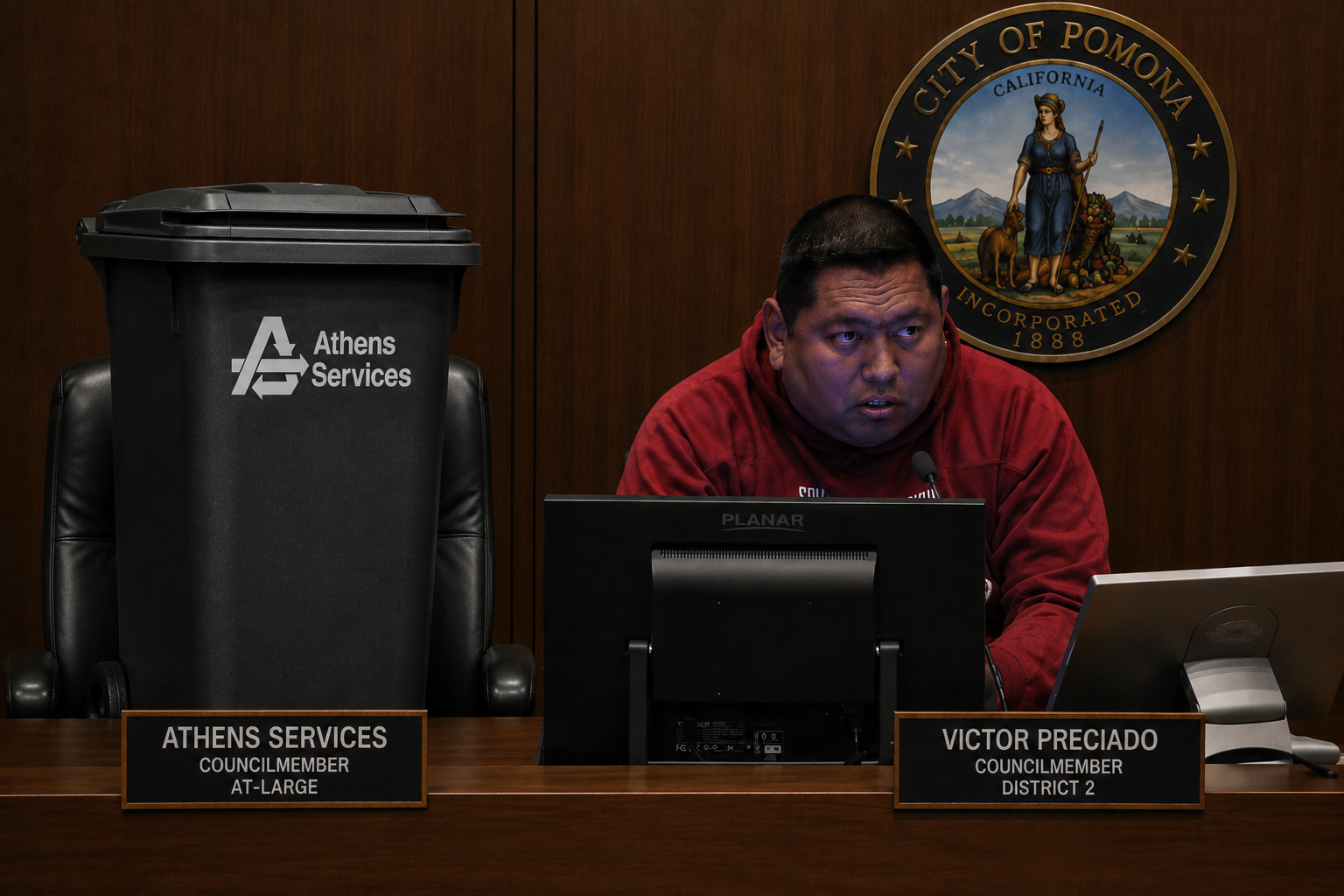
A campaign contribution from Athens Services is reopening old questions about privatization, infrastructure, political alliances, and who Pomona believes City Hall ultimately serves.

Editorial illustration by The Pomonan

There are only a few things less glamorous than garbage. It sits outside quietly in black and blue containers, rolled toward the curb once a week with the expectation that it disappears before the next morning. Most residents do not think about sanitation contracts, transfer stations, hauling agreements, or municipal privatization until something changes. But when the bill jumps. A service changes. A truck appears more often than it used to. Then suddenly, garbage becomes political.

And of course, in Pomona, where politics increasingly feels trendier than the restaurants, galleries, and art itself, trash had already become a political issue long before campaign season arrived. 

For years, residents, business owners, and city observers have argued over the city’s relationship with Athens Services, the private company tied to Pomona’s controversial waste collection transition. Some defended the move as modernization. Others viewed it as another example of a city steadily outsourcing pieces of itself while residents were left absorbing the consequences in real time.

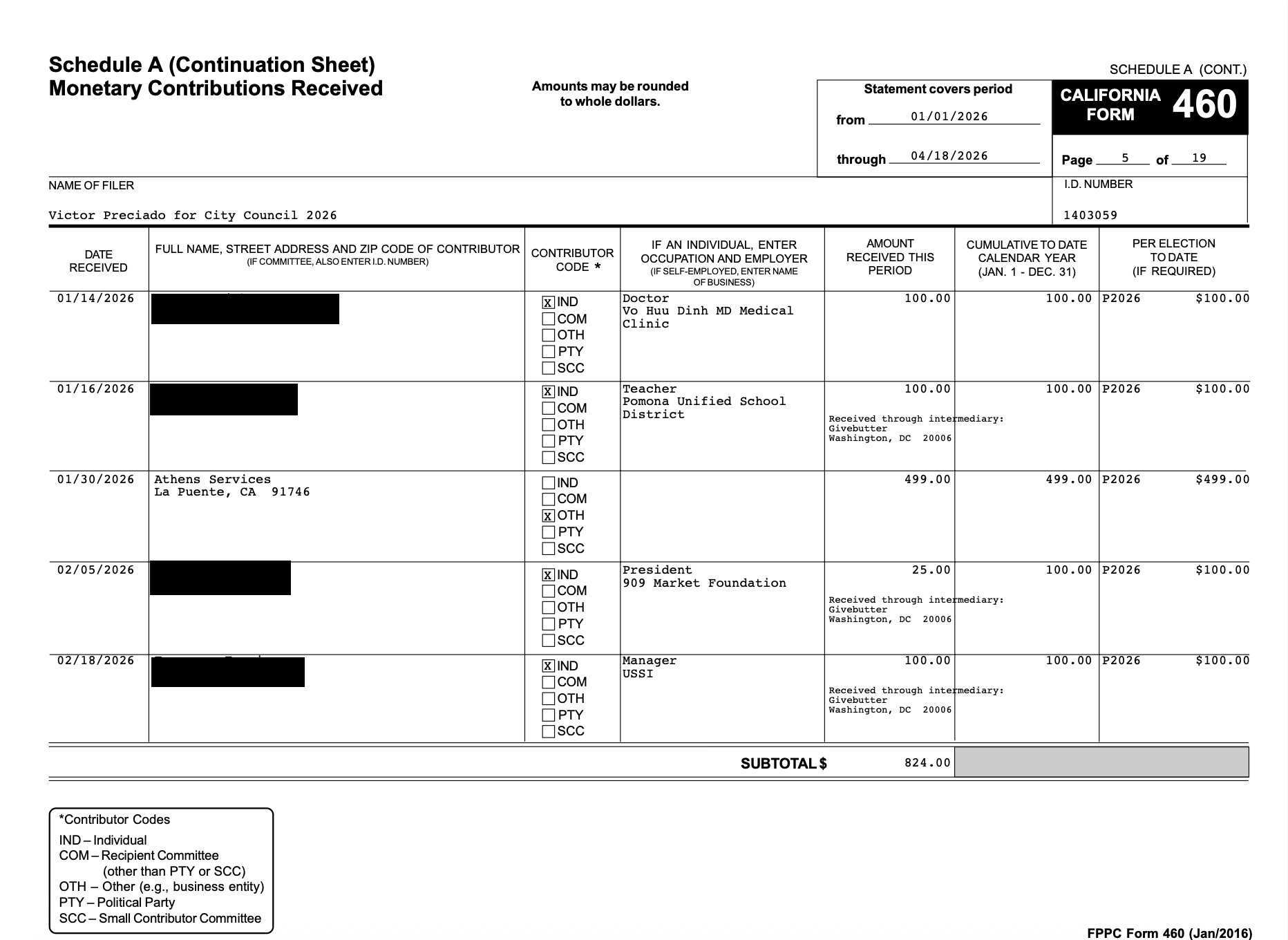
Now there's an issue that has entered the campaign season directly. Public campaign finance filings for Victor Preciado’s 2026 reelection campaign show a $499 contribution from Athens Services dated January 30, 2026. Preciado is not a neutral observer in Pomona’s trash debate. As an incumbent councilmember, he sits inside the same governing structure that defended and normalized the city’s relationship with Athens while residents and businesses continued raising concerns about cost, accountability, and transparency. 

The amount itself is not a 5 million dollar lottery ticket. In California politics, $499 barely qualifies as eyebrow raising. But local politics operates differently than Sacramento or Washington. In municipal elections, symbolism often matters more than scale. Residents do not experience city government through million dollar lobbying campaigns. They experience it through potholes, homicides (unless the cops are not reporting) warehouse fires, zoning decisions, abandoned buildings, police response times, parks, and trash bills. That is why the contribution matters.

Not because it proves corruption. It doesn’t. Campaign donations are legal and happen all the time. But when a company tied to one of the city’s most controversial contracts starts donating to elected officials during election season, people are naturally going to question how close City Hall has become with the same companies doing business with the city. 

The Athens debate never really ended in Pomona because it was never just about trash pickup. It has always been about control.

Residents watched the city transition away from a municipal service structure toward privatization while being told efficiency and improvement would follow. Instead, many businesses complained about increased costs. Residents questioned accountability. Illegal dumping remained visible in  parts of the city. And politically, the issue lingered in the background like the smell residents insist they notice even when officials pretend not to.

Meanwhile, parts of Pomona continue carrying the physical burden of the region’s infrastructure economy. District 3 remains surrounded by warehouses, truck routes, industrial land use, and the waste transfer station itself, where the movement of garbage becomes part of the neighborhood landscape rather than an invisible municipal function hidden safely elsewhere.

This is where Pomona’s politics become revealing. 

The city often speaks about growth abstractly, but growth always lands somewhere physically. Warehouses land somewhere. Heavy truck traffic lands somewhere. Waste infrastructure lands somewhere. Rarely are those burdens distributed evenly across the map. Some neighborhoods become corridors. Others become destinations.

And once residents begin seeing those patterns, every campaign contribution starts carrying a little more meaning than it otherwise might.

The current election cycle is already exposing tensions inside Pomona’s political culture. Challengers are openly discussing council voting blocs, predictable alliances, and decisions that residents increasingly believe are settled before meetings even begin. Questions about transparency, consent agendas, and political alignment are surfacing more publicly than they have in years.

The Athens contribution enters that atmosphere at precisely the wrong time for incumbents hoping the trash debate had faded quietly into administrative history. Because residents remember.

They remember the transition. They remember the arguments. They remember who defended the contract and who questioned it. More importantly, they remember that one of the most basic services in city life became a symbol for something larger. The feeling that decisions affecting everyday people are often negotiated far above them, then delivered back down as inevitabilities.

The problem for incumbents like Victor Preciado is not simply that residents noticed the contribution. It is that many residents already believe City Hall has grown too comfortable operating within a small political orbit where contractors, council alliances, and major city decisions increasingly overlap.

And that is the danger for Pomona’s political establishment heading into 2026. Not the contribution itself. The timing.

Because once infrastructure, campaign finance, district frustration, and public distrust begin entering the same conversation, local politics stops feeling procedural. It starts feeling personal.

Garbage has a way of doing that.

Op-ed: Why Transparency is Important and how Pomona Can Achieve it

Transparency is the principle of allowing those affected by administrative decisions to know about the resulting facts and figures and about the process that resulted in those decisions. – ICMA

Published January 12, 2024 | 7:35 am PST

The principle of open government is not new. Throughout our nation’s history we have made progress on making government more accountable and accessible to voters. Yet, many people still feel that government is not responsive to their concerns. This cynicism about government leads to low public participation in elections. In California, 81 percent of eligible voters are registered to vote, and only 41 percent of eligible voters cast ballots. In Pomona, off cycle elections typically see a turnout of 25 percent of registered voters. The lack of voter participation is due to a lack of transparency in decision-making. The voters can change this by insisting Pomona adopt a transparent budget process that engages the community and values their participation.

If you ask any elected official in Pomona if they think government should be participatory, they will likely answer in the affirmative. If you ask these same officials what they are doing to make governing more participatory, you’ll probably get a blank stare. Pomona struggles with finding constructive ways to engage residents in the decision-making process because the city schedules meetings at times that are inconvenient for residents. In 2023 the city announced budget meetings for March 27 at 5:30 pm and another on April 5 at 3:00 pm. These meetings are not accessible to people who work, but then maybe that’s the point of scheduling meetings at times where public participation is not possible. Participatory government is one whose intent is to make itself accessible to residents where they reside and at times that are convenient to them. The metric for these meetings should be the number in attendance, not the number of meetings. Having meetings at times that people cannot attend demonstrates a desire to prevent citizen participation. We should not accept a situation where our elected officials refuse to create forums for meaningful citizen participation.

Government should be collaborative. A collaborative government seeks to find ways to obtain community and stakeholder input on policies and community priorities. It uses an iterative process to inform decision-making. By creating a feedback loop, an iterative process ensures that policies can be adapted to changing conditions or as new information exposes flaws in previous approaches. A collaborative process ensures a dialogue rather than a focus on point-in-time feedback. The City currently employs surveys to obtain resident feedback but does not engage in ongoing discussions about policy implementation, updates on approaches, or alternatives to current approaches. Quarterly and midyear updates and meetings on important city projects should be the norm to ensure that residents remain informed about the status of these projects. These meetings should be more informal than council meetings to ensure that residents have the opportunity to engage in a dialogue with staff and elected officials.

Government should be transparent. Transparency is more than informing the public what the decisions are, it is about informing residents how decisions are made and what factors were considered and rejected, and why. We know the city formulates priorities, but we do not have any understanding why or how these became priorities, or even what issues were rejected and why. Santa Monica employs a budget process where it holds year-round town halls to listen and document community priorities. Through these meetings the city formulates a budget, which is a political document that reflects the values and concerns of the residents. Without question, this is arduous work, but it is necessary towards ensuring a well-functioning and transparent budget process. More importantly, it allows residents to see their participation come to fruition as it becomes city policy.

These ideas are not new, they are part of the core values for Public Administrators and should act to guide elected officials. If Pomona made a sincere effort to adopt these values it would see greater resident participation, greater satisfaction with government, and a city whose policies are more closely aligned with resident values. We must not accept the status quo and must continue to insist that our elected officials agree to abide by these core values; and we must be willing to oust those who are reluctant or refuse to adhere to them.


Guillermo Gonzalez has a Master of Science in Public Administration from California State University – Los Angeles where he graduated with honors. He has been a resident of Pomona since 2011 and is currently a candidate for Pomona City Council.