
A campaign contribution from Athens Services is reopening old questions about privatization, infrastructure, political alliances, and who Pomona believes City Hall ultimately serves.
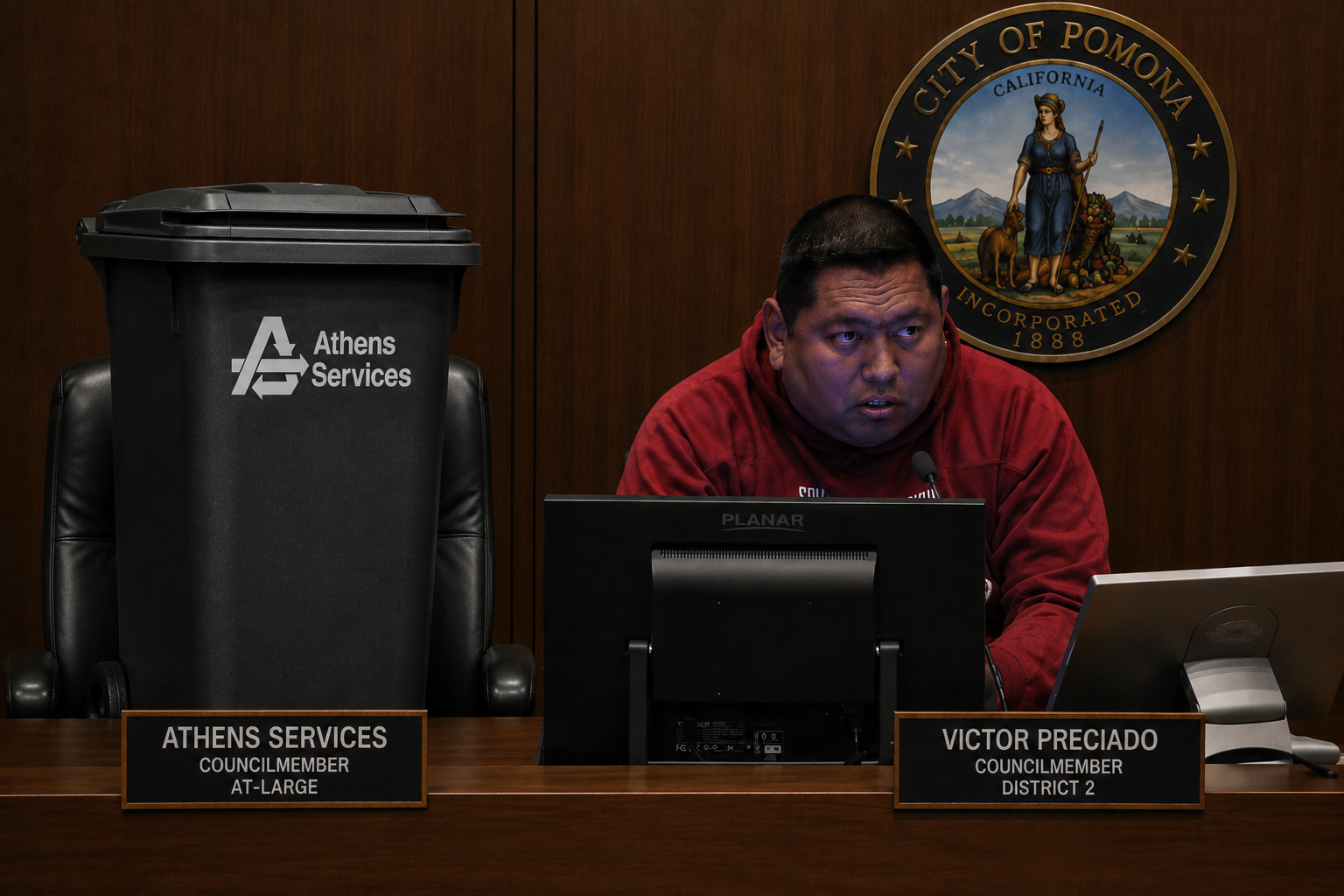
Editorial illustration by The Pomonan
There are only a few things less glamorous than garbage. It sits outside quietly in black and blue containers, rolled toward the curb once a week with the expectation that it disappears before the next morning. Most residents do not think about sanitation contracts, transfer stations, hauling agreements, or municipal privatization until something changes. But when the bill jumps. A service changes. A truck appears more often than it used to. Then suddenly, garbage becomes political.
And of course, in Pomona, where politics increasingly feels trendier than the restaurants, galleries, and art itself, trash had already become a political issue long before campaign season arrived.
For years, residents, business owners, and city observers have argued over the city’s relationship with Athens Services, the private company tied to Pomona’s controversial waste collection transition. Some defended the move as modernization. Others viewed it as another example of a city steadily outsourcing pieces of itself while residents were left absorbing the consequences in real time.
Now there's an issue that has entered the campaign season directly. Public campaign finance filings for Victor Preciado’s 2026 reelection campaign show a $499 contribution from Athens Services dated January 30, 2026. Preciado is not a neutral observer in Pomona’s trash debate. As an incumbent councilmember, he sits inside the same governing structure that defended and normalized the city’s relationship with Athens while residents and businesses continued raising concerns about cost, accountability, and transparency.
The amount itself is not a 5 million dollar lottery ticket. In California politics, $499 barely qualifies as eyebrow raising. But local politics operates differently than Sacramento or Washington. In municipal elections, symbolism often matters more than scale. Residents do not experience city government through million dollar lobbying campaigns. They experience it through potholes, homicides (unless the cops are not reporting) warehouse fires, zoning decisions, abandoned buildings, police response times, parks, and trash bills. That is why the contribution matters.
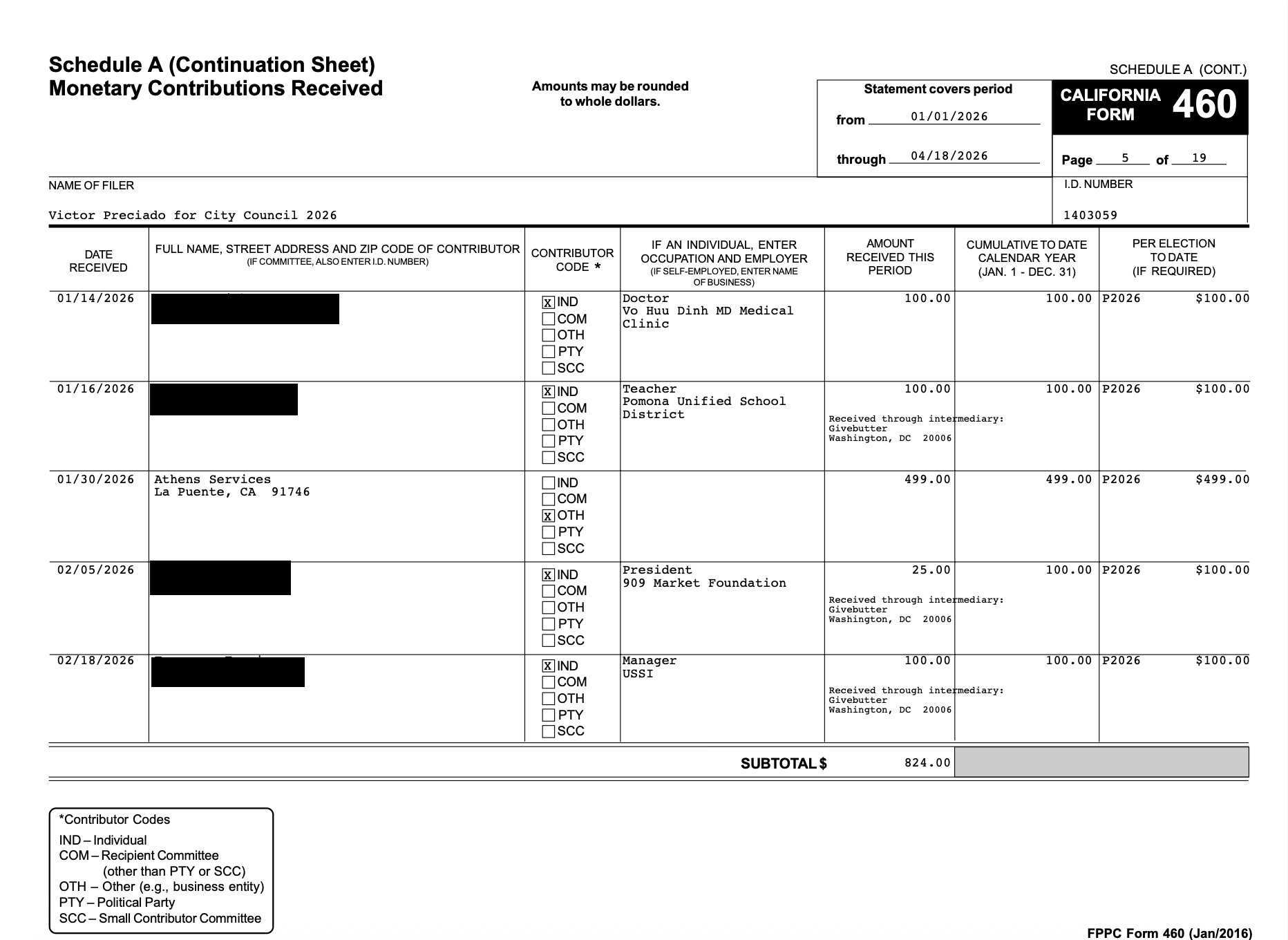
Not because it proves corruption. It doesn’t. Campaign donations are legal and happen all the time. But when a company tied to one of the city’s most controversial contracts starts donating to elected officials during election season, people are naturally going to question how close City Hall has become with the same companies doing business with the city.
The Athens debate never really ended in Pomona because it was never just about trash pickup. It has always been about control.
Residents watched the city transition away from a municipal service structure toward privatization while being told efficiency and improvement would follow. Instead, many businesses complained about increased costs. Residents questioned accountability. Illegal dumping remained visible in parts of the city. And politically, the issue lingered in the background like the smell residents insist they notice even when officials pretend not to.
Meanwhile, parts of Pomona continue carrying the physical burden of the region’s infrastructure economy. District 3 remains surrounded by warehouses, truck routes, industrial land use, and the waste transfer station itself, where the movement of garbage becomes part of the neighborhood landscape rather than an invisible municipal function hidden safely elsewhere.
This is where Pomona’s politics become revealing.
The city often speaks about growth abstractly, but growth always lands somewhere physically. Warehouses land somewhere. Heavy truck traffic lands somewhere. Waste infrastructure lands somewhere. Rarely are those burdens distributed evenly across the map. Some neighborhoods become corridors. Others become destinations.
And once residents begin seeing those patterns, every campaign contribution starts carrying a little more meaning than it otherwise might.
The current election cycle is already exposing tensions inside Pomona’s political culture. Challengers are openly discussing council voting blocs, predictable alliances, and decisions that residents increasingly believe are settled before meetings even begin. Questions about transparency, consent agendas, and political alignment are surfacing more publicly than they have in years.
The Athens contribution enters that atmosphere at precisely the wrong time for incumbents hoping the trash debate had faded quietly into administrative history. Because residents remember.
They remember the transition. They remember the arguments. They remember who defended the contract and who questioned it. More importantly, they remember that one of the most basic services in city life became a symbol for something larger. The feeling that decisions affecting everyday people are often negotiated far above them, then delivered back down as inevitabilities.
The problem for incumbents like Victor Preciado is not simply that residents noticed the contribution. It is that many residents already believe City Hall has grown too comfortable operating within a small political orbit where contractors, council alliances, and major city decisions increasingly overlap.
And that is the danger for Pomona’s political establishment heading into 2026. Not the contribution itself. The timing.
Because once infrastructure, campaign finance, district frustration, and public distrust begin entering the same conversation, local politics stops feeling procedural. It starts feeling personal.
Garbage has a way of doing that.


