Pomona Politics

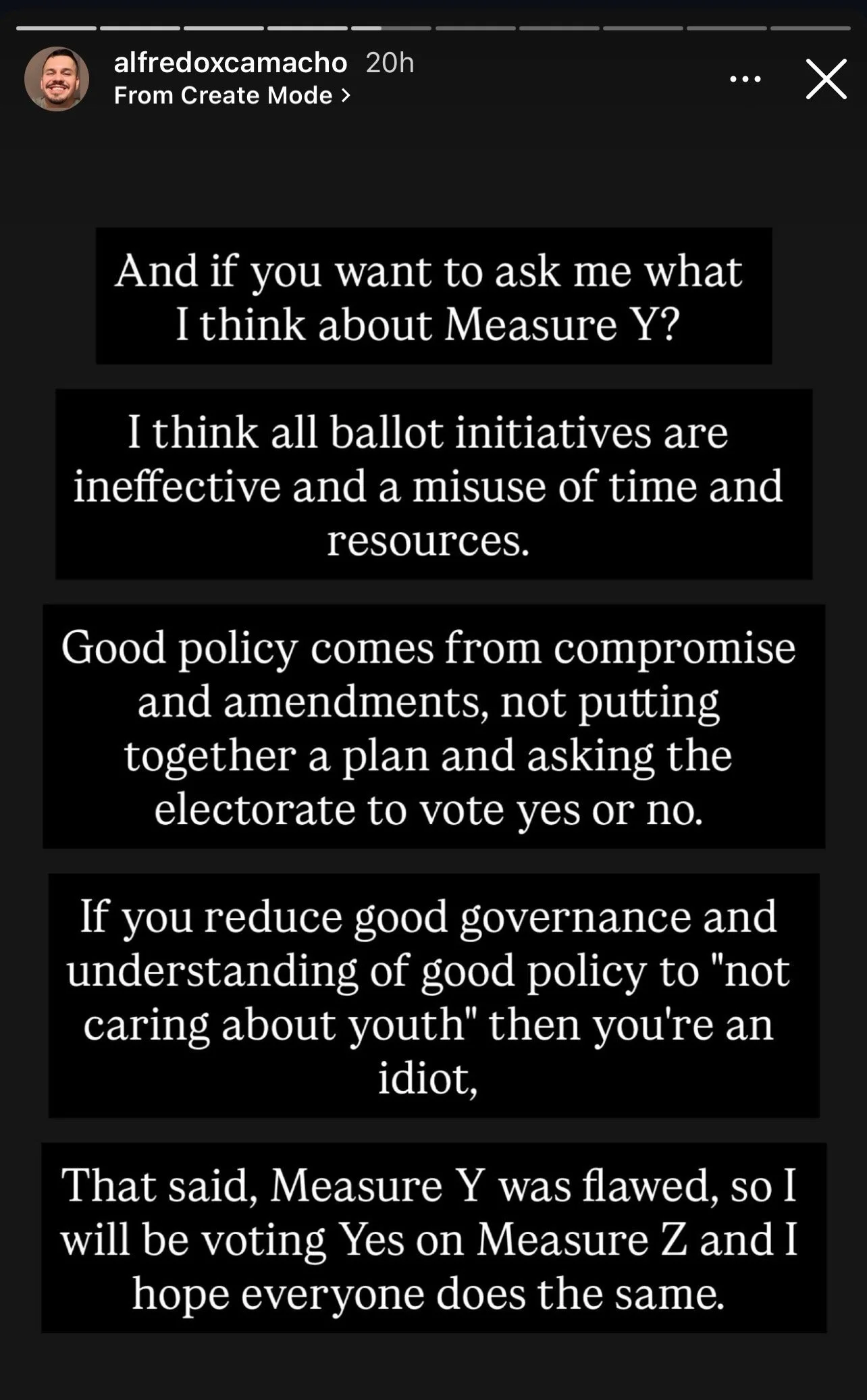
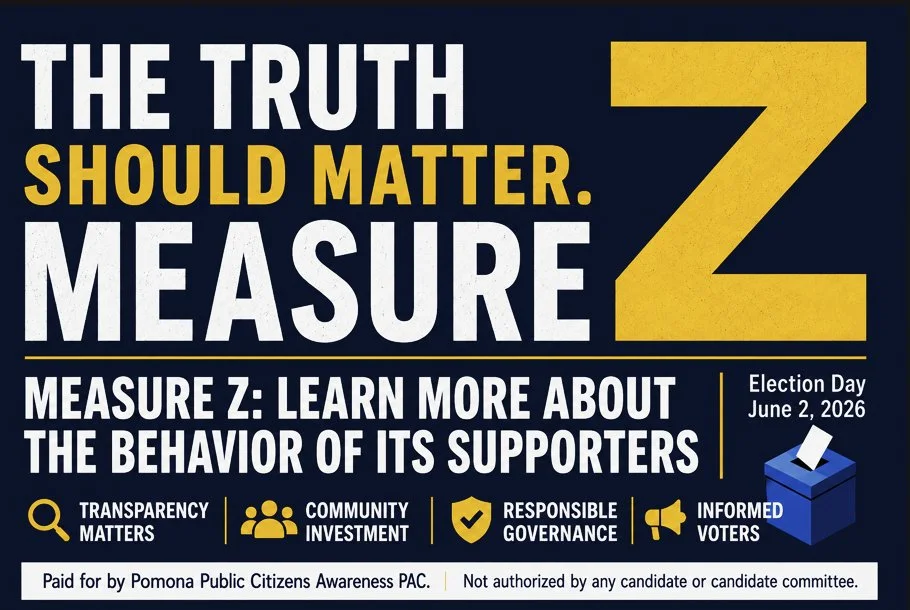
Measure Z: Learn More About the Behavior of its Supporters

Pomona politics has always had an oddly territorial quality to it. After a while, you begin noticing a kind of hyper-local identity bubble surrounding parts of Pomona’s culture, where social belonging, familiarity, and longtime relationships often matter as much as the actual issues being debated.

The public reaction surrounding Measure Z has exposed that dynamic in ways that go far beyond budgeting or youth funding.

At first glance the debate appears to be about budgeting. Youth funding versus city services. Fiscal responsibility versus protected investment. But spend enough time watching the social media conversations unfold and another pattern starts emerging underneath the numbers. The debate quickly stops being about policy and starts becoming about legitimacy. Suddenly the real question becomes, who is actually allowed to speak for Pomona? 

Support Measure Y publicly and watch what happens. Where do you live? How long have you lived here? Are you a home owner, or just a renter? Who do you work for? Are you connected to outside organizations? Do you actually understand the city? Did you even read the measure correctly? Are you really a concerned resident or just somebody pushing another agenda? Residents defending youth investment increasingly find themselves having to explain their community ties, backgrounds, volunteer history, employment, and even family roots simply to participate in the conversation without suspicion.

That reaction is revealing. Because healthy civic disagreement usually focuses on the policy itself. The insular community prioritizes social belonging over outside connection.

And once a city begins treating political disagreement like possible infiltration, the conversation shifts into something much deeper than budgeting.

And the language surrounding Measure Y has repeatedly drifted into exactly that territory. Opponents regularly describe supporters as influenced by “coastal elites,” outside organizations, Northern California money, or people who supposedly do not understand the consequences of what they voted for. One of the more revealing arguments circulating publicly is the claim that the only reason Measure Y passed was because average voters “didn’t understand” the impact it would have on the city.

That is an extraordinary thing to say about your own electorate.

Because once you frame voters as uninformed, manipulated, or emotionally misled, every supporter of the measure becomes politically suspect by default. Support for youth investment no longer appears as a legitimate civic position. It becomes evidence of confusion, outside influence, or ideological capture.

At times the reaction begins resembling the same insulated political behavior visible throughout national politics, where disagreement itself becomes treated as evidence of infiltration rather than a normal part of democracy.

And that is where the conversation starts revealing deeper anxieties inside Pomona’s political ecosystem.

For decades the city has comfortably operated through overlapping relationships between nonprofits, political figures, consultants, developers, commissions, unions, business interests, and civic organizations. None of that was ever treated like some dangerous outside invasion threatening the soul of Pomona. The city absorbed years of redevelopment promises, consultant culture, politically connected projects, and uneven reinvestment without this level of existential panic.

In cities this insular, even the self-proclaimed “only” local media (LOL) eventually stop functioning like independent observers and start sounding like extensions of the same political social circles protecting each other from criticism. 

There is also something almost performative in the way fiscal responsibility suddenly enters the conversation once youth funding becomes structurally protected. Pomona residents spent years watching warehouses spread across the city, expensive revitalization promises come and go, consultant studies pile up, executive compensation rise well into the hundreds of thousands, and politically connected development culture operate with relatively little public hysteria about bankruptcy. Public salary databases already show multiple city positions with total compensation reaching deep into six figures. Yet once the discussion shifts toward guaranteed investment in young people, the language immediately becomes apocalyptic. Suddenly the city is supposedly standing at the edge of collapse. That contrast is difficult to ignore.  

But Measure Y triggered something different.

Another revealing argument repeated throughout the debate is the insistence that Pomona already has youth programs. But that response unintentionally exposes another layer of the conflict. The issue was never whether young people receive absolutely nothing. The issue was who controls the investment, how protected it remains over time, and whether funding stays dependent on the same familiar institutional networks already embedded within the city’s political culture. Symbolic support feels comfortable when it moves through existing relationships. Structural obligation feels different.

Because unlike symbolic campaign promises about helping youth “someday,” Measure Y attempted to structurally protect funding outside the normal rhythm of political discretion. And once public money becomes structurally protected, the old political comfort zone starts changing. Future councils lose flexibility. Institutional networks lose leverage. The familiar relationship between speeches, priorities, and spending begins shifting away from personality-driven politics and toward obligation.

That is why the reaction feels so emotionally charged.

The fear is not simply about numbers on a spreadsheet. The fear is about losing control over the narrative of who gets to define Pomona’s priorities moving forward.

And honestly, that is why so much of the debate has started sounding strangely territorial. The rhetoric repeatedly circles back toward authenticity, belonging, and ownership over the city itself. Who is a “real” Pomonan? Who understands the city properly? Who gets trusted automatically? Who has to prove themselves first?

What makes the reaction especially revealing is how tightly parts of Pomona’s political culture now operate through identity, loyalty, and social belonging. “One Pomona,” a phrase heavily promoted over the years as a vision of unity, increasingly begins functioning less like a civic ideal and more like a political social circle with a strangely cult-like relationship to disagreement. Once that happens, disagreement itself becomes treated as betrayal.

Once that happens, criticism no longer feels like ordinary democratic conflict. It feels personal. Outsiders become suspicious. Dissent becomes disloyalty, and the name calling begins among grown-adults. And support for structurally protected youth funding suddenly gets interpreted as an attack on the city itself rather than a policy disagreement between residents.

Those questions now appear almost as often as discussions about the actual measures.

The irony is that cities do not survive by becoming socially sealed ecosystems suspicious of every unfamiliar voice or political coalition. Cities evolve through participation, disagreement, demographic change, migration, organizing, experimentation, and new generations demanding different priorities than the ones before them. Pomona itself has always been shaped by outside forces, regional economics, state policies, transportation systems, labor migration, development interests, and cultural change. The idea that the city exists as some isolated political island untouched by outside influence has never really been true.

But insular political cultures often respond to change by tightening social boundaries instead of widening civic conversation.

And that is exactly what parts of Pomona have revealed. 


Julian Lucas is a darkroom photographer, writer, and a bookseller, though photography remains his primary language. He is the founder of Mirrored Society Book Shop, publisher of The Pomonan, and creator of Book-Store and Print Pomona Art Book Fair. And yes he will charge you 2.5 Million dollars for event photography.
Op-ed: Water is Life

Published 02/22/2024 7:53am PST

As a lifelong, vested resident of this community–a proud husband, father, and grandfather who has raised his family here in Pomona, my dedication in protecting our water quality is not just a job to me, it’s personal.

Water is Life and must be safeguarded. It is our job at the water district to continue to provide our retail customers with a reliable source of water, and we pride ourselves in making sure of that, by working closely with the Water Resources Department in Pomona, our tap water is potable and safe for all your daily needs at home. In fact, to this day, I still drink our water from the tap.

Keeping Pomona’s water clean and affordable is no easy feat. One of the most significant fights in doing so was against the Cadiz Corporation plan to extract large quantities of groundwater from under dry lake beds in the Mojave desert from the Bonanza Springs. They are water speculators whose bizarre scheme was to drill for water under California's deserts and sell it to your area, which threatens springs that desert life depends on. This was not the solution to our water management and sustainability issues because Orange County would have had priority access to this water, and this water resource would have been depleted in a heartbeat. That is why I voted against it, even if I was a lone wolf in this decision. Ultimately, with the help of the Sierra Club, Native American tribes of the Mojave desert, community stakeholders and other water district colleagues who supported me in putting the project to rest.

Over the past 12 years of my tenure, the water district also strengthened partnerships with our local retail agencies like Pomona, Walnut Valley, and Rowland Water Districts in joint projects throughout our service area, to educate our community about water conservancy. This entailed how one exactly can become a wise water-conscious consumer through establishing drought tolerant landscaping, using water-efficient shower heads, toilets, and sprinklers in your homes and businesses.

Establishing career pathways, in partnership with other agencies and organizations in the water industry, for our students here in our community led to the initiation of the youth Junior Water Protectors Pilot Program. The goal of this program was to acclimate participants to the importance of water in their everyday life. This is something I will continue to advocate for to give students in communities of color exposure and access to careers that actually pay a livable working wage while tackling the drought issue. Many have joined our apprenticeship program and have gone on to obtain employment at various water districts.

Looking forward, it is imperative for us here at home to shore up our water supplies through stormwater capture and recharge of our basins and aquifers. Water reuse and recycling must also continue to be a priority. As we continue to deal with climate change and its effects on our weather, we must look at all options, including new technologies in desalination. By doing this we will lessen our dependence on imported water and ensure our water sustainability here athome for our community. If elected to the California State Assembly, one of my goals will be to continue this work for a better and safer future for all.


Carlos Goytia, an elected Three Valleys Municipal Water Board Trustee, is currently running for Assembly Member of Assembly District 52.

Community Responses: 2024 Mayoral & City Council Poll

By Julian Lucas
Published 12/20/2023 | 11:15 Am PST


Earlier this month, the Pomonan published an election poll, which included the race for Mayor and City Council Districts 1, 4, and 6. Additionally, the Pomonan asked a series of three questions in regards to transparency, accountability & election promises, and what issues voters feel need to be addressed.

The mayoral poll took a shocking turn when candidate California Assembly Member, Freddie Rodriguez from Assembly District 52, announced his candidacy for Mayor. Mayor Tim Sandoval, the incumbent, leading poll popularity was humbled and Rodriguez took a slight lead at the time of the poll’s closing.

Initially, District 1 City Council incumbent, John Nolte, had an enormous lead, but this lead quickly shrunk when Pomona Library Board of Trustees Commissioner Debra Martin made it known she was also running.

District 4’s incumbent, Elizabeth Cole-Ontiveras continues to lose popularity as voters continue to choose between the two other contenders, Chara Swodeck and Guillermo Gonzalez. Gonzalez has a commanding lead over both candidates.

There is no incumbent for the 2024 City Council race for District 6. The three contenders, Lorraine Canales, Miranda Sheffield, and Glenda Barillas are almost level at this point.

When individuals run for office, they promise to perform certain tasks once elected. Since the poll became active on December 4th voters have voiced their concerns about the functionality of the city. 76.6% of voters feel the leadership has not fulfilled their tasks as promised.

Voters also voiced their concerns about the lack of transparency in government. 76.6% feel there isn’t transparency within the government..

57.8% of voters feel Mayor Sandoval has not addressed important issues such as economic development, city budget management, infrastructure improvements, along with social equity and inclusion. While 20.8% voiced their confidence in the Mayor, but 20.1% said they were unsure.

Furthermore, community members were able to voice important concerns regarding what they’d like to see addressed by city leaders. Many concerns were voiced and the majority of what was concerning was crime, prostitution, and the unhoused situation. We have provided a list of items that are important concerns for the people of Pomona. This list does not include all concerns and many of the responders’ concerns were the same.

The concerns they listed tallied in this order: Crime followed by Taxes, Homelessness, Economic Development and Youth Services. 

The poll will close in 5 days, but The Pomonan plans to repoll in the spring and fall. The poll represents 154 people so far. They are responding in a city within a county that are both notorious for low voter registration rates and low voter turnout rates. 

The Pomonan sends an open invitation to all candidates to submit substantive op-eds stating their position on an issue (or issues) that they consider critical to our community. No campaign propaganda, please. The Pomonan plans to publish articles where a candidate takes a stand, explains their position and explains how they plan to address the issue.


Julian Lucas, is a photographer, a purveyor of books, and writer, but mostly a photographer. Don’t ever ask him to take photos of events. Julian is also the owner and founder of Mirrored Society Book Shop, publisher of The Pomonan, founder of Book-Store, and founder of PPABF.