
From Measure Y to Measure Z, what changed?
After Measure Z passed, Planning Commissioner Alfredo Camacho, M.P.P., posed a question that deserves an answer.
Why wasn’t anyone writing about Measure Z?
Fair question. Unlike “Pomona’s Only Local Newspaper”, The Pomonan does not require a month to process election results.
Measure Z won. Just about two-thirds of voters approved it. Pomona spent months debating Measure Z. Voters made up their minds pretty clearly. The measure passed, and the people who supported it have every right to celebrate the victory.
But election results are often the least interesting part of politics. Pomona politics is usually the most predictable part. If you’ve paid attention long enough, you generally have a good idea who will advance, who will be endorsed, and which political alliances will survive another election cycle. The campaign is where people make promises. The governing is where those promises are tested.
The more interesting question is how Pomona arrived here. Before there was Measure Z, there was Measure Y. Of course because in the alphabet Y comes before Z. Sometimes Pomona politics is more complicated than it needs to be. But it’s understandable. Z is the last letter of the alphabet. In Pomona politics, that would apparently mean the status quo has the last say.
Before there were debates about governance structures, amendments, and implementation plans, there was the grassroots effort called Pomona Kids First. The campaign argued that Pomona’s young people deserved dedicated investment and independent oversight. It was championed by organizers, educators, nonprofit leaders, parents, and residents who believed the city should make a long-term commitment to children and youth.
Among those supporters was Pomona Planning Commissioner, Alfredo Camacho, MPP. Campaign documents show Camacho formally endorsed Measure Y. He stated that he had read the initiative, supported its goals, agreed to recruit additional endorsers, and described the proposal as a vital investment in youth development, leadership opportunities, alternatives to incarceration, and community wellbeing. Measure Y was presented as an opportunity to strengthen families, support young people, and invest in Pomona’s future. But the conversation changed.
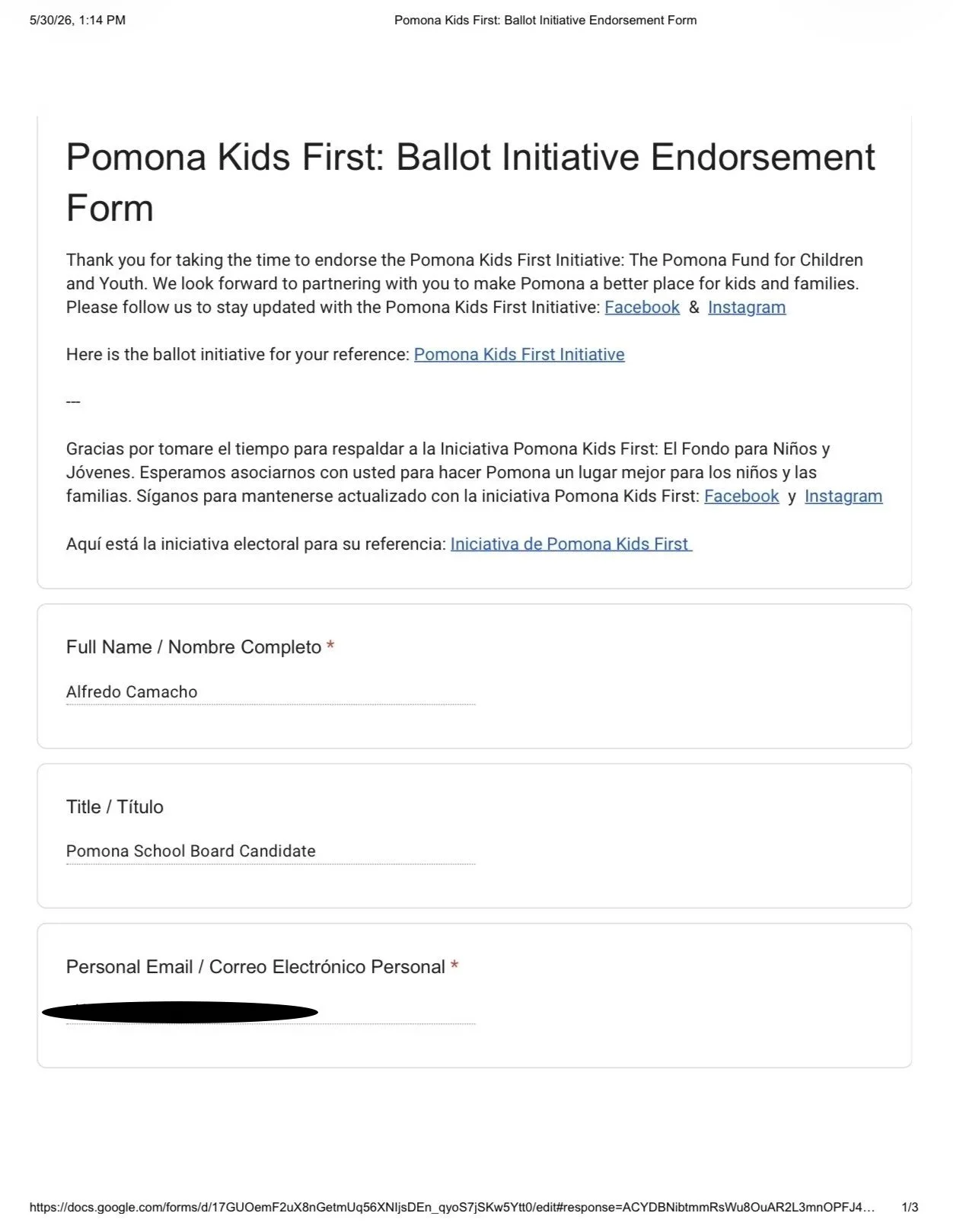
Source: Measure Y endorsement documents obtained by The Pomonan
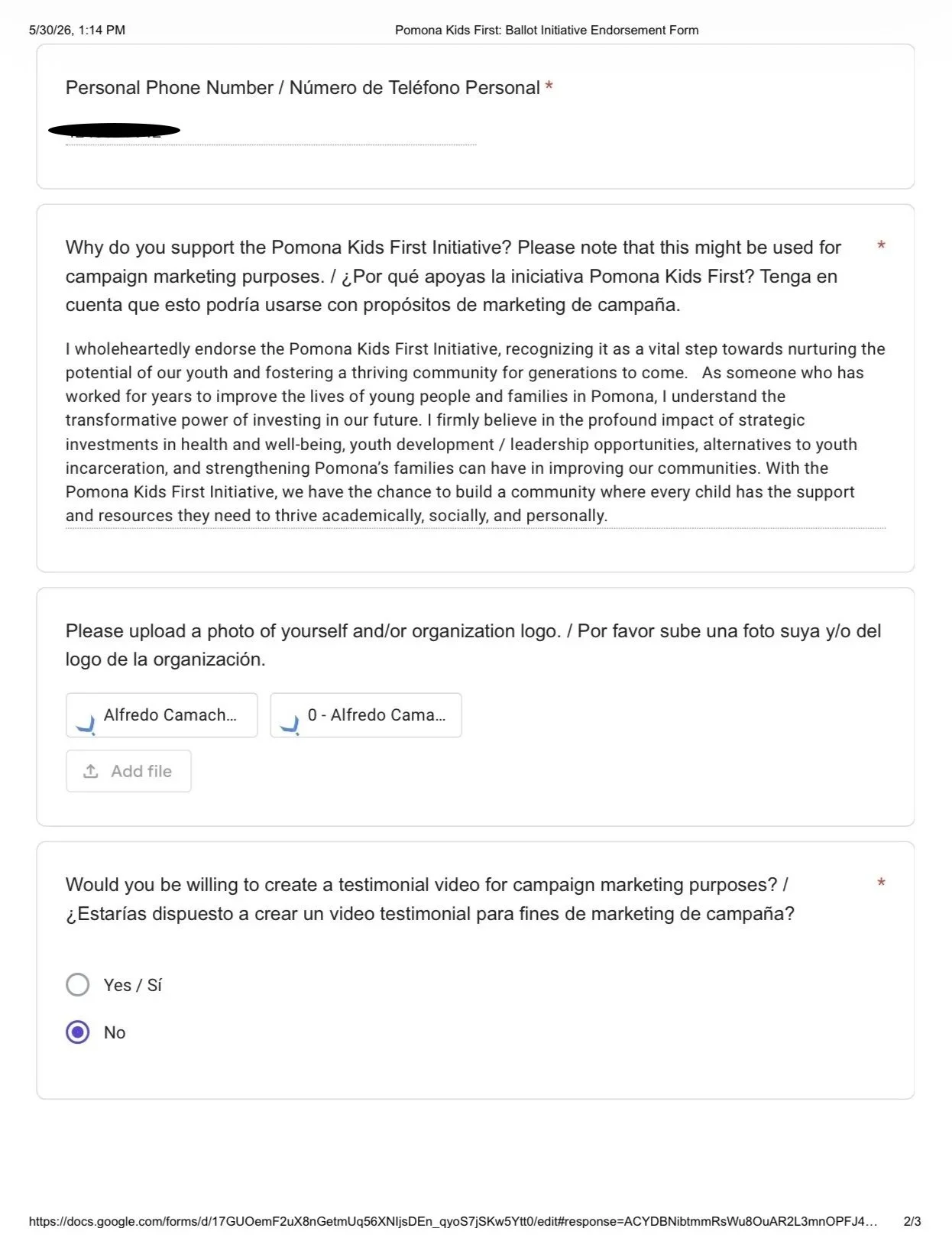
Source: Measure Y endorsement documents obtained by The Pomonan
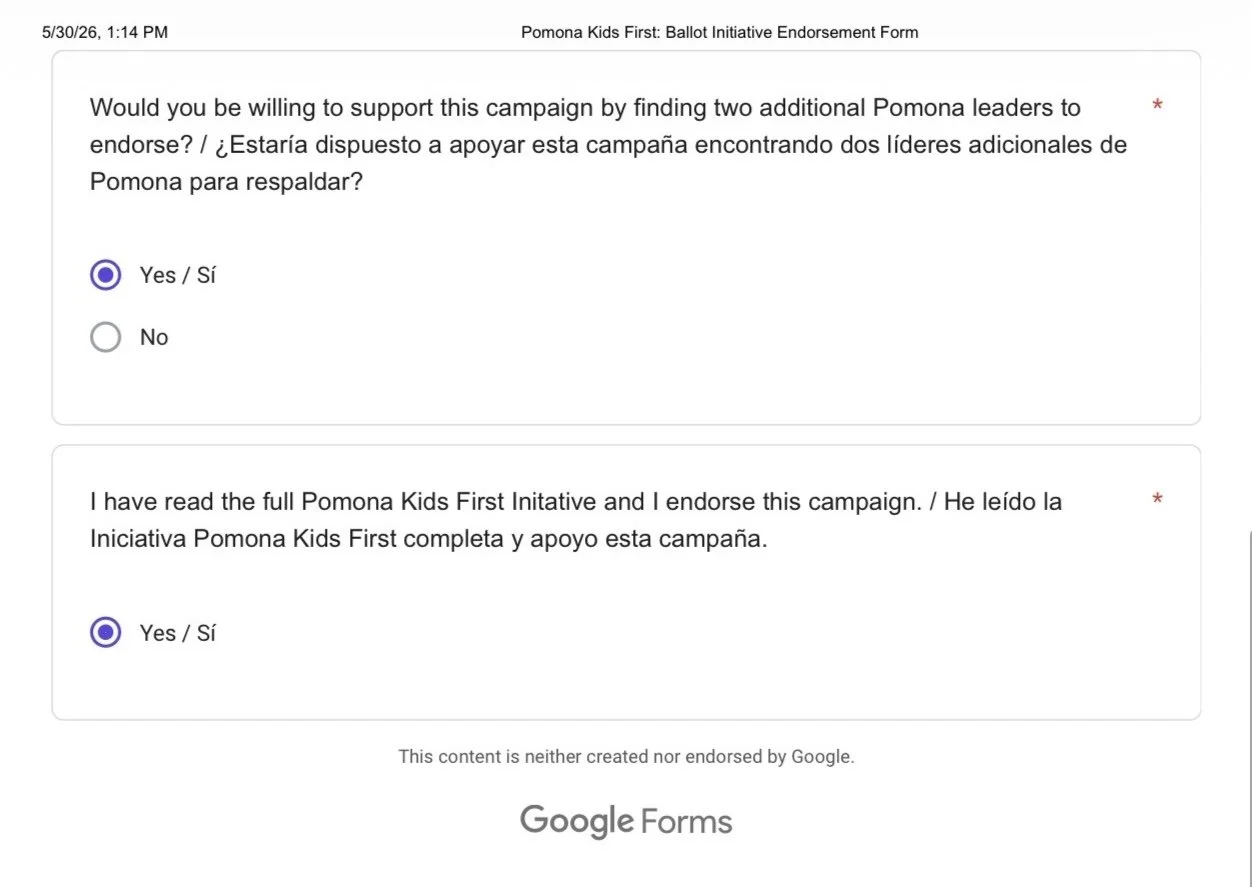
Source: Measure Y endorsement documents obtained by The Pomonan
More recently, Camacho, publicly argued that ballot initiatives are ineffective and a misuse of time and resources. Good policy comes from compromise and amendment rather than asking voters to approve or reject a proposal at the ballot box. Camacho stated Measure Y was flawed. Measure Z was better.
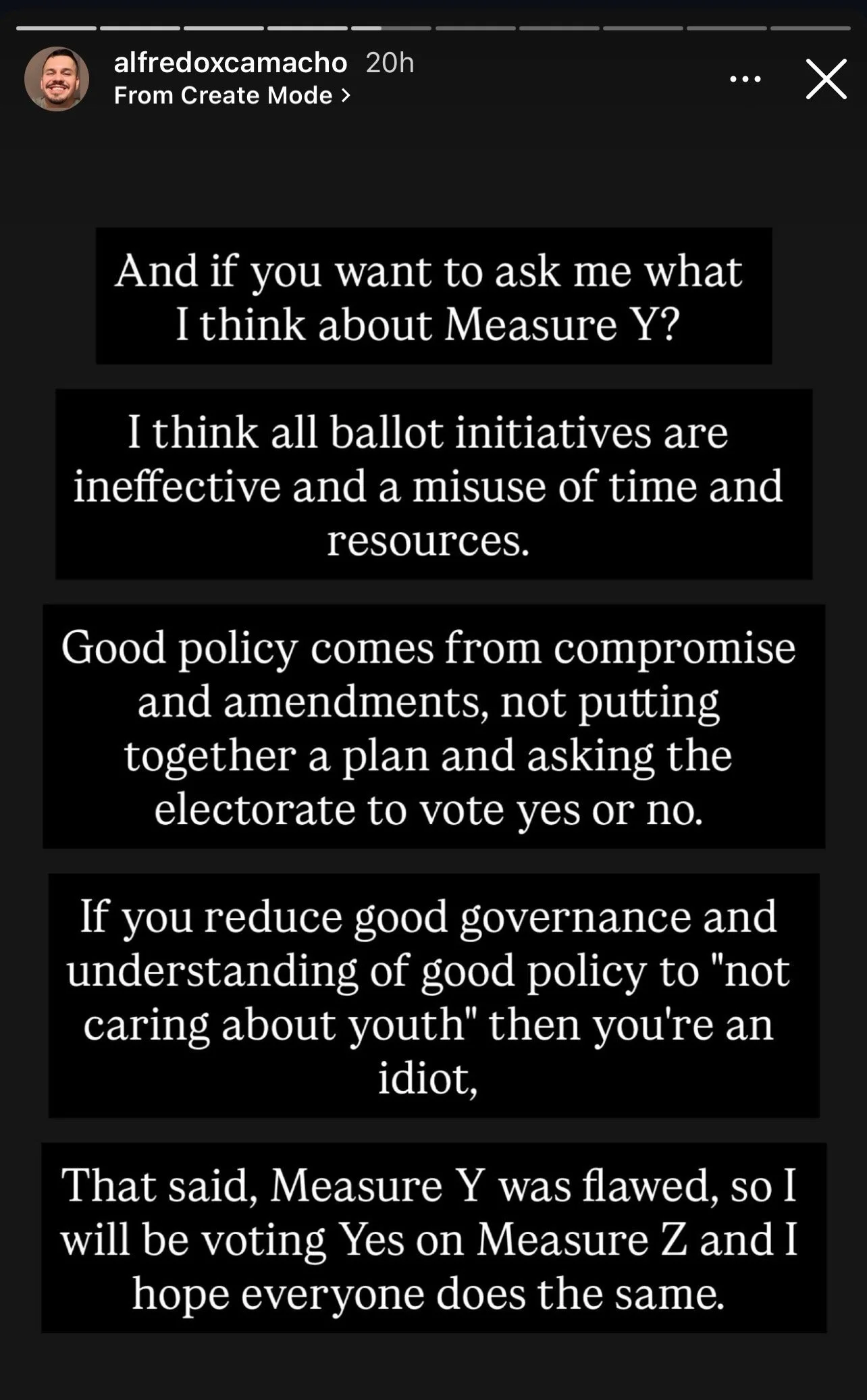
Source: Public Instagram Profile
There is absolutely nothing wrong with changing one’s position. Public officials should be willing to revise their thinking when circumstances change. A person who never changes their mind is usually more interested in being right than in finding the truth.
What makes the change fascinating is that very little effort has been made to explain it.
What exactly changed between Measure Y and Measure Z?
Which provisions were improved? Which provisions were weakened? Which safeguards were retained? Which safeguards disappeared?
If Measure Y was worthy of endorsement and Measure Z was worthy of replacement, the public deserves more than assurances that experts worked it out behind the scenes. The public deserves an explanation. Not just the usual Facebook and Nextdoor chatter that Measure Y was going to bankrupt the city. Aesthetically speaking, parts of Pomona already look bankrupt. The public deserves a clearer explanation of what changed, why it changed, and why the revised system is better than the one many of the same people once supported.
That question becomes even more important because the debate surrounding Measure Y and Measure Z was never really a debate about children. Nearly everyone involved including Pomona Police claimed to support children. The deeper disagreement concerned power. Who should oversee public money? Who should make decisions? How much authority should remain independent of City Hall, and how much should remain within existing political structures?
Camacho has often described his role on the Planning Commission as bringing a different perspective into local government. In one social media post, he described himself as a renter, a public health policy advocate, and someone who did not come from the traditional circles that historically dominated local decision-making. It was a compelling argument. For years, Pomona politics has been criticized for being insular, clubby, cliquey, and resistant to new voices. A younger commissioner with a different background represented a departure from that tradition. Kind of.
However, some of the language used has accompanied these debates and point toward a different type of tension. Increasingly, discussions about policy seem to drift toward discussions about qualifications. Who attended meetings? Who understands the process? Who possesses the expertise? Who has the credentials? Who is qualified to speak? And who is qualified to critique?
The irony is that many of the people who originally supported broader participation in civic life now spend a considerable amount of time explaining why certain critics are not qualified to participate in the conversation.
That tension surfaced again after the election. Critics were told they misunderstood the process. They lacked context. They lacked expertise. Their preferred candidates lost. They were not present in the room.
But democracy has always depended upon the inconvenient reality that people are allowed to ask questions whether they were in the room or not.
A resident does not need a commission appointment to question a public policy. That’s why the word “public” comes before policy.
A voter does not need a master’s degree to question a ballot measure.
A journalist does not need permission or have to live in Pomona to question a Pomona commissioner. The accredited university almost certainly covered that at some point.
Measure Z passed. That much is settled. What remains unsettled is whether the promises made by its supporters will become reality.
The election transferred responsibility. The people who argued that Measure Z was the better model now own the model. They own the oversight structure. They own the implementation. They own the outcomes. If the revised system proves more effective, they deserve credit. If it fails to deliver what was promised, they deserve scrutiny, which would be called accountability.
Which brings us back to the original question. Why write about Measure Z?
Because winning an election is easy compared to governing afterward. The campaign is over.
Now comes the part where the public gets to find out who was right. Whether anyone admits it is another matter entirely. Accountability has become something of an endangered species.
Julian Lucas is a darkroom photographer, writer, and a bookseller, though photography remains his primary language. He is the founder of Mirrored Society Book Shop, publisher of The Pomonan, and creator of Book-Store and Print Pomona Art Book Fair. And yes he will charge you 2.5 Million dollars for event photography.


