
Who are the YIMBYs? How did they come to amass so much power? And do they have the right ‘fix’ for our enormous affordability housing problem?

Illustration Julian Lucas
Updated 10/02/25 2:06 pm PST
YIMBY *grassroots or astro-turf . . . or both ?
[*astro-turf - an organization that appears to be grassroots, but is in fact funded by multi-millionaires]
This past California legislative season California YIMBY had an inordinate influence on housing legislation. This is not just my opinion, but an opinion shared by major media outlets and YIMBYs themselves who are planning a big victory party at the end of October to celebrate their legislative wins. (Tickets start at $100, going up to $10,000 for sponsors.)
So . . . who or what are YIMBYs?
YIMBY, the catchy acronym for “Yes, in my backyard!”, has recently notched some big legislative wins. Major outlets like Yahoo News, LAist, and the Los Angeles Times have all reported on the passage of SB 79, a bill that overrides local zoning to promote dense housing near transit hubs. CalMatters called it a landmark shift, while Yahoo framed it as YIMBYs achieving their “holy grail.” The movement itself even celebrated with a victory party.
And so, YIMBYs have self-defined as the ‘good guys’ in a binary fight between good v. evil. The fight is much more nuanced than that, but YIMBYs have gained traction by keeping the conversation about housing simple. Their solution is simply to build more - market rate or affordable housing - it doesn’t really matter. They figure that if we simply build more, housing will eventually ‘trickle down’ to become more affordable for more people. And the secret to building more? Upzone, that is, override local zoning ordinances. Eliminate local processes at the city level. Bypass community involvement in favor of state-run bureaucracy. Remove environmental review.
Early on, YIMBYs gained traction with high tech executives and the real estate developers who donated large amounts of money to get the YIMBY movement up and running. According to a 2018 article in Dollars and Sense, “California YIMBY, the first political YIMBY group, was founded with the funding of Bay Area tech executives and companies. Dustin Moskovitz (Facebook, Asana) and his wife Cari Tuna donated $500,000 via their Open Philanthropy foundation; Nat Friedman (Xamarin, GitHub) and Zack Rosen (Pantheon Systems) donated another $500,000. Another $1 million donation came from the online payments company Stripe.” See More
Early on, high tech executives recognized that lack of housing was preventing them from recruiting and retaining the labor force they needed. They also recognized that jumping on board demanding housing deflected attention from their complicity in the housing crisis in the first place. Their high tech workers were rapidly displacing longtime residents, lower income residents and people of color, and the optics were not good. High tech could have invested in workforce housing, but it was cheaper to donate to activist groups like YIMBY.
And it is not hard to imagine why real estate developers have also donated large sums of money. Deregulation smooths the way for them to build more and grow their profits.
Deregulation used to be the purview of the conservative right, but the neo-liberals and the libertarians have come to embrace the ideology. They call themselves supply-side progressives - and believe that simply by increasing the amount of essential goods and services - in this case, housing - will automatically achieve progressive outcomes.
The YIMBYs recently received a big, national boost for their philosophy when New York Times podcaster Ezra Klein and Altantic writer Derek Thompson just released their book this spring, titled, Abundance. The abundance ideology is based upon the precepts of ‘build, baby, build,’ and deregulate, deregulate, deregulate, and that with abundance, affordability will follow.
The logic of both the Abundance movement and the YIMBYs goes something like this: what’s great for landlords, developers, and the financial institutions has to be great for the rest of us too — at least, that is the YIMBYs’ story, and they are sticking to it.
The beauty (and terror) of supply side progressivism is that it poses a solution to a big complex and difficult problem without disrupting capitalism - in fact, it advantages the venture capitalist who operates in high tech and real estate. And this is exactly how the YIMBYs have managed to amass so much power. They have secured large amounts of money (and organization skills) from their wealthy benefactors.. A simple google search of YIMBY donors yields a plethora of names of CEOs and other high-ranking executives.
Many - myself included - have been inclined, to think of YIMBY as a grassroots movement, but in fact, YIMBY is actually a shell-game of many richly endowed nonprofit organizations, a syndicate as it were, who lobbies - and lobbies hard - on housing laws aimed at streamlining the development process.
For a start, in California, the YIMBYs are Yes in My Backyard, California YIMBY, California YIMBY Action, California YIMBY Victory Fund, YIMBY Law, YIMBY Education Fund.
Yes in My Backyard trains people to advocate for more housing in their neighborhoods. Tax-exempt revenue reported for Yes In My Back Yard for 2023, was $2.14M.
Yes In My Backyard is linked to YIMBY Law which reviews public records to identify cities that may be violating housing laws. They inform cities of possible violations and file litigation to ensure cities follow the law and housing is built.
In 2021, YIMBY Law filed its first lawsuit against Simi Valley. Since then, they have filed additional lawsuits in places like Cupertino, Los Angeles, San Francisco, Sausalito, Redondo Beach, Burbank, Burlingame, Culver City, Fairfax, Lafayette, Millbrae, Newport Beach, Santa Monica. YIMBY detractors and supporters alike have called their strategy “sue the suburbs.” YIMBYs have even filed a lawsuit against California’s Department of Housing and Community Development (HCD). Launching lawsuits costs money.
Yes In My Back Yard also partners with YIMBY Action to create and disseminate resources. YIMBY Action reported revenue for 2023 of $1,592,988 with assets of $1,022,696.
ProPublica: YIMBY Action financials
Then there’s California YIMBY which works with housing policy experts, elected officials, and grassroots organizations across California to craft and pass legislation at the state and local level that will accelerate home building and upzoning.
California YIMBY, tax-exempt, reported $4.49 million in revenue for 2023. Its total assets for that year were $6.89 million.
California YIMBY’s top people make a very good salary. In 2023, President and CEO Brian Hanlon made $335,815; Senior VP Melissa Breach, $224,939; Directors Matthew M. Lewis, $152,330; Robyn Leslie, $138,762; Konstantin A. Hatcher, $137,190; and Edward S. Resnikoff, Robert Cruickshank, Matthew N. Gray, made between $123,091 and $109,973. All actually earned additional income from the nonprofit, amounting to between $17,667 and $6,803 in 2023.
California Yimby is linked to the California YIMBY Victory Fund, a state Political Action Committee (PAC) that supports candidates for elected offices in California. The California YIMBY Victory Fund spends a great deal of money contributing to candidate campaigns - a strategy that appears to be working for them.
California YIMBY Education Fund features reports, maps, ongoing projects, and an extensive research catalog. In 2023, the California YIMBY Education Fund reported over $8 million worth of assets.
There are also any number of local splinter groups. The YIMBY Action website lists 19 in California and many, many more across the US. See here
Not all of the YIMBY organizations have YIMBY in their name. For instance, Streets For All is a fiscally-sponsored project of the California YIMBY Education Fund. And California YIMBY’s President and CEO Brian Hanlon co-founded the California Renters Legal Advocacy and Education Fund (CaRLA) in 2015. Abundant Housing LA works in conjunction with the Abundant Housing LA Education Fund to represent the YIMBY movement in Los Angeles.
Taken together, YIMBY nonprofit lobbying organizations in California post assets of likely more than 20 million dollars.
There can be no better indication that YIMBY’s sphere of influence is rising than the fact that a Congressional Yes In My Back Yard (YIMBY) Caucus, a bipartisan US congressional caucus, was founded in November 2024.
Currently, State Senator Scott Wiener (SF), YIMBY’s champion in the state senate, is making his own bid to move up to the national level. He recently opened a campaign committee to run for San Francisco’s congressional seat currently held by former Speaker Nancy Pelosi. Wiener is perhaps the singular California elected official who is most closely aligned with the YIMBY effort to build more housing and upzone through deregulation, streamlining, and loss of local control.
YIMBYs and this California legislative season
This year and in the last few years, the YIMBYs have lobbied for a large number of bills in California, and this year, their crowning achievement, among other achievements, was the passage of two anti-environmental bills (AB 130 and SB 131) in June, and the probable passage of a Transit-Oriented Development bill (SB 79) that is sitting on Governor Newsom’s desk, right now, awaiting his signing by October 12. All three bills were authored and sponsored by YIMBY-endorsed State Senator Scott Wiener (SF).
The Transit-Oriented Development bill (SB 79) comes as the third part of a one-two-three punch. Governor Newsom essentially paved the way for the passage of SB 79 when he strong-armed our state legislators in June of this bill to pass two anti-CEQA (California Environmental Quality Act) bills by tying them to the approval of our state budget. These bills waived the need for environmental reviews on infill housing projects in our cities. Governor Newsom lauded the passage of these anti-environmental bills, saying it "the most consequential housing reform that we’ve seen in modern history in the state of California.”Scott Wiener on “the most consequential housing reform” – LA Times
Environmental groups outraged by Newsom CEQA overhaul – LA Times
Which brings us to California Senate Bill 79: Housing development: transit-oriented development also known as the Abundant & Affordable Homes Near Transit Act.
SB79 will upzone and override local zoning to allow for the construction of greater height (5, 6, 7, 8, 9-stories) and density (up to 38,000 units in a 1/2 mile radius) near train stops and Metro light rail stations in 8 out of 58 of California’s counties - including Los Angeles.
Mapping the potential impact of SB79
The Potential (Negative) Impacts of SB 79: Transit Oriented Development
While locating housing developments near transit stops encourages people to get out of their cars and encouraging development away from our fire hazard severity zones is necessary, SB 79 brings with it plenty of negatives.
Primarily, there is the issue of affordability. Basically, only about 10% of the transit-oriented housing will be affordable, the remainder will be offered at market rate.
In addition, if Governor Newsom signs this bill in the next couple of weeks, local residents will no longer have the ability to weigh-in on such matters as setbacks and parking, open space, trees and environmental review, facades, architectural design, traffic and safety for new development for these new developments within a half mile of a train stop. The approvals for development will now come from a centralized intelligence - our state’s Department of Housing and Community Development (HCD). SB79 is basically undemocratic. With SB79, local communities lose their ability to make their city anything but cookie-cutter. As it turns out there is a whole lot more to planning and re-planning a neighborhood than simply drawing a circle on a map.
In a quarter to a half mile radius from a city’s train stop, apartment houses and multi-family housing will receive some protection from demolition - at least until 2030, when the state’s rental stabilization law sunsets - but there will be no protections for single family housing, housing with an ADU, two-on-a-lot, or duplexes.
Historical buildings and neighborhoods will not be adequately protected from demolition. Only 10% of historical buildings on the local registry will be protected. And protecting one building while surrounding it by 5, 6, 7, 8, 9-story buildings is really no protection at all. Housing advocates, including YIMBYs, are often dismissive of the need to preserve historic districts. “Our cities are not museums,” one State Senator said. But the truth is that conserving our historic districts is neither ineffective or irrelevant. As it turns out, our historic districts are not the enemies of diversity, density and affordability, rather, they are often the places that are already meeting these important and legitimate public goals.
In addition, the waiving of environmental reviews should be deeply concerning to all of us. In the so-called olden days, railway stops were the places for light and heavy industry where workers poured contaminants in the soil, and in some places, these have leached into our water systems. It’s hard to believe that our state government feels that the imperative to build outweighs our need for basic testing and clean-up.
My story, my hometown, my legislators
I only found out about SB 79 and the many ways it could negatively impact my hometown of Claremont, some 35 miles away from Los Angeles in early July - and I definitely came late to the ‘party.’
Unbeknownst to me, all four of the regional elected officials (two of them recently elected) that I spoke with before the vote in early September, had accepted campaign finance money from the California YIMBY Victory Fund.
Claremont City Councilman, Jed Leano received $5,500 for his unsuccessful bid for the Assembly, and Assemblymembers John Harabedian (Altadena to Pasadena to Upland) and Mike Fong (Alhambra to Temple City to Monterey Park) accepted $1,500 and $1,000 respectively. Newly-elected Senator Sasha Renée Pérez (Alhambra to Rancho Cucamonga) accepted $2,500.
Before the California Democratic Club’s Executive Board endorsed SB 79 in mid-August, they accepted $3,500 from the California YIMBY Victory Fund.
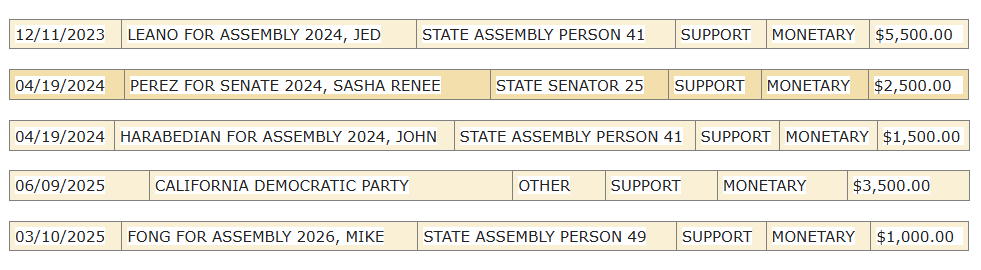
California campaign contributions – 2023
California campaign contributions – 2025
Two of my elected representatives, Councilman Leano and State Senator Pérez, endorsed SB 79 on the floor of the state legislatures. Council member Leano spoke before two Assembly Committees in July as Senator Scott Wiener’s ‘right hand’ man; and Senator Pérez endorsed SB 79 on the Senate floor in September right before the State Senate voted in support.
There is an old joke that our elected officials, like Nascar racers, should wear the patches of their sponsors on their coats. If only my representatives had been wearing their YIMBY patches when I met with them, our conversations would have been so much clearer.
On the local scene, on August 18, 2025, Claremont City Councilman Leano wrote an opinion piece for Pasadena Now, promoting SB 79, titled “The Real Reason California Housing Costs Are Outrageous: A Claremont city councilman explains how wealthy residents control housing decisions.” His talking points are basically YIMBY talking points - California YIMBY posted his op-ed on their website and circulated it on their Instagram account.
In it, he blamed the housing shortage on “older, male, longtime-resident homeowners” who he said “dominate” the town meetings in places like Claremont. Interestingly enough, Leano chose not to post his op-ed in his own local newspaper, but in Pasadena, some thirty miles away.
Undeniably, Councilman Leano is right. Whites, historically, are the reason for our segregated California neighborhoods. It happened over the centuries that red-lining, real estate covenants, sundowner towns, the California Native American genocide, Mexican repatriation of 1929 -39, and Japanese Internment of WWII, among other actions, effectively carved out ‘white’ neighborhoods in California.
However, there are definite questions about what is the correct ‘fix’ to systematic injustice. Here, Councilman Leano, by vilifying the very people who participate in his town’s government, is dismissive of the efforts of legions of people who have worked very hard serving on local commissions and committees, building local businesses, maintaining non-profits, in order to create a highly livable, walkable city with trees and parks where people want to live.
Claremont is not really the best example of NIMBYism - though, of course, it certainly exists.. In 2021, Claremont approved its own 25 acre transit-oriented development project (with height, density, historical preservation and open space) after an intense public process. Unfortunately, it has stalled out -for now - not due to local resistance or regulations, but due to problems with property owners and financing.
While Leano leans heavily on the stereotype of the white boomer NIMBY as the villain of the housing affordability crisis, in truth, there are many factors that interfere with housing construction, including rising material and construction costs, financing problems, private ownership, labor shortages, high interest rates, insufficient public funding for affordable housing, institutional investors buying up large amounts of housing, the failure to develop state-sanctioned development plans with nearby existing airports, along with all the infrastructure, planning, and costs that accompany rapid growth. In the meantime, Claremont is not quite the all-white city that Leano describes. According to the 2020 census, Claremont is now a minority-majority city, with less than half - 47% - self-describing as white.
Claremont, California – Wikipedia
Map of Los Angeles Metro Area (Claremont marked)
Elsewhere, in Councilman Leano’s op-ed, he declares that, “new homes are nearly impossible to build” - a statement that is both hyperbolic and inaccurate. Claremont sits on the edge of the Inland Empire that is experiencing a building boom - with 4-story or higher apartment houses going up all over the region.
According to the Inland Empire Multi-family Market Report, August 2025:
“Supply growth was on track to reach a new peak, with 2,864 units delivered during the first half of the year, while the pipeline remained robust with 9,549 units underway.”
And Cal State San Bernardino’s Housing & Transportation Report – CSUSB:
“Over the past 30 years, Southern California’s Inland Empire (IE), encompassing Riverside and San Bernardino Counties, has experienced rapid growth and economic change. As of December 2023, the region’s population reached approximately 4.7 million residents, making it the thirteenth most populous metropolitan area in the United States and the third largest in California (U.S. Census Bureau, 2024). The region has tripled in population and positioned itself as one of the nation’s fastest-growing areas . . . In 2022, the Inland Empire was identified as the fifth fastest-growing region in Southern California.”
Even in Councilman Leano’s own jurisdiction of Claremont, there are a multitude of development projects underway. Listed on the Claremont City website are: Old School House Development (OSH); La Puerta Development; Clara Oaks Development; Village South Specific Plan (VSSP); Residence Inn by Marriott (formerly Knights Inn); City Ventures Indian Hill Project; TCCS Student Services Building; Olson Housing Project - Descanso Walk; 365 West San Jose Condominium Project; and Larkin Place Permanent Supportive Housing Project.
Just on the other side of the Councilman Leano’s city borders - in Upland, Montclair, Pomona, LaVerne - multi-family apartment housing projects are springing up with astonishing speed. Driving on the 210 from Claremont to Fontana, there are giant swaths of new homes, roof to roof.
So . . . maybe the conversations that we need to have is what California could do to create the housing that people can actually afford.
Pamela Nagler Pamela Nagler is finishing her book, Unceded Land, Indigenous California and the Foreign Invasions: Spanish, Mexican, Russian, US 1769-1869.


