
public policy

Who are the Billionaires Opposing California’s Proposed “Billionaire Tax”?

Right now, people in California are circulating petitions to place a “Billionaire Tax” on California’s November ballot. If passed, it would impose a one-time tax of 5% on California’s tax residents whose net worth is $1 billion or more. The initiative, sponsored by the SEIU-United Healthcare Workers West (SEIU-UHW), would only target a small number of Californians - just slightly more than 200 - but would benefit approximately 3.4 million Californians who are presently at risk of losing their Medi-Cal due to recent massive funding cuts at the federal level. The California billionaire's tax initiative requires at least 874,641 valid signatures for it to appear on the ballot - a threshold the petitioners are likely to easily meet. Read

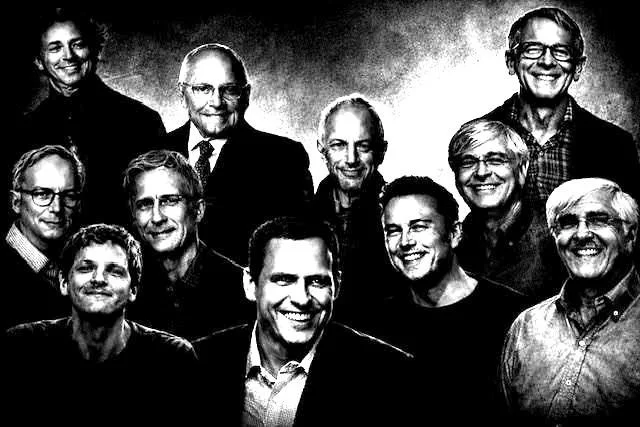
California has the most billionaires of any U.S. state and many - though certainly not all -  oppose this tax initiative. Some are funding the opposition movement - others are actively voicing their opposition - and a handful have moved out of state to avoid paying. Many who oppose - again not all - are Silicon Valley billionaires. The New York Times reported on a recent conference that convened in Orange County advising billionaires on how to avoid paying. Half-jokingly, advisors told billionaires to get divorced. They also advised “moving their Picassos” out of state or spending down their banking accounts by buying up properties elsewhere. Read  

Here’s a short list of the California billionaires who are funding the opposition:

Google co-founder Sergey Brin (net worth $242 billion) has contributed $20 million to establish the political action committee, "Building a Better California"  in January of 2026, aimed at defeating the tax initiative. Read


Cryto-currency executive, Ripple co-founder Chris Larsen (net worth $10 billion) has contributed $5 million to the opposition movement. Read

PayPal and Palantir co-founder Peter Thiel (net worth $26 billion) made a $3 million donation in late December 2025 to the California Business Roundtable, a major lobbying group opposing the measure. Read

SV Angel founder Ron Conway (net worth $1.5 billion) has contributed $100,000 to the “Stop the Squeeze" committee to oppose the measure.

According to a New York Times’ January 28, 2026 article, other seven-figure contributors to "Building a Better California" include prominent investors John Doerr (net worth $11.9 billion) and Michael Moritz (net worth ($5.6 billion); Stripe chief executive Patrick Collison (net worth $11.5 billion), a longtime advocate on housing issues; Former Google CEO Eric Schmidt (net worth $54.5 billion), and Stewart Resnick (net worth combined with his wife, $11 billion), who owns a farming empire that produces oranges, pistachios and POM Wonderful juice. Read

Two of the top funders of the anti-Billionaire Tax campaign, Sergey Brin and Peter Thiel, are also Trump supporters. They have something else in common - according to the Epstein Files, both associated with convicted sex offender Jeffrey Epstein.

Sergey Brin, one of the world’s richest men, began supporting Trump in 2025. In December 2024, he attended a dinner at Mar-a-Lago with Trump and was seated in a prime spot at the 2025 inauguration. In September 2025, Brin publicly praised the Trump administration for supporting AI companies, stating he was "very grateful" for the administration's backing. His company Google contributed $1 million to the inauguration fund for Trump in 2025.

During the first decade of the 2000s, Sergey Brin visited Mr. Epstein’s private island near St. Thomas, made plans to dine at Mr. Epstein’s Upper East Side home, and corresponded with Ghislaine Maxwell, Jeffrey Epstein’s longtime companion, convicted as Epstein’s co-conspirator in 2021. Read


In the Epstein files, Sergey Brin appears in an undated photograph on a patio looking out to a tropical destination with women whose faces are redacted. Another document shows that one of Epstein’s accusers told the Epstein Victims Claims Administrator that she met Sergey Brin and his then-wife when they spent a day on Epstein’s island in January 2007 with Jean-Luc Brunel, a modeling agent who died in 2022 in prison while awaiting trial on sex-trafficking charges. Read

Sergey Brin associated with Jeffrey Epstein prior to Epstein’s 2028 conviction for sex trafficking of minors and conspiracy to commit sex trafficking of minors, which has given him the opportunity of denying knowing about Epstein’s heinous crimes - at least to some people, in some circles.

Peter Thiel,  a key early supporter of Donald Trump in 2016, provided crucial donor, industry, and strategic support to his campaign. In 2016, Thiel delivered a speech at the Republican National Convention highlighting his support for Trump as a "political outsider.” He later served on the Trump administration’s transition team.

While Sergey Brin is mentioned in the Epstein files 4 times, Peter Thiel is mentioned some 2,200 times. Their relationship began after Epstein’s initial arrest and conviction in 2008. So fart, the interactions between Peter Thiel and Jeffrey Epstein appear to be all business-related. According to the documents, Peter Thiel had a continuous, long-term business relationship with the sex offender  that involved investments, private meetings, and advice from 2014-2019, the year Epstein was convicted for the second time.

In an August 2024 podcast, Peter Thiel revealed that he met Epstein starting in 2014. He was first introduced to Epstein by LinkedIn co-founder Reid Hoffman, another California billionaire who has voiced his opposition to the Billionaires/ Tax. According to the Wall Street Journal, Hoffman actually visited Epstein’s private island, Little St. James, in 2014. Read

Both the U.S. and the Israeli government are relying on Peter Thiel’s company, Palantir Technologies - the U.S. for its anti-immigration efforts and now its war with Israel on Iran. Israel has previously relied on Palantir, for among other things, its war on Gaza against Palestinians, but also its war on Lebanon.

Palantir has contracts with both the U.S. and Israeli governments. Founded in 2003 with seed funding from the CIA, the company specializes in artificial intelligence (AI) and software that aggregates, cleans, and analyzes massive, disparate datasets to find hidden patterns. Critics of Palantir consider it a dangerous corporation because its technology enables advanced mass surveillance, aids immigration enforcement (ICE), and powers military targeting systems with minimal public oversight or accountability. In February of 2026, the U.S. Department of Homeland Security negotiated a $1 billion purchasing agreement with Palantir, reinforced its already-existing  contracts that aid in arresting and detaining immigrants. Read

Reid Hoffman has stated that he included Peter Thiel, along with the world’s richest man, Elon Musk (net worth $900 billion)  and Facebook founder Mark Zuckerberg (net worth 227 billion), at an August 2015 dinner party in Silicon Valley that also included Epstein. No surprises here - all four of these men oppose the Billionaire’s Tax.

Elon Musk, a former advisor to Trump,  recently called a national effort to impose any tax on billionaires “stupid." He contends that taxing billionaires would eventually lead to tax hikes for the middle class. Musk recently moved his residence and Tesla's headquarters from California to Texas. PBS, Yahoo Business

Various news outlets have reported that Mark Zuckerberg has moved to Florida to escape California’s billionaire tax.

Here’s a short list of other California billionaires who have moved to avoid the billionaire tax:

Sergey Brin
and his fellow Google co-founder, Larry Page (net worth $262 billion) are in the process of setting up new residences and businesses in Florida and Nevada. Brin just moved to a $42 million mansion on the Nevada side of Lake Taboe, and Page has reportedly moved out of the state, with associated LLCs filing in Florida. Read

PayPal and Palantir co-founder Peter Thiel has expanded his Florida footprint and is moving his operations away from Los Angeles.

David Sacks (net worth $2 billion) left California for Texas in late 2025/early 2026. David Sacks, a prominent technology entrepreneur, investor, and former San Francisco resident often described as a billionaire and a member of the "PayPal Mafia,”  is currently serving in the Trump administration as Trump’s crypto/AI advisor. The New York Times recently ran an article on Sacks, titled, Silicon Valley’s Man in the White House Is Benefiting Himself and His Friends: David Sacks, the Trump administration’s A.I. and crypto czar, has helped formulate policies that aid his Silicon Valley friends and many of his own tech investments. Read

David Sacks’ business partner, Bill Lee, co-founder of Craft Ventures, recently relocated to Austin with Sacks to work out of the new Texas headquarters.

Oracle founder Larry Ellison (net worth $225 billion) sold his California home and moved to Hawaii.

Trump supporter Don Hankey (net worth $7.4 billion),  known for his high-interest auto loans and facilitating a $175 million bond for Trump's New York civil fraud case, has moved to Nevada in anticipation of the tax. Read

And, what about the politicians?  Current Governor Gavin Newsom (wealthy, but not a billionaire) is denouncing the measure as ruinous and has vowed to stop it. His allies are running the "Stop the Squeeze" campaign.

However,current California gubernatorial candidate and billionaire Tom Steyer (net worth $2 billion) supports the tax. In his recent substack, he said, “If there’s an opportunity to tax wealthy people to fund health care and education, I’d vote for it all day long.”  Read


Author’s Note: The billionaires’ net worths cited in this article were mostly sourced from a Business Insider article published June 10, 2926. As billionaire assets are always in flux, these figures are merel approximations. Read
Further reading:

On the split between Democrats who support the Billionaire Tax and those who don’t: Read

List of who supports and who opposes


Editors Note

When some of the wealthiest Californians frame this as “taxation without representation,” it’s worth remembering that the phrase originally described colonists taxed by a distant monarchy. Those affected by California’s 2026 Billionaire Tax Act are not disenfranchised subjects of an empire. They are among the most politically connected actors in the country.

If anyone is underrepresented in our tax structure, it may be the millions of wage earners whose labor is taxed more heavily than capital.


Pamela Nagler Pamela Nagler is finishing her book, Unceded Land, Indigenous California and the Foreign Invasions: Spanish, Mexican, Russian, US.

Why Suburbia Misunderstands Everything: Geography, Insulation, Nuance, and the Politics of Distance

Photography Julian Lucas ©2021

The title is most definitely a blanket statement. However in my interactions with many who live in the suburbs, I’ve found the misunderstanding isn’t random or accidental. It’s almost consistent and patterned. It presents itself in the same places, around the same issues, with the same confidence. What reads as ignorance is usually something more structural. It’s a way of thinking shaped by distance, insulation, and a daily life that rarely demands engagement with complexity.

There is a long American tradition of believing that proximity produces danger and distance produces clarity. The suburb was built on that belief, engineered as both a physical and psychological buffer from the complexities of big city life. And over decades, that distance hardened into a worldview. Not an accidental one, but a worldview shaped by planning decisions, racial covenants, policing practices, school funding structures, and a moral geography that equates separation with superiority.

In theory, the digital age should have neutralized this.

If information is everywhere, ignorance shouldn’t have a zip code.

But suburbia proves that information access and information literacy are not the same thing.

What follows isn’t a satire of the suburbs, that’s too easy.

It’s an examination of why so many suburban communities remain misinformed about the social issues they speak most confidently about. And yes, I’ll let a few subtle jabs leak through. I’m only human.

Urban scholars like William Julius Wilson and Loïc Wacquant have long argued that proximity to social institutions, courts, shelters, jails, social services, hospitals, produces a different form of political understanding. Not better or worse, just grounded.

Suburbia, by contrast, was designed through very deliberate public policy to avoid these institutions altogether.

Mortgage subsidies rewarded flight.

Zoning laws kept multi-family housing out.

Highways pushed poverty elsewhere. Redlining concentrated racialized disadvantage into the city.

Federally backed mortgage subsidies rewarded flight, a process that came to be known as white flight, insulating white, middle class suburbia from exposure to inequality while concentrating risk and enforcement elsewhere. That pattern didn’t stop at the city line. As Black families later gained access to suburban housing, the same logic repeated itself within suburbia, producing new lines of departure, new pockets of insulation, and the same avoidance of proximity.

This is why race continues to surface in debates where some insist it doesn’t belong. For many white suburban residents, policy feels abstract, detached from identity, history, or exposure. But for communities shaped by racialized enforcement and exclusion, race isn’t a lens applied after the fact; it’s the context the policy operates within. The refusal to engage that context isn’t neutrality. It’s the privilege of never having to.

These systems didn’t just shape neighborhoods, they shaped how people view the world.

Sociologist Douglas Massey calls this the “architecture of inequality.”

It isn’t just about where people live, it’s about what they do not have to see.

Distance became a lifestyle.

And eventually, a belief system.

When your lived environment is stable and predictable, your worldview tends to simplify.

Robert Sampson’s research on collective efficacy shows that stable, homogeneous neighborhoods often develop a kind of social confidence, a belief that people like us behave properly and systems behave properly toward us.

This becomes the foundation for slogans that feel like moral law:

  • “If you follow the rules, you’ll be fine.”

  • “Just do things the right way.”

  • “Crime is a result of bad choices.”

  • “People who struggle must have caused it themselves.”

These aren’t malicious statements; they’re statements made by people who have never experienced the alternative. Safety creates linear thinking.

Where nothing bends, nothing is questioned.

Most suburbs remain socially and racially homogeneous,  not by accident, but by the legacy of decades of exclusionary zoning and economic sorting.

Political scientist Lilliana Mason describes this as “stacked identities”: when racial, cultural, and political sameness overlap so tightly that disagreement becomes an anomaly rather than the norm.

In those environments, misinformation doesn’t just survive, it enjoys the comfort of repetition.

When a community hears the same narrative from neighbors, schools, churches, and local media, the narrative becomes common sense, regardless of its accuracy.

Consensus replaces evidence.

Repetition replaces inquiry.

The familiar becomes the truth.

It is hard to learn something new when everyone around you is rewarded for knowing the same old thing.

Sociologist Matthew Desmond, writing about eviction and poverty, notes that those who never interact with state power directly often imagine it incorrectly. This applies equally to immigration, policing, social services, and crime.

If you have:

  • never been profiled

  • never been detained

  • never needed a public defender

  • never struggled with rent

  • never lost a job and then a home

  • never relied on public transit, public aid, or public housing

…then your understanding of those systems will naturally be theoretical. And when something is theoretical, it’s easily moralized.

Distance makes judgment feel like insight.

This isn’t insight so much as interpretation filling in for lived experience.

This is where a familiar vocabulary enters the conversation, usually delivered with confidence and rarely interrogated.

Law abiding citizens.
Good neighborhoods.
Family values.
Doing things the right way.

These phrases are not descriptions; they are credentials. They function less as moral principles than as proof of belonging, signals that one lives in the class of people for whom the law feels neutral, the neighborhood feels protected, and mistakes are treated as anomalies rather than indictments. The language sounds ethical, but it is fundamentally positional. It tells you where someone stands in relation to enforcement, not how enforcement actually works.

When these phrases are repeated enough, they stop describing behavior and start justifying outcomes. They explain who deserves patience and who deserves punishment. They soften structural inequality into personal failure. And because they are spoken from a distance, from lives rarely tested by the systems being discussed, they feel like common sense rather than ideology.

We live in a time when any statute, ruling, or data point can be found in seconds.

Yet as media scholars have pointed out for years, information abundance doesn’t create informed citizens, it amplifies the gap between those who are curious enough to seek knowledge and those who seek a consensus of affirmation.

Suburban communities, because they are insulated from direct contact with state power, often seek information that reinforces their sense of order.

It’s not ignorance so much as adaptation to a life where complexity and nuance rarely interferes.

Why interrogate systems you never encounter? 

Why learn nuance when your life teaches you simplicity?

Why question the law when the law has always worked for you?

The result is what I call “high bandwidth, low comprehension.”

The Wi-Fi is strong.

The conclusions are weak.

Suburbia also claims to believe in capitalism, but mostly as long as it remains abstract. The market is celebrated until it sends a bill. Rising trash fees, higher electricity rates, utility surcharges, suddenly the free market feels like mismanagement. What rarely gets examined is how decades of privatization, guaranteed profits, and corporate consolidation produce exactly these outcomes. Capitalism is embraced as an identity, not understood as a system. The result is a politics where people demand market freedom but expect price stability, oppose regulation but rely on regulated infrastructure, and treat the costs of the system as someone else’s problem.

This is the part that scholars don’t say directly, so I will say it. 

Ignorance is survivable in the suburbs.

If you misunderstand immigration law, it will not be used against you, but it will make for a good heated debate on the Nextdoor app.

If you misinterpret crime data, which most are allergic too, your neighborhood will still feel safe. 

If you misjudge homelessness, you will not be priced out of your home.

If you believe policing is neutral, which most do, your body will never test that theory. 

When being wrong has no consequences, being wrong becomes easy.

It’s not so much a moral failure, so much as the result of a life curated from the outcomes of the policies being discussed. 

But that insulation creates political danger. People who live outside of metropolitan cities are often the farthest from issues, often wield the most influence over it. 

Suburbia is not the villain. But it is where the power of voting exists. It is those areas whose worldview is shaped more by distance than experience. This produces political priorities that often punish the very communities whose realities suburban voters misunderstand. When distance becomes the dominant perspective, the policies reflect the fantasy, not the lived world. And the lived world pays for it.

Suburbia is not ignorant because its residents are unintelligent.

Suburbia is misinformed because it was built to live in a comfortable bubble, and within that bubble comfortability rarely produces curiosity.

Comfort produces certainty.

And certainty, untested by experience, eventually becomes doctrine.

If suburbs want to understand the issues they debate, housing, immigration, crime, homelessness, policing, and inequality, the first step is accepting that distance is not clarity.

It’s just distance.

And sometimes the people who live closest to the problem aren’t “emotional” or “angry.”

They’re simply the ones who know.


References

Massey, Douglas S.
American Apartheid: Segregation and the Making of the Underclass. Harvard University Press, 1993. On suburbanization, segregation, and the structural production of inequality.

Wilson, William Julius. The Truly Disadvantaged. University of Chicago Press, 1987. On spatial distance from institutions and how geography shapes political understanding.

Wacquant, Loïc. Punishing the Poor: The Neoliberal Government of Social Insecurity. Duke University Press, 2009. On moralization, punishment, and governance from a distance.

Sampson, Robert J. Great American City: Chicago and the Enduring Neighborhood Effect. University of Chicago Press, 2012. On collective efficacy, neighborhood stability, and confidence produced by homogeneity.

Mason, Lilliana. Uncivil Agreement: How Politics Became Our Identity. University of Chicago Press, 2018. On “stacked identities” and consensus environments that discourage dissent and inquiry.

Desmond, Matthew. Evicted: Poverty and Profit in the American City. Crown, 2016. On how those insulated from state power often misunderstand how it functions.

Jacobs, Jane. The Death and Life of Great American Cities. Random House, 1961. On urban complexity versus suburban simplification.

Davis, Mike. City of Quartz. Verso, 1990.
On suburban fear, policing, and political power disconnected from lived consequence.

Baldwin, James. The Price of the Ticket. St. Martin’s Press, 1985. On moral distance, innocence, and the cost of refusing proximity to reality.

Julian Lucas is a darkroom photographer, writer, and a bookseller, though photography remains his primary language. He is the founder of Mirrored Society Book Shop, publisher of The Pomonan, and creator of Book-Store and PPABF. And yes he will charge you 2.5 Million for event photography.