

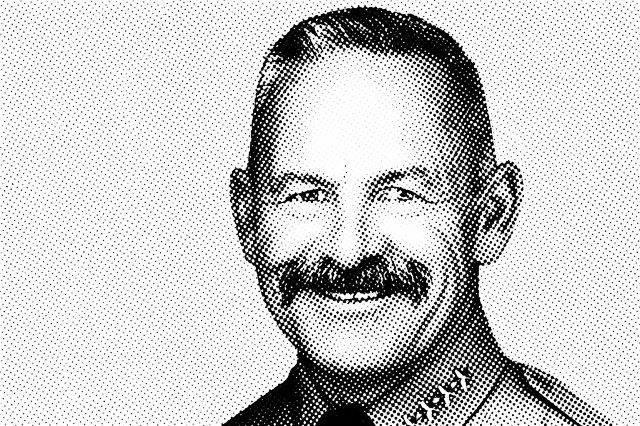
You can’t write about someone like Chad Bianco from the outside.
Bianco has a way of talking that sounds convincing if you don’t spend much time thinking about what’s underneath it.”Direct, confident, like everything is simple if people would just fall in line. I get why that works. In corrections, command presence matters. You don’t survive a module or tier based on theory. You survive on awareness, timing, reading a room before it turns. But that same experience also teaches you something else. The cleaner someone makes it sound, the more you start wondering what they’re not dealing with.
I worked inside the joint. Not Riverside, but it doesn’t matter as much as people think. Same rhythm. Same pressure. You learn real quick that control is fragile. You can’t fake it. You can’t posture your way through a dorm full of dudes who already know who’s present and who’s putting on a performance. The job is repetitive, tense, sometimes quiet in a way that isn’t actually quiet at all. Doors, counts, movement, paperwork, watching everything without looking like you are.
So when Bianco talks like the system is clean, like society breaks down into right and wrong if people would just act right, it sounds familiar. It’s that black-and-white framing that leaves no room for what’s actually happening in front of you. But race doesn’t disappear because you decide not to account for it.
And inside, race isn’t theoretical. It’s not something you debate, it’s something you manage. Prison politics is embedded in everything. Who sits where, who moves with who, who doesn’t cross certain lines. Staff read it whether they admit it or not. Both prisoners and guards live it every day. You don’t get to flatten that into “just follow the rules.” That’s not how it works.
And this idea that race doesn’t really factor in, it doesn’t hold up even before you step inside. Riverside County itself tells a different story. The population is roughly 47 percent Latino, around 38 percent white, and about 6 percent Black. But when you look at who ends up incarcerated across California, which Riverside tracks pretty closely, the proportions shift. Latinos still make up the largest group, but Black residents, while a small share of the overall population, are incarcerated at disproportionately higher rates. In Riverside County specifically, Black residents are arrested at more than twice the rate of white residents. That gap is already there before anyone even enters a housing unit.
So by the time you’re inside a module, you’re not starting from neutral. You’re walking into something that’s already shaped a certain way. And inside, prison politics are already there whether anybody wants to talk about it or not.
From inside a housing unit, prison politics don’t disappear just because you ignore race. Doesn’t matter what Chad Bianco said at that debate.
And honestly, the tough guy image starts feeling manufactured after a while. Bianco leans heavily into this black and white sheriff identity, the adult in the room surrounded by activists and chaos. But real life inside institutions doesn’t work like a campaign ad. Real rural people, the kind politicians love using as symbols, usually don’t spend this much time performing toughness. They’re working. Fixing engines, dealing with weather, growing food, hunting, handling whatever is in front of them. A lot of them would probably laugh at how theatrical modern political toughness has become.
Bianco comes from a semi-rural background and clearly identifies with that culture. Fine. But there’s still a difference between understanding rural life and talking like complicated systems are simple.
And then there’s the way he talks about activists, like they’re somehow separate from “adults” making real decisions. He talks about California being run by activists, says the ACLU runs Sacramento, frames public safety as if it exists completely apart from healthcare, education, housing, or poverty.
But anybody who has actually worked inside long enough knows those systems bleed into each other constantly.
You see mental illness untreated for years. Addiction. People cycling in and out because nothing outside changed before they came back in. You see enough people come through who can barely read and eventually all that “public safety has nothing to do with education” talk stops sounding serious.
At one point during the debate, after a reporter mentioned that California law directs roughly 40 percent of the state budget toward public education, Bianco said that was too much. He said he would change the law. He also blamed AB 109 for the downfall of public safety and said it should be completely reversed.
And this is where his worldview becomes really clear. Everything gets reduced into enforcement first, everything else second. Education becomes separate from public safety. Healthcare becomes separate from public safety. Poverty becomes separate from public safety.
But inside a jail, those lines don’t stay separate very long.
You see what happens when schools fail people early. You see untreated mental illness. Addiction. People who learned violence before they learned stability. You see the same names come back through the system because whatever happened outside the walls never changed before they came back in.
Bianco said California should have built more prisons. Maybe from his perspective that sounds practical. More beds, more control, more separation from the people he sees as dangerous.
But if you’ve worked around incarceration long enough, eventually you start asking a different question. At what point do we stop building larger systems around failure and start asking why the same pipeline keeps filling up in the first place?
Because prisons don’t exist separate from society. They absorb everything society ignored earlier. Poverty. Untreated mental illness. Addiction. Violence. Underfunded schools. Neighborhoods abandoned long before somebody ends up in handcuffs.
Listening to Bianco talk, you’d think California’s problems began the moment prisons started closing. But California has been moving vulnerable people between broken systems for decades.
Ronald Reagan helped oversee the dismantling of state mental institutions long before Gavin Newsom was governor. The promised treatment infrastructure never fully replaced them. So people ended up somewhere else instead. On the street. In county jails. In emergency rooms. Back on the street again.
Anybody who has worked around incarceration long enough has seen that cycle up close.
But in Bianco’s version of California, the story almost always begins at the point where enforcement weakened. Everything before that disappears.
And once you’ve watched enough people cycle through those systems, the idea that public safety exists completely separate from education or healthcare starts sounding less serious.
Listening to Bianco talk, you’d think California is in some permanent free fall where crime is endlessly rising and society is unraveling in real time. But even crime data has been more complicated than that. Some categories rose after the pandemic, others dropped, and in many places violent crime has leveled off or declined again.
But complexity and nuance never really seem to enter the conversation. Everything gets flattened into categories. Activists. Conservatives. Good people. Bad people. But people aren’t monoliths. Everything becomes crisis. Everything becomes collapse. Everything becomes another reason for more enforcement, more control, more certainty.
At another point in the debate, Bianco was asked how he would lower the cost of living in California. He said it would be “so easy” and pointed toward removing regulations.
Maybe some regulations should be revisited. California absolutely overcomplicates parts of its own economy. But anybody seriously looking at housing, energy, insurance, or infrastructure knows there is nothing easy about any of this.
And that’s the pattern that keeps repeating. Complex systems get reduced into simple answers. Crime becomes weak enforcement. Homelessness becomes prison closures. Economic pressure becomes regulations. Activists become the enemy. Everything gets flattened down until it fits inside a debate answer.
But reality doesn’t stay flattened for very long once you’re actually inside the systems themselves.
And that’s where it starts to feel off. Not because he’s confident, but because the confidence doesn’t leave much room for complexity. You start to wonder what that’s based on. What he’s reading, who he’s listening to, what kind of education, formal or otherwise, is shaping that worldview. Because if your position is that race isn’t a factor, then you’re either not seeing it, or choosing not to.
Riverside County has dealt with lawsuits, in-custody deaths, the same questions about conditions coming back again and again. It’s all still there. However it gets framed, it’s still there.
And the numbers don’t help him. During his time in office, his department has been described as having one of the worst crime-solving rates among California sheriff departments, clearing only around 9 percent of major crimes, well below the state average.
Bianco says the job is about integrity, honesty, and leadership. Then people have every right to ask why the same problems keep following the department around.
At the same time, Riverside County jails have seen some of the highest death figures in California. In one recent year alone, 18 people died in custody, the highest number the county had seen in over a decade. Riverside County also accounted for roughly 17 percent of jail homicides in California while holding only about 6 percent of the state jail population.
And this isn’t happening in some underfunded department. Chad Bianco was the highest-paid sheriff in California, pulling in over $593,000 in total compensation in a single year.
Bianco gives Gavin Newsom an “F,” talks like California is some completely failed state run by activists and chaos. Meanwhile, Riverside Sheriff operates with a massive budget, thousands of employees, state funding streams tied to policies like AB 109, and one of the largest economies in the world backing the entire system.
That doesn’t mean California doesn’t have serious problems. It obviously does. But the picture Bianco paints is always total collapse, total failure, total disorder. And eventually it starts sounding less like analysis and more like campaign rhetoric. So when the message is control, order, certainty, you start looking at what’s actually being controlled.
And then there’s the Oath Keepers history, something Bianco has repeatedly tried to brush off or ridicule reporters for even bringing up. But people keep asking because it matters. The Oath Keepers were not some random social club. The group became nationally associated with the January 6 attack on the Capitol, and several members were later convicted in connection to it.
Bianco says he distanced himself from the organization long before that. Fine. But the question doesn’t disappear just because he acts annoyed by it. People are still left wondering why a sheriff, someone responsible for public trust and constitutional authority, aligned himself with that kind of movement in the first place.
Then there’s the rest of it. The political attention, the broader fights, the time spent outside the day-to-day. Maybe that builds a following. But the work doesn’t pause. The modules still run. The tension is still there whether anyone is talking about it or not.
This isn’t about making him into something easy to dismiss. It’s about the gap. The distance between how authority presents itself and how it actually holds up when things aren’t being narrated. Inside, there’s no audience. There’s no applause. There’s just whether the place holds or it doesn’t.
And if you’ve been in that environment, even for a short time, you know exactly what that means.
Julian Lucas is a darkroom photographer, writer, and a bookseller, though photography remains his primary language. He is the founder of Mirrored Society Book Shop, publisher of The Pomonan, and creator of Book-Store and Print Pomona Art Book Fair. And yes he will charge you 2.5 Million dollars for event photography.


