
State Violence

What’s in a Name? President Trump Chooses Punishing, Testosterone-Driven Names for his Ever-Expanding Military Objectives

"Maybe not a good thing to say WAR . . . I won’t use the word ‘war’ because they say if you use the word ‘war,’ that’s maybe not a good thing to do. They don’t like the word ‘war’ because you’re supposed to get approval. So, I’ll use the word ‘military operation,’ which is really what it is. It’s a military decimation.”

President Donald Trump, March 26, 2026 at the National Republican Congressional Committee’s (NRCC) annual fundraising dinner.

On March 17, 2026, with little fanfare and scant press coverage, the Assistant Secretary of War for Homeland Defense and America’s Security Affairs, Joseph M. Humire, launched our new military offensive in Ecuador, Operation Total Extermination. Calling it a series of “bilateral kinetic actions against cartel targets along the Colombia-Ecuador border,” he indicated it was an effort by Ecuador against transnational criminal organizations with the support of the U.S.A.

Of course, the big concern with this announcement is the escalating violence across the globe and how President Trump is finding it easy to circumvent Congress in this escalation. But that’s not what this article is about. This article is about President Trump choosing increasingly bellicose and combative names to promote his ever-expanding war efforts.

Reminder - this is only the beginning of year two of his four year term.

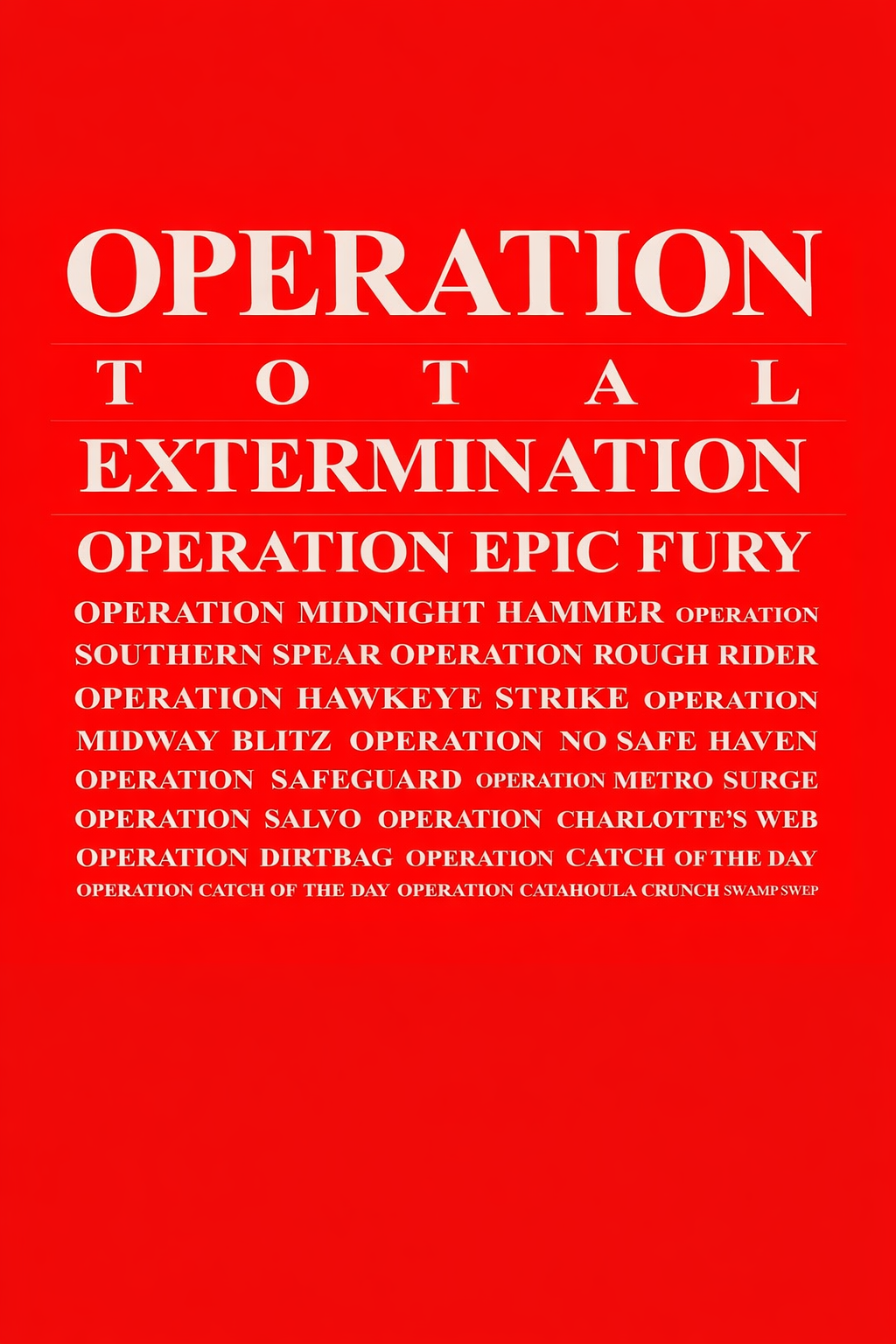
Since elected for the second time, President Trump has been choosing increasingly aggressive names to accompany his expanded use of military force and extension of a “strike first” doctrine. Prior to his announcement of Operation Total Extermination (with a name like that - what could possibly go wrong?), he has called his military aggressions, Operation Epic Fury, Operation Midnight Hammer, Operation Southern Spear, Operation Rough Rider and Operation Hawkeye Strike.

And Trump is waging his jingoistic name war domestically, as well. In the naming of his vicious attacks on immigrants, President Trump is riffing off of the same formula - with a twist. Showing off his virulent racism and his penchant for sick humor, he has named his operations to round up immigrants with cruel, taunting, schoolyard bully names like Operation Dirtbag, Operation Catch of the Day and Operation Charlotte’s Web - combining a bit of what he might call ‘whimsy’ with some very, very dark messaging.

All of these names for operations both international and domestic contrast the names that past presidents have coined to define their wars and military aggressions. A non-comprehensive review of names of past military actions includes: Operation Desert Storm in Iraq and Operation Just Cause in Panama (George H.W. Bush), Operation Allied Force in Yugoslavia (Clinton), Operation Enduring Freedom in Afghanistan (George W. Bush), and Operation Odyssey Dawn in Libya (Obama). In naming the recent war in Iran and Lebanon, Operation Epic Fury President Trump borrowed terminology from former President Ronald Reagan and amped it up some. Former President Reagan called his war on Grenada Operation Urgent Fury.

Of course, there is an inherent problem in past U.S. Presidents glorifying (and at the same time downgrading) the horrors of war with such lofty names. For instance, former President Truman labeled the Korean War a “police action” in 1950. Even so, President Trump’s names are starting a new trend of announcing to the world the nation’s new emphasis on military thuggery.

It has always been problematic that Presidents have felt free to exercise their executive authority to deploy military force without a formal congressional declaration of war, but with Trump’s new military actions, we’ve entered a new age of very, very few checks and balances from our legislative branch of government. Based on data from the Armed Conflict Location and Event Data Project (ACLED) covering the period from January 20, 2025, to early 2026, President Donald Trump's second term saw a rapid surge in military activity that surpassed the total number of airstrikes conducted during Joe Biden's entire four-year term from 2021-2025.

President Trump’s Second Term International Operations:

Operation Total Extermination (March 2026)
Operation Epic Fury (February 2026)  airstrikes against Iran
Operation Hawkeye Strike (December 2025) large-scale strikes against ISIS targets in Syria
Operation Southern Spear (September 2025) anti-narcotic/maritime campaign in the Caribbean
Operation Midnight Hammer (June 2025)  B-2 stealth bombers and missile strikes targeting Iranian nuclear infrastructure
Operation Rough Rider (March 2025) air and naval campaign against Houthi targets in Yemen, which included U.S.-led coalition

President Trump’s Second Term Domestic Operations Against Immigrants:

Operation Catch of the Day (January 2026)  Operations conducted in Maine
Operation Salvo (January 2026) An ICE raid in New York City targeting gang members.
Operation Catahoula Crunch (Swamp Sweep) (December 2025) Enforcement operations in Louisiana
Operation Metro Surge (December 2025) Immigration enforcement in the Minneapolis region
Operation Charlotte's Web (November 2025) a Department of Homeland Security action against undocumented immigrants in North Carolina
Operation Dirtbag (November 2025)  Enforcement operations in Florida

Operation Midway Blitz (January 2025) An operation in the Chicago metropolitan area where approximately 3,000 detained individuals reportedly disappeared from ICE records

In President Trump’s first presidency, his former Chief Strategist and Senior Counselor, Steve Bannon, in a 2019 PBS Frontline interview, outlined the strategy to overwhelm the media and opposition. by "flooding the zone" with rapid-fire initiatives, a concept he termed "muzzle velocity.” It’s a strategy President Trump has continued into his second term and it appears to be working.


Pamela Nagler Pamela Nagler is finishing her book, Unceded Land, Indigenous California and the Foreign Invasions: Spanish, Mexican, Russian, US.

If you use the word “illegal”, do you also say the N word?

Language changes, but the hate does not.

Illustration Julian Lucas

Language, erasure, and the violence we’ve agreed not to be bothered by.

It doesn’t even begin with a knock.

It’s more like the so-called smash and grab, only this time, it’s not teenagers,
Its federal agents in black vests,
doing their own harm to the community.
A pull-up-and-grab, not for sneakers, but for members of the community.
All of this sanctioned by Trump; State violence with a MAGA stamp of approval.

The only time kidnapping awakens patriotism is when the bodies being taken don’t look like theirs.

Why don’t the same people  screaming about shoplifters at CVS also scream out about people being kidnapped in broad daylight. Surely a crying child, as she sees her mother taken away, would elicit screams of injustice.

Let’s talk about masks.

When Palestinian protesters cover their faces, they are labeled terrorists.
When students wear keffiyehs, they’re accused of inciting violence.
When brown kids march, they’re “terrorists and thugs”.

But when ICE pulls up masked,  armed, no badge, no official vehicle, no warning, no accountability, that’s cheered on, that's ok?

People are  vanishing  in real time. No one is exactly sure about where they are taken.

We’ve been here before. 

1954: When a Slur Became Federal Policy

Operation Wetback

Operation Wetback was the real - and very derogatory and racist - name (used in official memos and press releases) of the campaign to remove Mexicans from the country by President Eisenhower. It was executed by armed agents and celebrated in newspapers and by some Americans. Sound familiar?  In the 1920s, when the economy was booming and white Americans wouldn’t pick beets, lay track, or clean hotel kitchens, the U.S. actively recruited Mexican laborers to fill the gap. Railroads, farms, and factories sent agents across the border to bring workers in, cheap, fast, and exploitable.

When the stock market crashed and unemployment surged, those same workers became scapegoats. No hearings. No charges. Just buses, trains, and public silence. In 1942, there was a  U.S. Mexican Farm Labor Program, which was also known as Operation Bracero. This  program brought Mexicans into the United States with the promise of decent wages and good treatment. During Operation Wetback as many as 1.3 million Mexicans, some of them U.S. citizens, were rounded up at gunpoint, dragged from fruit stands and factory floors. They were shipped off in overcrowded trains, ships, buses, often to places in Mexico that were unfamiliar to them. Sound familiar? 

There’s a plaque in downtown Los Angeles now. It admits what was done. But it doesn’t tell the whole story, that the people expelled were first invited, then blamed. Welcomed as labor and then removed as a threat.

And It Didn’t Start There

Hundreds of Mexicans at a Los Angeles train station awaiting deportation

Before Operation Wetback, there was the so called Mexican Repatriation of the 1930s.

These people have been scapegoated for unemployment, blamed for taking jobs from “real” Americans’. Sound familiar? 

It was racialized economic panic then and its racialized economic panic now.

The Invention of “Illegal”

In the decades since, we’ve gotten more careful with our words. The slurs are less acceptable. The harm and hate is still palpable.

The politicians have switched to something that sounds neutral: Illegal. People who intentionally use it must know how cruel it is. They must know the harm it causes?

You hear it when you watch the news, check in on Facebook or Nextdoor, or talk to a conservative media consumer. The word illegal is offensive and crass and it strips away at identity and says “you don’t belong here” to people who do, in fact, belong.

“Illegal” is not a status. It’s a whole sentence.

So I’ll ask again, do the same people who say “illegal” also use the N word?

Is the word “Illegal” like the N word? The origin and tone are different, but the use feels the same.

Both words serve the same social/political function: to dehumanize, disappear, insult and to say you don’t belong. 

Calling someone “Illegal” makes it easier to justify the harm and  ignore the trauma being inflicted.

This country doesn’t just deport people. It deports memory.

Are conservative commentators aware of the similarity? How about the  Latinos for Trump conservatives who scream the loudest. It is easy to forget where your roots first took hold and to dismiss the fearful people who look just like you. 

Ken Light. 6/2/1985 San Ysidro, California.

The question is avoided because facing it means facing the fact that the legal system is just a polished machine for disappearance.

The Myth the Right Way

Immigration done “right way” is expensive and fraught with confusion. People say this, like that path actually exists for everyone. But for many, it’s unaffordable, takes decades, and still ends in rejection. If your child’s life is at risk, you don’t wait for paperwork, you run. The “right way” is often just a privilege people mistake for a moral high ground. But don’t be surprised when the “right way” shifts again and you’re suddenly on the wrong side of the line.

Citizenship has always been a moving goalpost. Ask any Black American. Ask any Indigenous person. Ask any second generation kid watching their uncle being snatch-and-grab into detention while white coworkers joke about tacos and plan the next taco Tuesday.

What Does Language Allow?

“Illegal” doesn’t just erase the person.

It erases the context.

It erases the war, the drought, the cartel, the IMF, the colonial border drawn across someone’s ancestral land.

It erases the U.S. policies that created the very migration it now punishes. A simple google search can tell you what US policies lead to migrants leaving their homelands in search of a better future.

“Illegal” asks no questions about cause.

It just gives permission to punish the effect.

This country never apologized for the deportations of the 1930s. It never apologized for Operation Wetback. This country likes to pretend it forgot.

The state of California did issue a quiet apology in 2012, installing a plaque at LA Plaza de Cultura y Artes to acknowledge the forced removal of Mexican Americans during the Great Depression. It recognized that 400,000 Californians, many U.S. citizens, were deported, part of a repatriation of up to 2 million people. 

But did anyone notice?
No national headlines. No prime time apology. No reparations. No shared reckoning.

And the raids happening now? Don’t hold your breath waiting for acknowledgement or atonement.

Maybe one day there will be a monument. A footnote in a textbook. A documentary narrated by someone who mispronounces our names.

But by then, how many lives will have vanished?

So I’ll ask one last time, and this time, I want you to actually sit with it:

Is “illegal” like the N word?

Are we just too polite, too white, too complicit, too satisfied, to say what we really mean?

Final note. The term “Illegal” isn’t even accurate. It’s not a crime to exist without papers. It’s a word people use to ignore the reasons someone came, war, poverty, policy.

You can call the system broken, but don’t call the person illegal. That’s not law, that’s a choice.


Julian Lucas is the editor of The Pomonan. He writes about power, memory, and the parts of America that would rather forget.