Propaganda

What’s in a Name? President Trump Chooses Punishing, Testosterone-Driven Names for his Ever-Expanding Military Objectives

"Maybe not a good thing to say WAR . . . I won’t use the word ‘war’ because they say if you use the word ‘war,’ that’s maybe not a good thing to do. They don’t like the word ‘war’ because you’re supposed to get approval. So, I’ll use the word ‘military operation,’ which is really what it is. It’s a military decimation.”

President Donald Trump, March 26, 2026 at the National Republican Congressional Committee’s (NRCC) annual fundraising dinner.

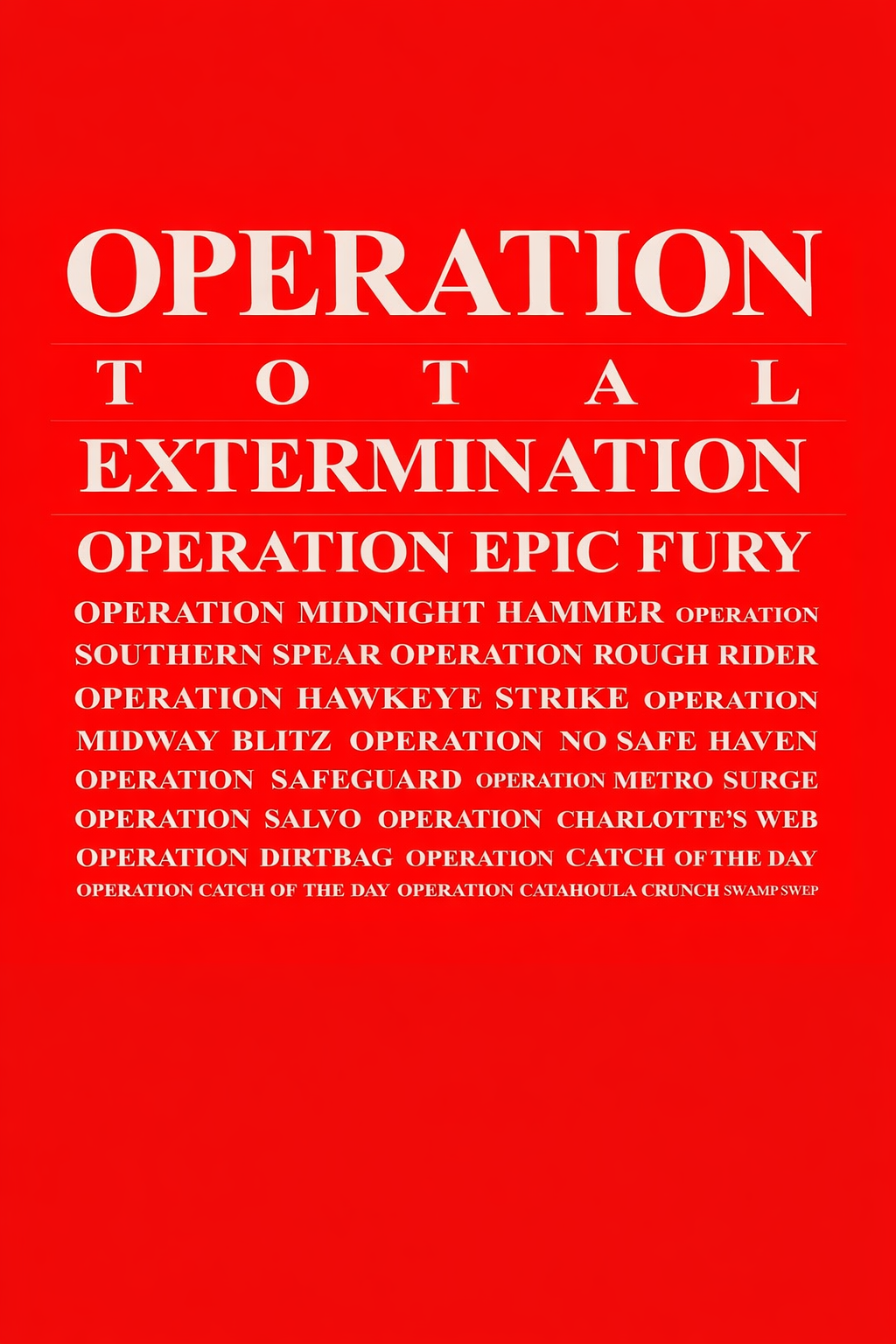
On March 17, 2026, with little fanfare and scant press coverage, the Assistant Secretary of War for Homeland Defense and America’s Security Affairs, Joseph M. Humire, launched our new military offensive in Ecuador, Operation Total Extermination. Calling it a series of “bilateral kinetic actions against cartel targets along the Colombia-Ecuador border,” he indicated it was an effort by Ecuador against transnational criminal organizations with the support of the U.S.A.

Of course, the big concern with this announcement is the escalating violence across the globe and how President Trump is finding it easy to circumvent Congress in this escalation. But that’s not what this article is about. This article is about President Trump choosing increasingly bellicose and combative names to promote his ever-expanding war efforts.

Reminder - this is only the beginning of year two of his four year term.

Since elected for the second time, President Trump has been choosing increasingly aggressive names to accompany his expanded use of military force and extension of a “strike first” doctrine. Prior to his announcement of Operation Total Extermination (with a name like that - what could possibly go wrong?), he has called his military aggressions, Operation Epic Fury, Operation Midnight Hammer, Operation Southern Spear, Operation Rough Rider and Operation Hawkeye Strike.

And Trump is waging his jingoistic name war domestically, as well. In the naming of his vicious attacks on immigrants, President Trump is riffing off of the same formula - with a twist. Showing off his virulent racism and his penchant for sick humor, he has named his operations to round up immigrants with cruel, taunting, schoolyard bully names like Operation Dirtbag, Operation Catch of the Day and Operation Charlotte’s Web - combining a bit of what he might call ‘whimsy’ with some very, very dark messaging.

All of these names for operations both international and domestic contrast the names that past presidents have coined to define their wars and military aggressions. A non-comprehensive review of names of past military actions includes: Operation Desert Storm in Iraq and Operation Just Cause in Panama (George H.W. Bush), Operation Allied Force in Yugoslavia (Clinton), Operation Enduring Freedom in Afghanistan (George W. Bush), and Operation Odyssey Dawn in Libya (Obama). In naming the recent war in Iran and Lebanon, Operation Epic Fury President Trump borrowed terminology from former President Ronald Reagan and amped it up some. Former President Reagan called his war on Grenada Operation Urgent Fury.

Of course, there is an inherent problem in past U.S. Presidents glorifying (and at the same time downgrading) the horrors of war with such lofty names. For instance, former President Truman labeled the Korean War a “police action” in 1950. Even so, President Trump’s names are starting a new trend of announcing to the world the nation’s new emphasis on military thuggery.

It has always been problematic that Presidents have felt free to exercise their executive authority to deploy military force without a formal congressional declaration of war, but with Trump’s new military actions, we’ve entered a new age of very, very few checks and balances from our legislative branch of government. Based on data from the Armed Conflict Location and Event Data Project (ACLED) covering the period from January 20, 2025, to early 2026, President Donald Trump's second term saw a rapid surge in military activity that surpassed the total number of airstrikes conducted during Joe Biden's entire four-year term from 2021-2025.

President Trump’s Second Term International Operations:

Operation Total Extermination (March 2026)
Operation Epic Fury (February 2026)  airstrikes against Iran
Operation Hawkeye Strike (December 2025) large-scale strikes against ISIS targets in Syria
Operation Southern Spear (September 2025) anti-narcotic/maritime campaign in the Caribbean
Operation Midnight Hammer (June 2025)  B-2 stealth bombers and missile strikes targeting Iranian nuclear infrastructure
Operation Rough Rider (March 2025) air and naval campaign against Houthi targets in Yemen, which included U.S.-led coalition

President Trump’s Second Term Domestic Operations Against Immigrants:

Operation Catch of the Day (January 2026)  Operations conducted in Maine
Operation Salvo (January 2026) An ICE raid in New York City targeting gang members.
Operation Catahoula Crunch (Swamp Sweep) (December 2025) Enforcement operations in Louisiana
Operation Metro Surge (December 2025) Immigration enforcement in the Minneapolis region
Operation Charlotte's Web (November 2025) a Department of Homeland Security action against undocumented immigrants in North Carolina
Operation Dirtbag (November 2025)  Enforcement operations in Florida

Operation Midway Blitz (January 2025) An operation in the Chicago metropolitan area where approximately 3,000 detained individuals reportedly disappeared from ICE records

In President Trump’s first presidency, his former Chief Strategist and Senior Counselor, Steve Bannon, in a 2019 PBS Frontline interview, outlined the strategy to overwhelm the media and opposition. by "flooding the zone" with rapid-fire initiatives, a concept he termed "muzzle velocity.” It’s a strategy President Trump has continued into his second term and it appears to be working.


Pamela Nagler Pamela Nagler is finishing her book, Unceded Land, Indigenous California and the Foreign Invasions: Spanish, Mexican, Russian, US.

Is Anti-Zionism, Anti Semitism?

Photography Courtesy Ahmed Abu Hameeda

By Gilbert Aguirre
Published 10/19/2023 | 7:22am PST
Photography Ahmed Abu Hameeda

NOTE to readers: This is a reprint of an article that The Pomonan printed a year and a half ago about what was happening not only on the University of California at Riverside campus, but on college campuses across the country. Now, here we are some twenty months later, and the question Is Anti-Zionism, Antisemitism? is just as pertinent - perhaps more so -  than it was back then. With the Israel-Hamas War raging in the Middle East, universities including Harvard, Stanford, Arizona State, Tufts, to name a few, are erupting over this issue. The Pomonan asks its readers to reconsider this issue in light of recent events. This opinion piece was written by former UCR student Gilbert Aguirre.


An email sent to UCR students from the UCR Life email list on May 27, 2021, caught this recipient’s attention with the subject heading: Anti Semitism: then and now. Instead of providing information on antisemitism, an abhorrent form of discrimination which has no place in civil society, the piece intended to conflate anti-Zionism with antisemitism and erase the existence and justified resistance of Palestinian people. 

This is my critique of the interview of UCR Jewish Studies professor Michael Alexander, and his interviewer Omar Shamout, for the disingenuous framing of critiques of the apartheid, settler-colonial state of Israel as antisemitic. Their discussion can be read here (1).

In the article’s opening lines, anti-Zionists, educated on what anti-Zionism and antisemitism is, are made aware that the framing of this article is entirely disingenuous— the working definition of antisemitism in the article comes from the Anti-Defamation League, which classifies antisemitism as being “based on age-old stereotypes and myths that target Jews as a people, their religious practices and beliefs, or the Jewish State of Israel” (2)

I will repeat that antisemitism, like all forms of prejudice, is absolutely abhorrent and must be destroyed by any means necessary. However, in framing critiques of Israel as antisemitic, activists fighting for justice in Palestine are silenced, as the Anti-Defamation League’s definition of antisemitism functions to quell dissent of Israel. 

Shamout frames his interview of Alexander as a response to “data compiled by the Anti-Defamation League [which] shows an increase in violent attacks, vandalism and harassment of Jews in the U.S., around the world, and online, since fighting broke out between Israel and Gaza’s militant rulers Hamas earlier this month.” Shamout, in analyzing this framing, identifies that actual antisemitic attacks are being lumped in with “vandalism and harassment” - meaning that vandalizing the phrase “Free Palestine'' on a wall or critiquing Israel on twitter would  qualify as antisemitic under this definition. 

Again, critiquing Israel is not antisemitic, and this framing portrays a fictitious world in which critiques of Israel have the same material impacts on Jewish people as violent hate crimes committed by white supremacists.

Additionally, others have contested the data compiled by the Anti-Defamation League. In an analytical article published by Jewish Currents, a magazine committed to leftist Jewish discourse, Mari Cohen questions and analyzes the data and methods that contribute to the ADL’s report. Cohen is concerned by the weaponizing of anti-Zionism as antisemitism, and her analysis is critical to the conflation of anti-Zionism with antisemitism contributes to misinformation and skewed data— which she states that the ADL’s report exemplifies (3).

My critique also includes the constant erasure of Palestinian people and Palestine as a sovereign state. In the quotation provided above, Shamout makes his first attempt, through the phrase “fighting broke out between Israel and Gaza’s militant rulers Hamas—“ not Israel and Palestine, not the Israeli Defense Force and Palestinian’s resistance movement, not Israel’s occupying force and the Palestinian resistance; Shamout erases Palestine entirely, as if it were a dirty word.

Shamout proceeds in the next paragraph to use the problematic framing that critique of Israel equates to antisemitism when he asserts, “while hatred toward Jews is sadly nothing new, these incidents are framed against the backdrop of recent Middle East violence, a surge in pro-Palestinian sentiment,” which implies that Palestinian existence is itself a problem.

So I ask, what exactly does the term “pro-Palestinian sentiment” imply? What makes “pro-Palestinian sentiment,” in other words defense of Palestinian’s right to exist and resist violence from the state of Israel, support hatred towards Jewish people? Would the international movements and demonstrations against police violence after the murder of George Floyd be considered “pro-Black sentiment”? Why is Palestinian existence framed as a problem?

Shamout seems to suggest that anti-Zionism is separate from antisemitism when he asks Alexander, “Many of the recent antisemitic incidents have used the term ‘Zionism.’ Can you explain what Zionism meant historically, what it means today, and how the term has been used by racists to target Jews?” To which Alexander gives a bloated, incoherent response that doesn’t state the clear intentions of Zionism, which is a colonial project whose modern conception was proposed and propagated by Theodor Herzl (4).

Zionism, a political position, is framed by Alexander as, “simply Jewish nationalism: the desire for the Jewish people to have and hold their own state,” ignoring that this political position hinges upon the colonization of Palestine, and the genocide of its native occupants. Alexander seems to support the ethnic cleansing of Palestinians when he states, “Let’s not forget, the logic of self-determination implies the cleansing of everybody else in order to achieve a majority. Cleanse or be cleansed. The logic is stark, but to date it remains the main means by which nation states are formed.”

So I ask, how is it that  UCR News published this violent, genocidal speech that it circulated to its student body? How can a professor be unashamed of giving a defense of what he himself refers to as “the cleansing of everybody else in order to achieve a majority”?

Shamout, expecting an answer to the question, “So it’s fair to say that not all critics of Zionism should be cast as antisemitic?” instead receives another bloated, asinine response where Alexander further defends genocide. Alexander proposes a both-sides defense of genocide in his next monologue, by skirting the question, as he states, “Zionism is as legitimate and as problematic as any other nationalism.”(5)

To this, I argue that nationalism against an oppressive force is legitimate. Nationalism against colonizing forces is what has historically motivated the Cuban Revolution, the Irish Republican Army’s resistance against British colonial rule, and Palestinians’ fight against the Israeli government - to name a few. In the case of Palestine, Israel has  actively pushed Palestinians out of their homes, murdered Palestinian children, and bombed its densely populated territories (6). This kind of nationalism is quite different from the kind of nationalism that seeks to oppress another group while expanding the nation’s borders in disregard to human rights and international law.

Alexander continues, “it is problematic in the sense that having formed an ethnic majority, Israel turns around and polices its remaining minorities.” As a reminder, the minorities Alexander refuses to name are Palestinians. Additionally, the Palestinians Alexander refuses to name have only become minorities as a result of Israeli occupation, a modern project that ironically results in some Palestinians being older than the illegitimate state of Israel.

Further Alexander states, “Nearly all majorities do this. This past year, we all saw once again how the American policing of minorities is no exception. The problem of minorities is systemic and is not particular to Israel or to the U.S. Yet that does not excuse Israel from the need to acknowledge and cease the violence of its nation building.”

Implicitly, excusing is exactly what Alexander is doing. To both-sides and what-about state violence via settler-colonialism and white supremacist policing in both Israel and the United States is a disingenuous deflection that attempts to justify the violence of Israel. Alexander is saying— Yeah, it sucks, but that’s just how it goes. By putting on an apolitical mask, in this case and in any other case, it is very clear that the person engaging in the both-sides / what-about argument is on the side of the oppressor.

In the last two sentences of his pro-genocide diatribe, Alexander attempts  to answer Shamout's question on whether or not all critiques of Zionism equate to antisemitism even though, thus far, he has shown a clear aversion to answering any question directly. He states, “I would say this is the great moral imperative and conundrum of the Jewish people in our time. Still, it is a conundrum that rightly should be admitted and shared by hundreds of nations and national movements.” Again, Alexander’s answer is an asinine non-answer that serves to conflate all Jewish people with the ideology of Zionism. It is all in service of Alexander’s personal political agenda.

At the interview’s conclusion, Shamout asks Alexander, “what do you think are the best ways to combat antisemitism in our communities, both physical and online?” to which Alexander does not speak to antisemitism, but once again to the prospects and effects of propagating Zionism without consequence. His opening statement to this sentence is, again, incoherent, so I’ve done the work of decoding it. He states, “I would need to expand the purview of the mandate to include the elimination of Islamophobia and the denial of Palestinian rights to a free and self-determined state.” This thirty-one word sentence means almost nothing, but serves to frame the Israeli occupation of Palestine as a religious issue.

Contrary to what Alexander is propagating, there are Palestinians of Muslim faith, Christian faith, Jewish faith, and atheists (7)— keep in mind the question Shamout asked concerned how to combat antisemitism, but Alexander’s monologue concerns Zionism.

In the following sentence, Alexander reveals his true intentions as he states, “it would also have to include complete civil rights for Palestinians and other minorities who are Israeli citizens.” By granting Palestinians citizenship status, he is finally revealing his agenda as a one state solution Zionist. Under the proposed civil rights, Palestinians won’t have their land, and they would be citizens of the illegitimate state of Israel that imposed itself onto the Palestinian people.

Ultimately, this interview published by UCR News is unacceptable in its disingenuous framing of a human rights issue that affects the lives of real people, and has affected the lives of Palestinian students at UCR. In framing critiques of Zionism as antisemitic, and speaking almost exclusively to Zionism in an interview which is supposedly about antisemitism, Alexander constructs an argument that, within the argument’s fabrication, cannot be critiqued without being antisemitic.

Furthermore, the answers Alexander gives are so bloated and incoherent, I don’t understand how he is a professor at UCR, as I’ve had more coherent and substantive conversations with my five-year-old brother, who would stand firmly against genocide if knowledgable enough to understand it— rather than providing  a both-sides / what-about defense so that his in-group can commit atrocities without critique.

To be explicit, my use of “in-group” is not an allusion to an antisemitic conspiracy, but a direct contention of the conflation of critiques of Zionism as antisemitic— a clear and obvious disingenuous framing that uses identity as a shield and weaponizes actual hate towards Jewish people, which has material consequences and thus should not be minimized to serve a political agenda.

Critique of Zionist Propaganda

By Gilbert Aguirre
Published 2/23/2022 6:00Am PST
Photography Ahmed Abu Hameeda

An email sent to UCR students from the UCR Life email list on May 27, 2021, caught recipient’s attention with the subject heading: Antisemitism then and now. Instead of providing information on antisemitism, an abhorrent form of discrimination which has no place in civil society, the piece intended to conflate anti-Zionism with antisemitism and erase the existence and justified resistance of Palestinian people. This is my critique of the interview of UCR Jewish Studies professor Michael Alexander, and his interviewer Omar Shamout, for the disingenuous framing of critiques of the apartheid, settler-colonial state of Israel as antisemitic. Their discussion can be read here (1).

In the article’s opening lines, anti-Zionists educated on what anti-Zionism and antisemitism are, are made aware that the framing of this article is entirely disingenuous— the working definition of antisemitism in the article comes from the Anti-Defamation League, which classifies antisemitism as being “based on age-old stereotypes and myths that target Jews as a people, their religious practices and beliefs, or the Jewish State of Israel” (2). I will repeat that antisemitism, like all forms of prejudice, is absolutely abhorrent and must be destroyed by any means necessary. However, in framing critiques of Israel as antisemitic, activists fighting for justice in Palestine are silenced, as the Anti-Defamation League’s definition of antisemitism functions to quell dissent of Israel. Shamout proceeds to frame the purpose of his interview with Alexander as a response to “data compiled by the Anti-Defamation League [which] shows an increase in violent attacks, vandalism and harassment of Jews in the U.S., around the world, and online, since fighting broke out between Israel and Gaza’s militant rulers Hamas earlier this month.” So, in analyzing this framing, actual antisemitic attacks are being lumped in with “vandalism and harassment,” keeping in mind that the working definition of antisemitism in Shamout’s piece includes critique of Israel as antisemitic, vandalizing the term “Free Palestine” on a wall, or critiquing Israel on twitter would also qualify as antisemitic. Again, critiquing Israel is not antisemitic, and this framing portrays a fictitious world in which critiques of Israel have the same material impacts on Jewish people as violent hate crimes committed by white supremacists.

Additionally, the data compiled by the ADL reporting an increase in antisemitism is contested. In an analytical article published by Jewish Currents, a magazine committed to leftist Jewish discourse, Mari Cohen questions and analyzes the data and methods that contribute to the ADL’s report. Cohen, like many leftists, is concerned by the weaponizing of anti-Zionism as antisemitism, and her analysis contributes greatly to how the conflation of anti-Zionism with antisemitism contributes to misinformation and skewed data— which the ADL’s report exemplifies (3).

Another part of my critique will include the constant erasure of Palestinian people and Palestine as a sovereign state. In the quotation provided above, Shamout makes his first attempt, through the phrase “fighting broke out between Israel and Gaza’s militant rulers Hamas—“ not Israel and Palestine, not the Israeli Defense Force and Palestinian’s resistance movement, not Israel’s occupying force and the Palestinian resistance; Shamout erases Palestine entirely, as if it were a dirty word. Shamout proceeds in the next paragraph to use the problematic framing that critique of Israel equates to antisemitism to assert, “while hatred toward Jews is sadly nothing new, these incidents are framed against the backdrop of recent Middle East violence, a surge in pro-Palestinian sentiment,” which implies that Palestinian existence is itself a problem. So I ask, what exactly does the term “pro-Palestinian sentiment” imply? What makes “pro-Palestinian sentiment,” in other words defense of Palestinian’s right to exist and resist violence from the state of Israel, support hatred towards Jewish people? Would the international movements and demonstrations against police violence after the murder of George Floyd be considered “pro-Black sentiment”? Why is Palestinian existence framed as a problem?

Shamout almost comes to see that anti-Zionism is separate from antisemitism when he asks Alexander, “Many of the recent antisemitic incidents have used the term ‘Zionism.’ Can you explain what Zionism meant historically, what it means today, and how the term has been used by racists to target jews?” To which Alexander gives a bloated, incoherent response that doesn’t state the clear intentions of Zionism, which is a colonial project whose modern conception was proposed and propagated by Theodor Herzl (4).

Zionism, a political position, is framed by Alexander as, “simply Jewish nationalism: the desire for the Jewish people to have and hold their own state,” ignoring that this political position hinges upon the colonization of Palestine, and the genocide of its native occupants. Alexander seems to support the ethnic cleansing of Palestinians as he states, “Let’s not forget, the logic of self-determination implies the cleansing of everybody else in order to achieve a majority. Cleanse or be cleansed. The logic is stark, but to date it remains the main means by which nation states are formed.” So I ask, how did UCR News allow this violent, genocidal speech to get published to its student body? How can a professor be unashamed of giving a defense of what he himself refers to as “the cleansing of everybody else in order to achieve a majority”?

Shamout, expecting an answer to the question “So it’s fair to say that not all critiques of Zionism should be cast as antisemitic?” receives another bloated, asinine response where Alexander goes to further defend genocide. Alexander proposes a both-sides defense of genocide in his next monologue, again not answering the question, as he states, “Zionism is as legitimate and as problematic as any other nationalism”— to this point I argue that nationalism against an oppressive force is legitimate (5). Nationalism against colonizing forces has been used historically by Cubans proud of their nation’s decolonial revolution, the Irish Republican Army’s resistance against British colonial rule, and Palestinians’ fight against the Israeli government that actively pushes Palestinians out of their homes, murders Palestinian children, and bombs densely populated territories (6).That nationalism is quite separate from nationalism that seeks to oppress another group, and expand the nation’s borders, disregarding human rights and international law— which is precisely what Palestinians have been resisting since the birth of Zionism. Alexander continues, “it is problematic in the sense that having formed an ethnic majority, Israel turns around and polices its remaining minorities.” As a reminder, the minorities Alexander refuses to name are Palestinians. Additionally, the Palestinians Alexander refuses to name have only become minorities as a result of Israeli occupation, a modern project that ironically results in some Palestinians being older than the illegitimate state of Israel. “Nearly all majorities do this. This past year, we all saw once again how the American policing of minorities is no exception. The problem of minorities is systemic and is not particular to Israel or to the U.S. Yet that does not excuse Israel from the need to acknowledge and cease the violence of its nation building.” Although implicitly, excusing is exactly what Alexander is doing. To both-sides and what-about state violence via settler-colonialism and white supremacist policing in both Israel and the United States is a disingenuous deflection that attempts to justify the violence of Israel. Alexander is saying— Yeah, it sucks, but that’s just how it goes. By putting on an apolitical mask, in this case and in any other case, it is very clear that the person engaging in the both-sides / what-about argument is on the side of the oppressor. In the last two sentences of his pro-genocide diatribe, it appears Alexander returns to answer Shamout's question on whether or not all critiques of Zionism equate to antisemitism, I am not sure because Alexander has thus far shown a clear aversion to answering any question directly. He states, “I would say this is the great moral imperative and conundrum of the Jewish people in our time. Still, it is a conundrum that rightly should be admitted and shared by hundreds of nations and national movements.” Again, an asinine non-answer that serves to conflate all Jewish people with the ideology of Zionism, to serve Alexander’s personal political agenda. 


At the interview’s conclusion, Shamout asks Alexander, “what do you think are the best ways to combat antisemitism in our communities, both physical and online?” to which Alexander does not speak to antisemitism, but once again to the prospects and effects of propagating Zionism without consequence. His opening statement to this sentence is, again, incoherent, so I’ve done the work of decoding it. He states, “I would need to expand the purview of the mandate to include the elimination of Islamophobia and the denial of Palestinian rights to a free and self-determined state.” This thirty-one word sentence means almost nothing, but serves to frame the Israeli occupation of Palestine as a religious issue. Contrary to what Alexander is propagating, there are Palestinians of Muslim faith, Christian faith, Jewish faith, and atheists (7)— keep in mind the question Shamout asked concerned how to combat antisemitism, but Alexander’s monologue concerns Zionism. In the following sentence, Alexander reveals his true intentions as he states, “it would also have to include complete civil rights for Palestinians and other minorities who are Israeli citizens.” By granting Palestinians citizenship status, he is finally revealing his agenda as a one state solution Zionist. Under the proposed civil rights, Palestinians won’t have their land, and they would be citizens of the illegitimate state of Israel that imposed itself unto the Palestinian people.

Ultimately, this interview published by UCR News is unacceptable in its disingenuous framing of a human rights issue that affects the lives of real people, and has affected the lives of Palestinian students at UCR. In framing critiques of Zionism as antisemitic, and speaking almost exclusively to Zionism in an interview which is supposedly about antisemitism, Alexander constructs an argument that, within the argument’s fabrication, cannot be critiqued without being antisemitic. Furthermore, the answers Alexander gives are so bloated and incoherent, I don’t understand how he is a professor at UCR, as I’ve had more coherent and substantive conversations with my five year old brother, who would stand firmly against genocide if knowledgable enough to understand it— not provide a both-sides / what-about defense so that his in-group can commit atrocities without critique. To be explicit, my use of “in-group” is not an allusion to an antisemitic conspiracy, but a direct contention of the conflation of critiques of Zionism as antisemitic— a clear and obvious disingenuous framing that uses identity as a shield and weaponizes actual hate towards Jewish people, which has material consequences and thus should not be minimized to serve a political agenda.


LINKS