

Illustration Julian Lucas ©2025
Googie architecture thrived in the Atomic Age, when America’s imagination was fueled by the space race, roadside culture, and the Jetsons’ gleaming optimism. Rooflines tilted like rocket fins, signs shouted in neon, and every design choice insisted the future wasn’t something to fear but something to be built, loudly, unapologetically, and in public view. To erase that is to chip away at a time when boldness was the default, not a risk.
But new age politicians aren’t interested in bold, they’re interested in streamlining culture until it’s flat enough to fit inside a marketing brochure. They sand down the edges, cut the neon, and sell the past back to you as a caricature of itself. To ignore Googie is to say history never mattered here, and maybe never will.
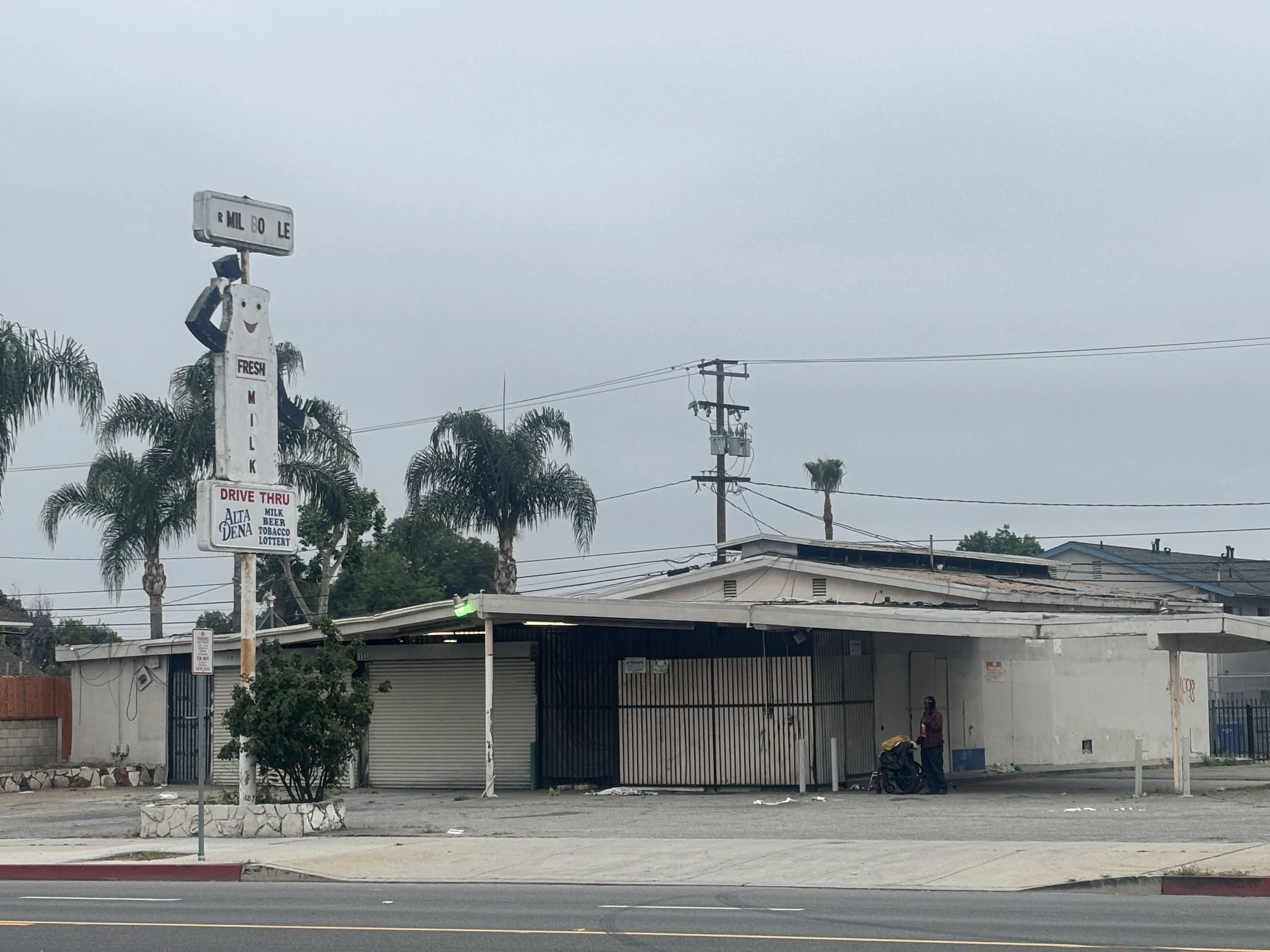
Pomona has a talent for missing the point. On July 21, the City Council proved it again, voting to preserve the old milk bottle sign on Indian Hill while ignoring the building it belongs to. The Historic Preservation Commission, which exists precisely to weigh in on such matters, had already said the building was historic. The Council didn’t listen. They listened to staff instead.
The result is a familiar scene in Pomona politics, history is flattened into set dressing for a city that can’t tell a story. History preserved only as kitsch. The sign gets to stay, floating in the air like a detached mascot, while the building, a rare piece of mid-century Googie architecture, is left to the mercy of demolition or gut-job redevelopment. It’s a decision rooted not in vision but in small-bore bureaucracy, the kind that confuses preservation with tokenism.
And what’s going up instead? Supposedly, a three-story housing block, cheek to jowl with a strip mall that’s already a hodgepodge of half-dead businesses, including, naturally, a liquor store. Because nothing says urban planning like stacking new apartments beside an outdated strip mall with a discount smoke shop and a nail salon, a barber because we don’t have enough barbers in the city.
The Council will say, they don’t want to override their commission and they care about economic development. They’ll say they’re making room for the future. But anyone with an imagination could see the future sitting right there, in that building, with its drive-thru bones and road-trip nostalgia. The problem isn’t that Pomona can’t innovate, it’s that its leadership can’t imagine innovation outside of the cookie-cutter apartments with “luxury” in the marketing brochure although “affordable” is usually the buzzword that comes before luxury.
Cities with ambition know how to work with their history. They repurpose. They reimagine. They keep the soul of a place alive even as they refresh its face. In Pomona, we get the opposite, leaders who treat their own historic commission like an advisory speed bump.
The milk bottle will stay, smiling down from its lonely perch. The building will likely vanish. And once again, Pomona will trade the possibility of a landmark for the safety of a signpost.
The tragedy isn’t that they can’t see the value. It’s that they never even tried. And that, more than anything, is why this city has gotten to be so corny.
Julian Lucas is a photographer, writer and provocateur committed to documenting what power tries to hide. Julian is the founder of The Pomonan and founder and owner of Mirrored Society, a bookshop dedicated to fine art books. His work, on the page, in the darkroom, and in the streets, documents what institutions try to forget. He publishes what others try to bury.


