
La Nueva Voz cannot serve two masters.
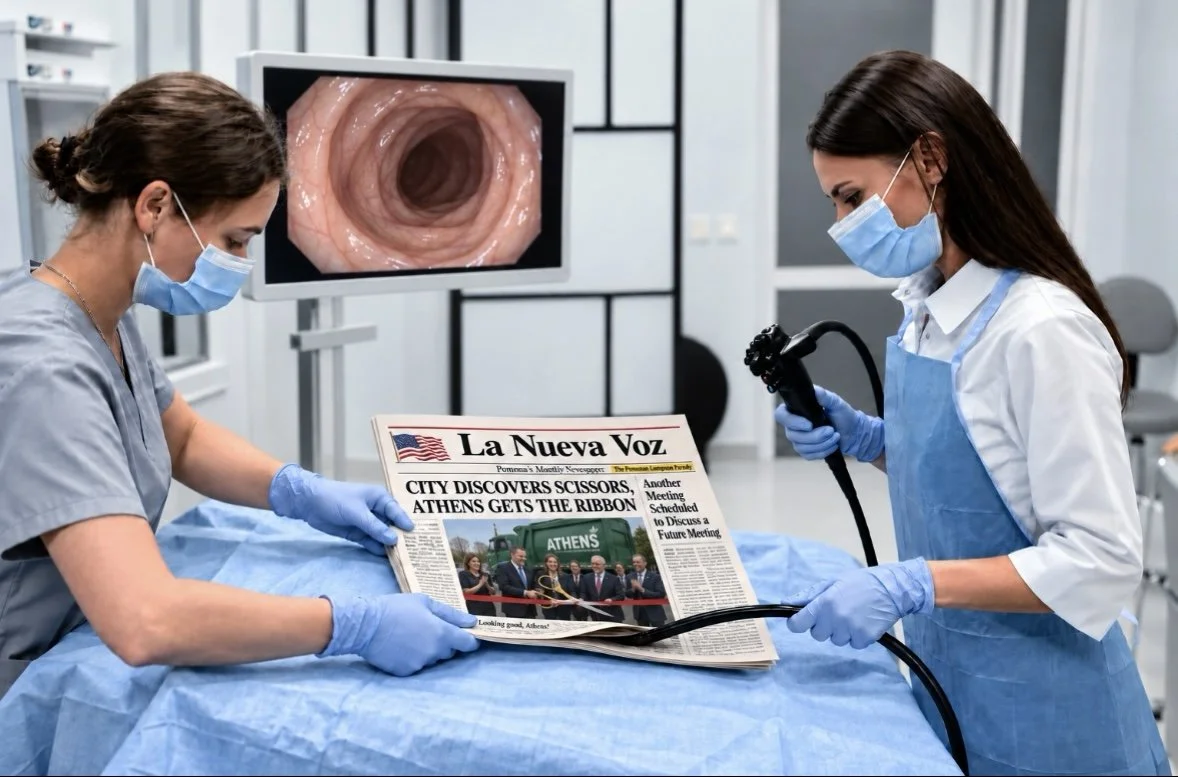
Parody Photo Illustration Julian Lucas ©2026
The publication calls itself Pomona’s “only community newspaper.” Its October 2026 masthead also identifies it as a division of South Coast Media Services, “Providing media relations services since 1983.” A public relations firm represents its clients. A newspaper is trusted to investigate, question and hold local institutions accountable. Putting both functions under the same business invites a conflict readers deserve to have explained. [1]
Pomona deserves an independent watchdog. The question is whether the publication’s practices live up to that responsibility.
The Spin Machine
La Nueva Voz introduces itself to the city with a tagline that is as comical as it is exclusionary: “Pomona’s only community newspaper.” It is a bizarre way to present yourself to a municipality where other independent voices publish, and it poses a question the slogan cannot answer: What, exactly, are readers getting from an operation that claims the whole town? [2]
An inspection of the publication’s archive reveals a messy landscape of reporting, public relations connections, congratulatory notes to financial sponsors and factual errors that should have been caught before the ink dried. There is no need to invent wild conspiracy theories about local media. The documented examples provide enough to examine.
So let’s give the paper’s own bullshit the colonoscopy it deserves.
An Inherited Identity
The name La Nueva Voz carries a legacy of community advocacy that its current management did not create. Candelario “Cande” Mendoza and Albert “Al” Castro founded the original La Voz in 1981 to counter the negative portrayal of Latinos in mainstream news coverage. Mendoza, an educator and longtime school board member, died in 2008. Castro died in 2020. Their original publication ceased operations in 2009. [3]
La Nueva Voz launched that August. The company’s website says preserving the original paper’s “look and feel” was part of the business plan, going so far as to hire the same person for page layout and Spanish translation. The visual resemblance was deliberate. [2]
That history deserves acknowledgment. It also deserves precision. The original La Voz and the current La Nueva Voz have different founding histories. Preserving an appearance does not, by itself, establish the quality or independence of the journalism published beneath it.
A Master in PR, a Servant in News
Today, the publication presents a dual identity on its own pages: community newspaper and a division of a business advertising media relations services. How does that operation maintain editorial independence when covering the local institutions around it? [1]
While journalism and public relations share writing skills, they serve different interests. Journalism requires asking the sharp questions that institutions would prefer to avoid. Public relations involves representing those institutions.
The connections are documented. In December 2019, La Nueva Voz reported that publisher Jeff Schenkel had been retained as a public relations consultant by Tri-City Mental Health in 2007. The story described a decade of partnership publishing the agency’s news, photographs and advertisements after the newspaper launched in 2009. Tri-City was honoring the paper as an outstanding community partner. [4]
The story disclosed that history. It does not establish that Schenkel’s consulting retainer continued after the newspaper launched. That distinction matters. A past consulting relationship is not proof of a current payment.
Renee Barbee, the paper’s vice president of marketing and operations, is listed as executive board secretary on the Pomona Chamber of Commerce’s 2026 to 2027 roster. The broader board includes representatives of city government, Foothill Transit, Athens Services and Valley Vista Services. [5]
Those positions do not prove that anyone dictates coverage. But they do put a newspaper executive inside an organization alongside representatives of institutions local reporters have reason to question. Their readers should understand how those obligations are handled when they intersect.
The overlap remains current. In the October 22, 2026 issue, a photograph places Barbee in the ribbon cutting for improvements at JFK Park alongside elected officials. Apparently, covering the ribbon cutting also requires being in it. Barbee isn’t merely documenting Pomona’s civic establishment. Here, she’s posing alongside it. Tone-def? Its caption identifies her Chamber role and her position as a Pomona library trustee. The following page carries a selfie with Barbee, Police Chief Mike Ellis, Councilmember Debra Martin and an assemblymember’s representative. [1]
Attending an event or appearing in a photograph is not evidence of purchased coverage. Participating in civic leadership while helping run a newspaper covering that civic establishment does raise a question about editorial distance. Where does the institutional partnership end and the independent examination begin?
Being a valued community partner is rather lovely. A newspaper also needs to be useful when the partner would prefer it shut the fuck up.
The Receipts: Trash Deals and Cannabis Spin
The December 22, 2022 issue makes the problem concrete. The front page reported the city’s award of an exclusive trash collection franchise to Athens Services. Inside that same issue, a Christmas parade special section congratulated Athens on its selection and welcomed the company as the section’s new sponsor. The printed caption read: “Looking good, Athens!” [6]
The sponsorship was disclosed. The issue also printed Councilmember Nora Garcia’s objections to outsourcing. Those details belong in the record.
But the decision to congratulate a corporate sponsor for winning a public contract while reporting on the award is embarrassingly homie like. A public decision affecting residents’ trash service deserves editorial distance, not a corporate greeting card.
The paper’s corrections show another problem: what happens when information supplied by an outside PR operation reaches readers without a crucial error being caught.
In its September 28, 2023 issue, La Nueva Voz clarified an August 24 story about a STIIIZY check presentation. The original piece included Lopez Urban Farm among organizations the cannabis company had worked with. The farm had not worked with STIIIZY. The paper said the information and photograph came from an external PR team representing the company. According to the clarification, an invitation list apparently accounted for the confusion. La Nueva Voz apologized to readers. [7]
An invitation is not a working relationship. The published error supplied a company with a community connection it did not have. A PR team has a client to represent. The newspaper has readers to answer to.
The School District Blunder
The May 27, 2021 correction involving Oliver Unaka, then Pomona Unified School District’s public information officer, was more consequential. La Nueva Voz acknowledged two factual errors in an opinion column. His open microphone comment happened after discussion of an Asian American and Pacific Islander vigil, during a different presentation. It had nothing to do with the AAPI discussion. The paper said it obtained and reviewed the meeting recording after publication. [8]
For its description of board member Roberta Perlman’s surprise at the comment, the newspaper pointed to three question marks in a text message. It also printed PUSD’s critical response and disputed the district’s broader accusations, including whether it had sought comment before publication. [8]
Whatever those disagreements, the correction acknowledged that the paper had attached the comment to the wrong discussion. Context affects how readers judge a person. Calling a column opinion does not make that context optional.
Checking the primary source before printing would have been a better use of editorial energy than explaining the mistake afterward.
The Printing Press as a Personal Weapon
In March 2015, the paper published a restaurant review labeled opinion criticizing a Pomona Papa John’s after staff declined to use customer supplied non dairy cheese for a lactose intolerant customer. The paper said it had called ahead, that the store had accommodated the request previously and that it later sought a response. [9]
Those details give the service complaint context. Then the review dragged in how well known the paper’s advertising and public relations director was around Pomona, complained that the staff did not know her and mocked the assistant manager’s youthful appearance. [9]
What the fuck did her local prominence have to do with the pizza? Dragging personal status into the review made it read like a wounded ego had found access to a printing press.
The paper’s dealings with other publications deserve attention, too. In September 2025, The Poly Post’s student editorial board announced that its Spanish language section, La Voz de Pomona, would become La Verdad. The students said Schenkel had demanded they drop the former name to avoid confusion with La Nueva Voz. They described the approach as a legal demand and criticized the absence of an earlier conversation. [10]
Schenkel disputed their account of his outreach. In a November 4, 2025 response, he said he had attempted contact before emailing and calling the faculty adviser. He cited his history of speaking to classes and sharing stories with student journalists. He defended protecting the business name and described his actions as consistent with “real world business tactics.” [11]
Fine. Readers can assess those tactics with his explanation included. Experience in the business does not place the way you conduct it beyond criticism.
The Pomonan has a connection to this subject that readers should know. Our archive carries a notice published September 19, 2019, attributed to Barbee, demanding that PomonaVoice.org change its name to avoid possible further action and expense. The notice claimed that federal copyright protection extended to La Nueva Voz’s name itself. This is our published archive of the notice; the original correspondence has not been independently authenticated in this review. [12]
The copyright claim is dead wrong. The U.S. Copyright Office identifies names and titles as material copyright does not protect. Trademark protection is a separate question, and that distinction does not settle every possible naming dispute. But a publication warning another outlet about legal expense ought to get the law it invokes right. [13] Additionally, there is a radio station called La Nueva Voz to say the least.
For a publisher whose own website describes deliberately retaining a predecessor’s appearance, demands that other publications change their names invite an obvious question: How much room does this self-described community newspaper believe the community should have to publish?
A Community Deserves More Than Congratulations
But ok, La Nueva Voz has published work that deserves credit. Its September 2024 issue pressed Councilmember Victor Preciado, who is up for reelection, over the closure of Pomona’s Foothill Transit store. That is a useful subject for a community newspaper to pursue. Pretending the paper never challenges institutions would be dishonest and would make this criticism easier to dismiss. [14]
But useful work does not cancel out bad judgment elsewhere. Neither does longevity, a Chamber title or an award from an institution you have worked with. The proximity between Pomona’s political establishment, corporate interests and its “only community newspaper” is, in my view, far too chummy for comfort.
Pomona deserves a transparent, independent watchdog. A paper can cover the community’s celebrations and still ask uncomfortable questions. It can sell advertising and still keep its reporting accountable to readers. What it cannot do is expect a respected predecessor, a familiar masthead or a roomful of institutional friends to answer for its mistakes.
Until this town gets a press that knows the difference between a hard-hitting report and a greeting card for a corporate sponsor, The Pomonan will be right here to hold the mirror up.
1. La Nueva Voz, October 22, 2026, pages 6, 17 and 18.
2. La Nueva Voz, About Us.
3. La Nueva Voz, January 23, 2020, page 5: obituary of Al Castro and history of La Voz.
4. La Nueva Voz, December 26, 2019, page 2.
5. Pomona Chamber of Commerce, 2026 to 2027 board roster.
6. La Nueva Voz, December 22, 2022, pages 1, 6 and 9.
7. La Nueva Voz, September 28, 2023, page 4.
8. La Nueva Voz, May 27, 2021, pages 2 and 5.
9. La Nueva Voz, March 26, 2015, page 6.
10. The Poly Post editorial, September 30, 2025.
11. Jeff Schenkel’s response in The Poly Post, November 4, 2025.
12. The Pomonan, Official Notice (Archived), published September 19, 2019.
13. U.S. Copyright Office, Circular 33: Works Not Protected by Copyright.
14. La Nueva Voz, September 26, 2024, page 6.
Reporting note: This article is fact checked and is based on published documents and statements, including La Nueva Voz’s corrections and Schenkel’s published response. The 2019 notice remains attributed to The Pomonan’s archive; the original correspondence has not been independently authenticated in this review. The accompanying medical scene is a parody illustration.
Julian Lucas is a darkroom photographer, writer, and bookseller, though photography remains his primary language. He is the founder of Mirrored Society Book Shop, publisher of The Pomonan, and creator of Book-Store and Print Pomona Art Book Fair. And he will charge you $ 2.5 million for event photography.