Book Review

Everything Starts Underground, Until the Underground Becomes a Scene

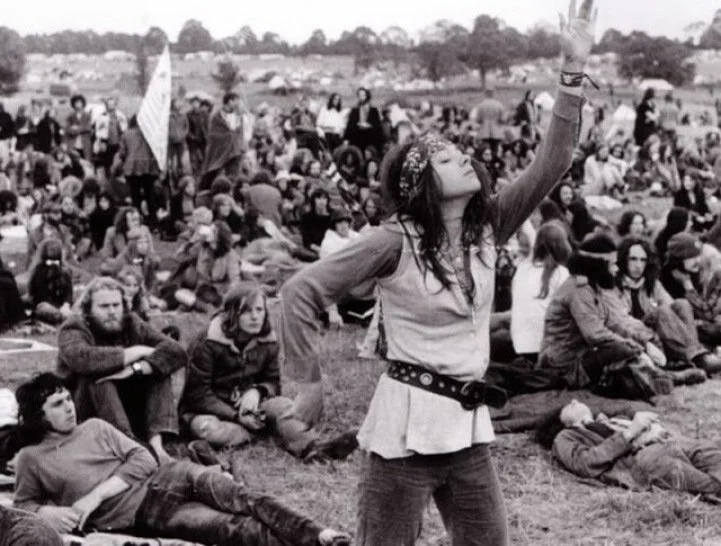
Timothy Miller’s The Hippies and American Values does something many books about the 1960s don’t. It doesn’t romanticize hippies. It doesn’t mock them either. It treats them seriously. Not as clichés. Not as an aesthetic. But as people trying to build a different way to live.

Miller looks at hippies as a moral and cultural movement. His focus isn’t elections or legislation. It’s everyday life, sex, drugs, music, community, and the rejection of mainstream expectations.

Reading the book now, more than thirty years later, it feels less like history and more like a mirror.


The Promise of Free Love

Free love was one of the most visible ideas of hippie culture. No sexual shame. No rigid monogamy. No moral policing tied to marriage.

In theory, it meant intimacy without ownership. Sex without the heavy rules that defined earlier generations.

It also carried a quieter radicalism: interracial relationships, queer visibility, nontraditional partnerships,  all pushing against a society that still treated many of these as taboo or deviant.

In the late 1960s, interracial marriage itself was still illegal in parts of the United States. So crossing racial lines wasn’t just personal. It was socially defiant.

But ideals don’t erase reality.
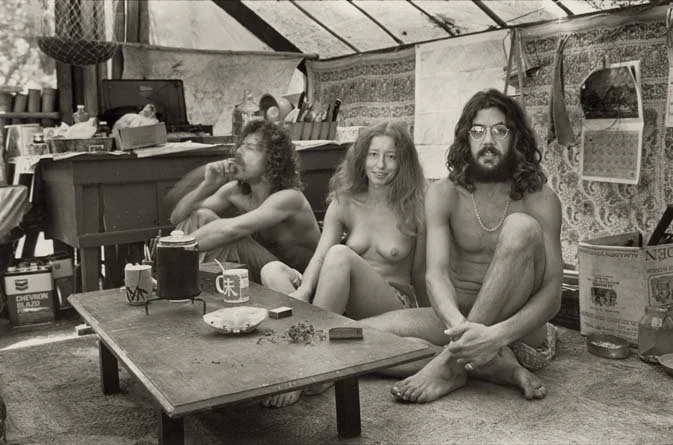
Photography John Wehrheim ©1970

The Reality Inside Hippie Spaces

For a movement that spoke constantly about freedom and community, hippie culture was often overwhelmingly white.

Appropriation vs. Inclusion

Hippies embraced Black music, Eastern spirituality, Indigenous imagery, and non-Western philosophy. But the presence of actual Black and Brown participants was far less consistent.

Borrowing culture did not always mean sharing space.

Interracial Sex

Interracial intimacy existed. Sometimes it was celebrated. Sometimes it was fetishized. Desire moved across racial lines, but it wasn’t free from stereotype, assumption, and power. No one entered these encounters untouched by the myths America had already written onto race and sex.

Much of hippie mythology centers whiteness, even though Latino, Indigenous, and Black cultural influences shaped the music, aesthetics, and spiritual language of the era. The counterculture imagined itself universal. In practice, participation did not always equal visibility, and the same boundaries it claimed to reject often persisted.

What looked like openness could still carry the same old inequalities.

Gender and Power

Free love didn’t automatically level the field. Women, especially women of color, often navigated a mix of liberation and pressure. Being “evolved” sometimes meant suppressing discomfort. Boundaries could be framed as repression rather than preference.

Freedom, even here, had uneven edges.

Free Love Didn’t Age Gracefully

Free love sounded simple. No rules. No jealousy. No shame. Just honesty and desire. And to be fair, it did crack something open. It challenged sexual conservatism and loosened norms that had long constrained women’s autonomy. But removing rules doesn’t automatically create fairness. Power didn’t disappear. It just changed clothes.

Then Came #MeToo

#MeToo didn’t end the idea of sexual freedom. It challenged the mythology surrounding it.

For many people, it genuinely felt like harmless liberation. But that experience didn’t cancel out the blurred lines, uneven power, and pressures others were navigating at the same time.

Jealousy wasn’t just discouraged, it could be treated as moral failure. Boundaries weren’t always respected, they were sometimes framed as repression.

Freedom became something people were expected to perform.

#MeToo forced a harder question:

Who actually benefited from this version of freedom?

Accountability vs. Nostalgia

What shifted culturally wasn’t sexuality.  It was tolerance for imbalance. Behaviors once minimized or excused suddenly had names, such as coercion, manipulation, and abuse of power. Free love didn’t collapse under puritanism. It collided with accountability.

The Hippie That Never Fully Disappeared

One of the book’s unexpected resonances is how often hippie culture keeps resurfacing.
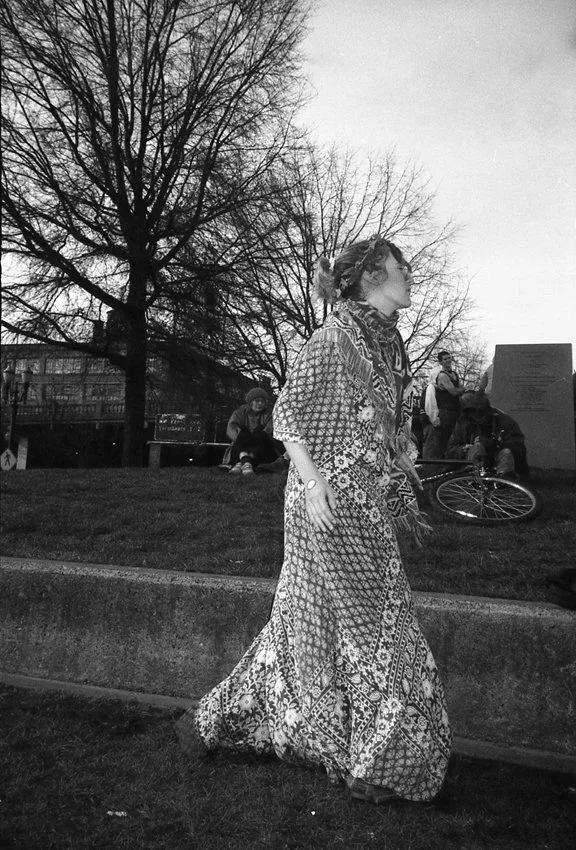
Photography Julian Lucas ©1997

The 1990s saw its own revival: thrift store aesthetics, neo-psychedelia, rave culture’s utopian language, the soft return of anti-corporate identity. Tie-dye came back. So did talk of dropping out, tuning in, living differently.

And today, since history repeats itself. The younger generations borrow the visual grammar again such as , crystals, vintage clothing, although now overpriced. Good vibes, spiritual curiosity, and anti-work rhetoric. Only now the flower child carries a smartphone and posts themselves engaging in curated liberation.  

The commune has now become a group text. The rebellion becomes content. The identity becomes a brand.

Even body liberation shifted in form. What once challenged sexual repression now appears online as hashtags like #FreeTheNipple, part protest, part aesthetic, part performance.

Miller’s Most Durable Insight

Miller’s strongest argument still holds. Hippies didn’t reject American values outright. They radicalized them. Freedom, individuality, authenticity, and pleasure.

These weren’t radical ideas. They were already embedded in American mythology. Hippies simply pushed them further, sometimes toward liberation, sometimes toward contradiction. 

The counterculture began underground. Hippie identity did not stay there. What started as resistance slowly became style, then a scene, then a marketable persona. The counterculture wasn’t separate from America. It became one of America’s most successful products.

Why This Book Still Matters

The values Miller documents didn’t disappear. They were absorbed, repackaged, and monetized. Sexual openness bled into a culture where people expose their intimate lives to dating app corporations. Psychedelic exploration resurfaced as a profitable therapy market. Spiritual curiosity became the wellness industry. Even authenticity hardened into marketing strategy. What began as resistance became lifestyle. What began as critique became commodity.

Final Thought

The Hippies and American Values remains valuable because it captures the counterculture before its afterlife fully unfolded.  Before rebellion became branding.  Before free love met accountability. Before “authenticity” became a sales pitch. Miller doesn’t romanticize hippies, and he doesn’t mock them either. He treats them as human. Which, decades later, feels like the most honest thing a book about the Sixties can do.


Timothy Miller, The Hippies and American Values (University of Tennessee Press, 1991)


Julian Lucas is a darkroom photographer, writer, and a bookseller, though photography remains his primary language. He is the founder of Mirrored Society Book Shop, publisher of The Pomonan, and creator of Book-Store and Print Pomona Art Book Fair. And yes he will charge you 2.5 Million for event photography.

Book Review: CITY ON THE SECOND FLOOR

City On The Second Floor: A work of mastery about the social and civil structures that we live and work under. An intellectually riveting description of the struggle in America today, put together with the patience and  skill of a precision clock maker.   A tremendous work of our times.

Review by Eddie Grijalva
Published 6/5/2022 9:47am PST
Buy Book —> Flower Song Press


Some poets write of love and bravery. Some write of politics, plague and war.  Matt Sedillo writes of America today, which means he writes of all these things, though he does so with ferociousness.  He writes during an age of great transition and wrath.  The very face of America is changing, which scares a lot of people.  Powerful ones too.  Though when the powerful become remorseless in their actions towards the less powerful it takes an equally remorseless (also fearless) pen to alert the masses that a sword of Damocles looms overhead.  City On The Second Floor, the third book by Matt Sedillo and second with Flowersong Press is a foray into sociology and his version of a love song/intervention to Los Angeles, the city he was born and raised in.


Excerpts from L.A. IS FULL OF PIGS:

Los Angeles is falling apart / In the streets, in the suburbs / In the wind / In a barely kept Hollywood

bathroom / Wheezing, vomiting, coughing up blood / The past few days, these past few years / I have

spread myself across this sprawl / and fear this drive may kill me / May kill us all and I wander / Over to

general hospital / Between whose walls desperation wears in high concentration / Across the faces of the

shopworn / And prematurely ill alike as they wait upon news of illness they cannot afford to have /

Survival without insurance / This may take a while….”


“…Los Angeles is full of good people / Who time to time / can turn a blind eye / to killer policy ....”

Sedillo’s last book: Mowing Leaves Of Grass, was a visceral yet intellectual sally into ethnic studies which took on a life of its own in the Chicano community and beyond. It is now taught in ethnic studies classes in universities around the country.  City On The Second Floor is an indictment of the governmental systems that created the society we’re all stuck with today.  One of racism, police killings, gentrification, consumerism as God, environmental exploitation, suffering of the poor and many other travesties.  Sedillo isn’t shy about it either, he’s a fire-spitter and he’s mentioned before, “ I’m not here to make friends” .   He’s been described as, “The stone-cold best political poet in America '' and the “Poet Laureate of the struggle”.  He’s been featured in a litany of publications, including The L.A. Times. He’s also appeared on CSPAN and has spoken at over one-hundred universities. He’s been compared to everything from a Biblical Prophet to a lyrical Marx. Whether you agree with his politics or not there are   undeniable truths in Sedillo’s historically dense works, or what the Chicano streets and Dr. Jose Prado—the Sociology Professor who authored the foreword—calls “La mera neta!”

Even with the deadly serious nature of the topics Sedillo covers in City On The Second Floor, he expertly balances them out with a bit of comic relief.  For example, in his poem Precarious Rex: after reminding us, “Just how precious little / Democracy there is in the way of things”, he then tempers this hard lesson with a bit of levity:

An invitation to reunion with a dear friend / Only to be met with attempts to be roped in / Into

some type of / Academic pyramid scheme / A tenure track position / In Carbondale Illinois / I would

rather die / A thousand deaths / in all the chain restaurants / of Monrovia / Then…./ I woke up

in the back of a rideshare/ Better there than the jailers I suppose, though I could not help but / Wonder if I had left the bar of my volition / Checked my pockets / losing tickets / still in place / I am after all / A fool

of / Odd and tragic / Sentiments….”

Having lived in the region of Carbondale in Southern Illinois (go Salukis) for a time as a young adult, I totally understand why one would rather, “die a thousand deaths” before committing their future to a life of academic exile in middle America, which I found particularly funny.  Sedillo skillfully uses this technique of weaving humor amongst some of the heaviest topics known to mankind throughout this volume of work.

With an extensive knowledge of history and philosophy Sedillo uses the cold hard facts of the past to demonstrate the ethical and moral dilemmas that are still right in front of our faces today.  As a result of this historically-deep research used to craft these poems, Sedillo speaks with the authority of a Will Durant.  Though also possessing a healthy suspicion of political and social structures he displays a natural instinct to investigate power, similar to a Mike Davis.  And akin to a Martin Espada, he’s on a mission to reclaim the historic record and undo the whitewashing of our past.  We are watching the blossoming of an incredible talent.  At this pace with his tremendous erudition, work ethic, and unflinching ability to tell the whole absurdly-tragic truth, in my humble opinion, he has the ability to be as important to the twenty-first century as Ginsberg and Neruda were to the twentieth.

Another theme in City On The Second Floor is that of environmental exploitation and the global warming that it’s ultimately leading to.  He touches on this subject in a few of the poems.  Painting a vivid picture of environmental crimes and the consequences we’ll all pay so the powerful can globe-trot and strip goods from the hinterlands of weaker nations to feed the insatiable appetite of ever-starving industry.


Excerpt from Storm Warnings:

When it all finally goes down / When the Titanic / Finally sinks / When there is nowhere / Left to hide the money / When the Alps finally melt / When Switzerland / Becomes a barren desert / And the Caymans/ Are buried / Miles below / Sea level / The fortune five hundred / Will set up / Tax shelters / On the moon /

A storm is brewing / From the winds of Fukushima / From the ash of Three-Mile Island / From the

Criminal negligence / The killing plunder / You can hear the distant thunder / strip the Earth to feed

Industry / Pillage the country / To please the city / Milk the city / To engorge the capital / Make weapons capable / Of destroying the planet / Turn profit /  From tankers that poison / The ocean / From factories /

That darken the sky / And a storm is brewing / From the ghosts of Bhopal ....”

As mentioned before, there’s history in every nook and cranny of this volume, lessons in every throwaway line.   He invokes the environmental disasters of Fukushima and Three-mile Island.  Two well known nuclear accidents in Japan and America respectively, though he mentions a third incident with “the ghosts of Bhopal”.  Which refers to a gas explosion at a Union Carbide Plant near Bhopal, India that killed three-thousand instantly and poisoned hundreds of thousands more in 1984.  It’s still killing people today and is considered one of the world's worst industrial accidents.  Here Sedillo reminds us of the true cost of industry while at the same time teaching a historical lesson and confronting the reader with a moral dilemma.  It is also a “storm warning” to the billionaire class.  Reminding them of the fact that they can run but can’t hide from the effects of climate change and the social chaos that comes with.  Eventually  the Earth will reckon with those who marshaled the wrath of the wind.  Golden parachutes are useless in category five hurricanes.

 
The Sea:

Whatever it is we are doing / It is only making the storm stronger / There is land under the water /

And there too we drill / Capitalists dream of bottomless pits / Then piss and shit the bed plastic / All life

began in the ocean / And there too we kill / There are mountains under the water / Cities too I imagine /

Arrogant and delusional / One day the sea will swallow us whole.”

City on the Second Floor
is a call to action.  Especially to the Chicano community.  Sedillo is on a mission to get his message across to as many people as possible. This book is his, “ Molotov, tossed towards Camelot”, his way of sounding the alarm.   Will we hear it though?  We can all smell what’s in the air in America today and we know that something is wrong in the way of things. Maybe we can’t put our finger on it, but a self-taught Chicano intellectual from Los Angeles just put a big red X on it for us all to see. I take an optimistic view of this complex work: that even though the world and our society are the way they are today, if we wake up and start pulling in the same direction the descendants of the poor and suffering of this world can shake off their yokes and experience a more saturnian society in their future. I highly recommend this book to anyone who enjoys well-crafted, deep and meaningful, historically inspired poems, with an edge. It’s a powerful work destined to become a classic.  Following his seminal work, Mowing Leaves of Grass was always going to be tough. Though Sedillo definitely rose to the occasion and answered the bell with this sublime volume of Poems.