

They got cars on Holt to slow down.
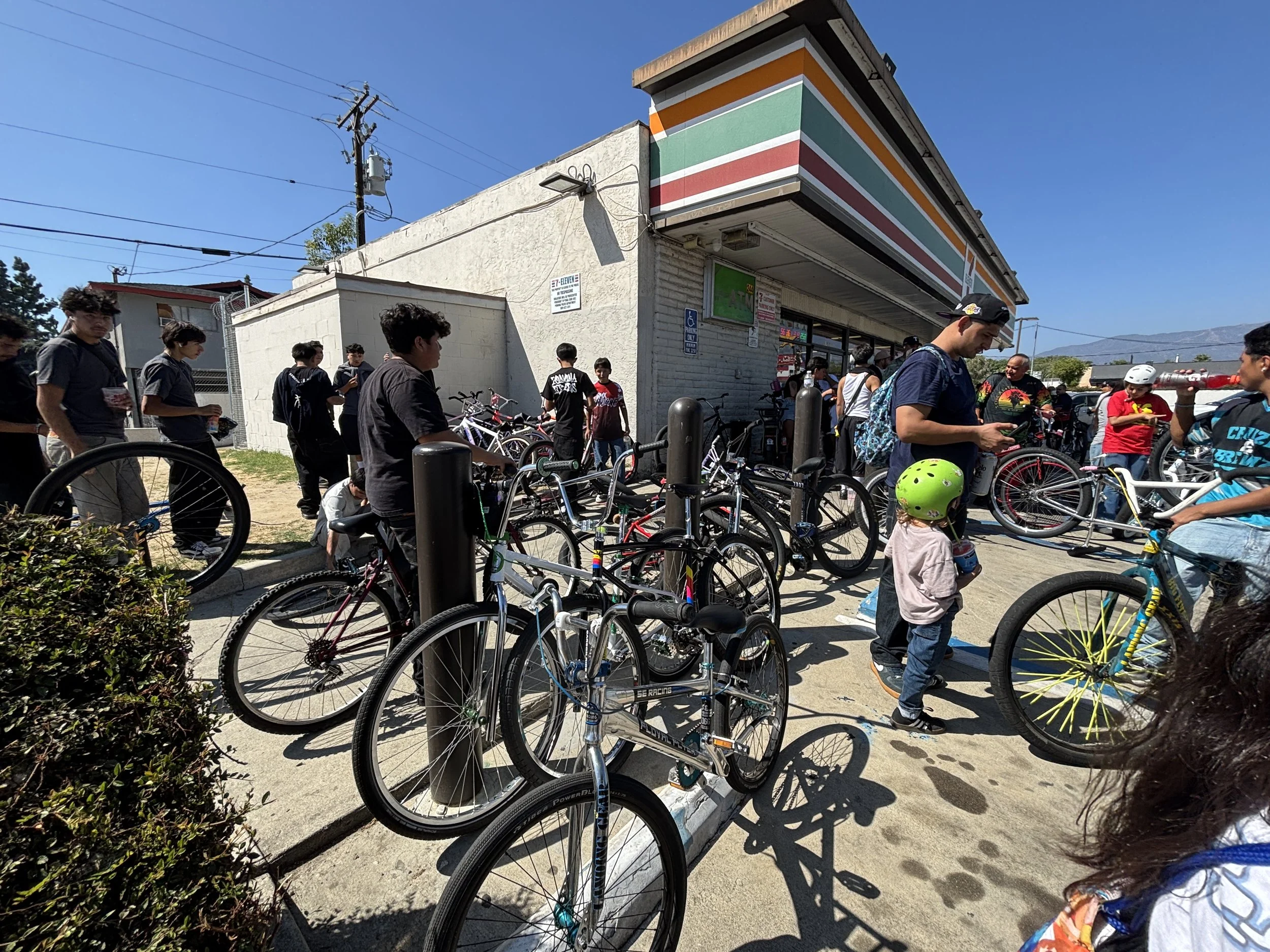
Photography Julian Lucas ©2026
Updated 11/09/2026 9:23 am PST
Young cyclists and riders are creating a culture of their own. Can the city tolerate something it doesn’t control?
When I was young, I rode and raced BMX. A bicycle meant being able to get somewhere without asking an adult for a ride. Riding with other people made that independence something we shared.
That is part of what I recognize in the kids riding through Pomona. From behind a windshield, a large group can look like an inconvenience. From inside it, the same gathering can mean friendship and belonging. Both experiences occupy the same street. Only one usually gets treated as a transportation priority.
Adults spend money trying to get kids to participate in community life. These kids have organized a reason to come together themselves, organically. That should count for something before an elected official decides the most useful thing to call them is “lawbreakers.”
There is a particular moment when adults stop understanding youth culture and start calling it a problem.
It usually happens somewhere between buying a house, attending a neighborhood Rotary and Lion’s Club meetings, and deciding that anybody under 25 having fun in public must be up to something.
Skaters went through it. Punk kids went through it. BMX riders have been going through it for decades. Every generation invents its own way of occupying public space, and every generation inherits a collection of adults who seem personally offended by the discovery.
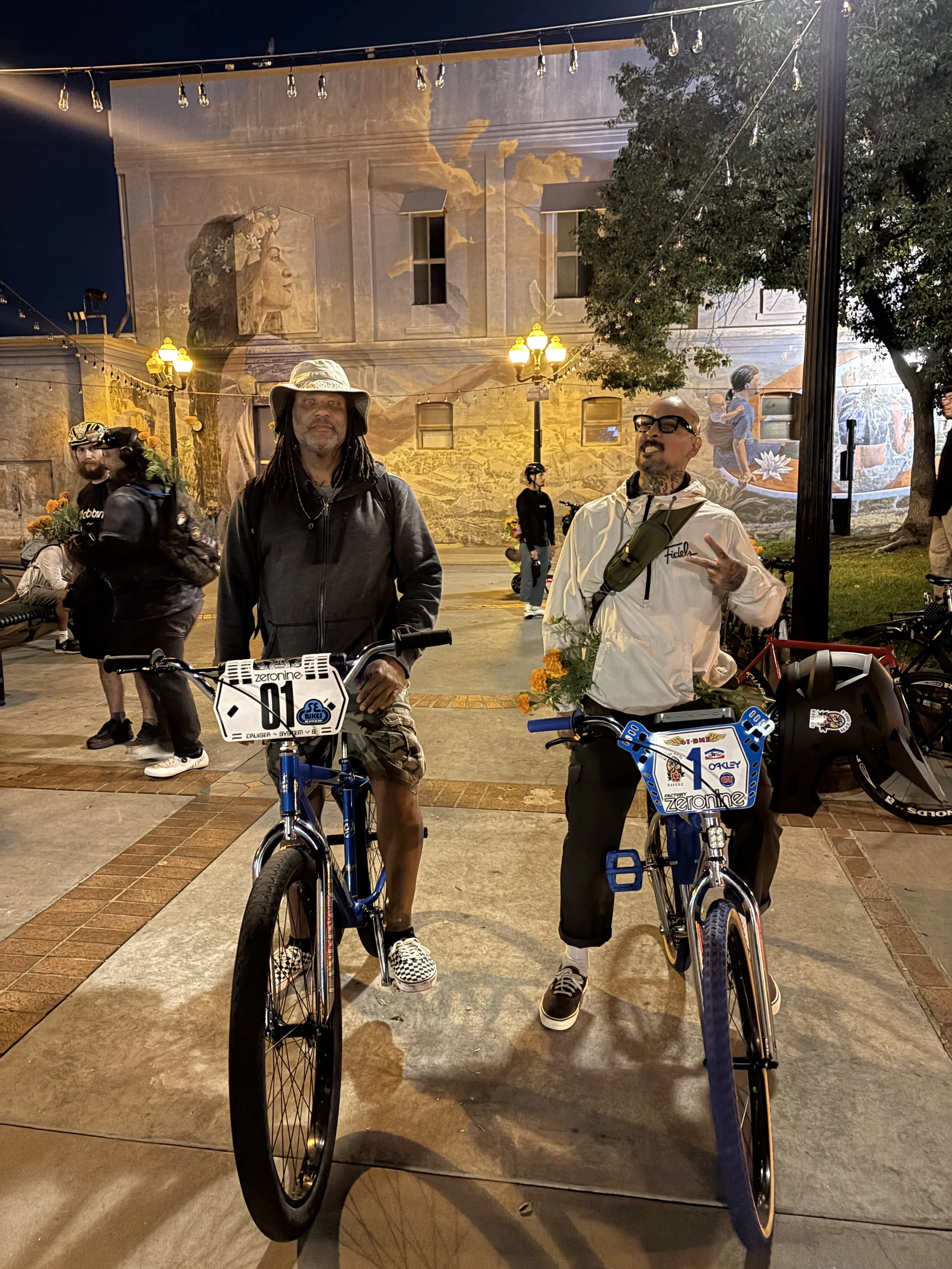
Photography Julian Lucas
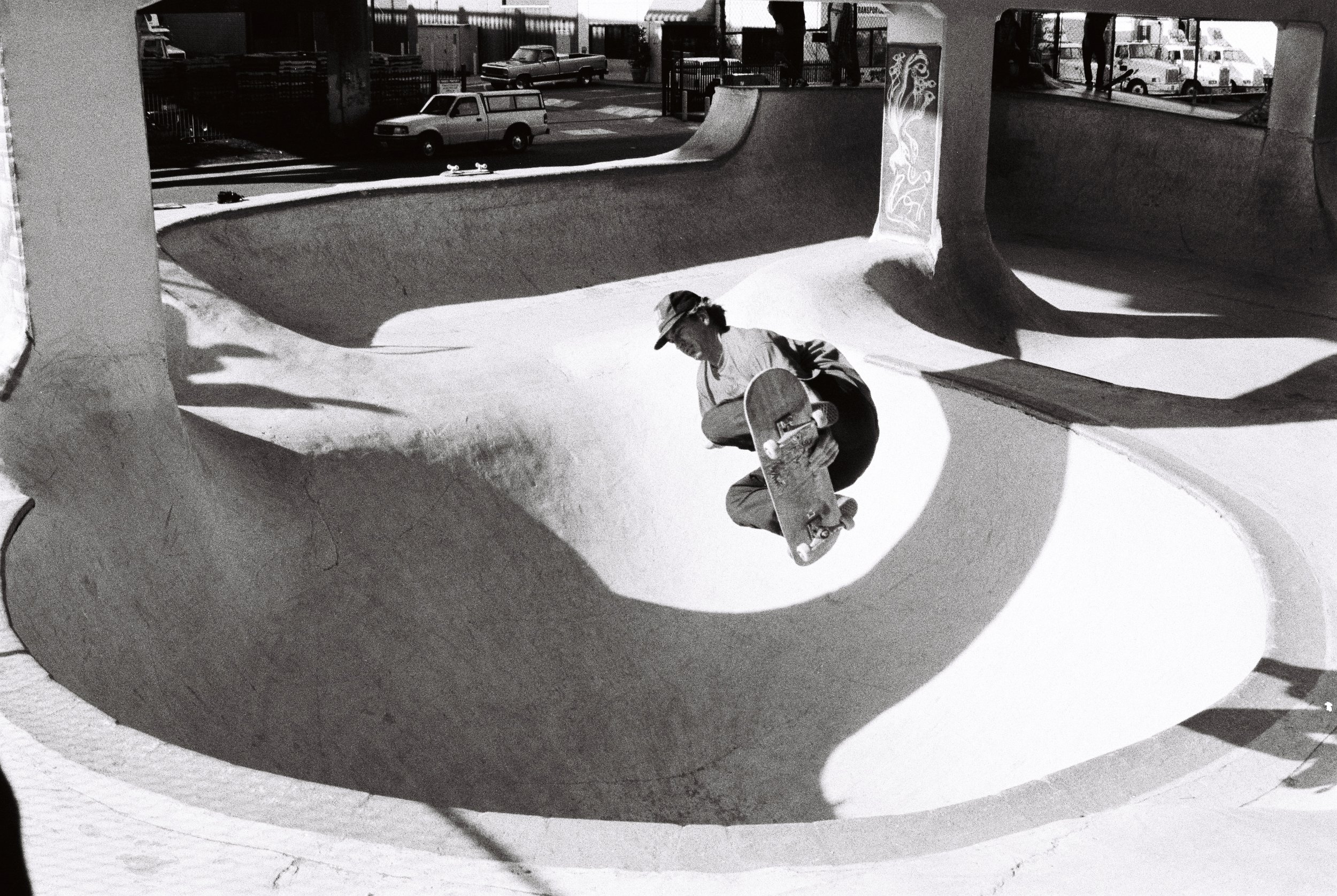
Burnside Skate Park ©2004
In 1990, a group of skaters in Portland, OR decided they were tired of waiting for the city to give them somewhere to skate. So they started pouring concrete beneath the Burnside Bridge without permission. No Cultural Arts committee or commission, no Ad-hoc, no consultant, no ribbon-cutting ceremony. Just skaters building something they wanted. Two years later, Portland sanctioned what became one of the most famous skateparks in the world, Burnside Skate Park. The city didn't create the culture. It eventually recognized what the culture had already built.
At the September 14 City Council meeting, Elizabeth Ontiveros-Cole raised concerns about young bike riders on East Holt and elsewhere in Pomona. According to the published meeting transcript, she described riders traveling against traffic, warned about a possible fatal collision and alleged that some were throwing things at cars. The transcript also records her calling the kids “lawbreakers.”[2]
Riding in a group and throwing something at a car are different acts. One rider creating a danger does not establish the guilt of everyone nearby. Address dangerous conduct. Work with the riders on how they use the street. An elected official should be able to do both without reducing an entire gathering to its worst alleged behavior.
In For the Culture, Marcus XR Collins connects culture to shared identity, beliefs, practices and expression.[1] Holt is a corridor, and these kids are moving through it together. The shared interest in bikes and the decision to ride with other people give us something to consider beyond how long a driver had to wait.
Robert Putnam approached the question of community from another direction in Bowling Alone: The Collapse and Revival of American Community. He examined declining participation in American collective life, including the informal social connections through which people know one another and develop trust.[3] A group ride gives people a reason to leave home and see each other again. That has value even when the gathering comes without a supervisor or a registration form.
We complain that young people are isolated, sedentary and attached to their phones. Here they are outside together. Apparently, they also need an adult to have arranged it.
The question in the title of my Mirrored Society essay, “When Did Culture Become a Brand?”, belongs here too.[4] Have we become so accustomed to culture arriving with a promotional campaign that we struggle to recognize something people create without one?
Politicians have become influencers. Every appearance supplies material for the next post. Being photographed near community life can pass for having created it. A gathering with no podium, no presentation and no obvious credit for an officeholder tests whether public service extends to things a politician cannot claim.
The useful response takes more work. Talk to the riders. Ask where they go and where they encounter danger. Include them before decisions about street design are finished. An invitation to applaud a completed plan is a poor substitute for having a say in it.
The riders have responsibilities. Pedestrians need room. Drivers need predictable movements. Throwing objects at vehicles is dangerous. But telling kids to behave does not settle the question of what adults have built for them to navigate.
Car culture has fucked up our sense of what a street is for. We expand roads to accommodate driving, then treat the traffic they attract as an argument for more expansion. Research summarized by UC Davis shows that additional roadway capacity induces more driving, eroding the initial gains in travel speed.[5] Transportation emissions contribute to smog and poor air quality.[6] Yet kids on bicycles become the intolerable disruption. Apparently, congestion is more respectable when everybody brings a car.
That thinking reaches into the through streets people cross and ride along every day. Lane width, crossing distance, signal timing and connected bike lanes shape those trips. At a traffic light, how long does someone on foot wait, and how much time do they get to cross? Where a bike lane ends, what is a young rider supposed to do next?
Ontiveros-Cole can start with Holt. Ask city staff where protected bike lanes could go and what it would take to build them. Every councilmember ought to ask the same thing about the busiest streets in their own district. Where exactly do they expect a kid on a bike to ride? Before you call a kid a lawbreaker, point to the lane you built for them to ride in.
Pomona’s own Safe and Active Improvements project identifies a critical gap in its bicycle network.[7] Officials cannot discuss riders’ choices as though the available choices were all equally safe. A child should not need a parent with a car to participate in the city.
A fight in the Arts District is a public safety problem. A kid on a bicycle is a person trying to get down the street. Between 2021 and 2025, Pomona recorded 12,741 traffic collisions. Just 245 involved bicycles. Yet somehow, young people riding bikes have become a subject of political concern. Perhaps City Hall ought to spend less time worrying about kids on bicycles and more time worrying about the streets they’re forced to ride on.
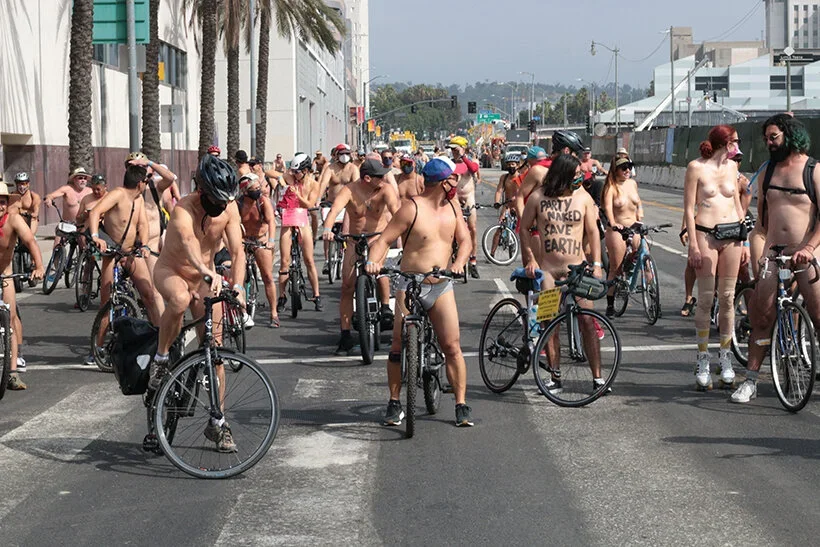
Photography Julian Lucas ©2021
The Pomonan documented the World Naked Bike Ride in Los Angeles in 2021. Bare asses, penises, vaginas and breasts rolling through the city in a protest against car culture and dependence on fossil fuels that also highlighted cyclists’ vulnerability.[11] Angelenos will surrender hours to somebody’s rear bumper. Put a bicycle in front of them and suddenly every second is precious.
In the video provided by Street People of Pomona, kids riding Holt also slowed traffic down. Urban planner Jeff Speck, author of Walkable City, argues that keeping vehicle speeds reasonable is central to making streets safe for people walking. His essay “Nine Keys to Safe Downtown Streets” connects that responsibility to street design.[8]
A group ride is no substitute for a safer street, and slowing cars does not make every maneuver safe. But a driver’s delay is not, by itself, evidence of a public safety failure. If Cole wants to discuss danger on Holt, the speed of the cars belongs in that conversation.
Julian Lucas ©2026
‘Mobbin Monday’
Julian Lucas 2026
‘Mobbin Monday’
Julian Lucas 2026
In neighboring Montclair on October 24, two people died after a driver struck members of a Halloween group ride near Kingsley Street and Tudor Avenue. Police later arrested a suspect on suspicion of driving under the influence and other offenses, ABC7 reported.[9] That collision was a separate event from the Pomona rides Cole discussed. It establishes nothing about those riders’ conduct.
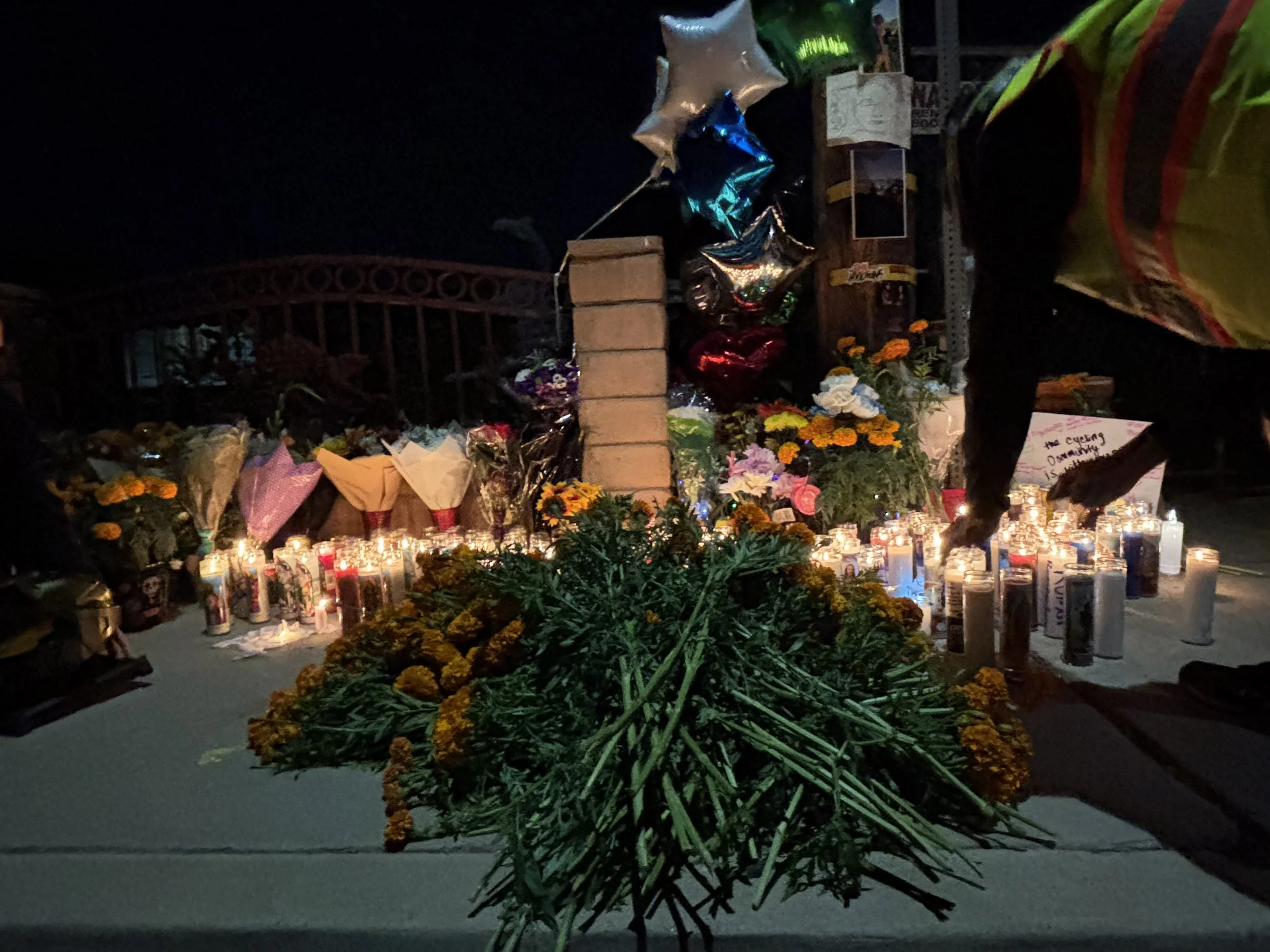
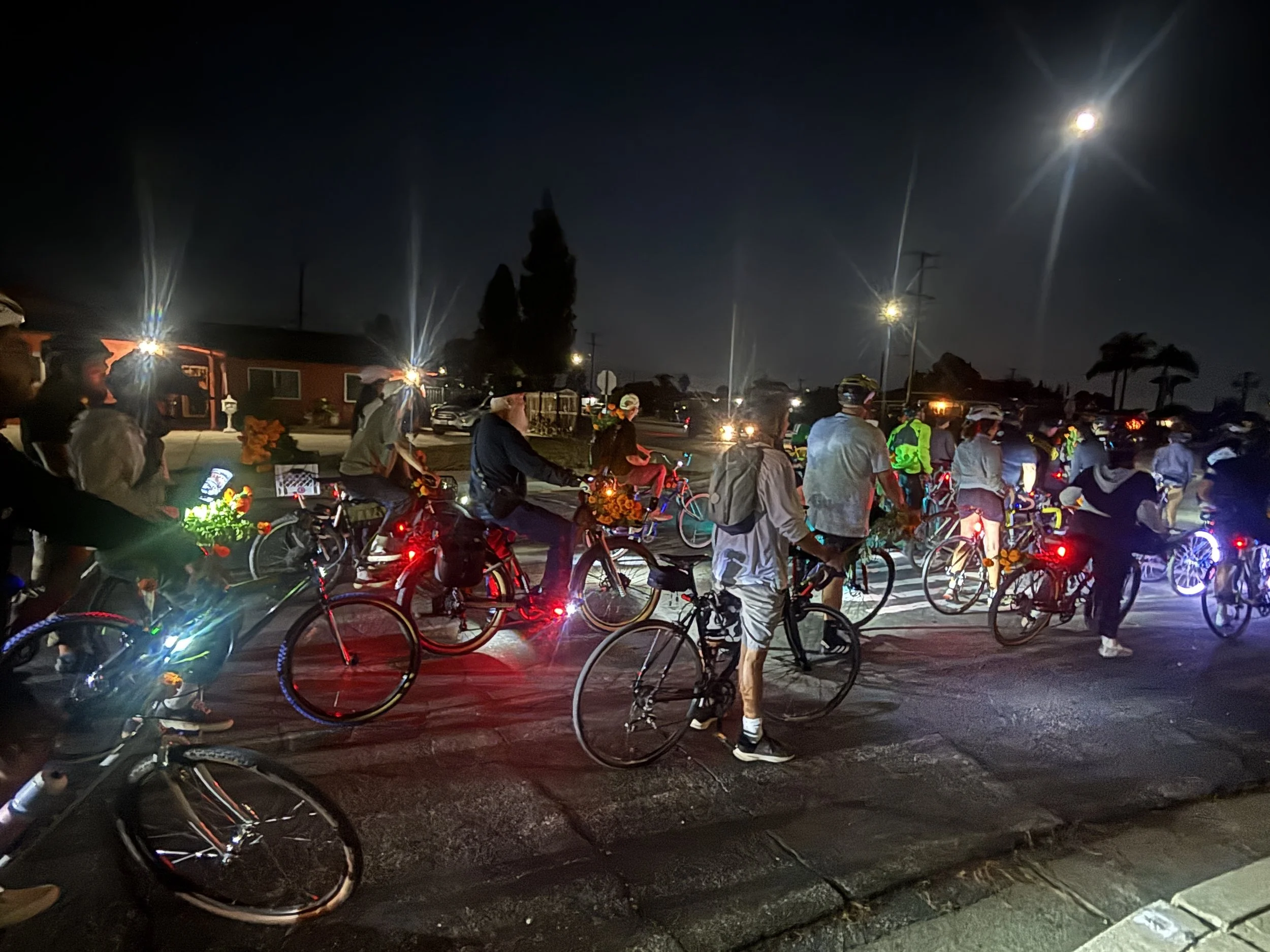
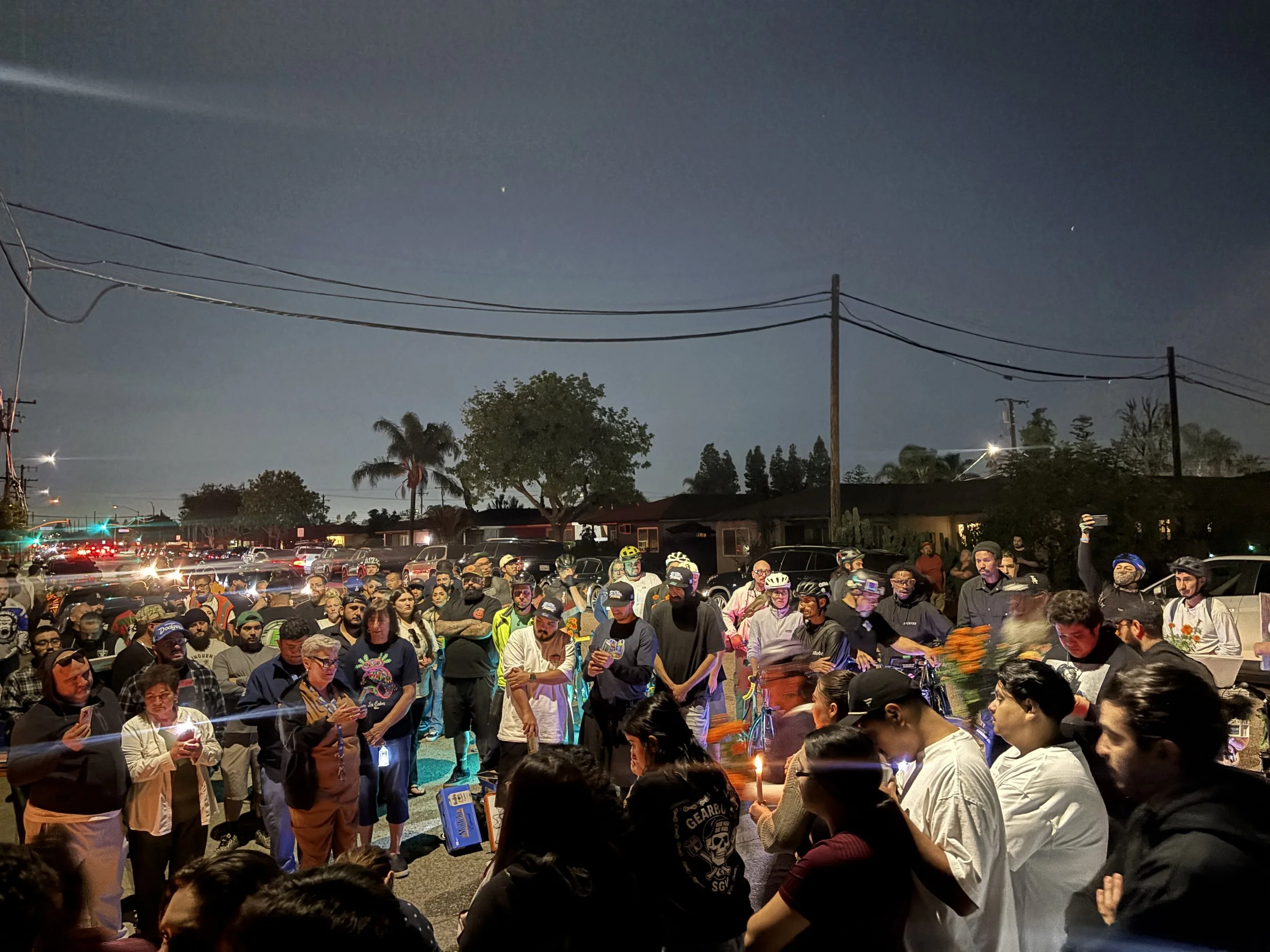
On October 26, cyclists gathered for a memorial ride organized by Mobbin Monday with IE Routes and Pedal Pomona. At the vigil, people stood close together around candles and flowers, with bicycles among the gathering. Some still wore their helmets. Cars passed beyond them.[10]
Streets Are For Everyone Inland Empire, known as SAFE IE, was also represented. The organization advocates for safer streets and supports people affected by traffic violence.[12]
Before the ride, organizers had announced a route using quieter streets and bike trails. They encouraged helmets and lights and offered a limited supply of lights to lend to people who could not afford them. The announcement described the pace as “no drop.” Nobody would be left behind.[10]
The young riders on Holt and the people at the memorial are not one interchangeable group. But the vigil showed something a discussion confined to traffic complaints cannot explain: the relationships people form through riding can become the relationships they rely on when someone dies.
Cole’s concern about injury requires a serious response. So does her language. Public safety should mean making it possible for young people to use the street and get home alive. If the response stops at calling them lawbreakers, it leaves the people responsible for the streets with remarkably little to answer for.
These kids do not have to become a city program to belong to the city.
Sources
Marcus Collins, For the Culture: The Power Behind What We Buy, What We Do, and Who We Want to Be (PublicAffairs, 2023).Publisher’s first chapter excerpt.
September 14, 2026, Pomona City Council meeting.Official recording page;published automated transcript, approximately 18:48–20:55.
Robert D. Putnam, Bowling Alone: The Collapse and Revival of American Community (Simon & Schuster, 2000).Author’s overview andSocial Capital Primer.
“When Did Culture Become a Brand?”, Mirrored Society, June 29, 2026.Journal index.
Jamey Volker and Susan Handy,“Increasing Highway Capacity Induces More Auto Travel”, National Center for Sustainable Transportation, UC Davis, January 24, 2023.
U.S. EPA,“Smog, Soot, and Other Air Pollution from Transportation”.
City of Pomona,“Pomona Safe and Active Improvements”.
Jeff Speck,“Nine Keys to Safe Downtown Streets”, Public Square, Congress for the New Urbanism, January 7, 2020.
Madison Weil and Tim Pulliam,ABC7 report on the Montclair collision, updated October 26, 2026.
“I Hung Out with Nude Cyclists at the World Naked Bike Ride in Los Angeles Over the Weekend and Took a Plethora of Photos (NSFW)”, The Pomonan, September 20, 2021.
Streets Are For Everyone Inland Empire. Presence at the vigil reported by Julian Lucas; organizational mission checked against the group’s own website.
Editorial verification notes — not article copy
Cole’s recording was inaccessible during this revision. Her remarks remain attributed to the published automated transcript, not represented as independently checked audio. The transcript’s allegations about riders are attributed to Cole.
The memorial passage describes the October 26 gathering based on the author’s supplied photographs and footage. Route planning and equipment offers remain attributed to the organizers’ prior announcement. The imagined City Hall rollout has been removed. The Los Angeles ride remains a brief reference, with no claim about specific drivers’ observed reactions.
The Mirrored Society reference invokes the verified title, not the unavailable body. Applications of Collins and Putnam to the local rides are the author’s interpretations. Slower traffic is the author’s reported observation, without measured speed or collision effects. The article makes no finding about street design causing the Montclair collision, and describes a reported arrest on suspicion of offenses, not a conviction.


