
Trump promised another bombshell about the election he lost. For the MAGA faithful, the explosion happened years ago.
Every presidency has its theater. Franklin Roosevelt had the fireside chat. John F. Kennedy understood the television camera. Ronald Reagan practically made love to it. Donald Trump has given us something more appropriate for an age of reality television, social media, and men selling miracle testosterone supplements between cable news segments: the presidential infomercial. Thursday night, Trump commandeered primetime television to reveal what had been advertised as another extraordinary development involving American elections, China, voter data, intelligence agencies, and, because apparently no evening in America can ever truly be complete without it, the 2020 presidential election.
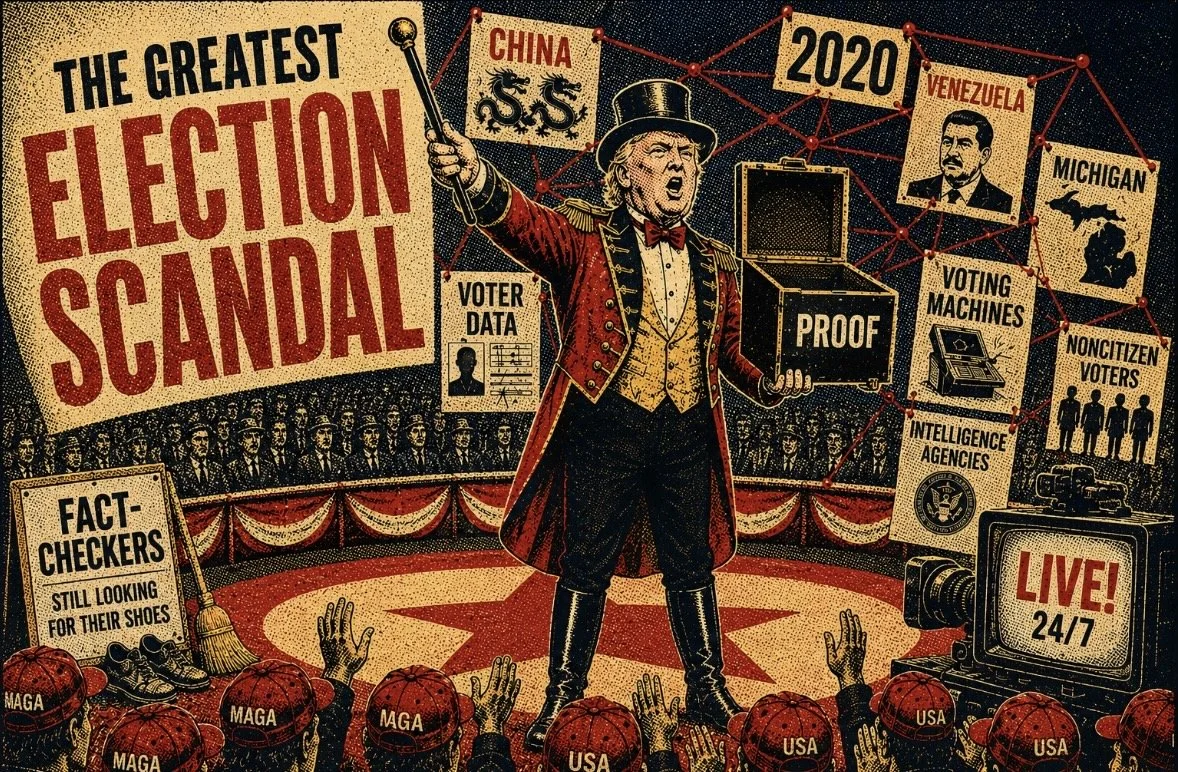
Nearly six years have passed since Donald Trump lost that election, which is apparently about five and a half years longer than Donald Trump has been emotionally prepared to accept it. Most Americans have changed jobs, moved homes, watched children grow up, buried relatives, survived inflation, endured presidential elections, and generally continued participating in the exhausting business of being alive. Trump, meanwhile, remains spiritually trapped somewhere around 11:43 p.m. on November 3, 2020, wandering through the political attic with a flashlight, opening boxes marked China, Venezuela, Voting Machines, Intelligence Agencies, and Suspicious Things That Happened in Michigan, convinced that somewhere inside one of them is the missing evidence that will finally return him to the winner's circle of an election whose winner was certified years ago.
Thursday night's address was the latest expedition into the attic.
At the center of Trump's presentation was a serious allegation involving China and American voter information. Trump claimed that Chinese actors obtained an enormous amount of voter registration data connected to the 2020 election and presented the matter as part of a broader story about election integrity and information supposedly concealed from the American public. If a foreign government obtained American voter information, that deserves investigation. Americans should know what happened, what information was obtained, when intelligence officials learned about it, and whether government officials withheld information that should have been disclosed. Congress should investigate it. Journalists should investigate it. Independent cybersecurity experts should examine it. Release whatever documents can legally be released and let the evidence endure the unpleasant experience of being examined by people who do not already know what conclusion they are supposed to reach.
But here is where Trump's magnificent political soufflé begins to fall a part.
A voter registration database is not a ballot box. Obtaining voter information is not the same as changing a vote. A cybersecurity breach is not evidence that voting machines were manipulated. Foreign interference is not synonymous with election theft. And discovering that China may have wanted information about American voters does not magically transform Donald Trump into the winner of the 2020 presidential election.
The distinctions are admittedly less exciting than a primetime presidential address. Nobody is selling commemorative hats emblazoned with the words NUANCED DISTINCTIONS BETWEEN VOTER REGISTRATION DATABASES AND VOTE TABULATION SYSTEMS. There are no rallies where thousands of people chant SHOW US THE METHODOLOGY. But these distinctions happen to be rather important when a president is once again asking Americans to question the legitimacy of an election.
Trump's genius, if we are willing to call it that, is understanding that he does not actually need to demonstrate the connection. He merely needs to place enough suspicious sounding things beside one another until the audience begins assembling the conspiracy themselves. China. Voter data. Venezuela. Voting machines. Intelligence agencies. Michigan. Noncitizens. California. Election fraud. Throw everything onto the kitchen counter, turn on the blender, and eventually you have something that looks enough like a scandal to serve on tv.
This is politics by word association.
China obtained voter information. Venezuela knows something about voting machines. Suspicious registration applications appeared in Michigan. California takes forever to count ballots. Therefore, somehow, Donald Trump may have won the 2020 election.
One could perform the same intellectual exercise with almost anything. My neighbor owns a Toyota. Toyota is a Japanese company. Japan attacked Pearl Harbor. Therefore, my neighbor is responsible for World War II. The individual statements may contain facts. The conclusion remains ridiculous because the connections have not been demonstrated.
But Trump has spent years perfecting the political art of making proximity feel like proof.
The 2020 election has consequently become the perfect Trumpian crime. A crime perpetually waiting for evidence. Every irregularity becomes suspicious. Every bureaucratic mistake becomes intentional. Every cybersecurity vulnerability becomes confirmation. Every government official who disagrees becomes part of the conspiracy. Every court that rejects a claim becomes compromised. Every investigation that fails to uncover the necessary evidence becomes evidence that investigators are hiding something. Even the absence of evidence can be repackaged as proof that the conspiracy is extraordinarily sophisticated.
It is a wonderfully convenient arrangement. Evidence proves Trump is right. Contradictory evidence proves Trump's enemies are lying. No evidence proves Trump's enemies destroyed the evidence. Sherlock Holmes would have been unemployed within a week.
This is not how evidence works, although it is an excellent way to maintain a political movement indefinitely. A mystery that can never be solved can also never be closed, and Trump has turned the 2020 election into America's longest-running dinner theater production. The cast changes. The villains rotate. New documents appear. New witnesses emerge. China replaces Venezuela until Venezuela returns for a guest appearance. Voting machines leave the stage and voter databases enter from stage right. But the ending remains stubbornly unchanged: Donald Trump was wronged, Donald Trump was cheated, and somewhere, somehow, someone is about to produce the evidence. Any day now.
None of this means Americans should blindly trust the government. Intelligence agencies deserve scrutiny. Election officials deserve scrutiny. Cybersecurity systems deserve scrutiny. The FBI, CIA, DHS, Congress, state governments, and presidents should all be subjected to aggressive journalism and public accountability. If intelligence officials concealed important information for political reasons, expose them. If election infrastructure is vulnerable, fix it. If foreign governments obtained American voter information, determine how and why.
But skepticism is not a coupon that can only be redeemed against institutions Donald Trump dislikes. If we are skeptical of intelligence agencies, we should also be skeptical when a president describes intelligence that conveniently supports his political grievances. If we demand evidence from election officials, we should demand evidence from the man accusing them. If Trump possesses information that fundamentally changes the historical understanding of the 2020 election, then he has an extraordinarily simple path available to him. Show us.
Release the documents that can be released. Let independent experts examine them. Let journalists who do not attend dinner at Mar-a-Lago read them. Let congressional committees investigate. Let election security experts explain precisely what systems were compromised and whether those compromises affected ballots, vote tabulation, or certified election results.
If the evidence demonstrates something extraordinary, then report something extraordinary. Until then, we are watching the flatscreen. And the flatscreen is where Trump has always been most comfortable.
The media, naturally, participates enthusiastically in this arrangement while occasionally pretending to be horrified by it. Trump announces that he will make an important announcement and immediately the countdown clocks appear. Cable networks assemble panels of eight people to speculate about what a ninth person might say several hours later. Social media fills with predictions. Journalists write previews of an event that has not happened. Commentators analyze the possible implications of information they have not seen.
The spectacle becomes news before the information does.
Trump understands this arrangement better than perhaps any American politician alive because he helped perfect it. He knows that millions of people will remember the accusation long after they forget the correction. He knows that "China compromised election data" travels faster than a paragraph explaining the technical differences between publicly available voter information, registration databases, ballots, and vote tabulation systems. He knows the bombshell will receive a push notification and the qualification will appear three days later somewhere around paragraph seventeen. By then, the circus has already left town.
Trump understands something advertisers have known for decades: people remember the commercial long after they’ve forgotten what the commercial was selling. By the time journalists begin separating evidence from insinuation, the product has already been purchased.
The fact-checkers arrive afterward carrying brooms. This may be Trump's greatest political innovation. He does not need to prove that the 2020 election was stolen. He merely needs to ensure that Americans never completely stop wondering whether it might have been. Suspicion is politically renewable energy. It requires no resolution and produces an apparently endless supply of outrage. It can be carried from election to election, rally to rally, lawsuit to lawsuit, and now primetime address to primetime address.
Thursday night, Trump returned once again to the scene of the crime he insists occurred but has never convincingly demonstrated. He brought China. He brought voter data. He brought voting machines. He brought intelligence agencies. He brought all the familiar characters back together for another reunion special.
The only thing still missing was the evidence connecting them all. Perhaps that evidence exists. If it does, Americans deserve to see it, and journalists should report it without hesitation. If the documents fundamentally change what we know about the 2020 election, then history should change accordingly. Truth does not become less true because Donald Trump says it, just as an allegation does not become true because he repeats it. That is why evidence matters.
Eventually the primetime special ends. The news panels go home. The social media clips disappear beneath tomorrow's outrage. The flags are folded away, the presidential podium is rolled out of the room, and the television cameras point toward the next spectacle.
Then we are left with the record. Donald Trump promised America a bombshell Thursday night. What he delivered was another trailer for a movie he has been promising to release for nearly six years.
At some point, even the most loyal audience is entitled to see the damn film.
The Pomonan is an independent publication covering politics, culture, art, and the contradictions shaping contemporary American life.


