

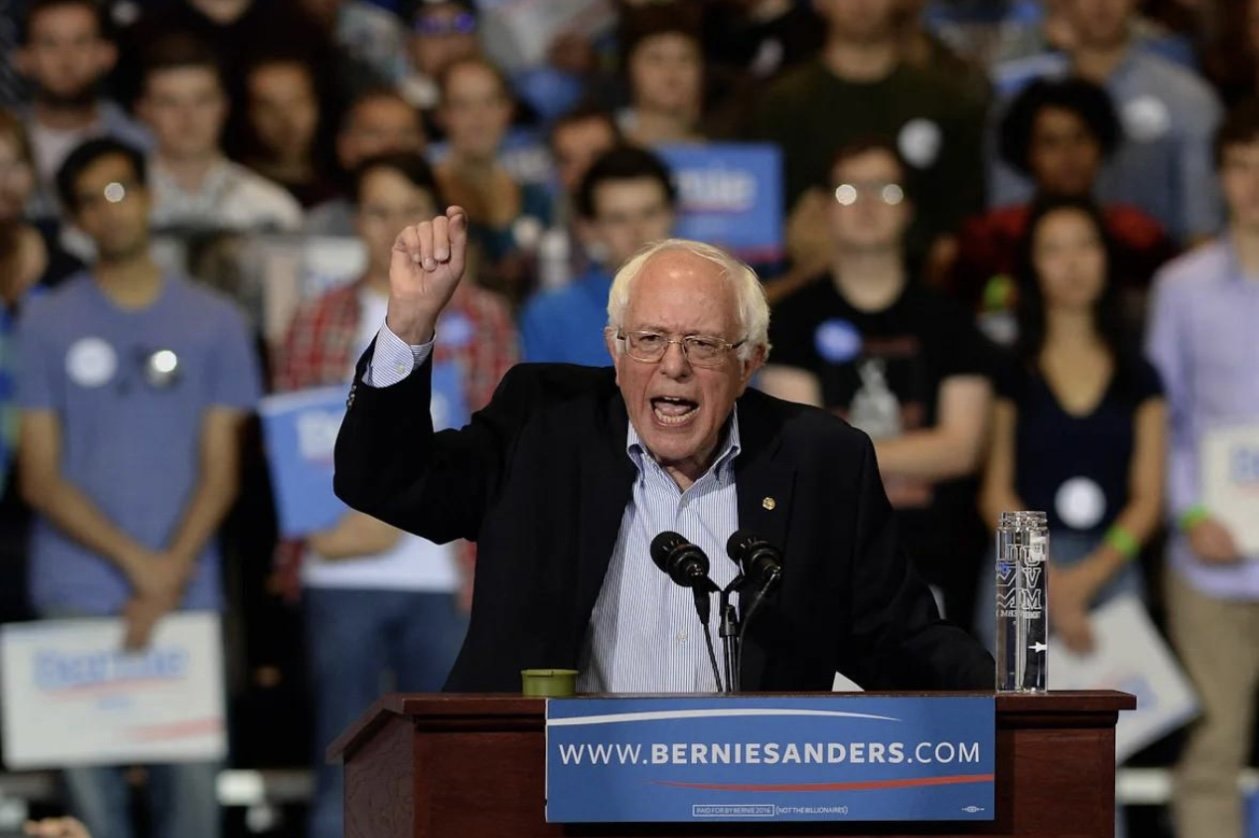
I first heard Bernie Sanders speak in person during his 2016 presidential campaign, when he stopped to speak at Ganesha High School in Pomona, California. There was excitement among the crowd of young people. Many in the crowd yelled out affectionately, “¡Te queremos, tío Bernie!” That experience changed how I think about politics and what it means to be a moral force in America in the 21st century.
I have been a high school government teacher for almost thirty years. When my students ask me who I think is the most influential voice in our country today, the person who comes to mind is Bernie Sanders.
For more than forty years, as mayor of Burlington, Vermont, in the House, and in the Senate, Sanders has taken a consistent moral stand: working families are getting squeezed, and the rules are written for the people at the top. He called himself a democratic socialist when the label cost him votes. He stood on picket lines while both parties courted wealthy donors. Politicians follow the polls. Sanders followed his convictions, and the country moved toward him. I remember his 2016 primary campaign. Many Democrats came out against him. Famously, South Carolina Congressman Jim Clyburn, one of the most powerful insiders in the Democratic Party, came out against him in both campaigns, endorsing Hillary Clinton in 2016 and Joe Biden in 2020, each time days before the South Carolina primary. Sanders never wavered. He stuck by his moral compass and kept spreading his message, bringing light to the massive inequality in this country.
Sanders also named the danger rising in this country, plainly and early. He warned that a small class of elites was buying elections and the media and turning working people against each other, so nobody would look up at who holds the power. The Federal Reserve's Distributional Financial Accounts show how far the gap has widened: in 1989 the top 1 percent held about 23 percent of the nation's wealth; by mid-2026 they held 32.5 percent, the highest share in the Fed's records, while the bottom half's share fell from 3.5 percent to 2.3 percent. His two presidential campaigns pulled the Democratic Party back toward wages, health care, and unions, and brought a generation of younger candidates and organizers into public life. When anger looked for someone to blame, Sanders pointed at the truer target: an economy rigged for the few.
That lasting impact showed in this month's historic midterm elections. Democrats flipped nine Republican Senate seats, the most since 1958, and took back the House at the same time, a double sweep against a party holding unified control that has happened only a few times in a century. Michigan elected Abdul El-Sayed, the nation's first Muslim senator. Mississippi, which Donald Trump carried by more than twenty points in 2024, elected Scott Colom, its first Black senator since Reconstruction. Native American women won Senate seats in Minnesota and Alaska and the governorship of New Mexico. Georgia elected Keisha Lance Bottoms, the first Black woman governor in American history.
While all these candidates ran incredible campaigns, it could be argued that much of their momentum was propelled by Bernie Sanders's consistent message on social justice and his stand against an economic system that neglects working people. Running on the cost of living, health care, and reining in corporate power, Democrats swept both chambers of Congress. That is the same message, carried for forty years, now reshaping how Americans see who a leader can be.
Sanders's message never changed because the facts have not changed. Federal Reserve figures from mid-2026 show the bottom 50 percent of households holding just 2.3 percent of the nation's wealth, roughly $4.7 trillion, while the top 1 percent hold 32.5 percent.
Workers produce more than ever and keep less of it. Families choose between rent and medicine. Sanders argues for Medicare for All, a living wage, free public college, and real taxes on extreme wealth. The Economic Policy Institute's tracker shows productivity up 92.4 percent from 1979 to 2025, while a typical worker's hourly pay, adjusted for inflation, rose only 33.6 percent. Productivity grew 2.7 times faster than pay. His case is basic fairness: in the richest country in the world, no one who works full time should live in poverty.
Bernie Sanders never became president. But holding office is not the same as making an impact. It is standing in one place on principle for a lifetime and moving a country toward decency. That is what Tío Bernie Sanders has done. And that is why I say Bernie Sanders is the most important American in the 21st century and perhaps even in the world today.
──────────
Ali Hangan is a government teacher of almost 30 years and a veteran who lives and teaches in Pomona, California.


