
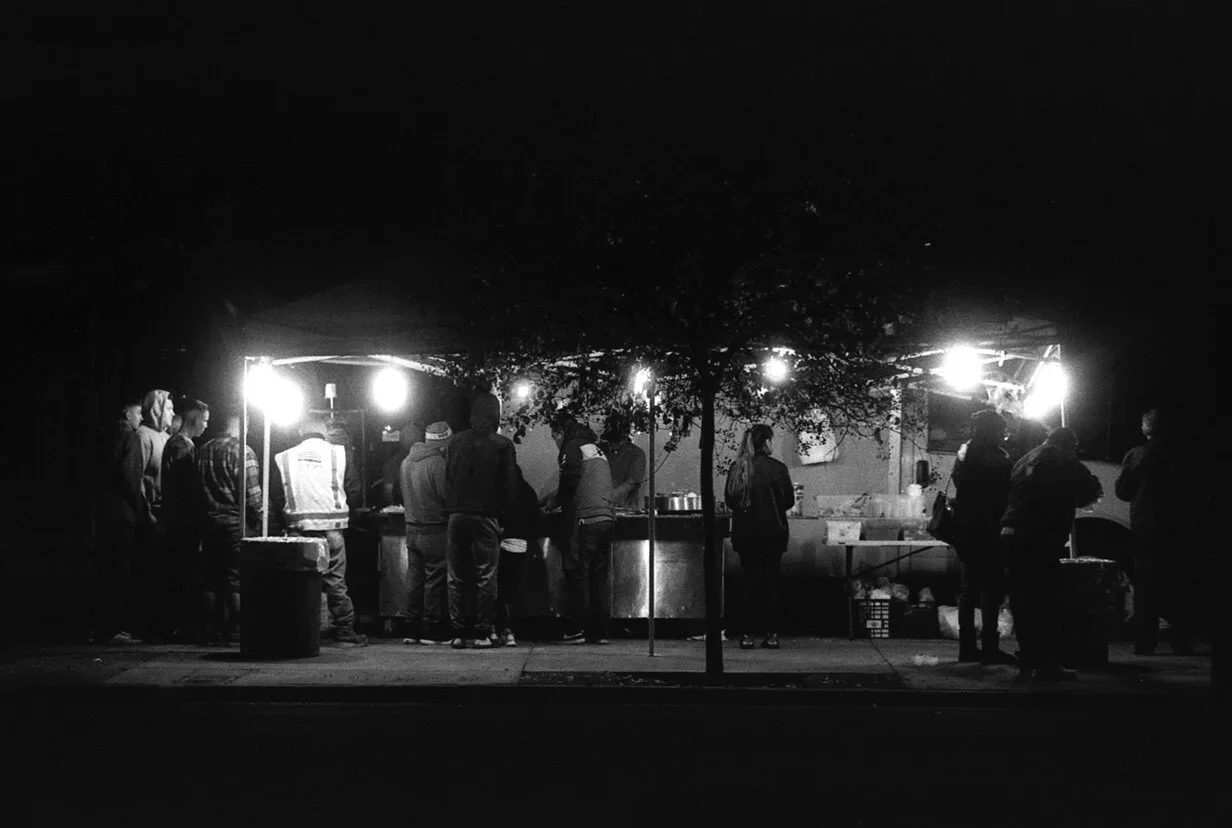
Photography Julian Lucas ©2018
On Monday, November 17, 2025, over forty Pomona and Claremont residents, showed up to tell the Pomona City Council that the city’s street-vending ordinance violates California Senate Bill 946.
Pomona’s ordinance completely falls apart once it is set next to SB 946. Lawmakers spent years listening to vendors, police, city attorneys, and public health professionals before the bill even moved. The point was straightforward. The state didn’t want cities blocking vendors with insurance demands, distance rules invented at City Hall, or broad “safety” claims that never point to a real hazard. Senate Bill 946 (SB 946) did away with criminal penalties and reduced what local governments are allowed to regulate.
Once you fully read SB 946, Pomona’s bullshit stands out. The insurance requirement on paper sounds clean, but in practice, most vendors have limited access to traditional insurance, or simply cannot afford it. The state didn’t forbid permits, but state law was clear that cities cannot build requirements that shut people out. Other cities tried this years ago and backed down after attorneys pointed out the obvious legal risk. Pomona didn’t, maybe because Pomona has a history of banking off people not watching. When will city leaders learn those days are over?
Then there are the distance rules, how far a vendor must be from a storefront, a corner, or another vendor. The state only lets cities regulate time, place, and manner when it’s tied to a real, identifiable health or safety concern. Complaints about competition don’t qualify. Preferences from business owners don’t qualify either. Courts have already pushed cities to remove spacing rules that had nothing to do with hazards. Los Angeles had to revisit its own system for this exact reason. Pomona adopted rules that mirror the same mistakes as usual.
And Pomona added layers onto operational limits, including equipment restrictions that go beyond county health standards. Cities are supposed to defer to county health codes, not invent their own parallel systems. When a local rule goes further than the health department, it becomes legally muddy. Pomona still went ahead and attached their own rules.
Enforcement is where all of this really breaks down. A bad rule is one thing on paper, but once the city starts sending people out to enforce it, the whole thing stops being theoretical. It becomes something vendors have to deal with every single day, sometimes multiple times a day. And the truth is, vendors become the easiest targets in the whole system. Low hanging fruit as city leaders would call them. Easy to cite, easy to push around, because they don’t have lawyers, local developer friends city leaders fear, or a chamber business association BID backing them. And SB 946 is pretty clear on this point: you can’t use fines or administrative pressure to make vending impossible. But that’s exactly what happens when you tighten the rules and then ramp up enforcement at the same time. The space vendors are supposed to work in gets smaller, and the penalties get bigger, and suddenly Pomona is drifting right up to the edge of what the state said cities are not allowed to do.
None of this is complicated. It is simply what happens when a local ordinance doesn’t match the boundaries set by the state. SB 946 says cities cannot adopt rules that function as barriers. Pomona adopted rules that function exactly that way.
And here’s the part the city never wants to discuss: who these rules actually fall on. If you sit with vendors for even a short time, you notice it immediately. Most are women. Many are immigrants. Plenty are undocumented or work in mixed-status households. They’re not part of the small business associations that email the city manager. They don’t have storefronts. They don’t own property in Montecito or Santa Barbara, they don’t have the cushion to wait out months of “review,” “adjustments,” or “clarifications.” And they definitely don’t have a biased, rinky-dink PR pamphlet for local leaders pretending to be a “newspaper” and trying to monopolize local journalism with that cheap slogan “The Only Local Newspaper in Pomona”. When the rules tighten, they feel it first, and they feel it hardest.
SB 946 wasn’t written for theory. It was written because this exact pattern kept happening across California, but cities inserted exclusion as a “regulation,” and the people who relied on vending were pushed into fines, removals, or worse, into the shadows. The state wanted a uniform floor so the same thing didn’t keep repeating. Pomona continues to create ordinance that looks like it was drafted without learning any of that history.
And if you zoom out, the city’s approach raises another question,what problem is Pomona trying to solve. If vendors were blocking sidewalks in ways that created actual safety hazards, you’d see that clearly in the data, instead of listening to Nextdoor app chatter. And let's be completely honest, those who yell the loudest about street vendors blocking sidewalks have never walked down Holt Ave during the day or at night, because they simply cannot relate to those who do walk down Holt Ave. Furthermore, if there were health violations, the county already has a process for that. Instead, the city built a system that focuses on paperwork, spacing, and insurance, all things that sound like order to the people writing the ordinance, but have nothing to do with the day to day reality of selling food outdoors.
People sometimes forget that vending is often the first economic foothold families get. It’s work that doesn’t require a loan, a credit check, a landlord’s approval, or some bureaucratic starting fee. It’s flexible. It’s fast. It’s one of the few ways people can survive the cost of living in this state without falling into homelessness. When a city adds layers of requirements that a typical vendor can’t meet, the outcome isn’t better safety or better sidewalks. The outcome is people losing one of the only ways they have to earn money.
Cities often say they’re trying to balance interests. But balancing requires actually knowing what’s on the scale, and Pomona hasn’t shown much interest in understanding vendor economics. If they had, they wouldn’t have written rules that cost more to comply with than a vendor earns in a week. They wouldn’t have built spacing rules that cut off entire blocks. They wouldn’t have added enforcement dollars while pretending this is just about “clarity.” Nothing about this ordinance shows balance. It shows the city reacting to complaints from people with more access and ignoring the people who can’t afford to stay quiet, which is really gate keeping, and Pomona leaders and those standing abreast to them manage to win the gold gatekeeping trophy every single year.
This isn’t about whether the city likes vendors or dislikes them. It’s about whether a local government is willing to follow the limits the state set for a reason. SB 946 didn’t create a gray area. It sets clear boundaries. Pomona chose to step outside those boundaries anyway and is now acting surprised that people noticed.
The simplest way forward is also the one cities resist the most, admit the ordinance overreached, strip out the rules that don’t meet state standards, and start over with the people most affected at the table. Plenty of cities have had to revise their vending laws. It isn’t complicated. What makes it messy is pride, not policy.
Pomona can fix this. The law isn’t stopping them. Vendors aren’t stopping them. The only thing standing in the way is the city’s refusal to acknowledge what is now obvious, the ordinance doesn’t line up with state law, and the people harmed by it are the same people the law was written to protect.
Julian Lucas is a darkroom photographer, writer, and a bookseller, though photography remains his primary language. He is the founder of Mirrored Society Book Shop, publisher of The Pomonan, and creator of Book-Store and PPABF. And yes he will charge you 2.5 Million for event photography.


