
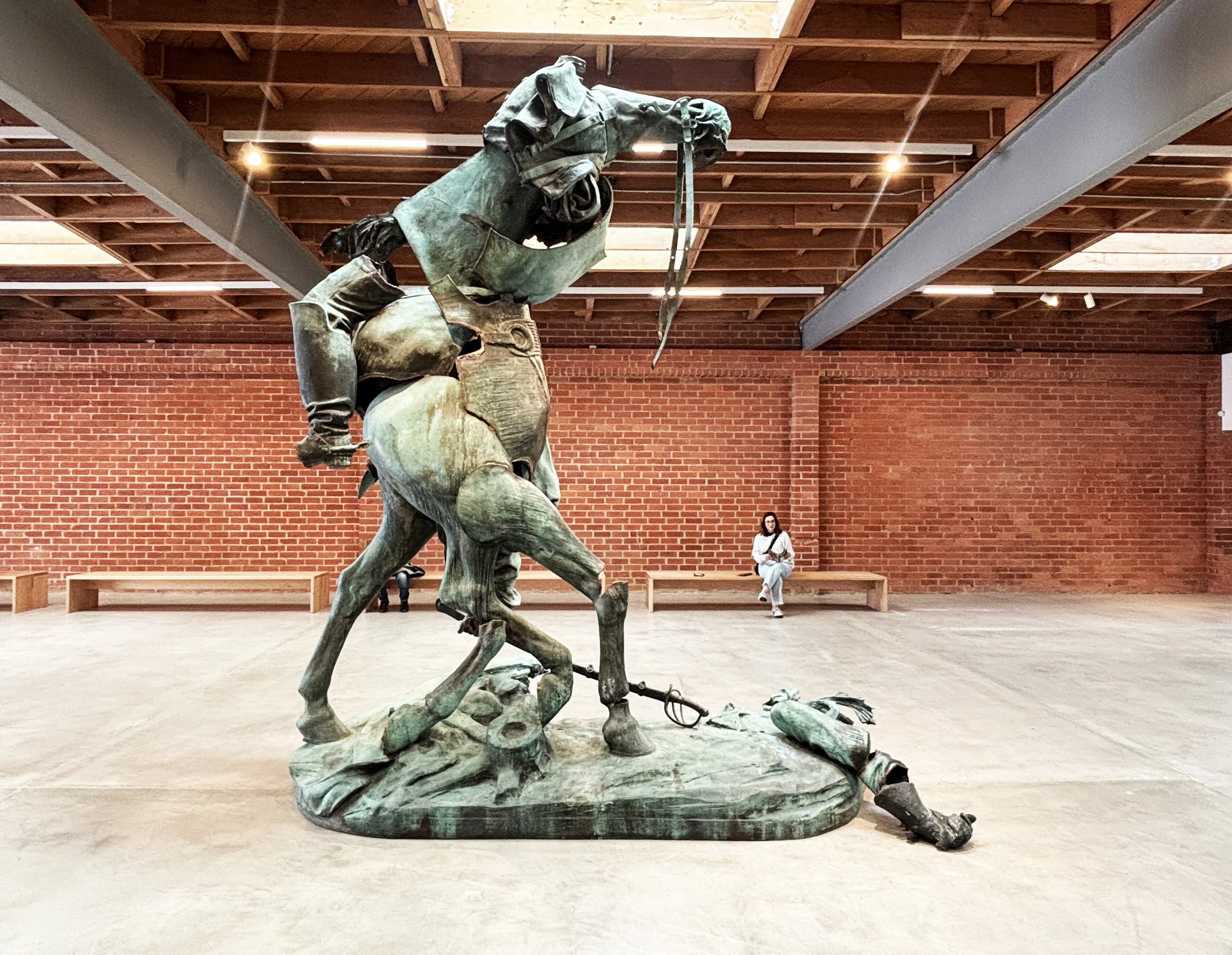
Photography Julian Lucas ©2025
The Brick, Los Angeles
I’ve been sitting with this for a minute, and what strikes me is how an empire manages to lose twice. First in the history books, and then again in bronze, remixed into a monument to its own foolishness. Kara Walker understood that instinctively. She didn’t just reconfigure a Confederate statue. She committed a kind of artistic autopsy. She cracked open the myth, scooped out the romance, and laid the carcass on the Brick Gallery floor for all of us to inspect.
Kara Walker didn’t just tear apart a Confederate monument. She cut Stonewall Jackson into pieces, or whatever was left of his mythology, and rebuilt him as a warning instead of a worship piece.
What’s left isn’t a hero.
It’s not even a warning.
It’s a mess, a disoriented horse and a dismembered rider who looks like he died fighting for the right to be forgotten.
And honestly?
May he rest in irrelevance.
Because for me the Confederacy has always been America’s longest running joke, a punchline carved into stone, and elevated onto pedestals, and all shined and polished by those who are desperate to pretend losing was an ideology. These bronze horsemen were supposed to look noble, unshakeable and righteous. Instead, they age like arrogance always does, badly.
Standing in front of Walker’s Unmanned Drone, I felt the weight of every lie America ever tried to hand me about men like the one melting at my feet. I felt the psychic distance between who they thought they were and who they actually were. I felt the heat of history, not as abstraction, but as evidence. As a body. As a crime scene without the yellow tape, finally exposed to the air.
And as a Black man, standing before what used to be a monument designed to intimidate people like me, the moment feels almost holy. There’s no reverence here. No nostalgia. No grief. Only clarity. And clarity is a kind of justice.
It feels abstract, but with clarity.
It feels like the first deep breath after centuries of holding one. It feels like someone finally turned on the lights.
This isn’t neutrality.
This isn’t objectivity.
This isn’t a museum whispering politely about “historical complexities.”
This is the truth, and the truth is loud.
What academic writers won’t say out loud, I’ll say plainly, these monuments were propaganda campaigns for losers. They were emotional support statues for white supremacy, public therapy for men who couldn’t accept reality. They weren’t built to honor the dead, they were built to intimidate the living.
People that look like me.
People who weren’t meant to see themselves in museums except as exhibits, not interpreters. But those times have changed.
When entering the gallery to see this Confederate figurehead on view stripped of dignity, literally limbless, headless, purposeless, I don’t feel grief. I don’t feel reverence. I don’t feel “complicated.”
I feel right.
I feel a sense of belonging in a way America rarely allows Black people to feel.
Because for once, I’m not the one doing the explaining.
The monument is.
It explains exactly what happens when a society builds idols out of hatred.
It explains what happens when myth collapses under its own weight.
It explains why the Confederacy’s spirit still haunts this country, drifting through policies, police budgets, voting laws, and suburban fear and panic even after its statues fall.
And Walker, with that razor wire genius of hers, gives us the ruins, not the retelling.
The bones, not the biography.
There’s something almost biblical in the way she dismantles this figure. Something righteous in the deconstruction. Something liberating in the aftermath.
It’s as if she’s saying many will see this as vengeance. But this is truth, and truth doesn’t apologize.
People love to ask why Black writers, Black thinkers, Black artists and Black people can’t “move on.” They say it with that condescending tone, the tone of people who think time heals all when they have been so privileged that time has never struck them. But standing in front of Walker’s sculpture reminds me why we don’t move on.
Because the past isn’t past.
It’s sculpted.
Funded.
Installed.
Protected.
And sometimes, finally, dismantled.
The Confederacy lost the war.
Walker makes sure it keeps losing.
And I’m grateful.
Grateful to see the myth cracked open.
Grateful to see the bronze unravel.
Grateful to stand eye-level with a fallen idol and feel nothing but relief.
This isn’t revenge.
This is record correction.
This is narrative sovereignty.
This is the art America didn’t know it needed because it never thought Black people would someday be the ones writing the captions.
The Confederacy stays losing.
And if this sculpture is any indication, the losing has finally started to look honest.
Kara Walker: Unmanned Drone
The Brick, Los Angeles
October 23, 2025 – April 11, 2026
Julian Lucas is a darkroom photographer, writer, and a bookseller, though photography remains his primary language. He is the founder of Mirrored Society Book Shop, publisher of The Pomonan, and creator of Book-Store and PPABF. And yes he will charge you 2.5 Million for event photography.


