

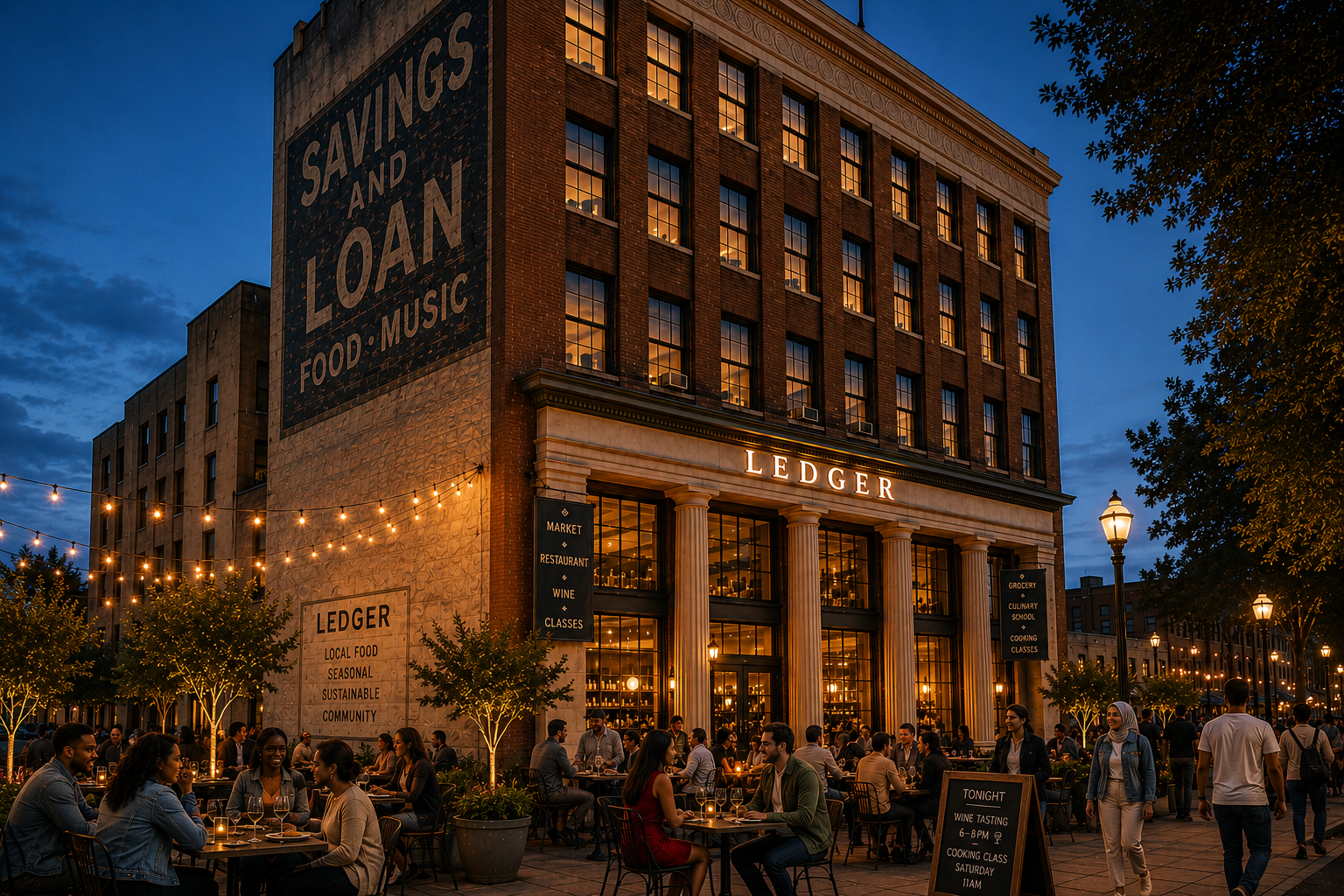
Illustration by Julian Lucas. Imagined from original photographs and realized with generative AI slop, because artists are flaky even when they’re offered money for the work.
By the time the second bottle arrived, we'd moved past dinner conversations. We always do that, too. We start with whatever we have in front of us and somewhere between our first wine and the dessert, we wind up talking about architecture or music or retirement or art or some fascinating lesson the cities have taught us about life.
The roasted beet salad had already disappeared. Red and golden beets lay on top of whipped goat cheese and toasted pistachios, with a little citrus, a little dill and a beautifully restrained sherry vinaigrette that knew when to say 'stop'. There was nothing trying to dazzle in the dish. Everything was simply true to the ingredients. A wood fired mushroom pizza followed, taleggio melting over roasted mushrooms, caramelized onions, thyme, and just enough black truffle to remind you it was there without overwhelming everything else.
She lifted her glass and smiled. “Isn’t this wine insane?” It was a Puligny Montrachet. A quiet, mineral, so elegant enough that it never had to brand or announce itself. “I knew you’d order the white,” I said. “You always know.” “I’ve been paying attention.” She laughed. “I’ve been predictable for years.”
I looked around the dining room. Nobody ever seems interested in leaving. Conversations lingered. Servers moved deliberately without rushing anyone toward the check. An old savings and loan bank had somehow become a place where time behaved differently than money.
“So,” she said, looking around the room, “you finally built it.” I smiled. “I think I finally understood it.”
She followed my gaze down to the market below. We watched through the window as folks filled their baskets with peaches, tomatoes, herbs, olive oil, cheeses, and freshly baked bread. Cooking students shuttled back and forth between the market and the culinary schools with boxes of vegetables picked that morning. The restaurant wasn’t out of sight of the market, and the market wasn’t out of sight of the cooking school. Every inch of the structure knew about the others.
“This isn’t really a restaurant,” she said.
“No?” She shook her head. “It’s an ecosystem.” I couldn’t help but laugh. “I was hoping you’d say that.”
She watched a student disappear through the kitchen doors carrying a crate of basil before turning back toward me. “You know what I love most about all of this?” “The food?” She smiled. “No. The system.”
I waited.
“The market promotes local farmers. The culinary program makes sure that the students cook what is really being grown rather than trying to make it seem like there are strawberries in January. The restaurant adapts according to what the harvest is bringing in.” She tore another piece of bread and dipped it through the last of the olive oil. “That’s what sustainability looks like.”
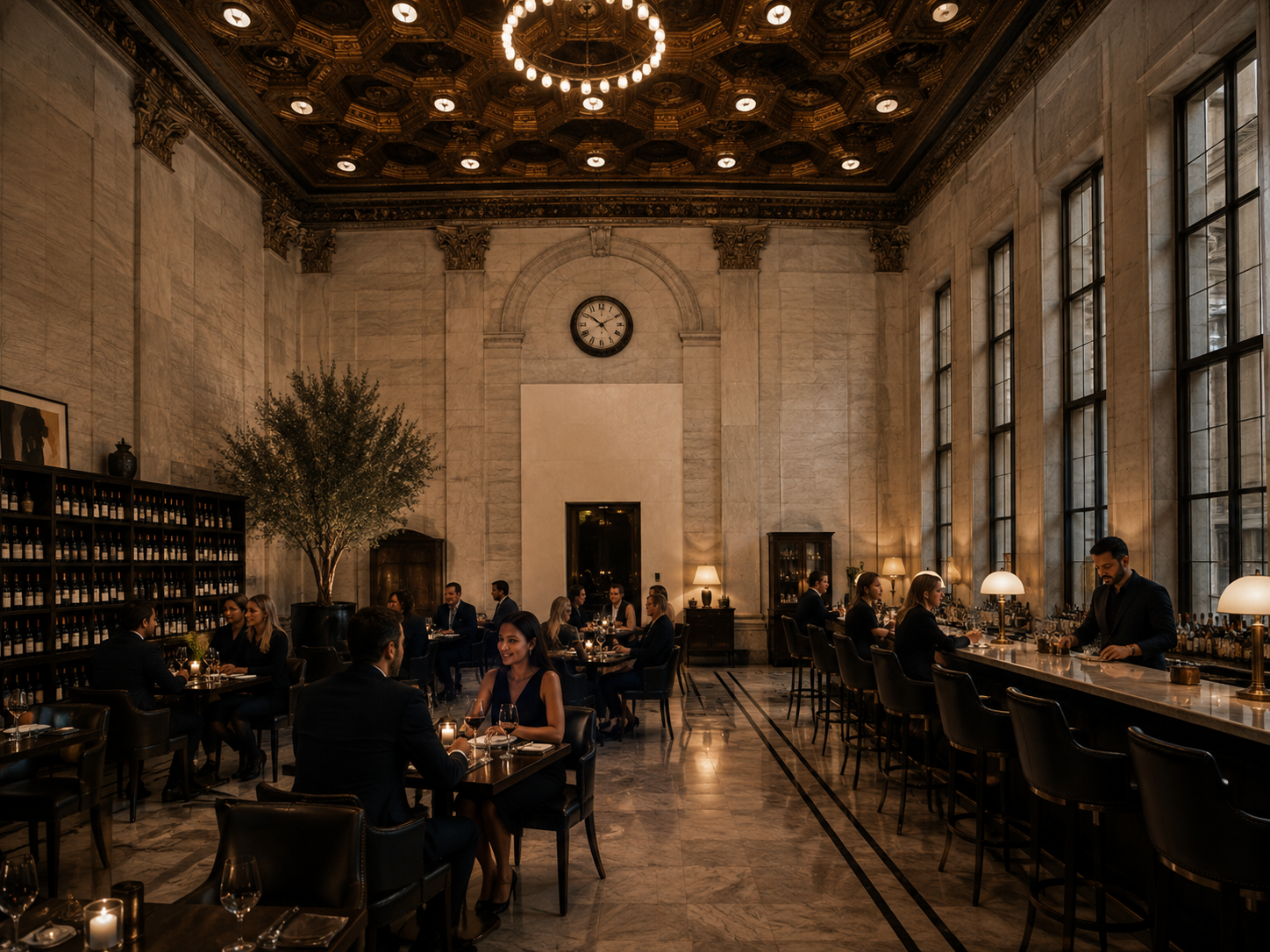
Illustration by Julian Lucas. Imagined from original photographs and realized with generative AI slop, because artists are flaky even when they’re offered money for the work. .
“It isn’t farm to table,” I said. She looked back toward the market. “No.” She paused for a moment before smiling. “It’s farm to community. Those three words stayed with me.
We seem to have an odd way of thinking that culture is exclusive. As if loving architecture, cooking, photography, music, or wine somehow belongs to another person. It doesn’t. Culture is for anyone interested enough to be a part of it. It’s for communities and museums; backyards and galleries; food trucks and fine dining restaurants. It hasn’t ever really been an issue of who culture is for. It’s always been an issue of investment.
For many years, I had planned the building’s design, its lighting, the menu items, the guest rooms, the market, the art gallery, and even the classrooms. The bakery location, the feeling of the wine cellar, and the way the building would make visitors stop and enjoy rather than rush through yet another night were among my thoughts.
She captured everything the building stood for with just three words, from farm to community.
We’d spent years complaining that you couldn’t find a truly thoughtful salad in Pomona. Not one that respected vegetables enough to let them be the meal rather than the obligation before the meal. She laughed. “Remember all those conversations?” “I do.” “We weren’t really looking for a salad.” “No?” “We were looking for people who cared.”
She wasn’t talking about lettuce anymore.
The server cleared our plates while we wandered downstairs into the market. Bakers were already pulling another round of country loaves from the ovens while someone signed up for Saturday’s pasta workshop. A retired couple studied the schedule for a Rhône Valley wine tasting, and a young family filled a basket with peaches, tomatoes, herbs, and fresh pasta before heading home. Nothing felt staged. Nothing existed simply for appearances. Every part of the building seemed to justify the next.
he existence of the next.
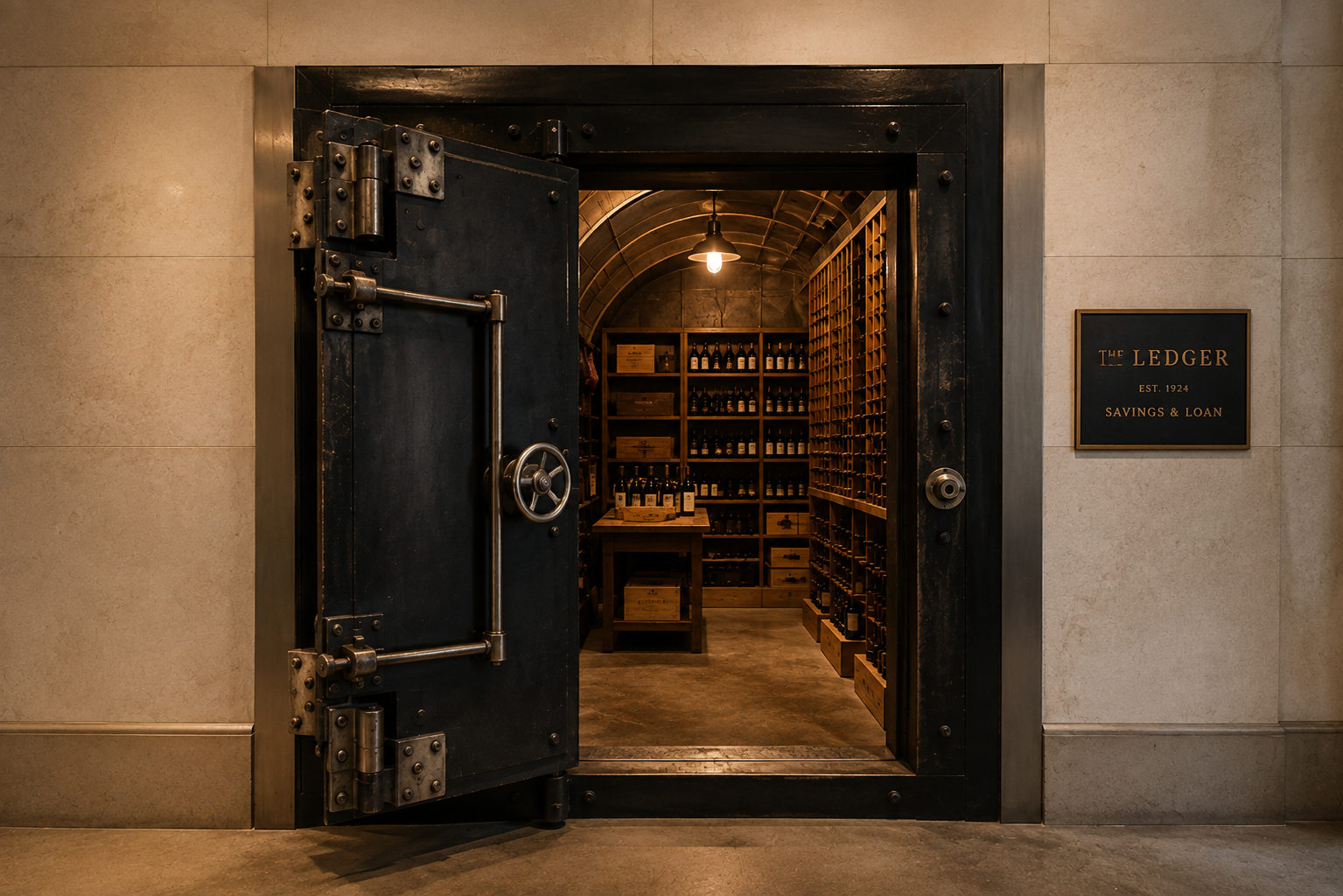
Illustration by Julian Lucas. Imagined from original photographs and realized with generative AI slop, because artists are flaky even when they’re offered money for the work.
She stopped beside the staircase and looked upward. “What happens up there?” “The gallery.” “And above that?” “Guest suites.” “For tourists?” “Sometimes,” I said. “The rest are for visiting artists, chefs, writers, photographers, and culinary students. Some stay for a weekend. Others stay for months.” She nodded slowly. “So people don’t just come for dinner. They stay. They learn.” “They leave with something besides a receipt.” She smiled. “I think that’s exactly what cities have forgotten.”
I looked around again. Banks once taught people how to save money. Places like this teach people what it’s for.
We made our way downstairs toward the vault, and the air changed almost immediately. It grew cooler and noticeably quieter, the sounds of dinner giving way to the heavy silence that only old buildings seem capable of holding. The steel door remained exactly where the bank had left it nearly a century earlier, its weight and presence reminding everyone that this room had once been designed to protect something considered indispensable.
“What did you do with it?” she asked. I reached for the handle. The vault opened slowly.
Rows of Burgundy, Barolo, Champagne, Riesling, and California Pinot Noir rested where cash and securities had once been locked away. Wheels of Parmigiano aged beside handcrafted cheeses from small California creameries. Charcuterie cured patiently overhead, while walk in refrigerators disappeared behind steel that had once been built to keep thieves out.
She ran her hand across the vault door before looking back at me. “It still protects something valuable.” “It does.” She smiled. “Just not money.”
We stood there longer than either of us expected. Funny how a building can continue doing the same job while completely changing what it protects. The vault hadn’t lost its purpose. It had simply traded currency for patience. Wine, cheese, bread, and ingredients all ask for the same thing money never could. Time.
Back upstairs, the mezzanine wrapped around the old banking hall, overlooking the restaurant below. Guests wandered through the gallery carrying glasses of wine before drifting back downstairs for dessert or another bottle. Nobody hurried them. The evening unfolded at its own pace, and the building seemed perfectly content to let people discover it one floor at a time.
“This is my favorite part,” she said. “The gallery?” She nodded. “It’s because it isn’t trying to separate everything.”
One side of the exhibition featured photographs by Herb Ritts, presented in collaboration with the Herb Ritts Foundation. Across the room hung my own photographs. His work possessed the elegance that made him one of the defining photographers of his generation. Mine asked different questions, grounded in migration, neighborhood, and belonging. We weren’t competing for the wall. We were participating in the same conversation.
She stopped in front of one of the photographs.
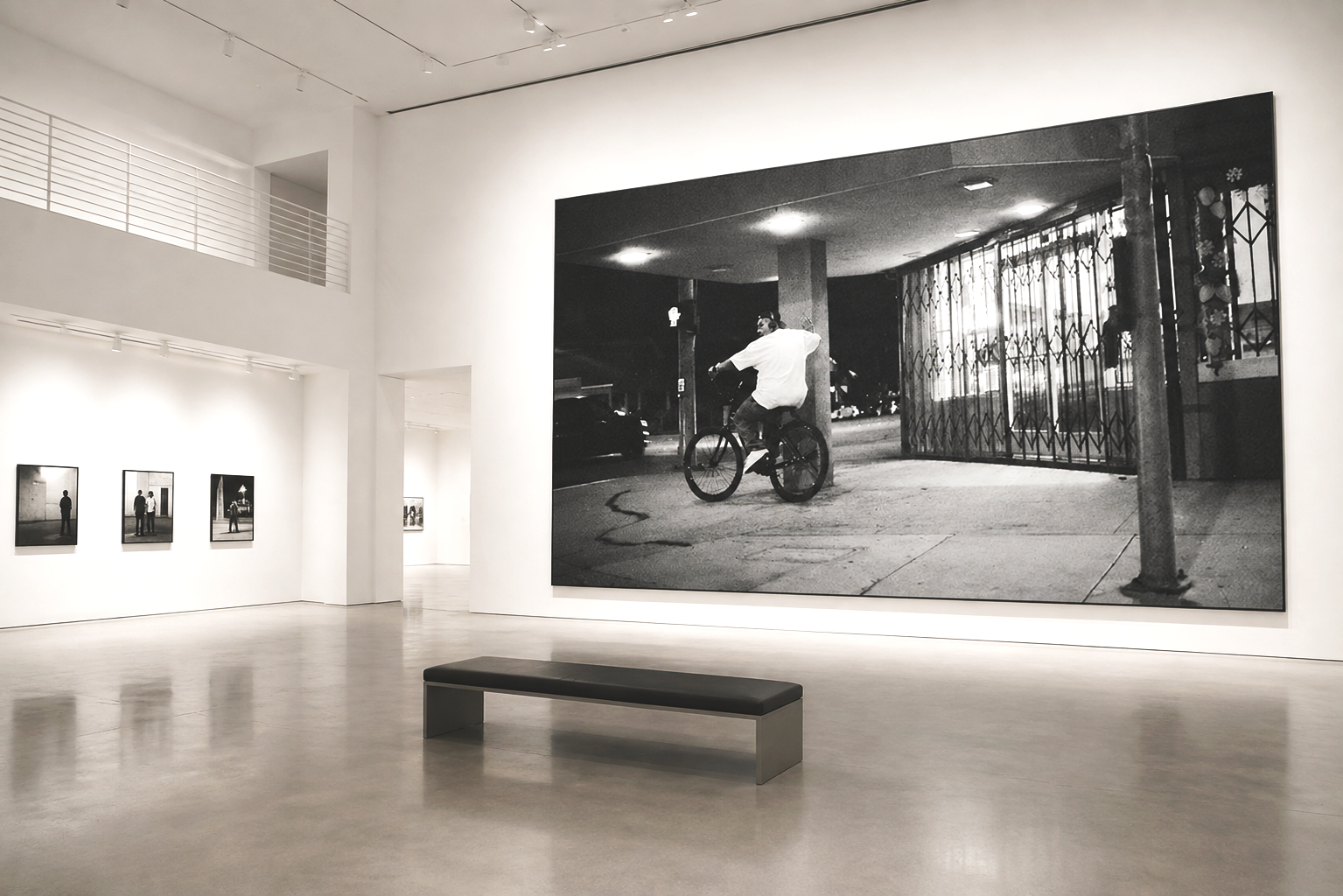
Illustration by Julian Lucas. Imagined from original photographs and realized with generative AI slop, because artists are flaky even when they’re offered money for the work.
“I like this.” “What?” “You didn’t make people choose.” “Choose what?” “Food or art.” I smiled. “That was never the point.”
She looked over the railing toward the dining room below where people laughed over another bottle of wine while others wandered through the exhibition carrying dessert forks they hadn’t quite finished using. “Culture has never lived in one room,” she said. “We’ve just gotten used to separating it.”
She was right. Somewhere along the way we decided restaurants belonged over here, galleries belonged over there, bookstores somewhere else, and classrooms somewhere farther away. We built cities around categories instead of curiosity. Yet some of the most memorable places I’ve visited refused to recognize those boundaries. You ate. You learned. You looked. You talked. None of it felt scheduled.
The conversation drifted the way it always does. Art gave way to work. Work became retirement. Retirement became family. Before long we found ourselves asking the same question we’ve returned to more times than I can count. Why do we spend forty years working for freedom instead of building our lives around it from the beginning?
Neither of us answered. The speakers did. Mary’s Prayer floated quietly through the dining room. She smiled before the first verse had finished. “My friend had the album.” “I remember.” “We used to play it ridiculously loud.” “I remember that too.” She laughed and shook her head. “I hate that you remember everything.” “I don’t.” “No?” “I remember the important things.”
A few songs later Kids in America found its way through the room. She laughed before the chorus even arrived. “Oh no.” “What?” “I completely wore this song out.” “I can picture it.” She smiled. “No, you can’t.” “I think I can.” “You probably imagine me looking cool.” “I do.” “I wasn’t.” “Were you at least dancing?” She laughed again. “Terribly.” “So was everyone else.”
For a while we stopped talking altogether. Below us, dinner continued. Students cleaned their stations in the teaching kitchen. Bakers prepared dough for the following morning. Someone downstairs signed up for a cooking class while another couple reserved seats for next month’s wine tasting. A guest checked into one of the rooms upstairs. Two visitors left the gallery carrying a book they had purchased before heading back through the market with a loaf of bread tucked under one arm.
The building no longer belonged to a single idea. Food lived beside art. Agriculture supported education. Hospitality created room for conversation. Every floor depended on the one below it until the entire building felt less like a restaurant than a cultural institution. It wasn’t simply a place to have dinner. It was a place to spend time.
We finished the last of the wine before walking outside. The old stone façade glowed softly against the evening sky while people filled the sidewalk café beneath it. Some had just finished dinner. Others lingered after visiting the gallery. A few carried bags of produce from the market, while another couple disappeared through the front doors with suitcases on their way to one of the guest rooms upstairs.
The old bank had once measured prosperity in dollars carefully counted behind a vault door. Ledger measures it differently. A loaf of bread still warm from the oven, a remarkable bottle of wine shared with friends, a photograph that lingers in your memory long after you’ve left the gallery, a farmer whose harvest appears on tonight’s menu, a student learning to cook with the seasons instead of against them, and a conversation that quietly outlasts dinner all become different ways of measuring abundance.
The building still safeguards wealth. It has simply changed its definition. Perhaps wealth was never about what we could lock away. Perhaps it has always been about what we are willing to share.
Julian Lucas is a darkroom photographer, writer, and bookseller, though photography remains his primary language. He is the founder of Mirrored Society Book Shop, publisher of The Pomonan, and creator of Book-Store and Print Pomona Art Book Fair. And he will charge you $ 2.5 million for event photography.


