Pomona

Pomona Kept Its Rent Cap. The Landlord Lobby Wants Another Expiration Date

Pomona’s rent protections survived the October 19 City Council meeting. The next day, the California Apartment Association announced that it wanted another expiration date.

“CAA plans to push for a new sunset date after the election,” the association wrote.

Renters kept their protections. The organization that opposed continuing them is already describing how it wants the Council to put them back on a clock.

Monday’s meeting produced two different decisions, and both matter. The Council rejected a proposal to move forward with a rental registry. It then voted to continue the existing Rent Stabilization and Eviction Control Program beyond its scheduled December 31, 2026, expiration.

The registry proposal, Option 2, failed 3–4. Mayor Tim Sandoval and Councilmembers Victor Preciado and Nora Garcia supported it. Councilmembers Debra Martin, Elizabeth Ontiveros-Cole, Steve Lustro and Lorraine Canales opposed it.

Canales then moved to approve Option 1, continuing the existing program without the registry. That passed 6–1, with Sandoval opposed.

Preciado and Garcia supported the registry, then accepted continuation without it. Sandoval supported the stronger option and argued that the alternative was inadequate. The four councilmembers who rejected the registry ultimately voted to preserve the existing program.

Before the second vote, Garcia asked whether a registry could be reconsidered later.

“Something is better than nothing,” she said.

The city attorney confirmed that continuing the existing ordinance would not prevent future amendments.

The approved resolution provides $273,801 from General Fund reserves to operate the program from January through June 2027. Under Ordinance 4359’s continuation provision, adopting the funding resolution allows the ordinance to remain in effect beyond December until repealed by another ordinance.

The six months of funding is not a six month extension of the law. The appropriation covers the remainder of the fiscal year. It does not create a June expiration date.

Covered renters retain the existing 5 percent annual rent increase cap, eviction protections, relocation assistance requirements and petition and hearing procedures. The exemptions remain as well. This is not a cap on every rental property in Pomona, and landlords retain procedures for seeking fair return adjustments and recovery of eligible capital improvement costs.

Without the Council’s action, the local ordinance would have become inoperative at the end of December. Applicable state protections would have remained, but Pomona’s local program would not.

That is a meaningful result. It is also different from giving the city the additional oversight tool its staff proposed.

A rental registry would create a centralized record of rental properties, helping the city identify covered and exempt units, communicate with owners and monitor compliance. Staff presented it as a way to improve the information available to administer the program.

Option 2 would have provided $355,401 for January through June, including $81,600 for registry implementation and related technology. Approval would have directed staff to return with an ordinance amendment. The registry’s requirements, fees and implementation details still needed further action.

The Council was deciding whether to move forward with that work, not approving a finished registry with every charge settled.

Lustro wanted to know how many rental units Pomona had. Staff initially could not give him an exact count. Staff responded, “But I could say this. If we had a registry, we would know.” Lustro paused, staring blankly. He later voted against moving forward with the registry.

Then came the calculator. Lustro took 526 customer contacts, divided them by a hypothetical 15,000 rental units and arrived at roughly 3.5 percent. He acknowledged that the contacts were not separated into tenants and landlords. When staff later estimated 20,000 to 22,000 rental units, he pointed out that the percentage would be even smaller.

The denominator grew. The information did not. A customer contact could be a landlord asking a procedural question, a tenant seeking help or someone calling again about the same problem. Without separating those categories and identifying the units involved, dividing contacts by rental units cannot tell the Council how many landlords are breaking the law. A calculator cannot squeeze an enforcement assessment out of a customer service tally.

Lustro said the numbers were lower than he expected. But the people who never called City Hall were absent from that calculation. Garcia raised the obvious problem: tenants may fear retaliation. Silence does not certify that a landlord is following the rules, and an unanswered question does not become an answer because someone has converted it into a percentage.

Lustro acknowledged the registry’s potential benefits but wanted more than nine and a half months of data, possibly through the end of 2027. Waiting another year would not resolve the limitations of his comparison.

The Council also had another opportunity to settle the details. Option 2 would have directed staff to return with an ordinance amendment. Lustro could have voted to develop the proposal, demanded a defensible fee structure and insisted on safeguards before approving the final rules. Instead, he voted to stop that work from moving forward under Option 2.

Canales worried about costs reaching renters. Those costs needed answers. So did the question Lustro’s arithmetic left untouched: how does Pomona find violations when tenants cannot or will not bring them to City Hall?

The cost discussion also needs the actual figures. Staff estimated that the existing program would cost the General Fund $578,076 in fiscal year 2027–28. With the registry, the estimate was $632,256, an additional $54,180. That estimate assumed a cost recovery fee applied to registrants.

Those are estimates with assumptions, not a final fee schedule. The rejected proposal did not settle how charges would be divided between landlords and tenants. The $81,600 startup figure should not be confused with the estimated additional annual cost.

The broader funding problem remains. American Rescue Plan money supports the program through December 2026. Staff identified the General Fund as the only available source beginning in January. Administering the program requires continued budget appropriations.

Canales initially tried to attach another deadline to that continuation. Her first motion proposed a December 31, 2027, sunset.

The city attorney explained that the Council could adopt the funding resolution that evening, but adding a new expiration date would require a separate ordinance amendment. Canales changed her motion to approve Option 1 as written. The new sunset was dropped.

A later motion by Preciado to bring back a discussion of possible changes passed 6–1, again with Sandoval opposed. It did not establish a registry, add an expiration date or amend the ordinance.

Outside City Hall, both sides emphasized different parts of the result.

Gente Organizada acknowledged that current protections remained while criticizing the four councilmembers who rejected the registry. Its Instagram statement accused them of siding with corporate special interests and said they had “killed any opportunity for landlord accountability.”

That overstates the result. The existing ordinance still contains petition and enforcement procedures. The Council rejected an additional oversight tool; it did not eliminate every existing means of holding a landlord accountable.

The California Apartment Association claimed that its outreach to councilmembers and testimony helped defeat the registry. Its October 20 statement said it opposed both the registry and continuation of the ordinance. It then announced the effort to pursue another sunset after the election.

That makes the next political objective explicit. The association did not get everything it wanted Monday. It intends to keep working.

The rental interests of councilmembers are also part of the public record, although they need to be described accurately.

LA Public Press reported on July 23, 2025, that Martin and Ontiveros-Cole owned rental properties in Pomona and received rental income, citing financial disclosure forms. Streetsblog separately reported in November 2025 that Martin owned two rentals.
Those reports describe their holdings in 2025. The Pomonan has not verified whether those holdings have changed.

The California Apartment Association has publicly identified Martin and Ontiveros-Cole as candidates it supported. In June 2025, the association credited changes in the Council’s composition and described the two as bringing a more business-friendly approach to housing policy.
Those connections do not establish an agreement over Monday’s votes, show whether the reported properties are covered by the ordinance or establish why either councilmember voted against the registry. The association’s statement does not specify a campaign contribution amount.

Its October statement also does not identify which councilmembers it contacted or what commitments, if any, it received. Canales’s withdrawn sunset proposal does not, by itself, establish coordination with the association.

For now, the existing protections continue without the registry or the new sunset Canales initially proposed. The program’s administration still depends on public funding and political decisions about enforcement.

The landlord lobby has announced its next move. Tenants are entitled to know who takes up its proposal, what changes are requested and whose interests those changes serve.


Pomona’s New Rules for Commissioners: Show Up, Shut Up and Behave

Pomona City Hall is about to start counting minutes like a manager who just discovered time sheets.

Under Ordinance 4372, which is scheduled for a second reading and possible adoption Monday night, arriving more than five minutes after a commission meeting begins would make someone officially tardy. Leave at least 15 minutes before adjournment and that would be an early departure. Collect any combination of three and congratulations, City Hall would convert them into one absence.

Then the proposal takes a hard left turn from an attendance policy into a municipal etiquette manual.

Commissioners would be required to maintain “civility and professionalism” during meetings and remain professional outside them. We would imagine that means no name calling or telling people to “go to hell” on social media. An interesting approach to “progressive” leadership. Such conduct reflects poorly on City Hall and can reinforce the negative stereotypes the city has long endured. But will councilmembers hold themselves to the same standard? Hopefully. That would mean no calling people “stupid” or talking shit in the streets. The ordinance does not explain where this expectation begins, where it ends or who gets to decide when somebody has failed it.

Ordinance 4372 appears as Item 9 on the October 19 consent calendar. The Council can approve it with the other consent items unless a councilmember pulls it for discussion.

City staff describes the proposal as eight revisions intended to provide clearer guidance. Some of them do. If attendance carries consequences, defining a tardy makes sense. Someone who arrives 40 minutes late should not receive the same attendance credit as someone who sat through the whole meeting.

The rest deserves a closer look, particularly because Pomona is attempting to deliver a lecture about precision through paperwork that could use some.

When The Pomonan reviewed the October 5 legislative page for Ordinance 4372, the attachment labeled “Staff Report.pdf” opened an unrelated July report concerning the attendance of Vehicle Parking District Commissioner Alejandra Tessier.

The staff report attached to Monday’s second reading says the Council introduced the ordinance on October 5, 2025. The meeting occurred October 5, 2026.

The proposed ordinance itself says City staff “shall will prepare the Agenda.”

The City wants to regulate whether a commissioner arrives six minutes late while its October 5 record carried the wrong staff report and its current documents carry the wrong year and two verbs crashing into each other. Maybe professionalism should begin at home.

The Dos and Don’ts of Ordinance 4372

Do

Watch the clock. Arriving more than five minutes after the meeting is called to order would count as a tardy.

Stay until the end. Leaving at least 15 minutes before adjournment would count as an early departure unless the commissioner leaves because of a disqualifying conflict of interest.

Keep track of both. Three tardies, early departures or any combination of the two would become one absence.

Be present when the meeting begins. If a regular meeting fails for lack of a quorum, a commissioner who is not present at the start and does not have an excused absence would receive an unexcused absence.

Remember that commissioners do not direct staff. The proposal says commissioners may not direct staff to initiate programs, conduct major studies or establish policy without approval from the City Council or city manager.

Do without the official extras. The ordinance states that City email accounts and business cards will not be issued to commissioners.

Don’t

Turn disagreement into a personal attack. The proposed standards prohibit abusive conduct, personal charges and verbal attacks on the character or motives of commissioners, City employees and members of the public.

Pretend to speak for Pomona when you do not. Commissioners may identify themselves as commissioners while performing official business or when authorized by the City. At other times, they must make clear that they are not speaking for the commission or the City.

Assume City Hall’s concern ends when the meeting does. Commissioners would be required to “maintain professionalism both during and outside of public meetings.”

Outside public meetings covers a lot of territory. It could mean social media, a neighborhood event, a protest, a candidate forum or an argument over a parking space at Stater Bros. The ordinance does not define unprofessional conduct outside a meeting. It does not identify who evaluates an alleged violation or establish a specific process for handling one.

“Be professional” is easy advice. As a rule governing people the Council can remove, it is something else. It can mean do not threaten people or scream at staff. It can also mean do not embarrass City Hall. The language leaves enough room for future officials to decide what it means when a dispute arrives.

That is the problem with gummy words such as civility and professionalism. They sound neutral because nobody openly campaigns for abuse or chaos. But vague behavioral standards can be harmless when ignored and powerful when selectively applied.

The Rule Pomona Did Not Change

The rewrite leaves the central threshold of three absences unchanged. Three absences in a calendar year, excused or unexcused, trigger a commission review and a possible recommendation for removal. The commission secretary “shall” place the matter on the agenda.

That matters because a response sent to The Pomonan on the City’s behalf recently described the trigger as “more than three absences.” That is incorrect. The existing bylaws say three. The proposed bylaws still say three.

It also matters because Pomona has not explained why Jacqueline “Jacky” Elizalde’s failed removal recommendation was taken to the City Council while other commissioners with comparable or worse attendance records remained after their commissions declined to recommend removal.

The Pomonan documented those cases earlier this month. The Parks and Recreation Commission voted 3 to 3 on whether to recommend Elizalde’s removal, so the recommendation failed. Councilmember Elizabeth Ontiveros-Cole then made a separate request to place the matter before the City Council.

The Council possessed the authority under the City Charter to remove Elizalde and used it. The unanswered question is why her case received that additional proceeding when the other cases did not.

Ordinance 4372 does not answer that question or establish a mechanism for showing that attendance and conduct rules are being applied consistently. It adds more ways to accumulate an absence and introduces a new collection of behavioral standards.

The timing should be stated plainly. The City created the legislative file on September 22, before The Pomonan published its October 13 report about Elizalde and commission attendance. There is no evidence that the ordinance was drafted in response to the article.

The ordinance is nevertheless arriving in the middle of an unresolved argument about what happens when a routine attendance matter moves beyond a commission and into City Council politics.

Maybe the Council will discuss the unanswered parts Monday night. Someone could ask who decides when criticism becomes incivility, what professionalism outside a meeting actually means and why City Hall needs authority over conduct it has not bothered to define.

Or maybe Ordinance 4372 will pass on consent, tucked between other items, giving Pomona another set of rules that look harmless on paper and become meaningful only when somebody decides to use them.


SOURCE


The Pomonan is an independent publication of essays, criticism, photography, and cultural commentary.

Pomona Reduced Youth Funding. Then It Added $4.1 Million to the Police Budget.

Pomona spent months warning residents that youth funding could gut public safety. Then voters approved Measure Z, cutting the city’s annual youth funding requirement by approximately $6.9 million. But what happened next was not complicated.

The city restored funding for 24 vacant Police Department positions at a combined salary and benefit cost of $4,117,822.

Police now have a $91.15 million budget. Pomona still expects to spend more money than it receives.

A draft first quarter budget preview lists $91,146,214 for police and a projected General Fund deficit of $7,946,475. The Citizens Oversight Committee is scheduled to review the figures Thursday, October 15.

Police account for 51.1 percent of the city’s amended General Fund spending plan. More than half.

That is not unprecedented. Police represented approximately 51.6 percent of adopted General Fund spending in fiscal year 2022 to 2023. But this year’s increase arrived immediately after the city reduced the amount of money it was required to send to youth programs.

The budget adopted on May 26 allocated $87,028,392 to police. Total General Fund spending was $181,904,077, putting the police share at approximately 47.8 percent.

That police allocation was already above the $80,970,080 adopted for fiscal year 2025 to 2026.

The May staff report blamed the increase primarily on salaries and benefits, pension liabilities, the Homeless Encampment Action Response Team and costs allocated across city departments. Then came Measure Z.

Measure Y, approved by voters in November 2024, required Pomona to send an increasing share of unrestricted General Fund revenue to its Children and Youth Fund. For fiscal year 2026 to 2027, the city budgeted approximately $9.2 million for that transfer. City Hall did not like that number.

Before the June election, the city warned that Measure Y would force deeper cuts to police, fire, parks, streets and other services unless voters changed the funding formula. Voters approved Measure Z on June 2.

Meanwhile, that bright—shiny new public safety panic City Hall is currently shilling? The data was already moving in the exact opposite direction while they were busy fearmongering.

According to the city’s Office of Violence Prevention and Neighborhood Wellbeing, general shootings plummeted 24 percent in 2024 and dipped another 9 percent in 2025. Gun homicides took a massive, 53 percent nosedive in 2024 and slid another 14 percent the year after. Overall homicides? Dropped 25 percent in 2025.

The notable detail is that all of this occurred before voters passed Measure Z, and before officials in Pomona allocated $4.12 million to fund vacant department positions.

While this does not definitively prove that increasing law enforcement budgets is ineffective, it indicates that public narratives regarding rising crime rates contrasted sharply with the city's own statistical data showing a decrease in violence.

Measure Z tied the youth transfer to 10 percent of Bradley Burns sales tax revenue. The city estimated the new transfer at approximately $2.3 million. That is approximately $6.9 million less than the amount budgeted under Measure Y.

Measure Z did not give that difference to police. It did not earmark the money for any particular department. It simply reduced what Pomona was required to transfer to the youth fund, leaving more General Fund money available for everything else.

Money already transferred to the youth fund remained restricted for youth purposes, according to the city’s August report.

In its August 3 budget amendment report, city staff directly connected the passage of Measure Z to restoring funding for 32 vacant positions. Twenty four of them were in the Police Department.

The position schedule lists 14 police officers, three jailers, one police dispatcher, three senior police dispatchers, two police records specialists and one senior police records specialist. The combined salary and benefit cost was $4,117,822.

That amount exactly matches the difference between the police budget adopted in May and the amount shown in the current draft preview.

The positions were vacant and had been left unfunded. These were not 24 employees who had been laid off and brought back to work. Restoring the money gave the department the ability to fill the positions.

The city’s paperwork does not establish that all 24 positions have actually been filled. Measure Y placed real pressure on the General Fund. But it was never the only reason Pomona was running a deficit.

The August report also pointed to labor agreements, the Los Angeles County fire contract, insurance increases and programs that had previously been supported by other funding sources. The May budget projected $170,530,134 in General Fund revenue and $181,904,077 in spending. That left an $11,373,943 deficit.

The draft preview now projects $170,538,069 in revenue and $178,484,544 in spending. The deficit decreased by approximately $3.43 million. It did not disappear.

Total General Fund spending fell by approximately $3.42 million from the amount adopted in May. Police funding went the other way, increasing by more than $4.1 million.

These are annual budget allocations, not amounts already spent. Through September 30, the preview lists $18,680,483 in police expenditures, approximately 20 percent of the amended police budget.

The two page preview does not connect the additional police money to response times, crime rates, case clearance rates or any other measure showing what residents receive for the increase.

It shows what the city intends to spend. It does not show what that spending will accomplish.

City staff warns that the numbers are preliminary and may change before the full first quarter report reaches the City Council.

The Citizens Oversight Committee meets at 6 p.m. Thursday in the Chuck Bader Conference Room. Pomona warned that youth funding threatened public safety. Voters reduced the youth requirement. The city restored $4.1 million for vacant police positions.

And after all that, Pomona is still nearly $8 million in the hole.


SOURCE

Pomona Could Accept $2.7 Million for Supportive Housing. The Report Leaves Out How Many People It Will Serve.

Pomona could accept nearly $2.7 million in federal funding for permanent supportive housing next week. The money will help pay rent for people who are unhoused with disabilities.

What the city’s report does not say is how many people will receive that help.

The City Council will consider the $2,684,269 grant during its meeting on Monday, October 5. The item is on the consent calendar, so it could be approved without a separate public discussion unless a councilmember pulls it.

The grant comes from the U.S. Department of Housing and Urban Development’s Continuum of Care program. It would fund Pomona’s Permanent Supportive Housing program from January 1 through December 31, 2027.

This is a renewal of an existing rental assistance program. It is not money for constructing housing.

The federal agreement assigns $2,569,428 to rental assistance and $114,841 to administration. It assigns nothing to acquiring property, rehabilitating apartments, new construction or operating costs.

Rental assistance is still housing assistance. It can keep someone housed even when a disability or limited income makes market rent impossible to afford. But the distinction matters in a city where housing remains scarce and expensive. This grant helps pay for housing that already exists. It does not add housing to the market.

Pomona must also provide a $671,068 match using eligible local or state resources. The staff report does not identify the sources of that match or say how much will be cash and how much, if any, will be provided through staff time or other in-kind contributions.

There are other questions in the paperwork.

The staff report says $42,000 will be awarded to Volunteers of America Los Angeles for a life-skills program. The HUD agreement, however, lists the entire $2,569,428 program allocation as rental assistance and shows zero dollars for supportive services.

That does not necessarily mean the $42,000 is being spent improperly. It means the two documents do not explain how the life-skills payment fits within the approved federal budget.

The city says the budget amendment will increase revenue estimates and spending authority by $2,223,835, rather than the full $2,684,269 award. But the table in the same report lists adjustments that net to a $1,552,767 decrease in revenue and a $1,552,767 increase in appropriations. The report does not reconcile those figures.

Pomona uses four organizations to identify and refer people to the program: Volunteers of America Los Angeles, Foothill AIDS Project, Tri-City Mental Health Authority and Prototypes.

Eligible participants include people experiencing homelessness with permanent disabilities and families in which an adult or child has a permanent disability. The referring organizations work with people living with HIV, people experiencing mental-health conditions and women and families affected by substance use, mental illness or domestic violence. The report describes who may qualify. It does not describe the program’s current reach.

The report does not provide a current number of participating households, adults, children or total people housed. It does not say how many people entered housing during the present grant year, how many remained housed or whether any rental assistance went unused.

A 2023 HUD housing inventory listed Pomona’s program at 139 beds: 59 family beds and 80 adult-only beds. The report going before the council does not provide an updated figure.

The 2027 award is also $9,180 lower than the $2,693,449 Pomona received for the same program in 2026. The difference is small, but the city does not say whether it will affect the number of people served.

The council is not being asked to create a new housing program. It is being asked to renew one that already exists and authorize the city manager to execute the agreements and any later amendments needed to operate it.

The council is not being asked to create a new housing program. It is being asked to renew one that already exists and authorize the city manager to execute the agreements and any later amendments needed to operate it.


The Pomonan is an independent publication of essays, criticism, photography, and cultural commentary.

Pomona Moves to Verify Candidate Residency Mid-Campaign

Pomona is preparing to adopt a formal residency-verification policy for candidates and elected officials, even as the 2026 campaign is already underway.

The City Council will consider Resolution 2026-95 at its meeting Monday, September 21. The item sits on the consent calendar, meaning it could be approved without separate public discussion unless a councilmember pulls it.

Pomona’s charter already requires the mayor to live in the city and councilmembers to live in the districts they represent. The proposed policy does not create that residency rule. It creates a formal process for deciding whether a candidate or elected official has produced enough documentation to prove compliance with it.

Under the proposed policy, candidates would have to show they are registered to vote at the address they claim as their residence, then provide at least two additional records from separate categories.

Those records could include a lease, property-ownership documents, vehicle registration, driver’s license, utility bill, paycheck, bank statement, insurance document, school record or court document.

The records would have to establish that the candidate lived at the address for at least 30 consecutive days immediately before receiving nomination papers. Candidates would also have to sign an affidavit under penalty of perjury.

The City Clerk would have five calendar days to review the documents. The policy says candidates who do not provide the required records before the nomination deadline “will not be permitted to file their nomination papers.”

It is a lot of paperwork for something that is supposed to be simple: Do you live where you say you live?

But elections are never simple once the filing deadlines, campaign signs, donor lists and political alliances have begun moving. A residency rule can look clear in a city charter. Proving it can be messier. A person may receive mail at one address, sleep at another, own property somewhere else and still insist they belong in a district.

The policy would give City Hall a checklist instead of leaving those disputes to rumor, neighborhood Facebook groups or last-minute political attacks.

It also raises a fair timing question. The City is moving to formalize the process after candidates have already declared campaigns, raised money and begun asking voters for support. The policy says missing documents can prevent someone from filing nomination papers, but the public agenda summary does not identify a specific candidate or elected official whose residency prompted the resolution.

That does not mean there is no legitimate reason for the policy. Election eligibility matters. So does a clear process that applies evenly, rather than one invented only when a particular candidate becomes politically inconvenient.

The council can adopt the policy in one consent-calendar vote Monday night. If nobody pulls the item for discussion, a new process governing one of the most basic requirements for public office may pass with little more than a motion and a roll call.

Official agenda and Resolution 2026-95⁠


The Pomonan is an independent publication of essays, criticism, photography, and cultural commentary.

Pomona Says Money Is Tight. The City Council Is Considering a Raise.

Pomona City Hall has spent months warning that money is tight. Pomona’s adopted General Fund budget spends approximately $11.4 million more than projected revenue, with the difference coming from reserves. Officials say services may have to be cut. Measure Y has now become the official scapegoat whenever investing in the city’s children is mentioned. And now the City Council is considering a raise.

On Monday, September 21, 2026 councilmembers will decide whether to advance a 9.91 percent increase in their monthly compensation. Regular councilmembers would go from $819 to $900 a month. The mayor would jump from $1,638 to $1,800.

Nobody is buying a yacht with that money. It is an extra $81 a month for councilmembers and $162 for the mayor. But City Hall has a funny way of discovering fiscal restraint when money is headed toward residents and discovering the Consumer Price Index when the money is headed upstairs.

The proposal also includes a one time expense payment of $600 for each councilmember and $1,200 for the mayor.

According to the City staff report, these payments would recognize expenses associated with public service and “extraordinary inflation, including recent increases in fuel costs.”

The recurring raise would cost Pomona approximately $4,544 a year. The on- time payments would add another $4,800. The total cost during the first year is $9,344.

That amount is lint in the municipal couch cushions. It will not wreck the budget, save the budget, or meaningfully alter Pomona’s financial condition. The point is not that a nine thousand dollar expense will bankrupt a city with a General Fund approaching $182 million. The point is timing.

Pomona’s adopted budget projects about $181.9 million in General Fund spending against approximately $170.5 million in revenue. The difference comes from reserves.

At the same time, the City is transferring approximately $9.2 million into the Children and Youth Fund required by Measure Y. Staff has warned that the voter approved youth measure could force reductions to “core services” unless Pomona finds additional revenue.

When the subject is youth funding, the City describes a looming fiscal burden. When the subject is council compensation, staff finds a legal formula and calculates the raise down to the dollar.

The same agenda item also updates Pomona’s salary schedule to reflect a 5 percent increase for full time and part time City classifications beginning October 1.

That raise is not a surprise and it was not negotiated last week. It comes from labor agreements and compensation plans approved in 2023 and was already built into the current operating budget.

The staff report does not disclose the total citywide cost of that 5 percent increase.

Councilmembers have not received a compensation increase since 2014. Pomona’s charter allows council pay to be adjusted using inflation, and state law would permit the City to pay councilmembers as much as $2,550 per month based on population. The proposed $900 remains far below that ceiling.

Those are fair facts. So is this one: the council considering the increase is the same council that controls the City budget and decides which expenses are necessary, which are untouchable, and which become warnings about impending cuts.

Monday’s vote would not make the council raise final. It would introduce the ordinance and approve its first reading. A second reading is scheduled for October 5.

If the ordinance survives both votes, it would take effect on November 5. The increased pay would begin on November 15.

Nine thousand dollars will not break Pomona. But austerity always sounds different depending on whose check is being discussed.

The City Council meeting begins at 7 p.m. at Pomona City Hall, 505 S. Garey Avenue.


The Pomonan is an independent publication of essays, criticism, photography, and cultural commentary.

Pomona Spent $309,642 Enforcing Sidewalk Vending Rules. It Collected $7,763 in Fines

Pomona spent $309,642 in overtime enforcing its sidewalk vending rules over the past two years. The City collected $7,763 from the fines it handed out.

That is one a hell of a gap.

The numbers appear in a new City report scheduled to go before the Pomona City Council on September 21. The report covers the City’s sidewalk vending crackdown from late 2024 through August 2026.

Code Compliance, Public Works and the Pomona Police Department conducted 106 enforcement operations, usually during evenings and weekends. Each operation lasted approximately six hours.

The City issued 419 citations carrying $143,126 in fines. Only about 5.4 percent of that money has been paid.

Pomona also impounded vending equipment 31 times. Vendors returned to retrieve their equipment in four cases. The report does not say what happened to the other 27 impounds.

The City Council originally approved $200,000 in overtime for vending education and enforcement during the 2024 to 2025 fiscal year. The reported overtime expenses have now passed that amount by $109,642.

Code Compliance spent $127,647. Police spent $116,078. Public Works spent $65,917.

There was no money specifically budgeted for sidewalk vending enforcement during the following two fiscal years. The departments are now pulling those expenses from their regular overtime budgets.

All of this was done to enforce rules against a fairly small group of permitted vendors.

Pomona issued 44 sidewalk vending permits during the reporting period. Only 16 are currently active. Eighteen expired and are waiting for renewal. Six businesses closed. Three permits are inactive and one application remains unprocessed.

The permits brought in $7,832. Add that to the $7,763 collected in fines and Pomona received about $15,595 while spending $309,642 in overtime.

The program was not necessarily created to make money. But the numbers raise an obvious question about what Pomona received for what it spent.

Before enforcement began, the City says Code Compliance spent 45 days conducting street outreach. More than 150 verbal warnings and referrals were given to vendors.

Pomona and the Los Angeles County Department of Public Health held a workshop in November 2024 that attracted more than 80 people. Another workshop held in January 2026 drew approximately 50 to 60 people.

The report says vending brochures and workshop flyers were provided to Gente Organizada and the Pomona Economic Opportunity Center to assist with outreach. It does not say either organization supported the ordinance or participated in enforcement.

Gente has published criticism of the City’s approach.

In a February 27 op-ed published by Gente Organizada, Cal Poly Pomona sociology professor Bianca N. Haro-Villa wrote that the ordinance had pushed vendors from Pomona’s streets while imposing requirements many immigrant, low income and renting families could not realistically meet.

Haro-Villa wrote: “Los vendedores ambulantes son empresarios, no criminales” — “Street vendors are entrepreneurs, not criminals.”

She also argued that the options presented at the City’s January workshop, including home food businesses and private markets, did not reflect how many vendors actually live and work.

Still, fewer than two dozen sidewalk vending permits are active.

Street vendors must first receive a permit from the County Department of Public Health. Pomona will not accept their city applications without it. Vendors must also carry liability insurance, which City staff says can cost approximately $30 per month.

The City says insurance protects Pomona, vendors and the public when accidents, foodborne illnesses or property damage occur. Los Angeles city and county do not require sidewalk vendors to carry similar insurance, according to the report.

No claims or lawsuits related to sidewalk vending were filed during the reporting period. The last claim against Pomona involving sidewalk vending was filed in 2022.

The report leaves out quite a bit.

It does not say how many individual vendors received the 419 citations. It does not identify where the 106 enforcement operations happened. It does not say how many fines are being appealed, how many vendors were repeatedly cited or whether cited vendors eventually received permits.

It also does not explain what the City plans to do with the 27 impounded carts and pieces of equipment that were never retrieved.

The council is not being asked to change the vending law Monday. The report sits on the consent calendar, where the council is being asked to receive it and place it on file.

For now, the clearest result is sitting inside the City’s own numbers: $309,642 in overtime, 419 citations and $7,763 collected.

Read the City’s full sidewalk-vending enforcement report here


The Pomonan is an independent publication of essays, criticism, photography, and cultural commentary.

The East Holt PBID: An Investigative Timeline of Money, Consultants and Questions

Have you ever wondered why it has been more than five years since the City of Pomona has discussed creating a Property Business Improvement District, or PBID, along the East Holt Avenue corridor? 

In 2021 the City of Pomona budgeted money for a PBID consultant. Two years later in 2023, the City hired Civitas Advisors, to form an East Holt Property Business Improvement District (PBID). Presently, the Pomona Chamber of Commerce continues to call the East Holt PBID a “current project.” But there is still no East Holt PBID.

We are releasing a timeline of the proposed East Holt PBID, the public money budgeted for it, the involvement of Civitas Advisors and the Pomona Chamber of Commerce, and the lack of answers from the City of Pomona about where the project stands today.

What is a PBID?

A Property Business Improvement District, or PBID, is a defined area where property owners pay an additional assessment to fund services within the district.

Those services can include security, street cleaning, maintenance, marketing, economic development and other improvements beyond what the City normally provides.

In that sense, a PBID shifts some responsibility for managing a commercial district away from City government and into a separately managed organization funded through assessments on property owners.

The City helps establish the district, but ultimately, property owners foot the bill. However in most cases depending on the lease, property owners may pass the PBID assessment on to their business tenants.

What a PBID also does is privatize some of the management of public space within its boundaries. Public streets and sidewalks remain public, but services traditionally provided by the City, including security, can instead be administered through a private organization.

Creating a PBID requires identifying the properties within the proposed district, determining assessments, developing a management plan, gaining property owner support and going through a petition and ballot process. This is important to the East Holt story.

Pomona was not simply discussing another City program. It was attempting to create a district that could eventually collect assessments from East Holt property owners to pay for services within the corridor.

Which raises perhaps the most basic question. Did the property owners along East Holt actually want one?

March 22, 2021

Pomona city staff presented its preliminary Fiscal Year 2021-22 General Fund budget. However, a PBID consultant was not specifically listed among the major increases in the preliminary budget.

However, the budget was still a work in progress. The city staff stated that the proposed budget would return to City Council for a Budget Study Session on May 10, and followed by final adoption on June 7.

One of the remaining issues was to identify funding sources, if available, for the City Council’s upcoming goals and priorities. Was this the beginning of the funding for an East Holt PBID? 

May 10, 2021

City Council held its Fiscal Year 2021-22 Budget Study Session. By this time, $90,000 for a PBID consultant appeared in the proposed General Fund budget. The $90,000 was listed as a controllable expense along with several other City contract increases. At this time there was no mention in this section of who the PBID consultant would be.

June 7, 2021

City Council considered adoption of the Fiscal Year 2021-22 Operating Budget. In the final staff report, the City again listed: “$90k for PBID consultant.”

The money was listed along with $400,000 for landscape maintenance, $150,000 for redistricting commission support, $150,000 for Police Commission support, $70,000 for grant writer services and $140,000 to restore a crosswalk contract.

Resolution No. 2021-69 was presented for adoption of the Fiscal Year 2021-22 Operating Budget. Therefore, by June 2021 the City had incorporated $90,000 in its budget for a PBID consultant. But who was the consultant? What work was the consultant supposed to complete? And was the consultant ever paid the budgeted $90,000. Or was the $90,000 ever spent.

June 21, 2021

Two weeks later, the City of Pomona published its City Council Priorities and Goals.

Under Goal H the City stated:

“Encourage and support Property Business Improvement Districts (PBIDs) to support business development.”

Under Economic Development, Step 1 was:

“Request funding of $100,000 in the FY 2021-22 Operating Budget to support creation of a PBID for Segment of East Holt and, if funded, complete the evaluation by June 2022.”

In the comments section, the City stated:

“Funding approved in FY 2021-22 budget.”

Interestingly enough now there are two numbers. The City’s budget documents say $90,000 for a PBID consultant. The City’s Council Priorities and Goals say $100,000 to support creation of an East Holt PBID. Which one is it? Was the $90,000 the consultant portion of the $100,000 and the remaining $10,000 was intended for other costs associated with creating the district?  Or were these two different amounts? And why? 

What the City’s own documents do show is that funding was approved and the City expected an evaluation of the East Holt PBID to be completed by June 2022.

June 2022

The city gave itself a deadline to have completed the east Holt PBID evaluation, however that deadline passed. The Pomonan has not located a completed East Holt PBID evaluation from this period.

Was the evaluation completed? If it was, what were the results? If it wasn’t, what happened to the money? 

August 2023

More than two years after the City budgeted money for a PBID consultant, Mayor Tim Sandoval discussed the East Holt PBID with the Pomona Chamber of Commerce.

According to the little engine that could, La Nueva Voz, “Pomona’s Only Local Newspaper”, Sandoval said the City was working with the Chamber to create a business improvement district along East Holt similar to the Downtown Pomona Owners Association. The proposed district could provide services such as marketing, security and upkeep. So, more than two years after funding was approved, the East Holt PBID was still being discussed as something to be created.

December 2023

The City of Pomona hired Civitas Advisors, a Sacramento based consulting firm, to form the East Holt PBID, according to a January 2024 report in La Nueva Voz.

The consultant’s work was to include a preliminary benefits assessment, creation of a stakeholder advisory committee, development of a budget, management plan, engineer’s report, petition and an actual election ballot.

The cost of the project was not to exceed $85,000, based on a fixed fee of $5,500 per month plus expenses for a 12 month period.

Engineering costs were expected to be another $6,000.

This raises another question. If money had already been approved for a PBID consultant in 2021, why was the City hiring Civitas Advisors in late 2023?

Was Civitas the consultant contemplated by the original funding?

Was another consultant hired before Civitas?

Was the original money never spent?

Or was Civitas paid from an entirely different source?

The Pomonan does not know.

That is why the financial records matter.

January 25, 2024

La Nueva Voz published, “Pomona hires Sacramento firm to form new ‘East Holt’ business improvement district.”

Pomona Economic Development Director Kirk Pelser told the newspaper that Civitas had been hired to form the district.

The scope of work described was not simply to study whether somebody might want a PBID someday. It included steps toward actually forming one, including a stakeholder committee, budget, management plan, engineer’s report, petition and election ballot.

The contract amount, however, does not tell us how much Civitas was actually paid.

An $85,000 contract ceiling is not an $85,000 payment.

The Pomonan has asked the City for invoices and payment records to determine how much Civitas was paid and what work was completed.

2024 - 2025

Perhaps this is where the trail becomes less clear.

Civitas was reportedly hired for a 12 month engagement beginning in late 2023.

The Pomonan has not located a property owner petition, election ballot or announcement establishing the East Holt PBID.

Nor has The Pomonan located an announcement from the City explaining that the project ended.

If the project stopped, when did it stop?

If it continued, what happened during this period?

2026

The Pomona Chamber of Commerce continues to list the East Holt PBID as a current project of its Economic Development Committee.

The Chamber states:

“Current projects include the Property Business Improvement District (PBID) along the East Holt Corridor…”

This language has appeared on Economic Development Committee meeting notices throughout 2026.

The committee is chaired by Hector Lopez and Monique Robles.

Perhaps the Chamber has continued the work that began with the City and Civitas.

Perhaps the description on the Chamber website is old.

But if the East Holt PBID is in fact a “current project,” what is currently happening?

Who is leading it?

The City of Pomona?

The Pomona Chamber of Commerce?

Civitas Advisors?

What are the proposed boundaries?

Has an assessment formula been created?

Have East Holt property owners been contacted?

Have petitions been circulated?

Has there been a ballot?

And after five years, how close is East Holt to actually having a PBID?

August 16, 2026

The Pomonan submitted a California Public Records Act request to the City of Pomona seeking records regarding the East Holt PBID.

The request included the Civitas contract, purchase orders, invoices and payments, consultant deliverables, engineer reports, stakeholder committee records, property owner and business outreach, correspondence between Civitas and the City and records showing the current status of the PBID.

The Pomonan also requested records accounting for the $100,000 identified in the City’s 2021 Council Priorities and Goals, including expenditures and records showing what happened to any money that remained.

August 27, 2026

After receiving no determination from the City, The Pomonan followed up on the request.

August 28, 2026

The City responded:

“City staff are still determining whether there are documents responsive to your request. Our office expects to provide you with a follow up response by September 3.”

By this point, The Pomonan had already located City documents because we have nothing better to do with our time. The documents showed $90,000 for a PBID consultant and the City’s Council Priorities and Goals stating $100,000 in funding was approved to support creation of an East Holt PBID. 

The question was no longer whether the City had discussed funding the project. The City’s own records show that it did. The question is what happened after that.

September 3, 2026

The date the City said it expected to provide The Pomonan with a follow up response. No response was ever received.

September 4, 2026

The Pomonan submitted two additional California Public Records Act requests to the City.

One asks specifically for the accounting records related to the East Holt PBID funding, including general ledger transactions, expenditures, encumbrances, purchase orders, payments, transfers, journal entries, budget adjustments and the disposition of any money that was not spent.

The second request follows Civitas Advisors as a City vendor, asking for contracts, purchase orders, invoices, payments, amendments and other accounting records.

The requests were submitted separately because The Pomonan does not know if the 2021 PBID funding and the 2023 Civitas contract are connected.

September 8, 2026

As of the end of the business day, The Pomonan had not received the follow up response the City said it expected to provide on September 3.

The Pomonan also contacted Civitas Advisors asking whether it completed its work for the City, the outcome of that work, whether Civitas remains involved and whether the East Holt PBID ever reached the property owner petition or ballot stage.

The Pomonan contacted the Pomona Chamber of Commerce asking about its involvement with the PBID, who is currently leading the effort, whether Civitas remains involved and whether the project has advanced to property owner outreach, petitions or balloting.

As of September 8, The Pomonan had not received a response from Civitas Advisors or the Pomona Chamber of Commerce. 

In 2021, the City of Pomona’s budget included $90,000 for a PBID consultant.

That same year, the City’s Council Priorities and Goals stated that $100,000 in funding was approved to support creation of an East Holt PBID and that the evaluation would be completed by June 2022.

More than two years later, the City hired Civitas Advisors under a contract not to exceed $85,000 to form the district.

Now, in 2026, the Pomona Chamber of Commerce continues to call the East Holt PBID a “current project.” But there is no East Holt PBID.

This does not necessarily mean the City spent $90,000 or $100,000. A budget is not the same thing as an expenditure. It also does not mean Civitas received the entire $85,000 allowed under its contract.

The records should show what was actually spent and what work was actually completed.

If no money was spent from the original funding, where did it go? 

If money was spent, who received it and what did Pomona receive in return?

If Civitas completed its work, what was the outcome?

If property owners rejected the PBID, where are the records showing that?

If the project ended, why does the Pomona Chamber of Commerce still call it a current project?

And if the project is still alive, what exactly is happening with it today?

These are questions that should not take five years of City budgets, Council goals, newspaper archives, Chamber meeting notices and public records requests to answer.

The City of Pomona should be able to account for what happened. The Pomonan has asked for the records.

As of publication, the City has not provided the follow up response it said it expected to provide by September 3.

The City also failed to provide the determination required by the California Public Records Act within the statutory timeframe for the original August 16 request.

The public should not have to piece together five years of government records to find out what happened to a funded City project for which public money was budgeted.

The Pomonan reached out to both Civitas and the Pomona Chamber of Commerce regarding the East Holt PBID. Both organizations did not respond to our request for comment.


Julian Lucas is a darkroom photographer, writer, and a bookseller, though photography remains his primary language. He is the founder of Mirrored Society Book Shop, publisher of The Pomonan, and creator of Book-Store and Print Pomona Art Book Fair. And yes he will charge you 2.5 Million for event photography.

Pomona Students Gather in Protest as Part of Nationwide Action Against ICE

Photography Julian Lucas ©2026

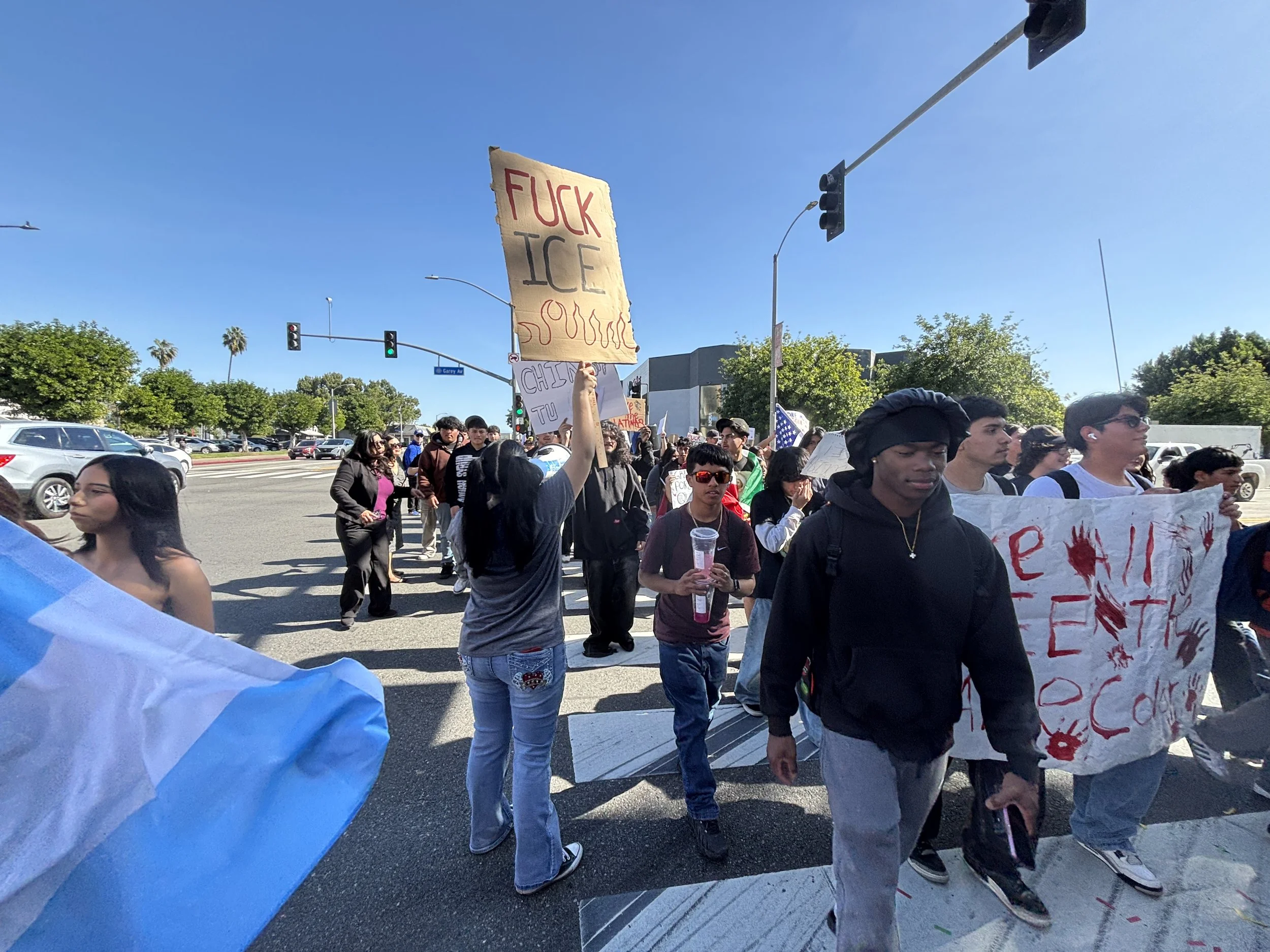
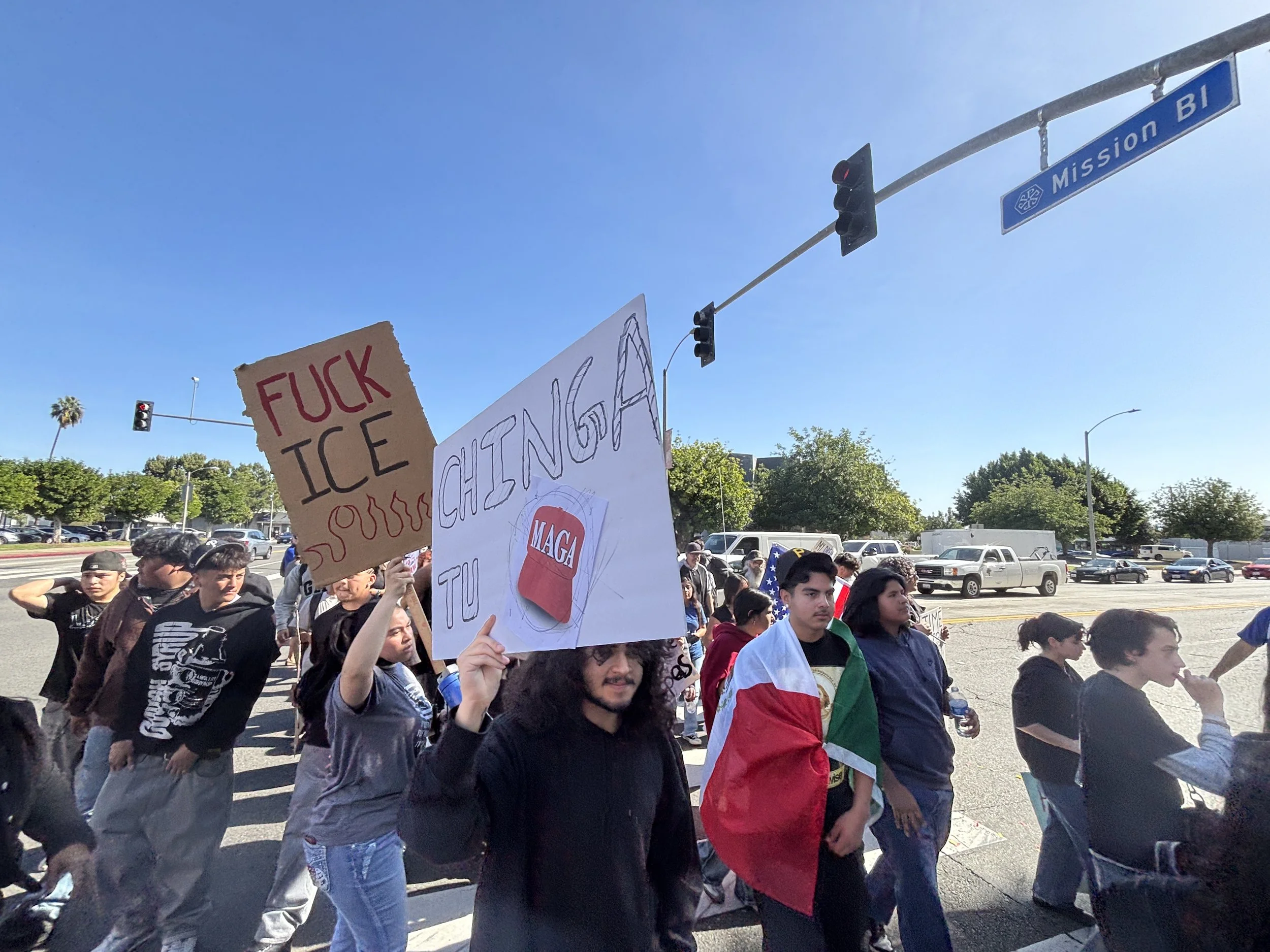
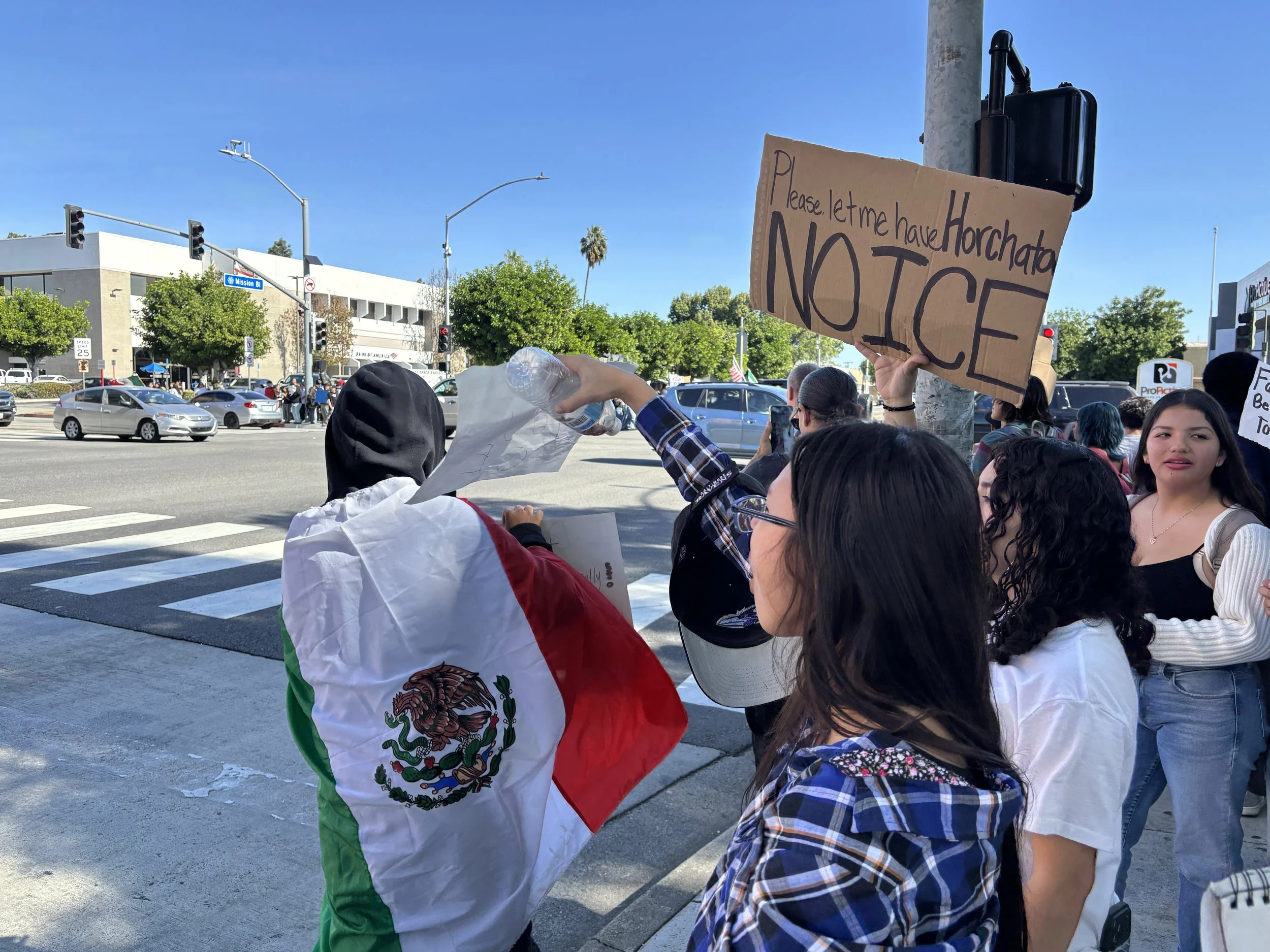
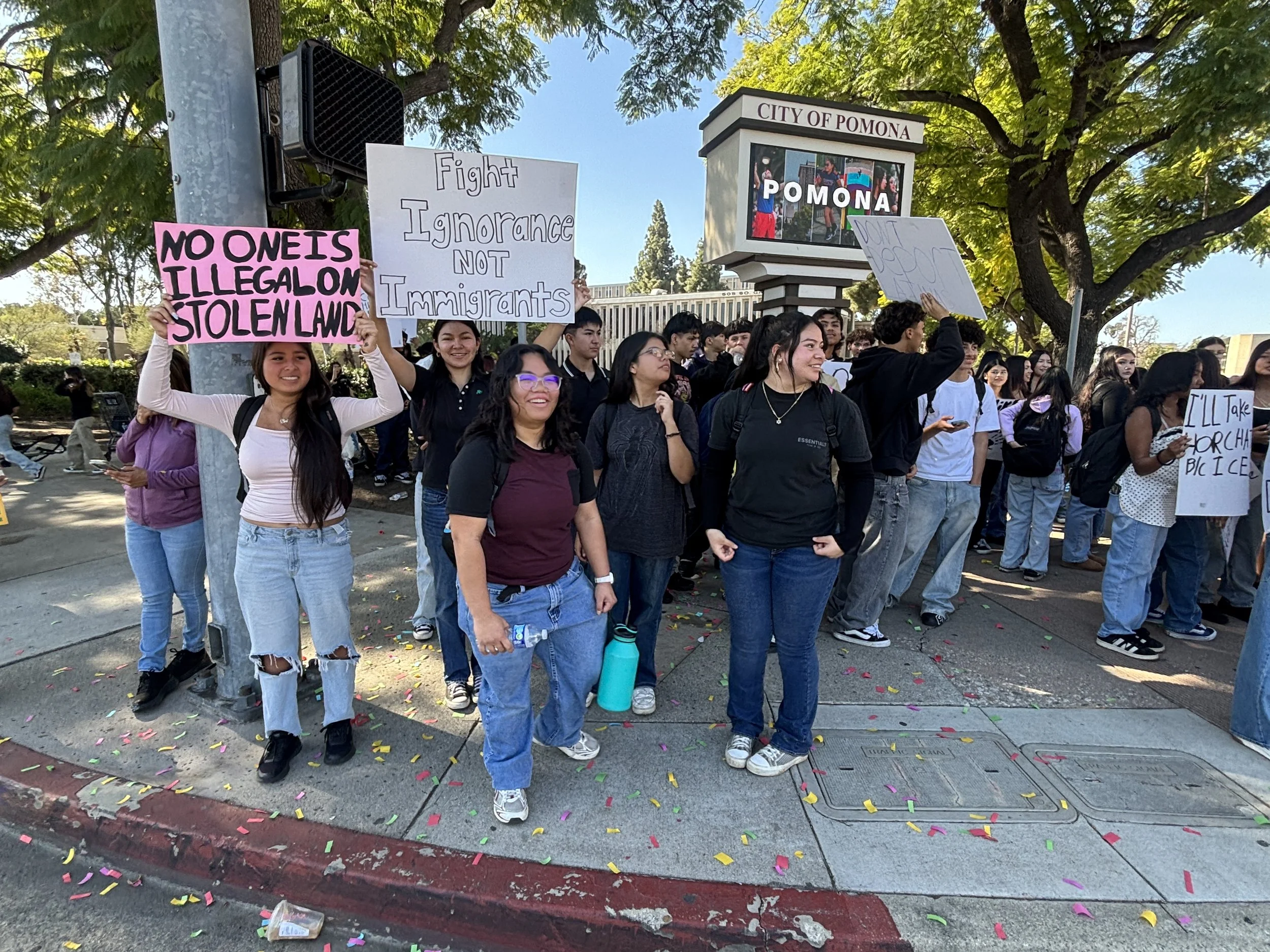
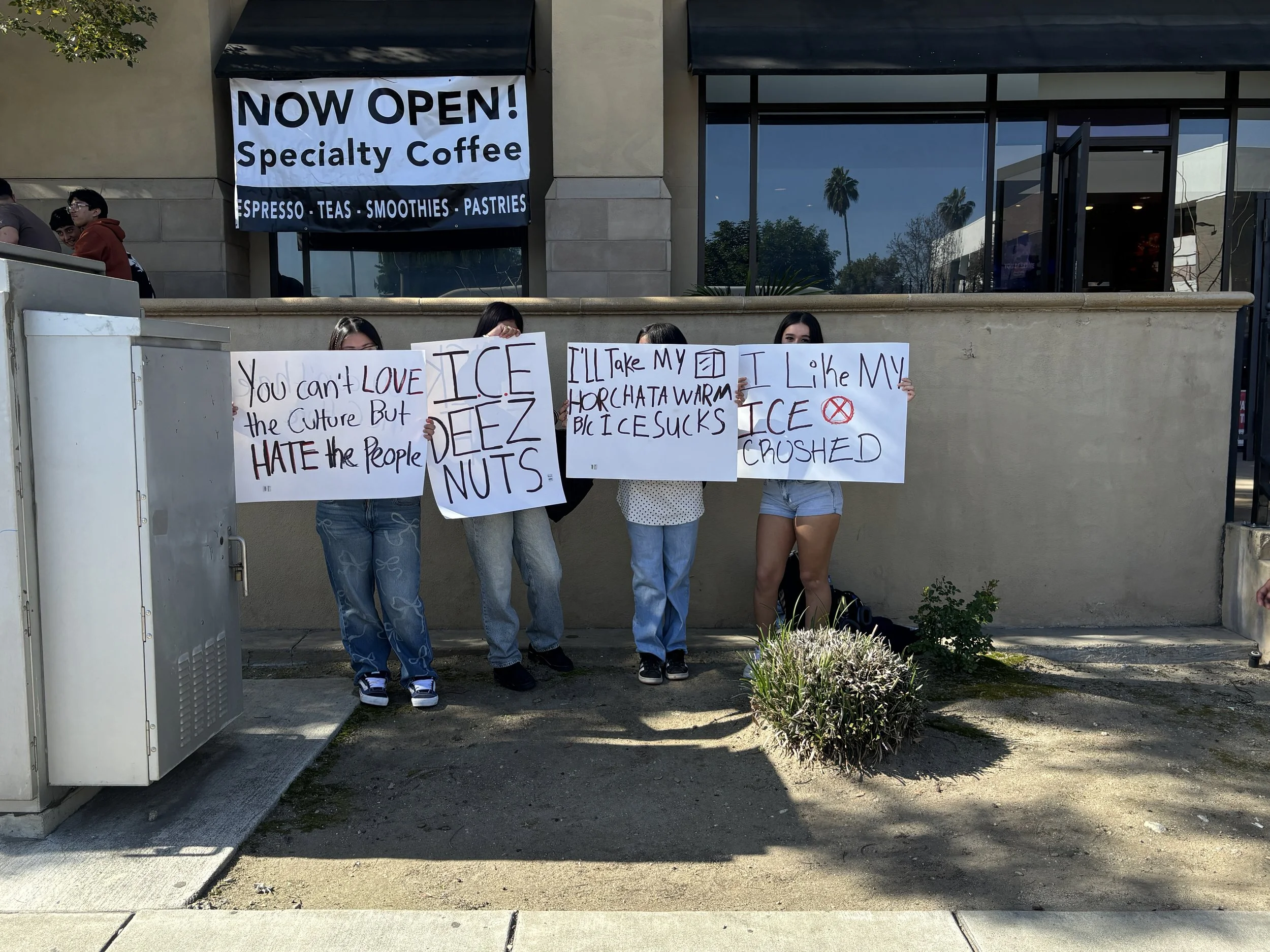
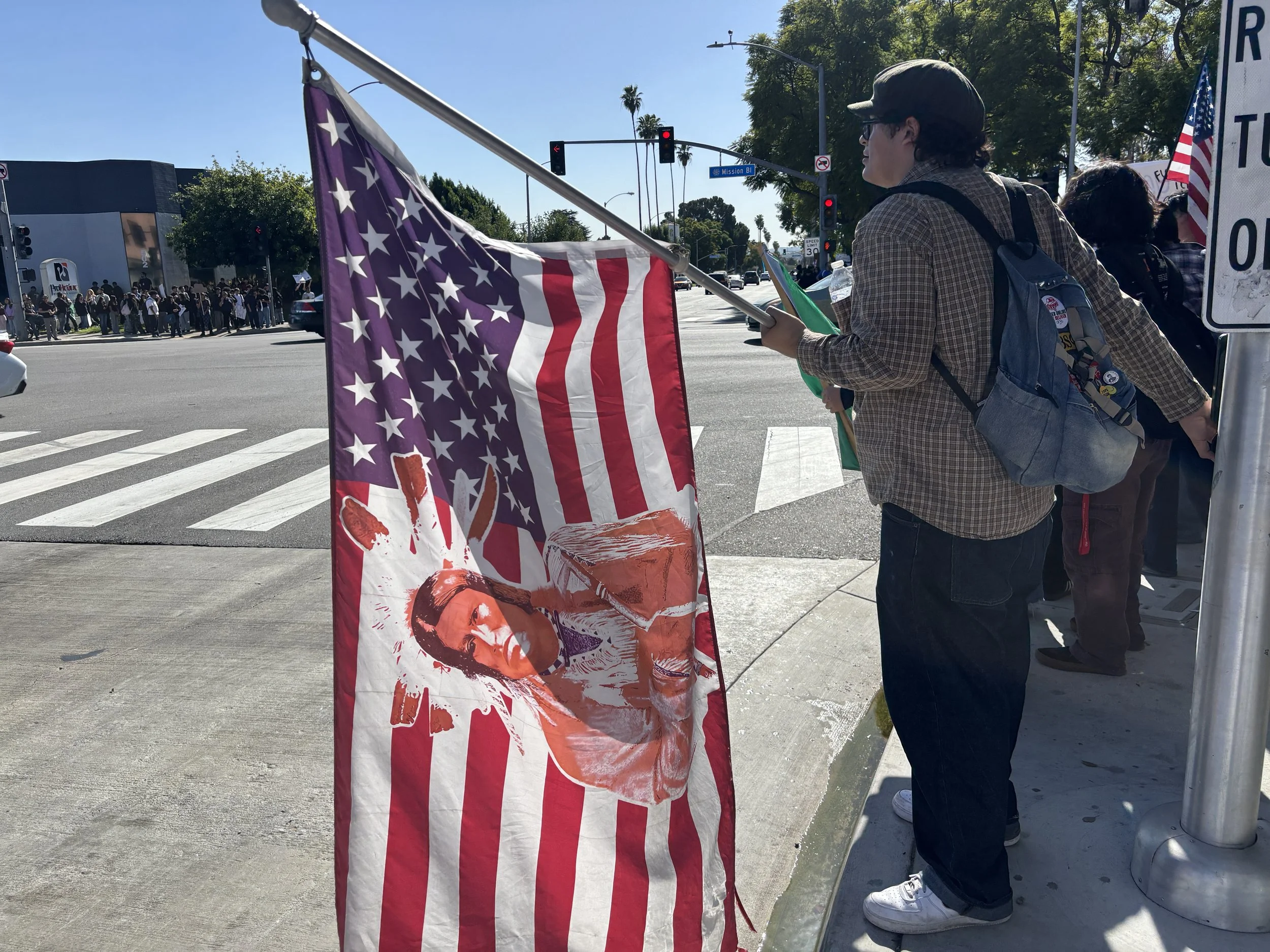
Pomona, CA — On Friday morning, January 30, 2026, students from Pomona High School, Garey High School, The School of Arts and Enterprise, and Village Academy all gathered at the intersection of Mission Boulevard and Garey Avenue to protest federal immigration enforcement and recent deaths in ICE custody. The demonstration took place alongside similar actions occurring across the country, including in Los Angeles and New York City.

A large group of students moved through the intersection carrying handmade signs, forming a loud and visible protest against Immigration enforcement. School leadership were present alongside the students as the demonstration continued through the area.

The protest coincided with a nationally circulated call for a “no work, no school, no shopping” day of action, promoted online in response to deaths reported in ICE detention facilities earlier this month. While there was no visible central organizer or formal program in Pomona, the messaging echoed themes seen in protests elsewhere: opposition to ICE’s role in immigration enforcement and anger over deaths occurring while individuals were in federal custody.

Students carried signs criticizing ICE directly, mixing humor and frustration. Several participants waved Mexican, American, Puerto Rican Flags. An altered American flag appeared among the crowd, its imagery repurposed to question traditional expressions of patriotism.

Students chanted “Who’s streets, our streets” as they moved through the intersection. The group crossed Mission Boulevard together while adults supervised and guided students. Traffic slowed and stopped, with some motorists honking in solidarity while others supported as they watched quietly and raised a fist from their out the windows of their vehicles.

The demonstration remained peaceful throughout. No police presence, and there were no visible confrontations.

Pomona has long been shaped by immigration policy in ways that are felt directly by families, schools, and neighborhoods. For many of the students present, the issue was not abstract or ideological but rooted in personal and family experience. The absence of formal structure gave the protest an organic quality, less a rally than a collective decision to be seen.

A review of public district communications did not show any official statements from Pomona Unified School District or individual high schools regarding the student gathering as of publication. While school districts and city officials had not issued public statements, the gathering reflects a broader pattern of youth political activity taking place nationwide in early 2026. The students who gathered in Pomona placed themselves visibly within that national moment.


Julian Lucas is a darkroom photographer, writer, and a bookseller, though photography remains his primary language. He is the founder of Mirrored Society Book Shop, publisher of The Pomonan, and creator of Book-Store and Print Pomona Art Book Fair. And yes he will charge you 2.5 Million for event photography.

Anita D. Gutierrez Takes on New Role as Acting City Manager for the City of Pomona

The Pomonan
Published 12/12/2023 | 3:10 Pm PST

POMONA, CA
– The City of Pomona is pleased to announce the appointment of Anita Gutierrez as the Acting City Manager, effective immediately. Gutierrez has spent over 20 years in public service and has been an instrumental part of the City’s leadership team for the last five years. She brings a wealth of experience and a strong commitment to enhancing the community’s quality of life.

Anita Gutierrez has been an exemplary public servant, demonstrating unwavering dedication to the City of Pomona since 2018. Her journey with the City began as the Planning Manager and then Director of Development Services, where she successfully directed and oversaw various Divisions, including Building and Safety, Planning, and Code Enforcement. In this role, Anita managed pivotal Commissions, including Planning, Cultural Arts, and Historic Preservation.

In her latest role as Assistant City Manager, Anita exhibited exceptional leadership, overseeing her Development Services and Public Works Departments with utmost competence and commitment With over two decades of experience in the local, state, and federal government sectors, Anita has an impressive track record of leading teams and communities in transformative work, development, and growth. Her expertise extends across numerous areas within Los Angeles County and the Inland Empire, addressing complex planning, real estate development, land use, regulatory challenges, policy development, and implementation.

Exemplifying Pomona’s core values, Anita’s leadership style is defined by collaboration, inclusivity, innovation, and resourcefulness. She is recognized for her ability to facilitate cooperation among stakeholders with diverse interests, including neighborhood representatives, the development community, and other agency partners. Anita’s dedication to refining Pomona’s development review process, elevating internal review systems, and enhancing external customer service has solidified her reputation for attentive listening, fairness, practicality, and a keen ability to find effective solutions.

Anita holds a Bachelor’s Degree in Political Science from California State University, San Bernardino, and a Master’s in Planning from the University of Southern California (USC). She will complete a Doctorate in Organizational Change and Leadership from USC in May 2024. She is a member of the American Institute of Certified Planners and an active member in the League of California Cities. She is deeply rooted in Southern California, where she has dedicated her career to serving the public and helping the community collectively shape their living environment.

The City of Pomona is confident that Anita’s extensive experience and unwavering commitment to the community will be invaluable as she assumes the role of Acting City Manager. Her leadership and dedication to enhancing the City’s prosperity and well-being are commendable, and we look forward to the positive impact she will continue to make in her new role. “We are fortunate to have Anita stepping in to lead our City team. Her leadership is a pillar of stability for the City. With an unwavering commitment to communication, thoughtful decision-making, and the overall well-being of our City organization and community, we are confident that the City is now under the guidance of an exceptionally capable leader,” said Mayor Tim Sandoval.

“I am deeply passionate about public service, and I am grateful for the opportunity to demonstrate my leadership abilities in service to our city,” Gutierrez said. “The Pomona team is like no other, and I am thankful to be a part of this exceptionally dynamic and dedicated organization.


The Pomonan is the cultural structure, empowering visionaries to propel the global society to the future.