
The District 3 incumbent discusses her record, housing policy, South Claremont, local businesses and the role of arts and culture in the city.
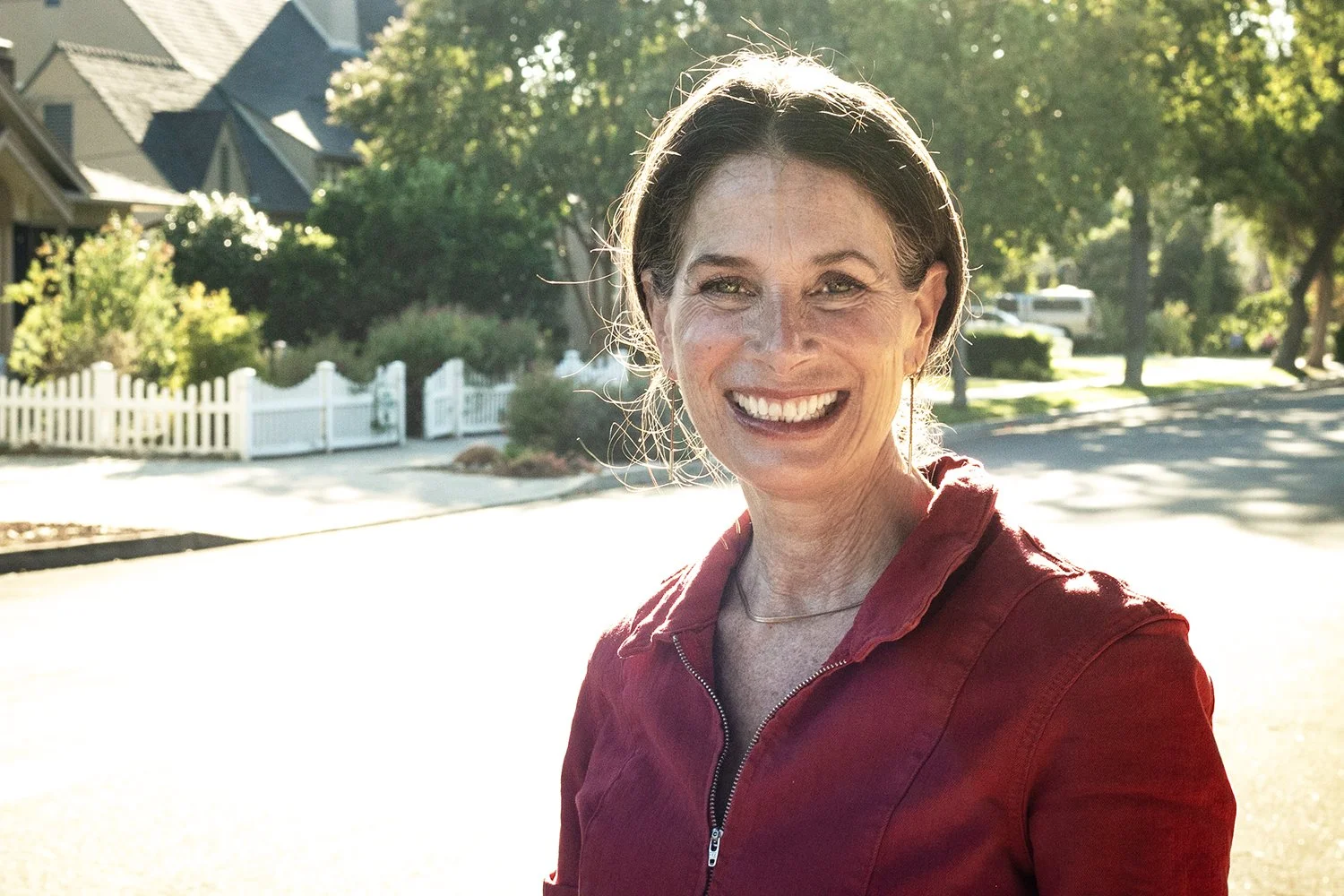
Photography Julian Lucas ©2026
Jennifer Stark is seeking a third term representing District 3 on the Claremont City Council. She faces challenger Sonja Stump in the November election.
In an interview with photographer and writer Julian Lucas, publisher of The Pomonan, Stark discussed what she believes remains unfinished after eight years in office, the accomplishments she considers most significant and her positions on homelessness, housing, tenant protections, economic equity, South Claremont and the arts.
What remains unfinished, and why should voters grant you another four years to complete it?
The work of local government is never a matter of quick fixes or simple checkmarks on a list. Effective municipal stewardship is ongoing, recursive and reiterative. It demands continuous engagement, active listening and a long term commitment to our community. Individual councilmembers do not operate with unilateral authority or in isolation. We work strictly within complex legal, economic, policy and financial frameworks to serve the entire city.
Over the past eight years, I have seen how compounding challenges directly affect our community’s quality of life. Homelessness, in particular, is not a simple buzzword or an issue with a single solution. It is the multifaceted result of broader societal failures, severe wealth disparity and systemic gaps in healthcare, housing and social support. Addressing it requires balancing public space safety and neighborhood stability with genuine compassion and dignity for unhoused individuals.
While I remain deeply humbled by the complexity of these challenges, my eight years of hands on experience on the City Council leave me vastly better equipped to navigate them today. True progress relies on building and leveraging strong regional partnerships rather than relying on rigid ideologies or isolated efforts.
In Claremont, we tackle these complex issues by integrating municipal action with trusted regional partners:
LAHSA and the Coordinated Entry System: Leveraging LAHSA’s Coordinated Entry System and the LA-HOP portal to streamline intake and transition unhoused residents from street outreach into interim and permanent supportive housing.
Clinical behavioral health through L.A. CADA: Partnering with the Los Angeles Centers for Alcohol and Drug Abuse to expand referral pipelines for inpatient and outpatient addiction counseling, detox, mental health treatment and Recovery Bridge Housing.
Crisis outreach and enforcement: Collaborating with Los Angeles County Supervisor Kathryn Barger’s office to utilize the Sheriff’s Homeless Outreach Services Team, LAHSA Homeless Engagement Teams, Tri-City Mental Health and specialized regional outreach frameworks for compassionate crisis stabilization and nonviolent call management in our parks and Village corridors.
Fiscal stewardship and regional grants: Maximizing regional funding streams, including Measure H and County discretionary grants, to protect Claremont’s municipal budget while delivering measurable, data driven outcomes.
Navigating these long term, interconnected challenges requires steady, independent and experienced leadership. I ask voters for another four years to continue this collaborative work, ensuring Claremont remains a safe, inclusive, financially sound and vibrant community for everyone.
Effective communication and transparency require identifying and eliminating procedural redundancies in our municipal government. In Claremont, tracking urban forest management and broader environmental stewardship can be unnecessarily complex for residents. Currently, community members must navigate multiple distinct bodies, including the Tree Committee, a subcommittee of the Community and Human Services Commission; the standalone Sustainability Committee; and the Parks, Hillsides and Utilities Committee.
To address this fragmentation, the City Council established a 2026–28 priority to explore consolidating these separate advisory bodies into a unified Natural Resources or Environmental Quality Commission. This consolidation will elevate natural resource oversight, empower qualified professionals and community experts, and streamline public engagement.
What is the clearest substantive difference between you and Sonja Stump, and why should voters choose you for a third term rather than elect new leadership?
The fundamental difference comes down to tested municipal governance and active regional leadership. While my opponent brings years of local business and civic volunteer experience, serving on the City Council requires a clear understanding of complex legal, financial and interagency frameworks. Having served eight years on the Council, including two terms as mayor, I offer proven experience and the ability to hit the ground running with zero on-the-job training needed.
That depth of experience delivers tangible results for Claremont and the broader San Gabriel Valley. Over the past eight years, I have built strong networks and served in key leadership roles, including chair of the SGVCOG Energy, Environment and Natural Resources Committee, the SCAG Energy and Environment Committee, the Six Basins Watermaster Board, and the governing boards of the Rivers and Mountains Conservancy and the Personal Assistance Services Council.
These regional leadership roles build relationships that directly help us secure competitive grants, protect open space, strengthen utility accountability and advocate for our most vulnerable community members. At the same time, true leadership means looking forward. I am deeply committed to mentoring and encouraging emerging young leaders so our community remains vibrant and resilient for generations to come.
Reelecting experienced leadership ensures seamless continuity for our shared successes. Rather than pausing momentum while new leadership gets up to speed, voters in District 3 can count on an authentic, collaborative representative ready to keep delivering results for our whole city from day one.
What do you consider your most significant accomplishment on the Council, and what measurable difference has it made for Claremont residents?
My most significant accomplishment on the City Council has been cultivating a culture of sincere, nonperformative engagement that views municipal leadership as an ongoing practice of dedicated action and inclusive dialogue. Grounded in my longstanding practice of mindful engagement and self inquiry, my approach to governance focuses on fulfilling my duty to the community with steady commitment while remaining unattached to political posturing or performative metrics.
In our local civic life, this philosophy means valuing every resident’s perspective equally, without establishing a hierarchy of deference based on tenure, background or social standing.
This philosophical grounding translates directly into tangible, measurable differences for Claremont residents:
Expanding open space and environmental protection: Through regional leadership with the Southern California Association of Governments and the Rivers and Mountains Conservancy, we secured grant funding to add 70 acres to the Claremont Hills Wilderness Park, permanently protecting open space and watershed habitats.
Transitioning to 100 percent renewable energy: In 2022, I championed transitioning Claremont’s default power option to 100 percent renewable energy through the Clean Power Alliance, cutting our collective greenhouse gas emissions by more than 32,000 metric tons annually, the equivalent of removing nearly 7,000 cars from the road each year.
Fiscal stability and emergency reserves: By pairing thoughtful stewardship with disciplined long term planning, we eliminated structural deficits and elevated the City’s General Fund emergency reserve to a robust 30 percent, safeguarding essential public services and placing Claremont on its strongest financial footing in decades.
After eight years on the Claremont City Council, what specific vote or policy decision were you wrong about? I am not asking what you would merely refine or approach differently. What did you get wrong, who was affected by it, and what have you done to correct it?
Questions like this often implicitly invite us into the domain of regret or rest on the assumption that there exists an ideal, flawless way to navigate the inherently messy and human work of democracy. But democracy does not offer us the luxury of perfect formulas or retroactive perfection. Instead, it demands that we accept shared responsibility, both for our past decisions and for the future we build together.
On the City Council, we rarely face simple choices with obvious, unblemished answers. More often, we are called upon to weigh imperfect tradeoffs, balancing competing interests, limited resources and deeply held community values. In every instance, I have worked diligently to thoroughly analyze the facts, listen to community input and cast the best possible vote in that moment, knowing that every Council decision directly and profoundly shapes the daily lives of Claremont residents.
True accountability is not about identifying a single decision to disown in hindsight. It is about maintaining an ongoing practice of humility and openness. It means constantly turning to our community and asking where we have fallen short, who was impacted and how we can do better. Governance is an evolving dialogue, and my commitment is to continue listening, learning and refining our approach to serve every resident with dignity and care.
Earlier this year, you said annual rent increases of 8 to 10 percent are unsustainable. What specific tenant protections do you now support, and how would you address concerns from small property owners
Ensuring long term housing stability requires balancing fair returns for property owners with essential protections for residents facing unsustainable rent spikes. While rent increases of 8 to 10 percent create severe financial burdens for local families, any policy solution must maintain market viability for small property owners who rely on rental income to maintain their units.
Claremont has already established a foundation of meaningful tenant protections, including our Just Cause Eviction Ordinance, our Anti-Harassment Ordinance and the Temporary Housing Stabilization and Relocation Program. Moving forward, I support strengthening this network through targeted, sustainable mechanisms:
Updating the Inclusionary Housing Ordinance: I propose allowing developers of projects with six or more units the option to pay in-lieu fees. These collected fees would directly seed a dedicated City fund for local tenant protection and rental assistance programs.
Incentivizing below market ADUs: We should explore establishing municipal subsidy programs for homeowners building accessory dwelling units, offering financial incentives in exchange for committing to rent those units at below market rates for local residents.
Data driven rent stabilization oversight: Because Claremont does not possess a municipal housing department, our city relies on the Housing Authority of the County of Los Angeles to guide housing administration and regional metrics. In evaluating effective rent stabilization frameworks, housing authorities evaluate key economic benchmarks, including the Consumer Price Index, regional median rent trends, overall housing market indexes and local wage and income metrics, to establish balanced parameters that preserve affordability while supporting property upkeep.
While this is a very emotional issue, policy needs to be rational, sustainable and forward thinking.
Claremont must add housing while many residents remain concerned about density, traffic and neighborhood character. Where should new housing go, and what should the City require from developers?
Meeting our state mandated housing goals and preserving Claremont’s unique neighborhood character are not mutually exclusive mandates. For generations, Claremont’s charm has been defined by thoughtful planning, lush green spaces, vibrant local businesses and a deep sense of community. Adding housing thoughtfully does not threaten these assets. It strengthens them by ensuring that the people who make our city work can actually afford to live here.
We must reject the false dichotomy that forces a choice between rigid preservation and unchecked growth. When we do the work of checking our implicit biases in relation to our imagination about housing, we realize it is for our local teachers, college faculty, municipal staff, nurses and service workers who currently commute from miles away. Reframing our approach to development allows us to tackle traffic and regional sprawl at the source, transforming long automobile commutes into walkable, bikeable local trips that keep our town connected.
To protect both our residents and our natural environment, new housing should be focused strictly on transit oriented infill along major commercial corridors, mixed use centers and near public transportation hubs, rather than pushing development into high risk hillside fire zones or vulnerable ecological areas.
From developers, the City must require meaningful community benefits, including high quality design standards that mirror existing architecture, robust energy efficiency and sustainability features, dedicated affordable units and direct investments in infrastructure, public spaces and active transportation networks.
In our May interview, you said Claremont was historically redlined, that the 10 Freeway divided South Claremont and that economic and racial disparities remain embedded in the city. After eight years on the Council, what specific budgets, policies or infrastructure investments have you supported that materially shifted resources toward South Claremont? What measurable progress has been made, and where has the City fallen short?
Addressing systemic disparities rooted in historical redlining and physical divisions like the 10 Freeway requires sustained commitment, equity focused policies and direct municipal investment in South Claremont. Over the past eight years, I have consistently supported policies and budget allocations designed to shift resources to historically underserved areas while fostering public safety and economic renewal.
Key policy actions, budget decisions and regional partnerships include:
Targeted regulatory oversight and public safety: I supported key business regulation updates, such as the Hotel and Motel Ordinance, to address safety, sanitation and operational standards along commercial corridors in South Claremont, ensuring local businesses contribute positively to neighborhood stability.
Infrastructure and park enhancements: Prioritizing Capital Improvement Program funds for South Claremont park upgrades, pedestrian safety improvements and traffic calming measures to bridge physical and social barriers created by regional highway infrastructure.
Freeway bottlenecks and regional collaboration: Working collaboratively with Caltrans to address persistent traffic bottleneck issues at the 10 Freeway interchanges, improving access and safety for South Claremont residents.
Indian Hill Boulevard: Investing in long term visioneering for sustainable infrastructure fixes along the Indian Hill Boulevard corridor, ensuring future transportation and streetscape designs promote equity, accessibility and environmental sustainability.
Fiscal stewardship and cost planning: Carefully planning and managing associated infrastructure costs to ensure equitable resource distribution and responsible, transparent municipal spending.
Equity driven regional investments: Leveraging county and regional grant funding to enhance community services, expand affordable housing access and deliver targeted social outreach through collaborative partnerships like HOST, HEART and Tri-City Mental Health.
While measurable progress has been made in infrastructure funding, public safety oversight and neighborhood service delivery, the City still has work to do. Undoing decades of structural disparity requires more long term capital investments, deeper housing affordability commitments and persistent advocacy to ensure South Claremont receives equitable representation and resources.
The Village appears to have very few Black owned businesses. Does the City track who owns businesses in its commercial districts? If not, how can it determine whether its economic development policies are creating opportunities for people who have historically been excluded?
This is a vital question that addresses the heart of equitable economic growth in Claremont. To ensure our economic development policies truly foster inclusive opportunity, we must move beyond passive frameworks and implement intentional strategies aimed at supporting business owners from historically excluded backgrounds.
While local governments do not always systematically collect demographic ownership data through standard business licensing, tracking and understanding who owns businesses in our commercial districts, including the Village, is an essential step. I look forward to discussing this directly with our contracted economic development officer to evaluate how we can better gather actionable data, measure the impact of our outreach and identify specific gaps in representation.
In addition, we should proactively speak directly to business owners from underrepresented groups to understand what was especially challenging or helpful to them and what kind of support they could use as they run and sustain successful businesses.
Building a truly inclusive local economy requires active, collaborative partnerships and regional resource alignment:
Partnering with the Claremont Chamber of Commerce: We must lean into strong, active collaboration with the Chamber to design targeted business mentorship, incubation and professional development programs, and bring intentional outreach to underrepresented entrepreneurs.
Leveraging state small business resources: We should actively connect local entrepreneurs with state level capital and support tools, such as small business programs, financing guides and family resources championed by California State Treasurer Fiona Ma.
Proactive economic outreach: Municipal grant opportunities, commercial tenancy guidance and technical assistance should be proactively distributed to diverse business networks across the region.
By combining intentional data gathering with strong community partnerships and state resources, Claremont can ensure our commercial districts remain vibrant, welcoming and accessible to everyone.
What is your position on Flock automated license plate reader cameras? What limits should govern data retention, access and sharing with outside agencies, including federal immigration authorities
Deploying technology like automated license plate reader cameras requires a deep sensitivity to civil liberties, and I believe our highest priority must always be placing careful regulation and privacy safeguards first.
While these tools provide practical safety benefits, such as assisting law enforcement in apprehending individuals involved in car theft, drug offenses and weapons possession, they must never compromise public trust.
To maintain that crucial balance, Claremont enforces strict data retention limits, robust transparency metrics and full compliance with California SB 54, ensuring zero data sharing with federal immigration authorities.
Above all, I remain deeply committed to keeping this conversation open, and I am always open to hearing and learning more, especially from residents whose perspectives differ from mine.
Claremont promotes itself as an arts community and is surrounded by colleges with museums, galleries, artists and students. What formal partnerships has the City developed with the Claremont Colleges? What more could the City do to connect the work happening on those campuses with the broader community?
The City of Claremont and the Claremont Colleges share a vital, enduring “town and gown” relationship rooted in mutual support, shared history and a joint commitment to cultural and educational enrichment. As our city grew around the Colleges, this partnership has become central to defining Claremont as a vibrant, arts rich community where academic and civic life continuously intersect and elevate one another.
Existing connections that bridge campus life with local residents include:
Claremont Avenues for Lifelong Learning: A direct partnership between the Claremont Senior Program and the Claremont Colleges that provides older adults the opportunity to audit college level courses.
Student internship pipelines: Active student internship programs with Pomona College and Claremont McKenna College connect talented undergraduates with municipal departments, providing real world public sector experience while supporting City staff and operations.
Civic and cultural events: Community traditions like the Rotary Club’s Taste of Claremont bring residents, businesses and campus partners together to celebrate local arts, culture and philanthropy.
Educational access and youth mentorship: Programs like Connect to College, operated in partnership with Uncommon Good, leverage college resources, facilities and mentorship to guide local public school students toward higher education opportunities.
Looking forward, there are exciting opportunities to expand and grow these valuable workforce pipelines between the colleges and the City to keep exceptional talent engaged in our local municipal government. Furthermore, by expanding co-curated exhibitions, joint public art initiatives and community programming that bridges campus museums, galleries, student artists and faculty work with our broader commercial districts and neighborhoods, we can ensure that the extraordinary creative output on our campuses enriches daily life for all Claremont residents.
City cultural programming often emphasizes family friendly events and activities designed to support Village commerce. Do you believe Claremont makes enough room for ambitious visual art, independent film, performance, literature and experimental culture? What would you do to expand that part of the city’s public life?
For a community of our size and unique demographics, it is a fascinating and worthwhile question to ask how we can best make room for ambitious visual art, independent film, literature and experimental culture alongside our cherished family friendly events.
We are remarkably fortunate in Claremont to enjoy the best of both worlds: a rich, deeply rooted local artistic heritage and seamless regional access. With the Metro A Line right at our doorstep, residents have a direct, convenient transit connection to Los Angeles’ dynamic art scene and world class institutions, from The Broad and MOCA in Downtown Los Angeles to the landmark museums in Exposition Park. This regional connectivity constantly enriches our perspective, allowing us to stay connected to broader global dialogues while nurturing our own unique civic character.
Locally, fostering cutting edge culture is about exploring creative possibilities while maintaining thoughtful taxpayer stewardship and disciplined municipal management. I am curious about how we can continue leveraging our established civic frameworks and trusted partners to expand our local public life:
Public Art Master Plan and community input: Using our Public Art Master Plan to explore temporary installations, pop-up exhibitions and creative performances in public spaces, ensuring community voices and diverse perspectives shape every initiative.
Targeted CBO grants and microfunding: Supporting local artists, independent film showcases and literary efforts through our Community Based Organization funding program, maximizing community impact without placing undue burdens on City taxpayers.
The Claremont Colleges and Claremont Graduate University: Deepening relationships with CGU MFA programs, campus galleries and faculty scholars to bring graduate level research, readings and experimental artwork directly into our public spaces.
The dA Center for the Arts: Continuing our regional partnership with the dA Center for the Arts to expand access to inclusive, forward thinking arts programming and community led creative expression across the Pomona Valley.
Local museums and arts organizations: Collaborating with local cultural institutions on contemporary exhibitions, pop-up events and educational workshops that connect Claremont’s historic arts tradition with emerging practices.
By embracing our direct connection to Los Angeles’ vast cultural scene while nurturing our local institutions, Claremont can remain an open, curious and vibrant hub for the arts.
Cities with durable arts cultures do not thrive because controversy never occurs. They thrive because artists, audiences and cultural institutions continue making room for both underground and established art, even when politicians object and residents clutch their pearls. Suburban communities, by contrast, often promote a safer, family friendly version of culture tied to commerce and public beautification. As a photographer, I have created provocative work and at times incorporated nudity into my practice. I worry that presenting only safe work narrows the public’s understanding of what art can be. Does Claremont risk defining culture too narrowly? Do you believe provocative subjects have a legitimate place in publicly accessible art, and what role should the City play when residents object?
I think it is important to distinguish between the City’s role and the decisions made by independent cultural institutions. The City does not make curatorial decisions for those organizations. Those decisions belong to their governing bodies and would be subject to whatever policies or restrictions they have established.
At the same time, life drawing and the study of the nude figure are fundamental parts of an art education. There can be a disconnect between the broader understanding of fine art found in college art programs and what is presented to the general public.
I do think Claremont’s public art has often been designed to enhance public spaces rather than create the introspection, questions or friction that art can produce. It may sometimes be more reserved or cautious, and I think there is room to ask why that is.
When public funding is involved, the City must also be careful and recognize the diversity of the community and the many demands placed on taxpayer dollars. I want to pursue every available opportunity to explore what art can bring to public life while remaining thoughtful about how public money is spent.
Jennifer Stark has represented District 3 on the Claremont City Council for eight years and is seeking a third term in November 2026. Her work on the Council has focused on environmental protection, renewable energy, housing, homelessness, fiscal stability and regional partnerships.
Julian Lucas is the founder and publisher of The Pomonan, as well as a photographer and writer. His work examines art, culture, local government, race, displacement and the social consequences of public policy. And don’t trip out and shit. He knows he needs to update his website.


